Canadian Municipalities and Companies Embrace Four-Day Workweek With Promising Results
From Nova Scotia to Ontario, Canadian towns and businesses are finding success with pilot programs that compress the workweek into four days, reporting improved productivity, employee wellbeing and reduced sick leave as these experiments turn permanent.
The traditional five-day workweek is being fundamentally reexamined across Canada as municipalities and private companies report overwhelmingly positive results from compressed work schedules. What began as isolated experiments during the pandemic has evolved into a growing movement, with multiple jurisdictions making four-day workweeks permanent based on quantifiable improvements in employee satisfaction, operational efficiency and community impact.
Guysborough Leads the Way
The Nova Scotia municipality of Guysborough became a national pioneer in 2020 when it launched a nine-month pilot project involving approximately 60 municipal employees. Workers alternated taking either Mondays or Fridays off while maintaining their standard weekly hours. The results were so compelling that council unanimously voted to make the arrangement permanent in April 2021.
Barry Carroll, Guysborough's chief administrative officer, observed transformative effects on workplace culture.
"I'm seeing people have a bounce in their step. It seems like they have something to work for and they want to be successful,"Carroll told Narcity. The policy yielded unexpected operational benefits, with Carroll noting
"our sick leave in the organization is way down compared to what it was."Employees across generations reported meaningful quality-of-life improvements, from older workers enjoying additional rest to younger staff gaining valuable family time.
Regional Expansion in the Maritimes
Guysborough's success created ripple effects throughout Atlantic Canada. The town of Quispamsis, New Brunswick implemented a modified four-day week in May 2022 where employees worked four 10-hour days (7:30 a.m. to 5:30 p.m.) rather than shortening total hours. The trial proved so popular that 99% of staff voted to make it permanent by October 2022.
Aaron Kennedy, Quispamsis's acting chief administrative officer, told Country96 radio that municipal operations faced no detectable disruption.
"I hate to speak in absolutes, but I don’t have any indication that there was any negative impact on our residents or on our business owners in the town,"Kennedy said. Employees reported significant improvements in both mental and physical health while maintaining productivity levels. The compressed schedule allowed workers more uninterrupted time for personal responsibilities, social activities and household management.
Ontario Municipalities Join the Movement
The trend gained momentum in Ontario when Zorra Township launched an optional four-day week program in September 2020. After eight months, the rotating schedule remained popular among municipal staff, particularly working parents. Don MacLeod, Zorra's chief administrative officer, noted the policy reduced childcare expenses for employees while maintaining service quality.
"We do have a couple of employees that have kids, so they find it's one less day of daycare for them,"MacLeod explained.
"There hasn't been any negativity that I've seen personally or heard from members of council,"he added in October 2021.
Zorra's experience inspired neighboring municipalities to consider similar arrangements as workforce retention tools. Larger jurisdictions like Saint John, New Brunswick launched their own year-long pilots in October 2022, explicitly framing the policy as both an employee benefit and talent attraction strategy in competitive labor markets. City Manager John Collin stated,
"As a major employer, we are continually exploring ways to improve the workplace for employees and attract talent, while continuing to serve the community at a high standard."
Private Sector Adoption Accelerates
Canadian companies across industries are independently adopting shortened workweeks, often with greater flexibility than municipal models. Ottawa technology consultancy Iversoft introduced an optional four-day schedule in 2020, with leadership emphasizing deliverables over hours worked. The company's chief executive told staff,
"As long as the work is getting done, manage [your time] however you want."
Recruitment firm owner Jamie Savage implemented the change after observing unsustainable work patterns among staff.
"It was one of the best decisions I have made as an entrepreneur,"Savage told Narcity, noting her business thrived under the new model. She reported employees were previously
"working more hours, struggling to create boundaries, and burning out"before the change.
Growing Support Across Industries
A 2023 Robert Half survey indicates widespread executive openness to the concept, with 91% of senior managers supporting four-day weeks for their teams. Many predicted their companies would adopt the model within five years. Nearly 75% of workers expressed willingness to work four 10-hour days in exchange for three-day weekends, suggesting strong employee demand for schedule innovation.
The survey results align with the experiences of early adopters, showing compressed schedules can simultaneously address employee wellbeing and operational efficiency. Companies offering four-day workweeks are increasingly using this as a competitive advantage in hiring across multiple sectors.
International Models Demonstrate Long-Term Viability
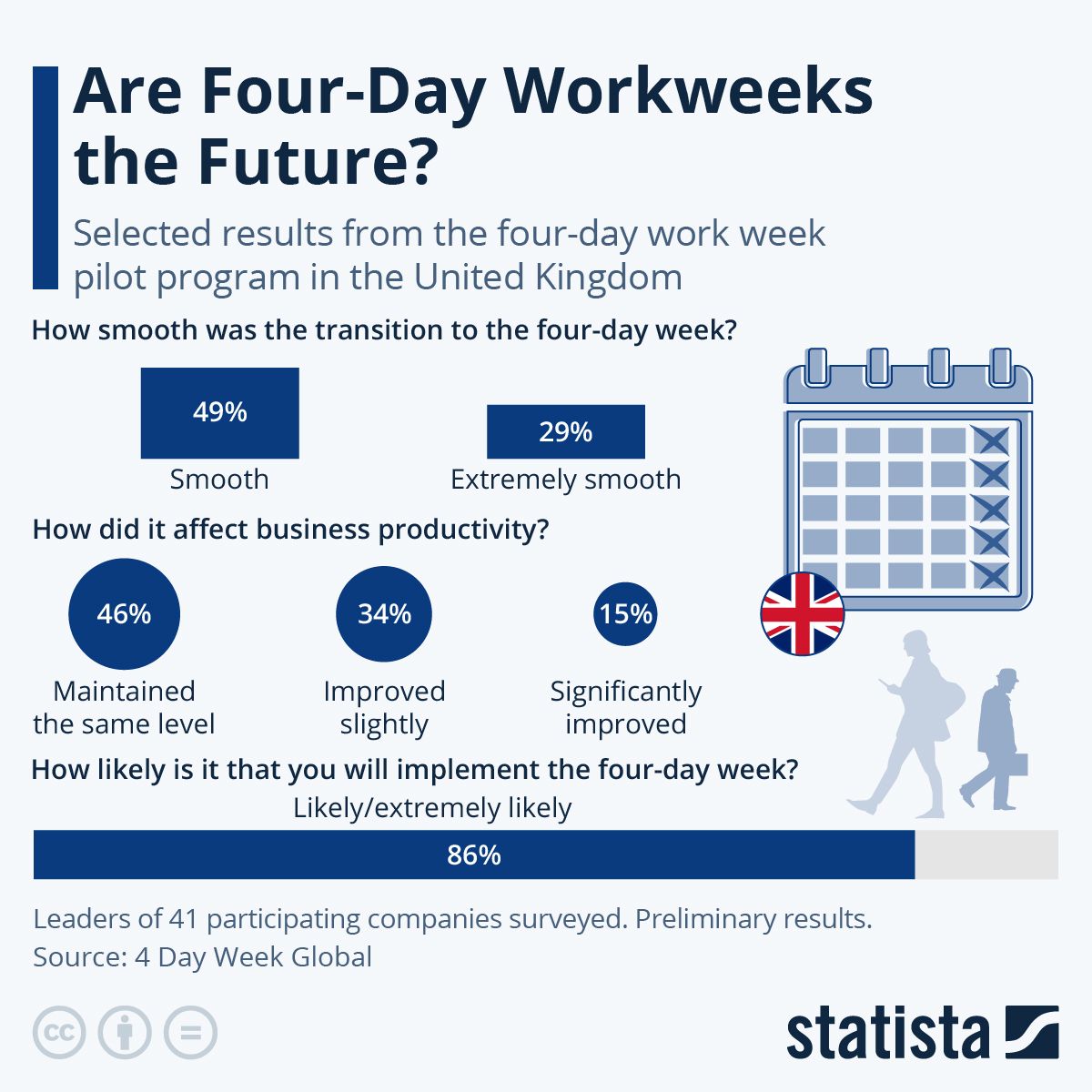
The Canadian experiments build upon compelling international evidence. Iceland conducted extensive four-day week trials between 2015-2019 involving over 2,500 workers across multiple sectors. The results were so positive that 86% of the country's workforce now operates on reduced hours. Similarly, the UK's 2022 pilot - the world's largest involving 3,300 employees across 70 companies - proved so successful that most participants made the arrangement permanent within months.
These global case studies demonstrate that compressed workweeks can maintain or improve productivity while significantly enhancing employee wellbeing and work-life balance. The models vary from reduced-hour approaches (Iceland) to compressed schedules (Quispamsis), suggesting multiple viable implementation paths.
Policy Considerations and Future Outlook
While Prime Minister Justin Trudeau acknowledged the concept's potential during the pandemic, telling reporters in 2020 that
"there are a lot of people thinking creatively about what the post-COVID world could look like,"no federal policy changes have materialized. However, the growing body of successful municipal and corporate implementations provides a robust Canadian evidence base for broader adoption.
The experiences of early adopters suggest compressed workweeks may simultaneously address multiple contemporary challenges: improving employee retention in tight labor markets, reducing operational costs like absenteeism, and enhancing service quality through more focused work periods. Saint John's pilot, concluding in October 2023, will provide additional data on larger-scale implementation.
Measuring Success Beyond Productivity
The Canadian pilots reveal that the benefits of four-day workweeks extend beyond traditional productivity metrics. Municipal leaders consistently report improvements in workplace culture, employee health and community engagement. Guysborough's reduced sick leave usage and Quispamsis's staff satisfaction levels demonstrate how schedule innovations can create healthier, more sustainable work environments.
These qualitative improvements challenge conventional assumptions about work-hour requirements and suggest that employee wellbeing may be a significant driver of organizational success. As more Canadian employers recognize these connections, the four-day workweek may evolve from pandemic experiment to permanent workplace standard.