Kalshi's Sports Contracts Dominate Trading Volume as Legal Battle Over Swap Classification Intensifies
Analysis of Kalshi's trade data reveals 95% of staked money in August went to contracts with disputed swap status, as federal courts split on regulatory jurisdiction.
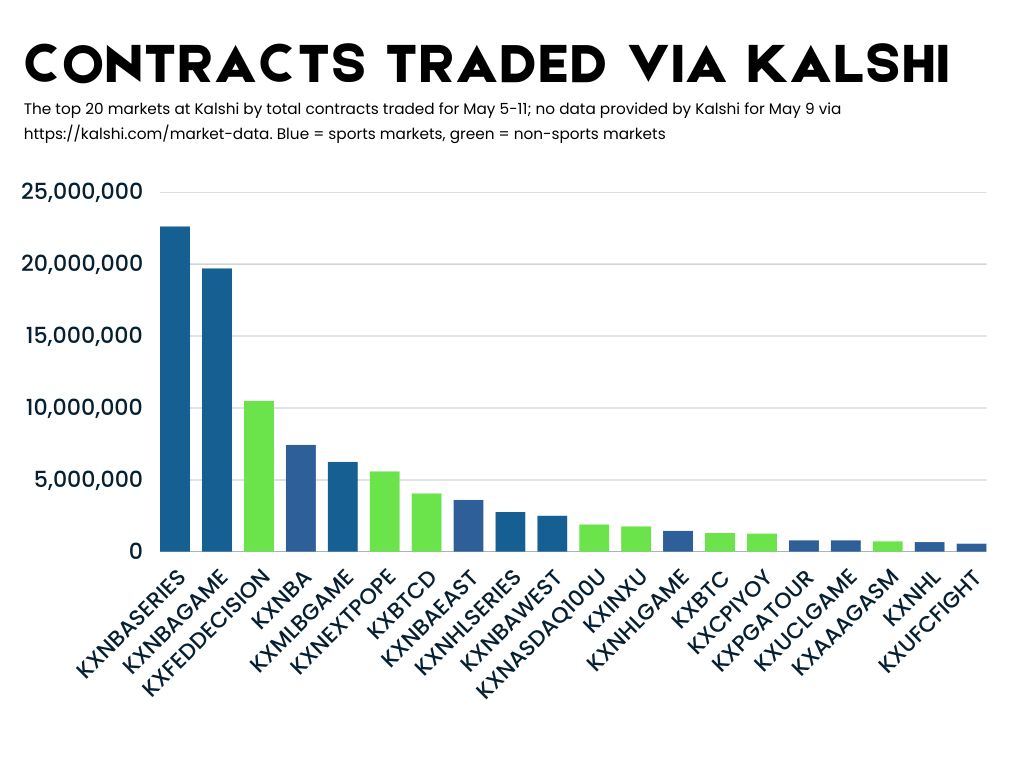
The ongoing legal battle surrounding Kalshi's prediction markets has reached a critical juncture as detailed analysis of the platform's trading data reveals a striking concentration of activity in contracts whose regulatory classification remains hotly contested. According to a comprehensive review of Kalshi's full trade record from Dune analytics, an overwhelming 95% of the $11.4 billion staked by customers in August 2026 flowed into products that federal courts are currently debating whether to classify as swaps under the Commodity Exchange Act.
Federal Courts Divided on Core Legal Question
The fundamental dispute centers on whether Kalshi's contracts qualify as swaps subject to exclusive CFTC oversight or whether they constitute gambling activities falling under state regulatory authority. This question has now produced a direct split between federal appeals courts. In April 2026, the Third Circuit Court of Appeals issued a ruling that adopted a broad interpretation of the Commodity Exchange Act's definition of swaps. The majority opinion held that sports outcomes inherently carry sufficient economic consequences for various stakeholders to satisfy the statutory requirement of being 'associated with a potential financial, economic, or commercial consequence.' This decision allowed Kalshi to continue operating in New Jersey under federal jurisdiction.
However, the legal landscape shifted dramatically on August 28 when the Ninth Circuit reached the opposite conclusion in KalshiEX, LLC v. Assad. The court's opinion drew clear distinctions between events and their outcomes, emphasizing that the economic consequences must be direct to the contracting parties rather than diffuse societal impacts. The decision specifically warned against interpretations that could theoretically encompass activities like bingo games or ping-pong tournaments, and found that Kalshi's sports contracts lacked genuine risk-transfer function since participants typically have no actual exposure to the underlying events.
Sports and Crypto Markets Drive Trading Activity
The trade data paints a clear picture of where customer money actually flows on Kalshi's platform. Sports-related contracts dominated August's trading volume, with single-game markets accounting for $5.6 billion (49% of total staked money). When including multi-leg combination bets and smaller international leagues like Test cricket and Japanese baseball, the sports category grows to approximately 61% of all activity. The second-largest segment consisted of short-dated crypto and commodity contracts at $3.9 billion (34%), with bitcoin price predictions in 15-minute intervals generating $2.7 billion alone.
These figures stand in stark contrast to the undisputed swap contracts that form the core of Kalshi's legal argument. Interest rate decisions, inflation measures, index levels and government funding deadlines - the types of contracts universally acknowledged as legitimate swaps - attracted just $64.3 million in August, representing a mere 0.6% of total staked money. This minimal participation in the markets with strongest legal protection raises significant questions about the platform's actual business model versus its regulatory positioning.
Reporting Methods Create Significant Volume Discrepancies
Kalshi employs a volume reporting methodology that substantially inflates its apparent trading activity. The exchange counts every contract at its full $1 face value regardless of actual purchase price, producing an August volume figure of $40 billion. However, when calculated based on the money actually at risk - multiplying each trade by its individual clearance price - the adjusted volume drops to $11.4 billion. This nearly 4:1 discrepancy stems from the fact that most contracts trade well below face value, with an average clearance price of just 28.6 cents.
The reporting difference becomes particularly pronounced in Kalshi's multi-leg parlays. While these combination bets show $17.8 billion in face-value volume, they represent only $1.1 billion in actual money staked - a 16-fold inflation caused by the prevalence of penny bets in this product category. This measurement gap highlights the importance of examining actual customer money flows rather than nominal contract counts when evaluating the platform's operations.
Regulatory Implications for Growing Prediction Market Sector
The legal uncertainty surrounding Kalshi carries significant implications for the broader prediction market industry. With appellate courts now split on the jurisdictional question, many observers believe Supreme Court intervention may become inevitable. Mike Roselli, Chief Regulatory Officer at 365Prediction, noted that the Ninth Circuit's recent decision makes Supreme Court review appear likely. The case's resolution could fundamentally reshape the regulatory landscape for prediction markets, especially given Kalshi's rapid growth.
When annualized, Kalshi's August trading volume of $11.4 billion projects to approximately $137 billion - a figure that approaches the size of the entire U.S. legal sports betting market. This scale transformation, achieved by a platform that only began offering sports-related contracts in 2025, underscores why regulators and courts are paying close attention to the jurisdictional question.
Market Trends Undermine Core Legal Argument
Perhaps the most revealing insight from the trade data analysis is the divergent growth patterns between different contract types. The markets with strongest claims to being legitimate swaps - macro economic indicators and political events - have not only remained a tiny fraction of overall volume but have actually shrunk in absolute terms. These products peaked at 2.5% of staked money in January 2026 during a period featuring both Federal Reserve chair nominations and government funding debates, but declined to just 0.6% by August.
Meanwhile, overall exchange volume tripled from $3.8 billion in January to $11.4 billion in August, with nearly all growth concentrated in sports outcomes and ultra-short-term crypto markets. This trend presents a potential challenge to Kalshi's legal position, as the Ninth Circuit specifically questioned whether contracts lacking genuine risk-transfer function could qualify as swaps. The data suggests Kalshi's business success depends overwhelmingly on products that courts may view as closer to sports betting than financial derivatives.
As the legal battle continues, the trade record provides concrete evidence that Kalshi's platform has evolved in a direction that may complicate its regulatory arguments. With 95% of customer money flowing into contested contracts and the undisputed swap markets representing less than 1% of activity, the exchange's future may hinge on whether courts view its core products through the lens of financial regulation or gambling oversight.