Laurentian elite
The Laurentian elite, also known as the Laurentian Consensus, is a term describing the political, business, academic, cultural and media establishment centred in Canada's St. Lawrence River watershed, primarily in the cities of Toronto, Ottawa and Montreal. Coined by journalist John Ibbitson and academic David Cameron, the concept refers to a governing consensus that shaped Canadian identity and policy from Confederation until the early 21st century. It is closely associated with the Liberal Party of Canada and policies such as the National Policy, multiculturalism and the Charter of Rights and Freedoms. The term remains a focal point in debates about Western alienation, national unity and the shifting dynamics of Canadian power, especially following the 2025 federal election of Prime Minister Mark Carney.
Origins and definition of the concept
The term Laurentian elite was popularized following the 2011 Canadian federal election by journalist and author John Ibbitson, who shared credit for its coinage with University of Toronto academic David Cameron. Ibbitson later expanded the idea in the 2013 book The Big Shift, co-authored with Darrell Bricker, arguing the Laurentian Consensus was on course to be replaced by a new coalition from Western Canada and suburban Ontario. In that work, the authors defined the Laurentians as the political, academic, cultural, media and business elites of central Canada who were responsible for shaping Canadian identity for generations. They argued this group viewed Canada as a fragile nation kept together by a strong federal government, a perspective designed to protect the country from American influence. The Laurentian Consensus refers to the general governing agreement among this elite, which Ibbitson argued had dominated Canadian politics since Confederation. The term has since been widely adopted by other journalists and political commentators as a shorthand for the Central Canadian establishment and its perceived worldview, used to describe individuals in the upper class living along the St. Lawrence River and its watershed.
Historical influence and key policies
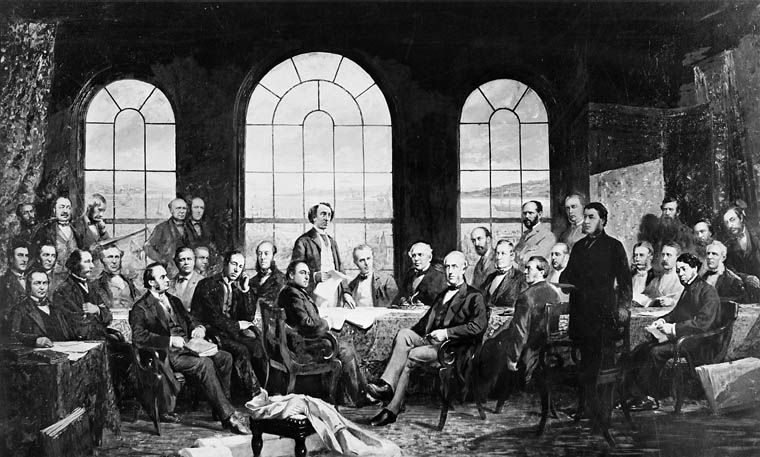
The Laurentian elite's influence is traced from the Confederation era through to the late 20th century, representing a significant portion of Canada’s population and power. Scholars like Michael Cuenco have connected this elite to a centralizing school of political economy rooted in an early modern commercial liberal tradition, which he described as a distinct 'court party' tradition. This tradition carried over from the Conservative Party of Sir John A. Macdonald into the mid-century Liberal Party governments of William Lyon Mackenzie King and his successors, forming a continuous thread of elite governance. According to Ibbitson and analysts, the Laurentian Consensus was responsible for crafting and upholding several foundational Canadian policies that defined the nation's development. These include the National Policy of protective tariffs to support manufacturing and farming industries, a generally pro-free trade stance internationally coupled with tolerance for some internal trade barriers, and the establishment of the Charter of Rights and Freedoms. The elite also championed shared-cost federal programs and cooperative federalism, albeit with a noted bias towards federal power over provincial jurisdictions, supporting a strong central government to manage the federation. This centralizing tendency became a recurring source of tension with regions outside the Laurentian heartland, particularly as Western Canada grew in economic and political confidence.
The perceived decline and the 'Big Shift'
John Ibbitson's central thesis in The Big Shift was that the Laurentian Consensus's dominance was being challenged and was in decline, a seismic change in Canadian politics, business and culture. He pointed to Stephen Harper's majority victory in the 2011 election, achieved without significant support in Quebec, as a key sign of this shift away from Laurentian control. Ibbitson argued a new political coalition was rising, consisting of voters from Western Canada and suburban Ontario, particularly the '905' region around Toronto with its large numbers of immigrant and children-of-immigrant voters. This coalition was described as realistic, pragmatic, cosmopolitan, global and forward-thinking, rather than inherently conservative, and its values were something progressive politicians needed to tailor to. Several specific factors were cited for the Laurentian decline, including infighting within the Liberal Party, immigration patterns that reoriented Ontario toward the West, and rising oil prices that fueled Western economic and population growth. Additional causes were a weakening Quebec sovereignty movement, which reduced the perceived need for a Laurentian unity project, and a growing sense of Canadian patriotism that existed outside the elite's narrative. The concept framed a fundamental realignment in Canadian politics away from the traditional St. Lawrence corridor centres of power, though this shift would prove to be contested and incomplete.
The Laurentian resurgence in the 2025 election
Despite predictions of its decline, the Laurentian elite was credited with a significant political resurgence during the 2025 federal election, demonstrating its enduring capacity to mobilize. Following the resignation of Finance Minister Chrystia Freeland from the Toronto riding of University-Rosedale and Prime Minister Justin Trudeau in late 2024, the Liberals under new leader Mark Carney faced a strong Conservative challenge led by Pierre Poilievre. Ibbitson argued that the Laurentian elite, feeling its very survival was under threat, rallied powerfully to the Liberal cause and brought it victory one more time, convincing older suburbanites to join them. The election became a straight two-party fight outside Quebec between the Laurentian and Conservative coalitions, with NDP support evaporating on April 28. Older, middle-class suburban voters in Ontario and British Columbia, concerned about economic stability amid threats of American tariffs and annexation from President Donald Trump, allied with downtown Laurentians in their determination to advance Carney. This coalition viewed Carney, a former central banker with experience managing the 2008 financial crisis and Brexit, as a well-versed bureaucrat and crisis manager who held special appeal for Baby Boomer voters counting on property equity. The Conservatives captured over 41 percent of the popular vote and made gains in the outer 905 and NDP seats from Windsor to Vancouver Island, but the galvanized Laurentian elite secured a Liberal minority government with about two percentage points more of the popular vote.
Contemporary tensions and Western alienation
The term Laurentian elite remains a potent symbol in contemporary debates, particularly concerning Western alienation and federal-provincial tensions, which were highlighted in a 2026 risk report. Critics in Alberta and Saskatchewan accuse the Laurentian establishment of dismissing Western economic grievances, especially regarding resource development and pipeline approvals, viewing the West merely as suppliers of wealth. The elite is often portrayed as using state-funded media to mock the working class and suppress concerns about regional sovereignty, assuming they can contain the rising tide of Western discontent. The 2025 election of Prime Minister Mark Carney, viewed as a Laurentian figure from his central banking background and Toronto-Ottawa base, intensified these feelings of eastern disconnect. In 2026, Alberta held a referendum on provincial autonomy featuring nine questions, including on gaining more control over areas like immigration, which Premier Danielle Smith expected to receive a 'Yes' from Albertans. While the option for a referendum on independence, known as Option 2, was defeated by about 50 percentage points, Smith and commentators noted the vote did not erase Alberta's grievances and that the eastern establishment could not now go to sleep. Commentators warned that frustration over Ottawa's lack of urgency on economic files, such as pushing pipelines forward, continued to fuel separatist sentiments among some citizens, with untold Albertans and Saskatchewanians ready to consider the option if empty promises continued.
Academic and critical reception
The concept of the Laurentian elite has been analyzed and debated within academic and journalistic circles, with scholars identifying its specific policy attributes. University of Toronto political scientist Andrew McDougall identified key attributes of Laurentian rule, including support for tariffs for manufacturing and farming, a tolerance for internal trade barriers, and a bias towards federal power in disputes with provinces. Conversely, some commentators have challenged aspects of Ibbitson's framework, with Jared Milne writing for iPolitics questioning whether the decline of the Laurentian Consensus would actually make Indigenous people and francophone Quebecers feel less alienated. Milne suggested that Canadian regional groups share more similarities than differences, implying the elite's narrative may overstate divisions. Other analysts like Michael Cuenco see the elite as representing a distinct centralizing political economy tradition, tracing its evolution from Confederation to the present in publications like American Affairs. The term's usage often extends beyond strict academic definition to become a rhetorical device in political discourse, symbolizing a disconnect between the central Canadian establishment and the priorities of other regions, a theme prevalent in post-2025 election analysis.
Key figures and institutions associated with the concept
Several individuals, groups and institutions are commonly referenced in discussions about the Laurentian elite. The group is not a formal organization but a descriptive label for a network of influence spanning politics, media and culture. Key figures include John Ibbitson and Darrell Bricker, the journalist and pollster who authored the defining book The Big Shift and argued the consensus was being replaced, along with David Cameron, the University of Toronto academic credited with coining the term. The Liberal Party of Canada is the political party most historically associated with Laurentian policies and leadership, from Mackenzie King to Justin Trudeau, while Prime Minister Mark Carney, elected in 2025, is viewed as a Laurentian figure due to his central banking background and crisis management experience. Major urban centres and neighbourhoods like Toronto's Annex, Ottawa's Glebe and Montreal's Outremont are cited as residential hubs for the elite, alongside central institutions such as key universities, cultural organizations, national media outlets and the federal bureaucracy in Ottawa. Historical figures like Sir John A. Macdonald, William Lyon Mackenzie King, and Pierre Trudeau are seen as early architects or embodiments of the consensus, and contemporary media, often accused by critics of being a vehicle for Laurentian perspectives, matters in disseminating this worldview. The perception of this group's continued influence, whether waning or resurgent, remains a central theme in analysis of Canada's political and cultural fractures, particularly in the context of the Carney minority government facing trade and unity challenges in 2026.
Policy legacy and ongoing debates
The policy legacy of the Laurentian elite is deeply embedded in the Canadian state and continues to frame national debates. Beyond the National Policy and the Charter, this consensus bequeathed programs like equalization, official multiculturalism and universal public health care, all seen as tools to manage a diverse and regionally divided federation. The elite's approach to federalism, characterized by shared-cost programs and cooperative federalism, has created enduring federal-provincial entanglement while maintaining a central government bias. This legacy is now contested on multiple fronts, with Western provinces demanding more autonomy over resources and immigration, as seen in Alberta's 2026 referendum questions. The Laurentian preference for a strong federal role in protecting Canadian culture and identity from the United States also faces new tests in the era of digital globalization and under the pressure of American trade threats from the Trump administration. The elite's consensus on environmental policy and resource development, often seen as cautious or oppositional to major Western energy projects, is a direct source of the alienation felt in Alberta and Saskatchewan. These policy clashes ensure the concept of the Laurentian elite is not merely historical but a live framework for understanding contemporary conflicts over the direction of the Canadian project.
The future of the Laurentian dynamic
As of 2026, the role and influence of the Laurentian elite remains a subject of intense speculation and political consequence, with Canada's path forward described as uncertain. Prime Minister Mark Carney's minority government operates in a landscape marked by significant federal-provincial tensions, economic challenges like inflation and housing shortages, and the persistent threat of American protectionism following stalled trade talks. The Laurentian coalition that elected Carney relied on an alliance between downtown elites and older suburban homeowners, a bond that may be tested by ongoing issues like housing affordability for younger workers and energy policy that affects Western Canada. The decisive rejection of Alberta separatism in the 2026 referendum did not resolve underlying Western grievances, suggesting continued pressure on the Laurentian-dominated federal government to address regional concerns beyond sweet talk and worthless promises. Commentators question whether the 2025 election victory represents 'one last time' the elite can rally to hold power, or if it has successfully adapted to the new political reality. The future of Canadian politics may hinge on whether the Laurentian Consensus can genuinely address the demands of younger generations and resource-rich regions, or if it will be permanently supplanted by the coalition of Western and suburban voters first identified over a decade earlier, a question that will likely define the next federal election.
Questions about Laurentian elite
Who are the Laurentian elite in Canada?
The Laurentian elite refers to the political, academic, cultural, media, and business elites of central Canada based primarily in the St. Lawrence River watershed cities like Toronto, Ottawa, and Montreal. They are individuals in the upper class of society from this region. John Ibbitson described them as responsible for shaping Canadian identity and viewing Canada as a fragile nation. The term is often used as shorthand for the Central Canadian establishment.
What is the Laurentian Consensus?
The Laurentian Consensus is the governing political consensus that John Ibbitson argued was established and maintained by the Laurentian elite from Confederation until the early 21st century. This consensus supported policies like the National Policy and the Charter of Rights and Freedoms. It was characterized by a centralizing vision of Canada and a belief that the elite should debate among themselves and implement their agreed upon direction for the country. The consensus viewed Canada as a fragile nation requiring a strong federal government.
Why is the Laurentian elite associated with Western alienation?
The Laurentian elite is associated with Western alienation because critics in Alberta and Saskatchewan believe this eastern establishment dismisses Western economic grievances regarding resource development. The elite is accused of using media and political power to advance central Canadian interests at the West's expense. This fuels feelings of being misunderstood and taken for granted as suppliers of wealth. The perception is that the Laurentian elite opposes key Western energy projects for selfish interests, making the region feel powerless relative to Ottawa.
Did the Laurentian elite really decline after 2011?
John Ibbitson argued the Laurentian Consensus began to decline after Stephen Harper's 2011 majority victory, which was won without significant Quebec support. However, the concept experienced a notable resurgence in the 2025 federal election. The Laurentian elite rallied to support Mark Carney's Liberal leadership, forming a coalition with older suburban voters in Ontario and British Columbia to secure a minority government. This demonstrated the elite's enduring capacity to mobilize in a perceived crisis, challenging the notion of its permanent decline and showing its influence could reassert itself under the right conditions.
What role did the Laurentian elite play in the 2025 election of Mark Carney?
In the 2025 election, the Laurentian elite is credited with rallying to elect Mark Carney as prime minister. The downtown Laurentian establishment in cities like Toronto and Ottawa allied with older, property owning suburban voters in Central Canada and B.C. This coalition viewed Carney, a former central banker, as a competent leader who could protect them from economic threats. Their mobilization was seen as a decisive factor in delivering a Liberal minority government. The elite convinced suburbanites that Carney's crisis management experience was needed.
Is the Laurentian elite the same as the Liberal Party?
While not identical, the Laurentian elite is closely and historically associated with the Liberal Party of Canada. Ibbitson linked the elite primarily with the Liberals and sometimes with politicians from the former Progressive Conservative Party. The elite's consensus is seen as embodied in Liberal policies like the Charter and multiculturalism, and its resurgence was key to the Liberal victory in 2025. However, the concept also encompasses influential figures in academia, media, culture and the federal bureaucracy who may not be formally partisan but share a similar worldview centred on St. Lawrence corridor institutions and a bias towards federal power.
Sources and further reading
- Laurentian elite (Wikipedia)
- John Ibbitson: The Laurentian elite strikes back (thehub.ca)
- The Collapse of the Laurentian Consensus (reviewcanada.ca)
Checked by the Novello Desserts desk. Last updated 2026-10-26.