Visible minority
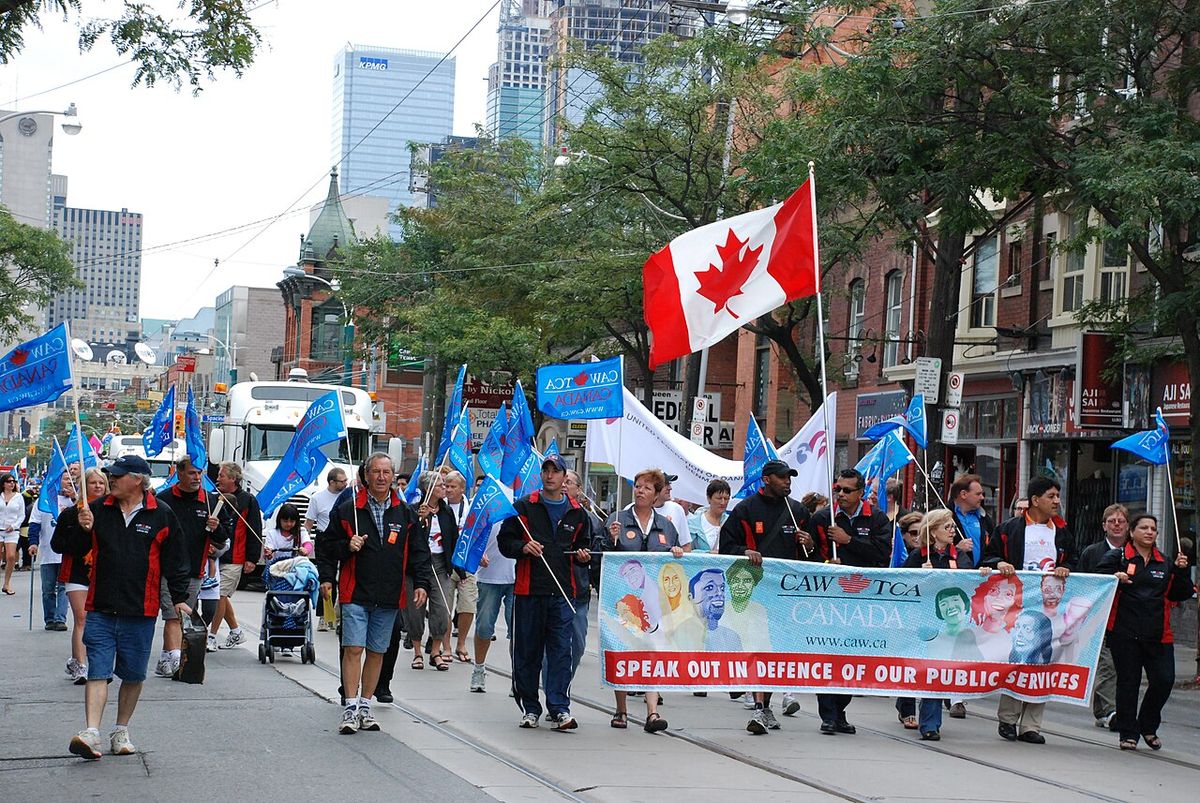
The term "visible minority" is a demographic classification used by the Government of Canada to refer to persons, other than Aboriginal peoples, who are non-Caucasian in race or non-white in colour. Primarily employed for statistical purposes and in the administration of employment equity and human rights laws, this category reflects the significant demographic shift in Canada's population since the 1960s. The concept, while instrumental in tracking diversity and addressing systemic discrimination, has also been the subject of considerable debate regarding its utility and appropriateness. The term and the qualifier "visible" were specifically chosen by Canadian authorities to distinguish newer immigrant minorities from both Aboriginal peoples and from older minorities defined by language or religion.
Definition and Legal Framework
The term "visible minority" is formally defined in Canada's Employment Equity Act of 1995. The Act specifies that visible minorities are persons, other than aboriginal peoples, who are non-Caucasian in race or non-white in colour. This definition originated from the 1984 Report of the Abella Commission on Equality in Employment, which described the term as an ambiguous categorization but interpreted it practically to mean visibly non-white. For operational purposes in censuses and equity programs, Statistics Canada identifies individuals as visible minorities based on their responses to population group and Indigenous identity questions. The main groups classified under this category are South Asian, Chinese, Black, Filipino, Arab, Latin American, Southeast Asian, West Asian, Korean, and Japanese. A person who identifies as First Nations, Métis, or Inuit on the census is explicitly excluded from the visible minority count and is categorized as Not a visible minority. The classification rules are detailed, accounting for scenarios where individuals mark multiple categories or provide write-in responses, particularly noting that combinations of certain groups like Latin American and White result in exclusion from the visible minority population. The term non-white is sometimes used as a shorthand in employment equity questionnaires, intended to refer to those in the Aboriginal and visible minority groups collectively.
Demographic Trends and Projections
The visible minority population in Canada has grown dramatically from less than 1% of the total population in 1961 to 26.5% in the 2021 census. This represents 9,639,200 individuals. This ongoing increase is a direct result of changes to immigration policy in the 1960s, which shifted the primary sources of newcomers from Europe to other regions of the world. The growth has been steady across recent censuses, rising from 13.4% in 2001, to 16.2% in 2006, 19.1% in 2011, 22.2% in 2016, and finally to 26.5% in 2021. Statistics Canada projects this trend will continue, estimating that by 2041, visible minorities will constitute between 38.2% and 43.0% of Canada's total population. The growth is even more pronounced within the working-age population (15 to 64 years), which is projected to be 42.1% to 47.3% visible minority by 2041, compared to 28.5% in 2021. Projections from 2011 indicated that by 2031, nearly 40% of children under the age of one would belong to a visible minority group, highlighting the youthful demographic of this population segment. By 2031, Canada could be home to 14.4 million people belonging to a visible minority group, more than double the 5.3 million reported in 2006.
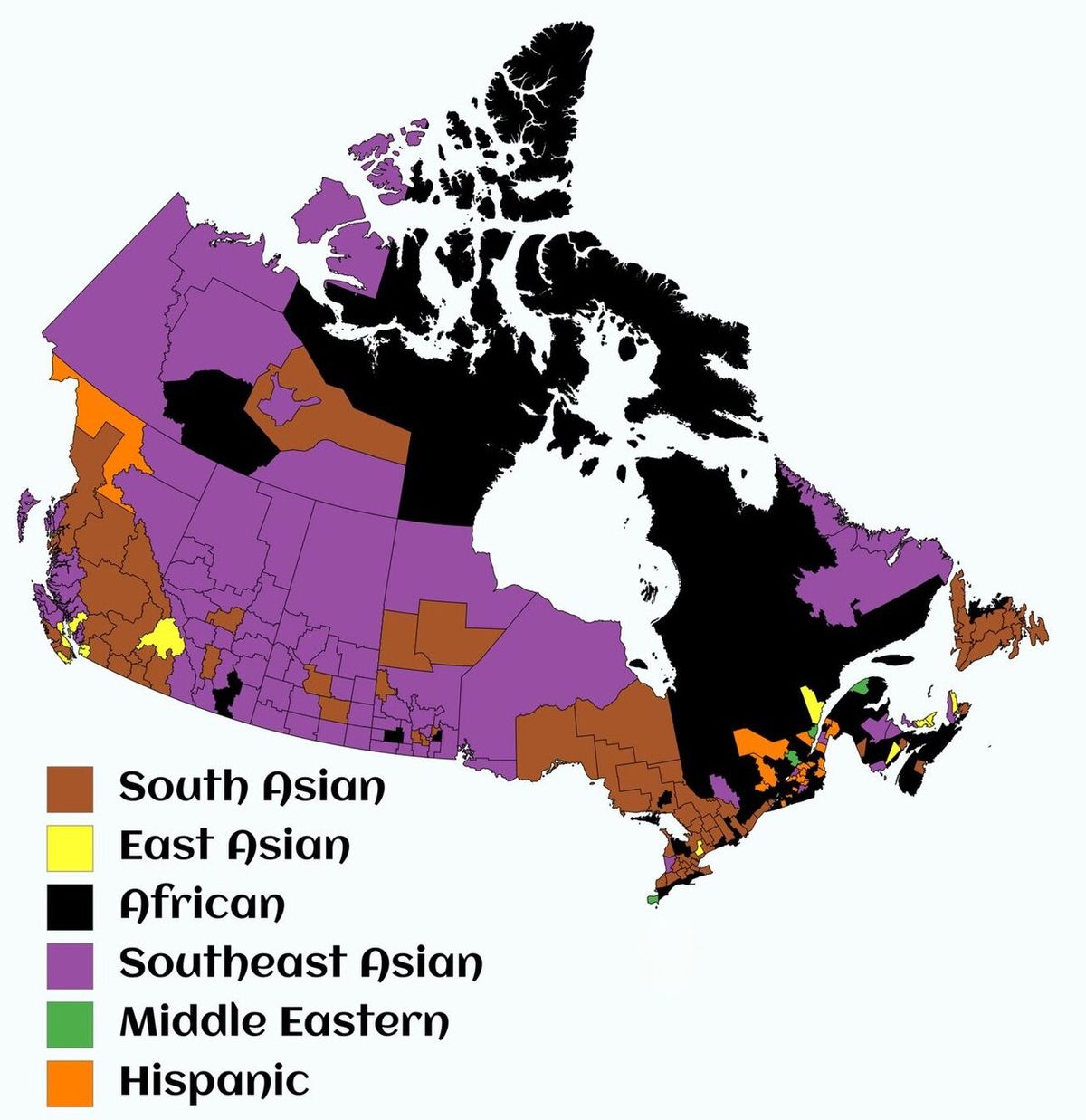
The composition of the visible minority population is also evolving. As of the 2021 census, the largest single group was South Asian Canadians, with approximately 2.6 million people representing about 7.1% of the national population. They were followed by Chinese Canadians at 4.7% and Black Canadians at 4.3%. Statistics Canada has projected that the South Asian population could grow to 4.1 million by 2031, while the Chinese population could reach 3 million. Diversity is increasing not only through immigration but also among the Canadian-born population. By 2031, it was projected that 47% of second-generation Canadians, those born in Canada with at least one foreign-born parent, would belong to a visible minority group, nearly double the 24% proportion recorded in 2006. The rest of the Canadian population, in contrast to the visible minority population, was projected to increase by less than 12% between 2006 and 2031.
Geographic Distribution
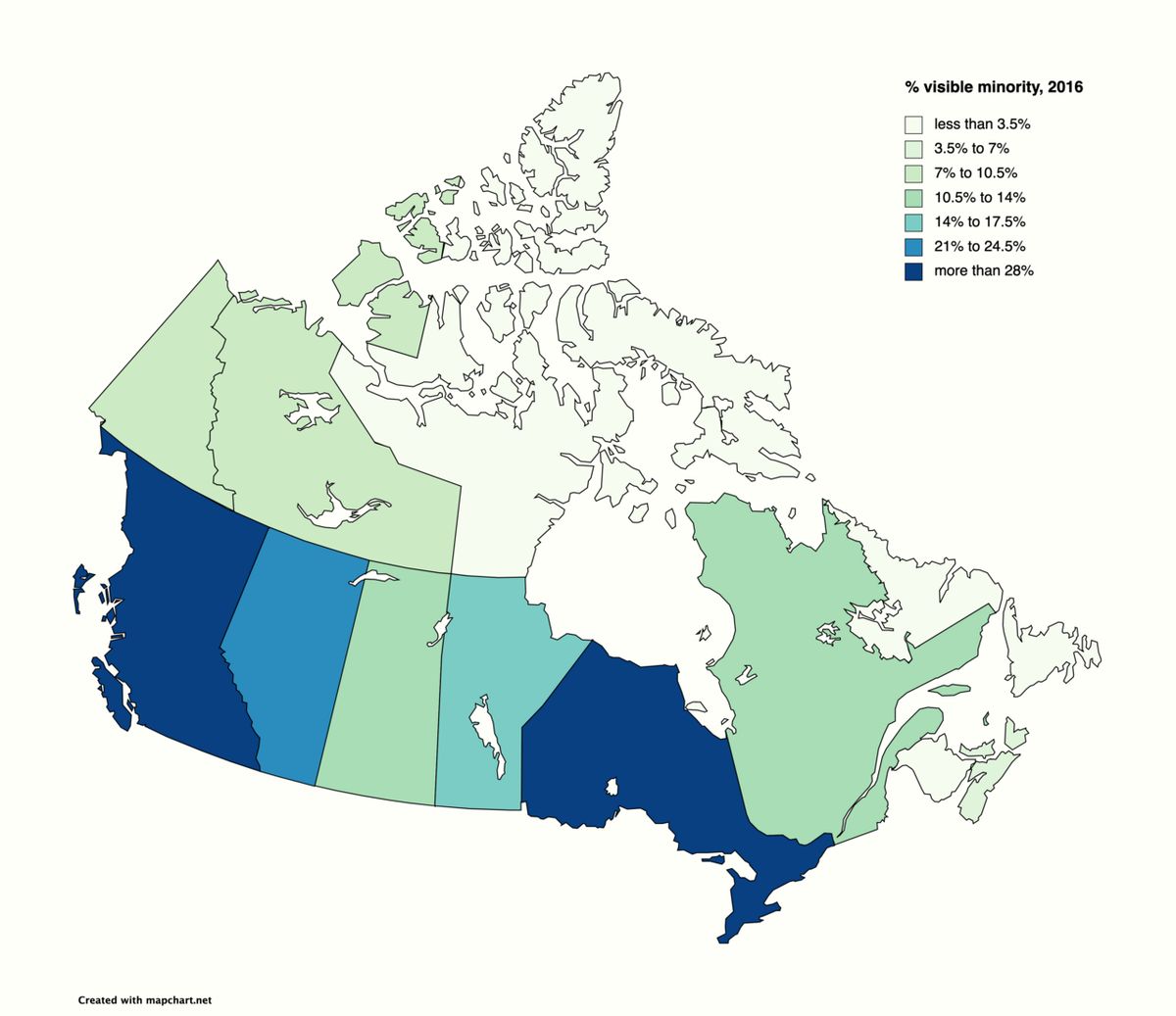
The distribution of visible minorities across Canada is highly uneven, with significant concentrations in major metropolitan areas and certain provinces. According to the 2021 census, British Columbia had the highest provincial proportion of visible minorities at 34.4% of its population, followed closely by Ontario at 34.3%. Alberta's visible minority population was 27.8%, while Manitoba's was 22.2%. These figures are all above the national average of 26.5%. The concentration is most intense in census metropolitan areas. For example, projections from 2011 indicated that by 2031, visible minorities could make up 63% of the population in the Toronto census metropolitan area, which stretches from Oshawa to Burlington and Barrie. The number of visible minorities in the Toronto area was projected to grow from 2.3 million in 2006 to 5.6 million in 2031, while the rest of the area’s population was projected to rise by only 8%. In such urban centres, visible minorities can form a majority-minority population, meaning they collectively represent more than half of the local residents. This reality challenges the conceptual basis of the term minority in these specific geographic contexts. The table below illustrates the growth of the visible minority population as a percentage of the total population across recent censuses.
| Census Year | Visible Minority Percentage |
|---|---|
| 1981 | 4.7% |
| 1991 | 9.4% |
| 1996 | 11.2% |
| 2001 | 13.4% |
| 2006 | 16.2% |
| 2011 | 19.1% |
| 2016 | 22.2% |
| 2021 | 26.5% |
Purpose and Use in Policy
The visible minority classification was created primarily as a tool for public policy, specifically to monitor and promote equity in employment. The data collected under this category is used to enforce the Employment Equity Act, which requires federally regulated employers and contractors to identify and eliminate barriers in the workplace for four designated groups: women, Indigenous peoples, persons with disabilities, and visible minorities. By tracking representation, the government aims to address systemic discrimination and underrepresentation in the workforce. The term also appears in human rights legislation and other policies designed to foster multiculturalism and combat racial discrimination. The operational definition provides a standardized method for Statistics Canada to collect comparable data over time, which is essential for measuring progress toward equity goals. The classification helps to make disparities visible, such as the documented difficulty visible minority individuals face in accessing the labour market and the greater economic and health impacts reported by these groups during the COVID-19 pandemic. Recent analysis shows that groups designated as visible minorities report greater economic and health impacts from COVID-19. The findings are clear that belonging to a visible minority reduces the likelihood of finding employment, and visible-minority individuals born in Canada also face these labour market difficulties.
Criticism and Controversy
The term visible minority has been the subject of sustained criticism from academics, community advocates, and international bodies. A primary critique is that the label itself may be considered objectionable or discriminatory. In 2007, the United Nations Committee on the Elimination of Racial Discrimination expressed doubts about the term's use, stating it may not be in accordance with international anti-racism conventions and recommended Canada evaluate it. Critics argue the term homogenizes vastly different groups with little in common, bundling both historically disadvantaged and non-disadvantaged communities under a single racialized category. Scholars like Harald Bauder have described it as a statistext, a census category contrived for a specific policy purpose that can reinforce racialization. The label's accuracy is questioned in regions where visible minorities form a local majority, making the term minority a demographic misnomer. Some advocates, such as Rosemary Campbell-Stephens and Sachin Maharaj, propose alternative terms like global majority to reframe the discussion. The Canadian government has commissioned studies and held workshops to evaluate the term's use, reflecting the ongoing national conversation about racial classification and inequality. The UN committee also raised concerns over heightened risks of discrimination from national security measures and disproportionate police force against African-Canadians, issues intersecting with the visible minority classification.
The Move Away from the Term
In recent years, there has been a marked shift in terminology within government and academic discourse away from visible minority. The standard was approved as a departmental standard on August 25, 2021, even as its conceptual limitations were widely acknowledged. The presentation titled The Rise and Fall of 'Visible Minority' in Canada highlights that this uniquely Canadian classification is being retired from government terminology. This move addresses the unresolved tension in racial classification systems that aim to acknowledge difference while often obscuring the structural nature of racial inequality. Increasingly, terms like racialized minority or racialized person are used in policy discussions and summaries to more accurately describe people affected by racism and systemic discrimination. This language shift emphasizes the process of racialization, how societies construct racial categories and attach social meaning to them, rather than implying that visibility is an inherent or defining trait. The term racialized minority is used in plain-language summaries to explain that racialized people are affected by racism, which can make it more difficult for them to find work or access services. Debra Thompson, an associate professor and Canada Research Chair in Racial Inequality at McGill University, has written on this topic, authoring works such as The Schematic State: Race, Transnationalism, and the Politics of the Census which examines these classification systems.
Major Visible Minority Groups in Canada
As defined by Statistics Canada for employment equity purposes, the visible minority population consists of several distinct groups. These groups are identified through census responses and have shown significant growth patterns. The largest groups, based on the 2021 census and historical projections, include South Asian, Chinese, Black, Filipino, Arab, Latin American, Southeast Asian, West Asian, Korean, and Japanese. The category Visible minority, n.i.e. captures those who do not fit into the listed groups, while Multiple visible minority is for people who identify with more than one of these origins. The South Asian category includes persons who mark South Asian or write in responses like Bangladeshi, Indian, Pakistani, Punjabi, or Sri Lankan. The Chinese category includes mark-in responses of Chinese or write-ins like Han. The Black category includes mark-in responses of Black or write-ins such as African American, Congolese, Haitian, or Nigerian. The Filipino category includes those marking Filipino or writing in Igorot or Ilocano. Specific derivation rules exist for mixed responses. For instance, a person marking both South Asian and White is still counted as a visible minority, but a person marking Arab and White is excluded from the visible minority population. These groups are not monolithic and encompass immense internal diversity in terms of language, religion, nationality, and immigration history.
Specific Derivation Rules from Census Data
The process of deriving visible minority status from census responses involves precise rules applied by Statistics Canada. The population group question includes 11 mark-in circles and one write-in space, with categories like White, South Asian, Chinese, Black, Filipino, Arab, Latin American, Southeast Asian, West Asian, Korean, and Japanese. Respondents mark one or more and can specify another group. The Indigenous group question asks if the person is First Nations, Métis, or Inuit. Anyone identifying as Indigenous is placed in the Not a visible minority category and does not answer the population group question. For others, classification proceeds based on their population group responses. The rules for specific groups are detailed. For the South Asian category, inclusion occurs if a person provides a mark-in response of South Asian only, a write-in response associated with South Asian only like Bangladeshi or Pakistani, a combination of such mark-in and write-in responses, mark-in responses of both South Asian and White only, or a combination of responses associated with both South Asian and White only. Similar multi-part rules exist for Chinese, Black, and Filipino categories. A key distinction is made for certain groups. Persons who reported Latin American and White, Arab and White, or West Asian and White are excluded from the visible minority population. Likewise, persons who reported Latin American, Arab, or West Asian and provided a European write-in response like French are also excluded. These persons are included in the Not a visible minority category.
International Context and Comparisons
The Canadian concept of visible minority exists within a broader international context of racial and ethnic classification. Similar demographic shifts have occurred in other immigrant-receiving nations. Statistics Canada projected a similar trend, noting that by 2031 nearly 40 per cent of children under one in Canada would belong to a visible minority group, up from 22 per cent six years prior. The UN Committee on the Elimination of Racial Discrimination, which critiques the term visible minority, operates under the International Convention on the Elimination of All Forms of Racial Discrimination. This convention states that distinction based on race, colour, descent, or national or ethnic origin is discriminatory. The committee's 2007 report on Canada praised some initiatives like committees to fight discrimination and stronger hate crime laws but raised concerns on several fronts beyond terminology. These included insufficient progress tackling discrimination against Aboriginal people in employment and under-representation in public office, disproportionate police force against African-Canadians, high incarceration rates among First Nations, and the treatment of undocumented migrants. This international scrutiny shows how domestic classification systems like visible minority are evaluated against global human rights standards.
Key Criticisms from the UN Committee
The United Nations Committee on the Elimination of Racial Discrimination issued a detailed report on Canada in 2007. While the report acknowledged positive steps, it raised several specific concerns directly and indirectly related to the classification and treatment of visible minorities. The committee's recommendations highlight areas where Canadian policy was seen as falling short of its international obligations. The committee called on Canada to reflect further on the use of the term visible minorities itself. Beyond terminology, the report identified multiple substantive issues affecting racialized and Indigenous communities in Canada.
- In 2007, the UN committee stated the term "visible minorities" may not be in accordance with the aims of the international convention against racism.
- The committee expressed concern over heightened risks of discrimination from national security measures like the Anti-terrorism Act and security certificates.
- It found insufficient progress in tackling discrimination against Aboriginal people in employment and under-representation in public offices.
- The report accused police of using a disproportionate amount of force against African-Canadians.
- It noted a disproportionately high rate of incarceration among Canada's First Nations and recommended alternatives to prison.
- The committee raised concerns over the treatment of undocumented migrants and stateless persons whose asylum claims were rejected, calling for access to social security and health care.
Projected Growth of Major Groups
Statistics Canada has produced detailed projections for the growth of specific visible minority groups, based on trends from immigration and fertility. These projections illustrate how the composition of Canada's population is expected to change in the coming decades. The South Asian population, already the largest visible minority group, is projected to see particularly significant growth. The Chinese population is also expected to expand substantially. These projections help inform policy planning in areas like settlement services, education, and labour market integration. The following list outlines key projected growth figures for major visible minority groups, based on Statistics Canada estimates from 2011 looking ahead to 2031.
- The South Asian population was projected to more than double from roughly 1.3 million in 2006 to 4.1 million by 2031.
- The total visible minority population was projected to reach 14.4 million by 2031, more than double the 5.3 million counted in 2006.
- By 2031, visible minorities were projected to make up 63% of the population in the Toronto census metropolitan area.
- By 2031, 47% of second-generation Canadians were projected to belong to a visible minority group.
- By 2031, nearly 40% of children under the age of one in Canada were projected to belong to a visible minority group.
Operational Groups and Examples
For census and policy application, the visible minority category is broken down into specific operational groups. Each group includes individuals who mark a specific category or provide certain write-in responses. The definitions ensure consistency in data collection over time. The examples of write-in responses help clarify the origins and diversity encompassed by each broad label. Understanding these operational definitions is key to interpreting Statistics Canada data on visible minorities.
- The 'South Asian' category includes write-in examples such as 'Bangladeshi', 'Indian (India)', 'Pakistani', 'Punjabi', and 'Sri Lankan'.
- The 'Chinese' category includes write-in examples such as 'Chinese' and 'Han'.
- The 'Black' category includes write-in examples such as 'African American', 'Congolese', 'Haitian', and 'Nigerian'.
- The 'Filipino' category includes write-in examples such as 'Filipino', 'Igorot', and 'Ilocano'.
- The 'Arab' and 'West Asian' categories are distinct, with the latter including groups like those from Iran.
- Other designated groups are 'Korean', 'Japanese', 'Latin American', and 'Southeast Asian'.
Questions about Visible minority
What is the definition of a visible minority in Canada?
In Canada, a visible minority is legally defined by the Employment Equity Act as persons, other than aboriginal peoples, who are non-Caucasian in race or non-white in colour. This definition is used for federal employment equity and statistical purposes. Statistics Canada operationalizes this by classifying individuals based on their responses to census questions about population group and Indigenous identity. Major groups include South Asian, Chinese, Black, Filipino, Arab, Latin American, Southeast Asian, West Asian, Korean, and Japanese. The term is specifically designed to separate newer immigrant minorities from Aboriginal peoples and from older linguistic or religious minorities.
What percentage of Canada's population are visible minorities?
According to the 2021 Canadian census, 9,639,200 people identified as a member of a visible minority group. This represents 26.53% of Canada's total population. This marks a steady increase from previous censuses: 22.2% in 2016, 19.1% in 2011, 16.2% in 2006, and 13.4% in 2001. The growth is attributed to immigration patterns that have favoured non-European source countries since the 1960s. Statistics Canada projects that by 2041, visible minorities will make up between 38.2% and 43.0% of the total population, indicating this demographic shift will continue.
Why is the term 'visible minority' considered controversial?
The term visible minority is controversial for several reasons. Critics, including a United Nations anti-racism committee, have argued the label itself may be discriminatory and does not align with international conventions. It homogenizes diverse groups with different histories and experiences under a single racialized category. In cities like Toronto and Vancouver, where visible minorities collectively form a majority of the population, the term becomes a demographic misnomer. Academics also note it is a statistext created for policy that can obscure structural inequality. The criticism has led to a move towards terms like racialized person that focus on the social process of racialization rather than an inherent trait of visibility.
What are the largest visible minority groups in Canada?
As of the 2021 census, the largest visible minority group in Canada is South Asian Canadians, with a population of approximately 2.6 million, representing about 7.1% of the country's total population. The second largest group is Chinese Canadians, at 4.7% of the population, followed by Black Canadians at 4.3%. Other significant groups include Filipinos, Arabs, Latin Americans, and Southeast Asians. Statistics Canada projections from 2011 suggested the South Asian population could grow to 4.1 million by 2031, and the Chinese population to 3 million, indicating these groups will likely remain the largest.
How does Statistics Canada determine who is a visible minority?
Statistics Canada determines visible minority status primarily through responses to the census. Individuals are first asked if they are First Nations, Métis, or Inuit. Anyone who answers yes is classified as Not a visible minority. All others answer a population group question where they can mark one or more categories such as White, South Asian, Chinese, Black, etc., or write in another group. Based on these responses, individuals are classified as a visible minority if they mark or write in a non-white, non-Caucasian group, with specific rules for mixed responses. For example, marking both South Asian and White still results in a visible minority classification, but marking Latin American and White does not.
Is the Canadian government moving away from using the term 'visible minority'?
Yes, there is a clear movement away from the term visible minority in official and academic discourse. While it remains a defined standard for statistical purposes, its conceptual limitations have led to its gradual retirement. Presentations and analyses now discuss the rise and fall of the term. The shift is towards language that emphasizes racialization, such as racialized minority or racialized person. This change aims to more accurately describe the experience of being subjected to systemic racism rather than defining people by a perceived visible trait. The term racialized minority is increasingly used in plain-language policy summaries to highlight the impact of discrimination.
Sources and further reading
- Visible minority (Wikipedia)
- The Rise and Fall of "Visible Minority" in Canada (queensu.ca)
- Visible minority of person (www23.statcan.gc.ca)
- Visible minorities increasing in Canada: Stats Can (canadianimmigrant.ca)
- Term 'visible minorities' may be discriminatory, UN body ... (cbc.ca)
Checked by the Novello Desserts desk. Last updated 2026-10-26.