Little Caesars
Little Caesars is an American multinational pizza restaurant chain and the third-largest pizza chain by total sales in the United States. Founded in 1959 by Mike and Marian Ilitch in Garden City, Michigan, the company is known for its value-oriented, carryout-focused business model, most famously the Hot-N-Ready large pepperoni pizza. In Canada, where the chain has operated since 1969, Little Caesars is a significant player in the quick-service pizza market, adapting its marketing to work within trademark restrictions while offering its core menu of pizzas, Crazy Bread, and other items. The company is owned by Ilitch Holdings and maintains its global headquarters in Detroit, Michigan.
History and corporate development
Little Caesars was founded on May 8, 1959, by the married couple Mike and Marian Ilitch. The first location, named Little Caesar's Pizza Treat, opened in a strip mall in Garden City, Michigan, a suburb of Detroit. This original store closed in October 2018, relocating to a new building in nearby Westland. The company sold its first franchise in 1962 in Warren, Michigan, and by 1987 had restaurants in all 50 U.S. states. A significant turning point came in 1979 with the introduction of the advertising catchphrase Pizza! Pizza!, which promoted two pizzas for the price competitors charged for one. This value proposition was central to the brand's identity for decades, though its packaging evolved from a distinctive long cardboard sleeve to standard pizza boxes.
Throughout the 1980s and 1990s, the company experimented with diversification, including opening family entertainment centres in the Detroit and Chicago areas. These venues, initially called Little Caesars Family Fun Pizzerias and later rebranded as Caesarland, operated until the last locations closed in 2011 due to declining business. The chain's modern business model crystallized in 1997 with the introduction of the Hot-N-Ready concept, a large pepperoni pizza sold for a low, fixed price and advertised on shaker boards. This focus on ready-made, carryout pizza proved highly successful and became a permanent fixture. Corporate expansion continued with plans for a major new headquarters, the Global Resource Center in downtown Detroit, announced in 2014. The building, which grew to nine stories, faced construction delays but eventually expanded the company's campus.
The company's visual identity has also evolved. The original 3D Caesar logo was introduced in 1962. In 2017, coinciding with the opening of Little Caesars Arena, the company launched a slightly updated logo that removed Caesar's chest hair, updated the wreath, and incorporated hidden LC letters into the toga. This new design replaced the more cartoonish version used in advertising since 1988. The Ilitch family's ownership through Ilitch Holdings has provided stability, allowing for sustained growth and strategic investments in the brand's infrastructure and market presence. The company is also known for large-scale operational achievements, such as filling an order for 13,386 pizzas for the VF Corporation in 1998, which was then the largest pizza order on record.
International presence and Canadian operations
Little Caesars began its international expansion early, with its first Canadian locations appearing in 1969. The company significantly bolstered its Canadian footprint in 1989 by purchasing the Mother's Pizza chain out of receivership, gaining locations in Canada, the United States, and the United Kingdom. While the brand eventually left the UK market for a period, it maintained a strong presence across Canada. As of 2022, the company operates in numerous countries across North America, South America, Asia, and Europe. Its international growth has been dynamic, marked by entries into and exits from various markets based on commercial performance. The chain's international trajectory includes several key events, such as re-entering the Philippine market in January 2019 after a prior presence in the 1990s and entering India in January 2020 with two stores in Ahmedabad.
The brand expanded to the United Arab Emirates in July 2025 with a branch in Dubai and to Malaysia in May 2026 with a location in Damansara Utama. Conversely, the company has exited several markets, including Australia in 2019, Russia in March 2022 due to the war in Ukraine, and Singapore in September 2024. After re-entering the United Kingdom in December 2022, the chain quietly closed all its UK locations by 2026, exiting the market once more after four years. The company has also announced plans to expand into France, Germany, and Portugal. In Canada, Little Caesars faces a unique marketing restriction because the unaffiliated Pizza Pizza restaurant chain holds the countrywide trademark for its name, which legally prevents Little Caesars from using its famous Pizza! Pizza! slogan.
In response, the chain has employed alternative slogans such as Two Pizzas! and Delivery! Delivery! for its Canadian marketing campaigns. This adaptation demonstrates the brand's flexibility in working within local market conditions while maintaining its core value message. The Canadian operations are part of a broader global network that reflects a strategy of entering new markets while consolidating or withdrawing from others based on performance and local economic factors.
Menu and product innovations
The Little Caesars menu is built around value and convenience, anchored by the Hot-N-Ready program which ensures popular items are available for immediate carryout. Core offerings include a variety of pizzas, from the classic round to specialty pies. In 1988, the chain introduced a square deep-dish pizza called Pan! Pan! which could be mixed with the original round pizza in the two-for-one deal. A more significant menu addition came in 2013 with the Deep! Deep! Dish Pizza, a Detroit-style pizza. Beyond pizza, the menu features Caesar Wings, salads at select locations, and popular bread sides like the original Crazy Bread, sticks of baked dough topped with garlic and cheese, which was introduced in 1982.
Little Caesars has a history of introducing and discontinuing innovative products. In 1996, it launched Pizza by the Foot, a three-foot-long rectangular pizza, though it has since been discontinued. An equivalent product, Pizza by the Meter, has been sold successfully in Saudi Arabia since the 1990s. The company frequently tests limited-time offers, such as the Soft Pretzel Crust Pizza in 2014 and the Bacon Wrapped Deep! Deep! Dish Pizza in 2015. It has also ventured into alternative proteins, testing a pizza with meatless sausage made by Impossible Foods in May 2019. In June 2020, the chain reintroduced Stuffed Crazy Bread, a product first launched in 1995.
Recent introductions include Crazy Puffs, a handheld snack made with pizza dough filled with cheese, pepperoni, and sauce. This product launched in Canada on May 15, 2023, and later in the United States on March 11, 2024, in both pepperoni and cheese varieties. All Little Caesars locations carry Pepsi products for beverages and also sell dessert items like brownies. The company's product development reflects a balance between maintaining classic, crowd-pleasing items and experimenting with new formats and flavours to drive customer interest.
Marketing and sponsorships
Little Caesars marketing has long been defined by its emphasis on value and memorable advertising. The Pizza! Pizza! slogan, introduced in 1979, became one of the most recognizable in the fast-food industry, directly communicating the chain's two-for-one value proposition. This slogan, however, is not used in Canada due to trademark conflicts, leading to the use of alternative phrases like Two Pizzas!. The 1997 introduction of the Hot-N-Ready pizza for five dollars was promoted via simple, effective shaker board signage at storefronts, a tactic that became synonymous with the brand's low-price, high-convenience model. This shift in marketing and operations moved the chain's focus decisively toward carryout.
The company has engaged in several high-profile sponsorships and promotions. In September 2022, Little Caesars became the official pizza sponsor of the National Football League (NFL), aligning the brand with a major American sports institution. Earlier in its history, the chain had a notable retail partnership, commonly operating restaurants inside Kmart stores throughout the 1990s and early 2000s. These were often found in Big Kmart and Super Kmart locations. After Kmart's bankruptcy, most locations replaced Little Caesars with their own K-Cafe, though as of 2021, two combined Little Caesars and Kmart locations remained in Guam and the US Virgin Islands.
Key marketing milestones and partnerships:
- 1979: Introduction of the Pizza! Pizza! slogan in the United States.
- 1997: Launch of the Hot-N-Ready pizza and associated shaker board advertising.
- 1990s-2000s: Widespread presence within Kmart stores across the United States.
- September 2022: Becomes the official pizza sponsor of the NFL.
Franchising and business model
Little Caesars operates primarily through a franchising model, having sold its first franchise in 1962. The estimated total investment required to open a franchise ranges from $378,700 to $1,695,500, covering costs such as real estate, equipment, and initial inventory. This model facilitated rapid growth, enabling the chain to reach all 50 U.S. states by 1987. Between 2008 and 2015, Little Caesars was the fastest-growing pizza chain in the United States, demonstrating the appeal of its streamlined, carryout-focused operational system. As of 2017, the company had 5,463 locations globally, including both U.S. and international units.
The business model is heavily oriented toward carryout and value, which reduces operational complexity and cost. The Hot-N-Ready system, where popular pizzas are made continuously for immediate purchase, minimizes customer wait times and labour costs associated with custom orders. This efficiency is supported by kitchen technology. The chain was among the first to adopt speed-cooking Rotary Air Impingement Ovens. The model also allows for a simplified menu in many locations, focusing on high-volume items like pepperoni pizza, Crazy Bread, and a limited selection of wings and drinks.
Key aspects of the Little Caesars franchise and business model:
- Franchise investment range: $378,700 to $1,695,500.
- Core operational focus: Carryout and value-priced, ready-made pizzas.
- Key growth period: Fastest-growing U.S. pizza chain from 2008 to 2015.
- Technology adoption: Early use of Rotary Air Impingement Ovens for speed cooking.
Corporate footprint and community presence
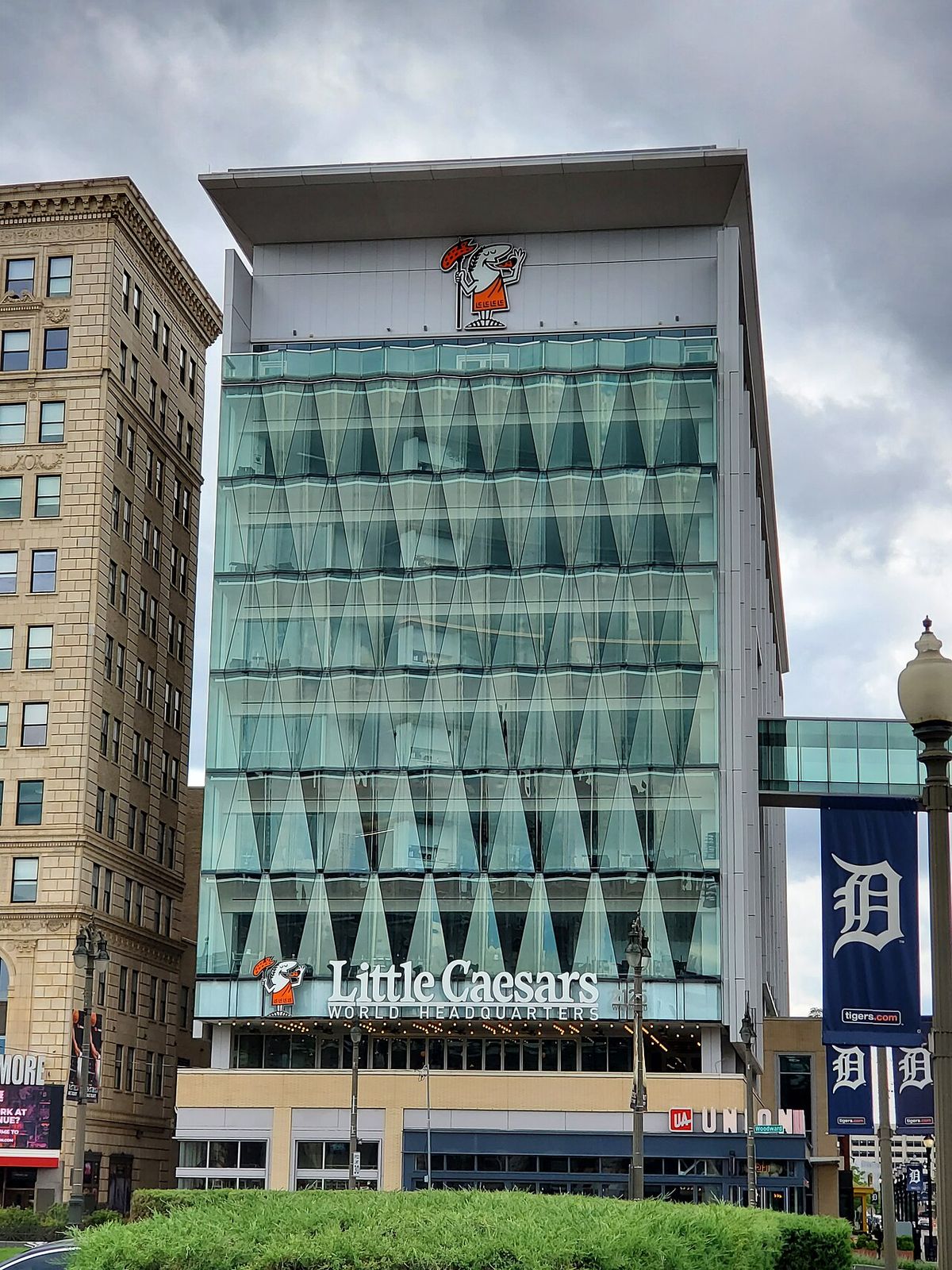
Little Caesars maintains a significant corporate and physical footprint in its hometown of Detroit, Michigan. The company's global headquarters is part of the Ilitch Holdings portfolio, which includes other notable Detroit assets like the Fox Theatre. In December 2014, the company announced plans for a new Global Resource Center at Woodward Avenue and Columbia Street in downtown Detroit. The project, intended to double the size of the World Headquarters Campus, was planned as an eight-story, 205,000-square-foot building with a pedestrian bridge connecting it to the Fox Theatre complex. By January 2016, the design had grown to nine stories, though construction delays pushed its completion past the original 2018 target.
The company's presence extends beyond restaurants to include major entertainment venues. Little Caesars Arena, home to the Detroit Red Wings and Detroit Pistons, opened in 2017 and prompted the refresh of the company's logo. The Ilitch family's investments in Detroit through their holdings have been substantial, contributing to downtown development. The company has also made its mark through large-scale orders and operational achievements. In 1998, it filled what was then the largest pizza order ever, producing 13,386 pizzas for the VF Corporation in Greensboro, North Carolina. While the brand is global, its identity remains deeply tied to Detroit and the Midwest United States, a connection reinforced by menu items like the Detroit-style Deep! Deep! Dish Pizza introduced in 2013.
Little Caesars was founded in a strip mall in Garden City, Michigan, a suburb of Detroit, in 1959. The company is headquartered in Detroit, Michigan. In 2014, Little Caesars announced plans for a new Global Resource Center in downtown Detroit to double the size of its World Headquarters Campus. The company operates and franchises pizza restaurants internationally in Asia, Europe, North America, and South America.
Questions about Little Caesars
Why doesn't Little Caesars use the 'Pizza! Pizza!' slogan in Canada?
Little Caesars is legally prevented from using its famous Pizza! Pizza! slogan in Canada because the unaffiliated Pizza Pizza restaurant chain holds the countrywide trademark for that phrase. To communicate its value proposition of offering two pizzas, Little Caesars uses alternative slogans in the Canadian market such as Two Pizzas! and Delivery! Delivery!. This is a unique adaptation to local trademark law, while the core marketing message of value and multiple pizzas remains consistent.
When did Little Caesars first open in Canada?
Little Caesars first established a presence in Canada in 1969, with locations opening in some Canadian cities. The chain significantly expanded its Canadian footprint in 1989 when it purchased the Mother's Pizza chain out of receivership. This acquisition provided an established infrastructure from which the brand could grow its operations across the country. As of 2022, the company is present in Canada.
What is the Hot-N-Ready pizza?
The Hot-N-Ready pizza is a central part of Little Caesars' business model, introduced in 1997. It is a large pepperoni pizza that is pre-made and kept hot, ready for immediate carryout without the need for a custom order or waiting. Originally sold for five dollars, the concept was advertised on simple shaker boards outside stores. Its success led the chain to shift its focus more decisively toward carryout, and the Hot-N-Ready system remains a permanent, defining feature of the brand's value and convenience offering.
Who owns Little Caesars?
Little Caesars is owned by Ilitch Holdings, the private holding company of the Ilitch family. The chain was founded in 1959 by the married couple Mike Ilitch and Marian Ilitch. The company remains under family control, with its global headquarters located in Detroit, Michigan. Ilitch Holdings also owns other major Detroit assets, including the Fox Theatre and has significant interests in sports through the Detroit Red Wings and Detroit Pistons, whose arena is named Little Caesars Arena.
What are some of Little Caesars' most popular menu items besides pizza?
Beyond pizza, Little Caesars is well known for its bread sides and other offerings. The original Crazy Bread, introduced in 1982, consists of baked dough sticks topped with garlic and cheese. The chain also sells Italian Cheese Bread, Caesar Wings in various flavours, and select locations offer salads. For dessert, brownies are available. A more recent innovation is Crazy Puffs, a handheld snack filled with cheese, pepperoni, and sauce, which launched in Canada in 2023 and in the United States in 2024.
Is Little Caesars expanding internationally?
Little Caesars continues to pursue international growth, though its presence fluctuates by market. Recent expansions include entering the United Arab Emirates in July 2025 with a branch in Dubai and Malaysia in May 2026 with a location in Damansara Utama. The company has announced plans to expand into France, Germany, and Portugal. However, it has also exited several markets recently, including Singapore in September 2024 and the United Kingdom by 2026, demonstrating a strategy of entering new markets while consolidating or withdrawing from others based on performance.
Sources and further reading
- Little Caesars (Wikipedia)
- Little Caesars Franchise (franchise.littlecaesars.com)
- Little Caesars Franchise Little Caesars Canada | Top Pizza ... (littlecaesarsfranchise.ca)
Checked by the Novello Desserts desk. Last updated 2026-10-18.