Stratford Festival
The Stratford Festival is a major repertory theatre festival operating each year from April to November in Stratford, Ontario. Founded in 1952 by local journalist Tom Patterson, it began as a Shakespearean festival aimed at revitalizing the local economy and has grown into one of Canada's most prominent and internationally recognized cultural institutions. While maintaining a core commitment to the works of William Shakespeare, its seasons now encompass a diverse repertoire from Greek tragedy to contemporary works and Broadway musicals. The festival is a significant driver of cultural tourism in Canada, attracting hundreds of thousands of visitors annually and shaping the identity of its host city.
Founding and Early Years
The Stratford Festival was born from the vision of Tom Patterson, a Stratford-born journalist concerned about his hometown's economic future. Patterson conceived the idea of a Shakespearean theatre festival, inspired by the town's shared name with Shakespeare's birthplace, Stratford-upon-Avon, as a means of economic and cultural revitalization. With support from Mayor David Simpson and the local council, the Stratford Shakespearean Festival of Canada was legally incorporated on October 31, 1952. Patterson, with assistance from established Canadian theatre figure Dora Mavor Moore, successfully recruited the renowned British director Tyrone Guthrie to lead the artistic venture after an initial transatlantic phone call.
The inaugural season opened on July 13, 1953, under a large canvas tent erected on the banks of the Avon River. The first performance was Shakespeare's Richard III, with British actor Alec Guinness speaking the famous opening lines and Irene Worth also in the cast, with actors working for expenses only. That initial six-week season also featured All's Well That Ends Well, also starring Guinness. The festival quickly established a pattern of mixing Shakespeare with other classics, expanding to a nine-week season in 1954 with productions that included Sophocles' Oedipus Rex and Shakespeare's Measure for Measure and The Taming of the Shrew. The early tent seasons nurtured a generation of Canadian acting talent, including Douglas Campbell, Timothy Findley, Don Harron, William Hutt, and Douglas Rain, many of whom achieved great success in subsequent years.
To provide off-season work for its actors, the festival organized the Canadian Players touring company in 1954. This company produced touring productions each summer until it folded in 1966 due to accumulated debt. Fundraising for a permanent theatre structure began early, aided significantly by donations from Governor General Vincent Massey and the Perth Mutual Insurance Company. The success of these first seasons under the tent demonstrated a strong public appetite for professional classical theatre in Canada and set the financial and artistic foundation for the construction of a permanent home.
Growth and Permanent Theatres
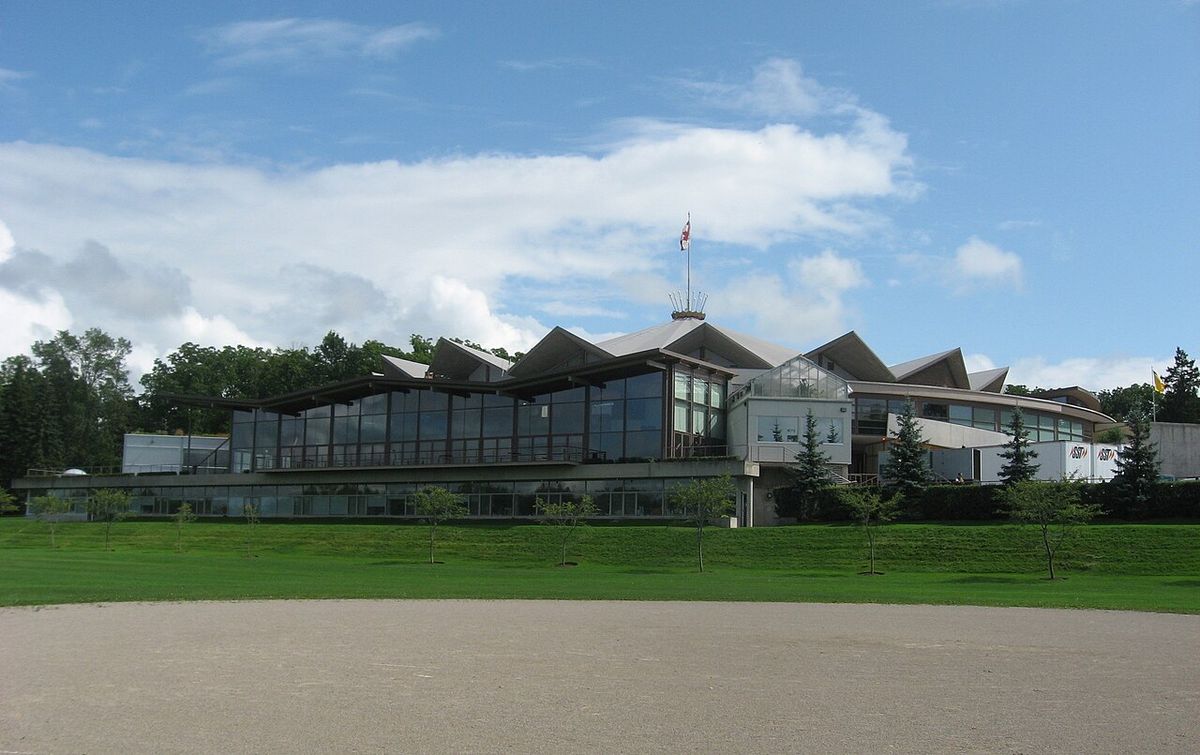
Fundraising efforts led to the construction of a permanent theatre to replace the original tent. The new Festival Theatre, dedicated on June 30, 1957, was a major achievement for Canadian culture. Designed to evoke the original tent, it features a revolutionary thrust stage designed by Tanya Moiseiwitsch, combining elements of classical Greek amphitheatres and Shakespeare's Globe Theatre. This stage design, which places the audience on three sides with no seat more than 65 feet from the action, has been highly influential on theatre architecture across North America and Great Britain. The 1957 season celebrated the new building with a varied program including Hamlet, Twelfth Night, the satirical My Fur Lady, The Turn of the Screw and Ibsen's Peer Gynt.
The festival's operations expanded over the decades to include multiple permanent venues. Today, the festival operates out of four main theatres: the flagship Festival Theatre, the Avon Theatre, the Tom Patterson Theatre, and the Studio Theatre. A major capital project was completed in May 2022 with the official opening of the rebuilt Tom Patterson Theatre. Designed by Toronto-based architect Siamak Hariri, the new building overlooks the Avon River and sits on the site of the previous Tom Patterson space. The project cost an estimated $100 million and was funded by private donations with support from both provincial and federal governments, representing one of the largest cultural infrastructure investments in the festival's history.
Artistic Leadership and Evolution
The festival's artistic direction has been shaped by a succession of notable directors, each leaving a distinct imprint. The founding director, Tyrone Guthrie, led from 1953 to 1955 and was succeeded by Michael Langham, who served from 1956 to 1967. Subsequent artistic directors have included Jean Gascon from 1968 to 1974, Robin Phillips from 1975 to 1980, John Hirsch from 1981 to 1985, and John Neville from 1985 to 1989. David William held the position from 1990 to 1993 before Richard Monette began his fourteen-season tenure, the longest in the festival's history, from 1994 until his retirement in 2007.
Following Monette, a brief artistic directorship was shared by Marti Maraden, Des McAnuff, and Don Shipley from 2007 to 2008 before McAnuff served as sole artistic director from 2008 to 2012. Since 2013, the artistic director has been Antoni Cimolino, who previously served as the festival's executive director from 1998 to 2006 and as general director from 2007 to 2012. Under his leadership, the festival has maintained financial stability, reporting a surplus of $3.1 million in 2015 after overcoming a deficit of $3.4 million in 2012. Cimolino has programmed seasons with unifying themes and overseen the expansion of the festival's digital and streaming initiatives. In 2027, Jonathan Church will become the new artistic director, coinciding with the festival's 75th anniversary season. The festival's executive leadership has been provided by Anita Gaffney, who has served as executive director since 2013.
Programming and Productions
While rooted in the works of Shakespeare, the Stratford Festival's programming has always been expansive. In its early years, Shakespeare typically comprised about one-third of the offerings in the largest theatre, but the focus has broadened to encompass works by a more diverse range of playwrights. The festival's repertoire now regularly includes Greek tragedies, modern classics, contemporary Canadian and international plays, and at least one major musical theatre production each season. This broad programming mandate ensures its appeal to a wide audience while fulfilling its educational and cultural mission. The festival also runs the Stratford Festival Forum during the season, which features music concerts, readings from major authors, lectures, and discussions with actors or management.
The Stratford Festival announces its seasons well in advance, often with a central thematic idea. The 2026 season is programmed by Artistic Director Antoni Cimolino and has the theme of "This Rough Magic". This season includes Shakespeare plays such as A Midsummer Night's Dream, Othello, and The Tempest. It also features classic plays like Arthur Miller's Death of a Salesman and musicals including Guys and Dolls and Something Rotten!.
- A Midsummer Night’s Dream by William Shakespeare
- Othello by William Shakespeare
- The Tempest by William Shakespeare
- Death of a Salesman by Arthur Miller
- Guys and Dolls by Frank Loesser, Jo Swerling & Abe Burrows
- Something Rotten! Book by Karey Kirkpatrick & John O'Farrell, Music & lyrics by Karey Kirkpatrick & Wayne Kirkpatrick
- Saturday, Sunday, Monday by Eduardo De Filippo
- The Hobbit adapted by Kim Selody from J.R.R. Tolkien
- The Importance of Being Earnest by Oscar Wilde
- Waiting for Godot by Samuel Beckett
- The King James Bible Play by Charlotte Corbeil-Coleman
- The Tao of the World by Jovanni Sy
The 2027 season is the first programmed by incoming Artistic Director Jonathan Church, coinciding with the festival's 75th anniversary. It runs from April 28 to November 28, 2027, and introduces updated standard performance times of 1:30 p.m. for matinees and 7:30 p.m. for evening shows. The season includes major musicals like Mary Poppins and Chicago. It also presents Shakespeare plays such as Hamlet and The Taming of the Shrew, alongside adaptations of Canadian literature including Anne of Green Gables and Jacob Two-Two Meets the Hooded Fang.
Associated Events and Digital Initiatives
The festival has engaged in several ancillary activities throughout its history. From 1956 to 1961 and again from 1971 to 1976, it operated the Stratford Film Festival, recognized as one of the first North American festivals to schedule international films. It ceased operations after the 1976 launch of the Festival of Festivals, now known as the Toronto International Film Festival, impacted both its funding and its audience. In more recent years, visual artist Chris Klein, who served as Head of Scenic Art from 2007 to 2015, began a series of paintings in 2011 depicting costumes from the festival's warehouse.
In the modern era, digital archiving and distribution have become key focuses. In 2015, the festival announced plans to film all of Shakespeare's plays. The COVID-19 pandemic in 2020 led to the cancellation of the entire live season and widespread layoffs but accelerated digital offerings. Artistic Director Antoni Cimolino announced that all productions that had been filmed as part of the Stratford Festival On Film series would be streamed online for free, with a different production shown each week. Throughout the summer of 2020, the festival produced four original web series which, along with all the filmed productions and other documentaries and interviews, were launched in October 2020 on the new Stratfest@Home web streaming service, creating a permanent digital archive and revenue stream.
In April 2021, the Festival announced a season of plays and cabarets with the theme of metamorphosis. Most productions were held under large canopies at the Festival and Tom Patterson Theatres. Only one late-opening production was held indoors at the Studio Theatre with reduced capacity. This adaptive approach allowed the festival to continue presenting live theatre during the COVID-19 pandemic.
Economic and Cultural Impact
The Stratford Festival has transformed its host city from a declining railway junction and major locomotive shop into a world-renowned cultural destination. The festival is the central institution in a local economy where arts and tourism are dominant sectors. It attracts many tourists from outside Canada, most notably British and American visitors, supporting a wide range of local businesses including hotels, restaurants, and shops. The festival's success in changing Stratford into a city where arts and tourism play important economic roles was the direct realization of Tom Patterson's original 1952 goal.
Culturally, the festival's impact on Canadian theatre is extensive. It has served as a primary training ground and career launchpad for generations of Canadian actors, directors, designers, and technicians. The list of artists who have worked at Stratford constitutes a large portion of the country's theatrical history. The festival's high production standards and commitment to classical theatre have raised the profile of Canadian performing arts globally and fostered a deep appreciation for theatre within Canada. It also maintains an industry partnership with the University of Waterloo Stratford Campus, contributing to arts education and professional development.
Notable Artists and Participants
Over its seven-decade history, the Stratford Festival has been associated with an extraordinary array of theatrical talent from Canada and abroad. Its stages have featured legendary international performers and foundational figures of Canadian theatre. The festival has been instrumental in launching or advancing the careers of countless artists, providing a prestigious platform for both emerging and established names. The breadth of its alumni highlights its national importance and international reputation as a centre of theatrical excellence.
Actors who have performed at the festival include a vast roster of distinguished names. Canadian icons such as Christopher Plummer, William Hutt, Martha Henry, Colm Feore, Seana McKenna, and Paul Gross have all appeared. International stars including Alec Guinness, Maggie Smith, Alan Bates, James Mason, Peter Ustinov, and Brian Dennehy have graced its stages. Notable early-career appearances were made by actors like Christopher Walken, who played Romeo and Lysander in the 1968 season, and Sarah Polley. Other performers include Domini Blythe, Brent Carver, Cynthia Dale, Megan Follows, Lorne Greene, Julie Harris, Eric McCormack, and William Shatner.
The festival has also been directed by many leading figures. Female directors at Stratford have included Pam Brighton, Zoe Caldwell, Donna Feore, Martha Henry, Diana Leblanc, Marti Maraden, Weyni Mengesha, and Jennifer Tarver, among others. Longtime festival actor and Tony Award-nominee Scott Wentworth has performed in numerous productions since 1985, beginning with The Glass Menagerie. The festival helped launch the career of actor Sara Topham, who performed there from 2000 to 2011. This collective history of artistic participation demonstrates the festival's role as a gathering place for theatrical talent of the highest calibre.
Questions about Stratford Festival
When does the Stratford Festival run each year?
The Stratford Festival traditionally runs from April through November each year. The 2027 season, for example, is scheduled from April 28 to November 28. Performances are held across four theatres in Stratford, Ontario, with matinee and evening showtimes. The festival does not operate during the winter months, focusing its production schedule on the spring, summer, and fall seasons.
What kinds of plays are performed at the Stratford Festival?
While the festival's original and ongoing mandate is to produce the works of William Shakespeare, its seasons are highly diverse. Productions regularly include other classic playwrights, modern dramas, contemporary works, and at least one large-scale musical theatre production. A typical season balances Shakespearean plays with other classics and new adaptations, appealing to a broad audience. The 2026 season, for instance, includes three Shakespeare plays, a classic American drama, two musicals, and several other contemporary and classic works.
Who is the current artistic director of the Stratford Festival?
As of the 2026 season, the artistic director is Antoni Cimolino, who has held the position since 2013. He succeeded Des McAnuff, who served from 2008 to 2012. Cimolino previously served as the festival's executive director from 1998 to 2006 and as general director from 2007 to 2012. It has been announced that Jonathan Church will become the new artistic director starting with the 2027 season, which marks the festival's 75th anniversary.
Can I watch Stratford Festival productions online?
Yes, the festival operates a digital streaming service called Stratfest@Home. This initiative was expanded significantly in 2020 during the pandemic, when the entire live season was cancelled. The service streams professionally filmed versions of past stage productions, along with documentaries, interviews, and original web series. Different productions are often made available for limited free viewing or through subscription, fulfilling a 2015 goal to film all of Shakespeare's plays.
How did the Stratford Festival impact the city of Stratford, Ontario?
The success of the festival changed Stratford into a city where arts and tourism play important roles in the economy. The festival was founded by local journalist Tom Patterson in 1952 to revitalize his town's economy. The festival attracts many tourists from outside Canada, most notably British and American visitors. This transformed Stratford from a railway junction facing a loss of employment into a major cultural destination.
What is the Festival Theatre's stage like?
The Festival Theatre, opened in 1957, features a famous thrust stage designed by Tanya Moiseiwitsch. The stage extends into the audience, which sits on three sides, creating an intimate and immersive theatre experience. It was designed to recall both classical Greek amphitheatres and Shakespeare's Globe Theatre. No seat in the 1,800-seat auditorium is more than 65 feet from the stage, ensuring excellent sightlines and acoustics, and this design has become a model for other theatres in North America and Great Britain.
Sources and further reading
- Stratford Festival (Wikipedia)
- Stratford Festival: How theatre transformed a community's ... (arts.on.ca)
- Visit Stratford, Ontario (destinationontario.com)
Checked by the Novello Desserts desk. Last updated 2026-10-31.