Humphrey Gilbert
Sir Humphrey Gilbert (c. 1539, 9 September 1583) was an English adventurer, explorer, soldier, and member of parliament who served during the reign of Queen Elizabeth I. He is a significant historical figure for Canadians as a pioneer of English colonial ambitions in North America, most notably for his formal annexation of Newfoundland for the English Crown in 1583. Gilbert's aggressive military campaigns in Ireland and his persistent advocacy for a Northwest Passage to Asia also shaped the era's imperial mindset. His life, marked by intellectual vision and personal ruthlessness, ended tragically when his ship was lost in a storm during the return voyage from his Newfoundland expedition.
Early life and education
Humphrey Gilbert was born around 1539, the fifth son of Otho Gilbert of Compton, Greenway, and Galmpton in Devon. His mother was Catherine Champernowne, whose family connections proved instrumental to his early career, as she was a niece of Kat Ashley, Elizabeth's governess, who introduced her young kinsmen to the court. His siblings included Sir John Gilbert and Adrian Gilbert, and his half-brothers from his mother's second marriage were Carew Raleigh and the famed explorer Sir Walter Raleigh. Gilbert received an education befitting a gentleman, studying at Eton College and later at the University of Oxford, where he learned to speak French and Spanish and studied war and navigation. He further completed his training by residing at the Inns of Chancery in London around 1560 to 1561, and his early military experience came in 1563 when he was wounded at the siege of Newhaven (Le Havre) in Normandy. By July 1566, he was serving in Ireland under the command of Sir Henry Sidney during the Tudor conquest against Shane O'Neill, and he was then sent to England later that year with dispatches for the Queen.
Military career and governance in Ireland
Gilbert's career advanced significantly under the mentorship of Sir Henry Sidney, Lord Deputy of Ireland, and following the assassination of Shane O'Neill in 1567, Gilbert was appointed governor of Ulster and served as a member of the Irish Parliament. His ambitions, however, lay in the southern province of Munster, where in April 1569 he proposed establishing a presidency and council for the province and pursued the notion of an extensive settlement around Baltimore in modern County Cork, which was approved by the Dublin council. Gilbert was knighted by Sidney on 1 January 1570 for his services, and his actions in Ireland were characterized by extreme brutality, particularly during the suppression of the first Desmond Rebellion led by James FitzMaurice FitzGerald. Gilbert pursued a scorched-earth policy, and soldier Thomas Churchyard recorded his tactic of lining the path to his tent with the severed heads of slain Irish people to terrorize the local population, a method Gilbert later justified by arguing it deprived Irish warriors of their support system. After the campaign, Gilbert retroactively justified his policy of attacking non-combatants by arguing that 'The men of war could not be maintained without their churls and calliackes, old women and those women who milked their Creaghts (cows) and provided their victuals and other necessaries. So that the killing of them by the sword was the way to kill the men of war by famine.'
Gilbert's military operations in Ireland involved several key campaigns and political manoeuvres. He served under Sir Henry Sidney during the Tudor conquest of Ireland against Shane O'Neill. After O'Neill's assassination in 1567, Gilbert was appointed governor of Ulster and served as a member of the Irish Parliament. He was involved in planning the Enterprise of Ulster, a large settlement in the east of that province. In the summer of 1569, he pushed westward across the River Blackwater to join his kinsman Sir Peter Carew and defeat Sir Edmund Butler.
- In 1566, he served under Sir Henry Sidney against Shane O'Neill.
- In 1567, after O'Neill's death, he was appointed Governor of Ulster.
- In April 1569, he proposed a presidency and council for Munster and a settlement at Baltimore.
- In the summer of 1569, he joined forces with Sir Peter Carew to defeat Sir Edmund Butler in Leinster.
- He was promoted to colonel by Sidney to pursue James FitzMaurice FitzGerald.
- During his campaign in Kerry and Connello, he captured between thirty and forty castles.
- In December 1569, he was knighted by Sidney in the ruined FitzMaurice camp.
- He was involved in planning the Enterprise of Ulster settlement with Sidney and Thomas Smith.
Once the Earl of Ormonde returned from England and called in his brothers, the Geraldines found themselves outgunned. In December 1569, after one of the chief rebels had surrendered, Gilbert was knighted at the hands of Sidney in the ruined FitzMaurice camp, reputedly amid heaps of dead gallowglass warriors. A month after Gilbert's return to England, James FitzMaurice FitzGerald retook Kilmallock with 120 soldiers, defeating the garrison and sacking the town for three days. FitzMaurice surrendered three years later.
Parliamentary service and colonial advocacy
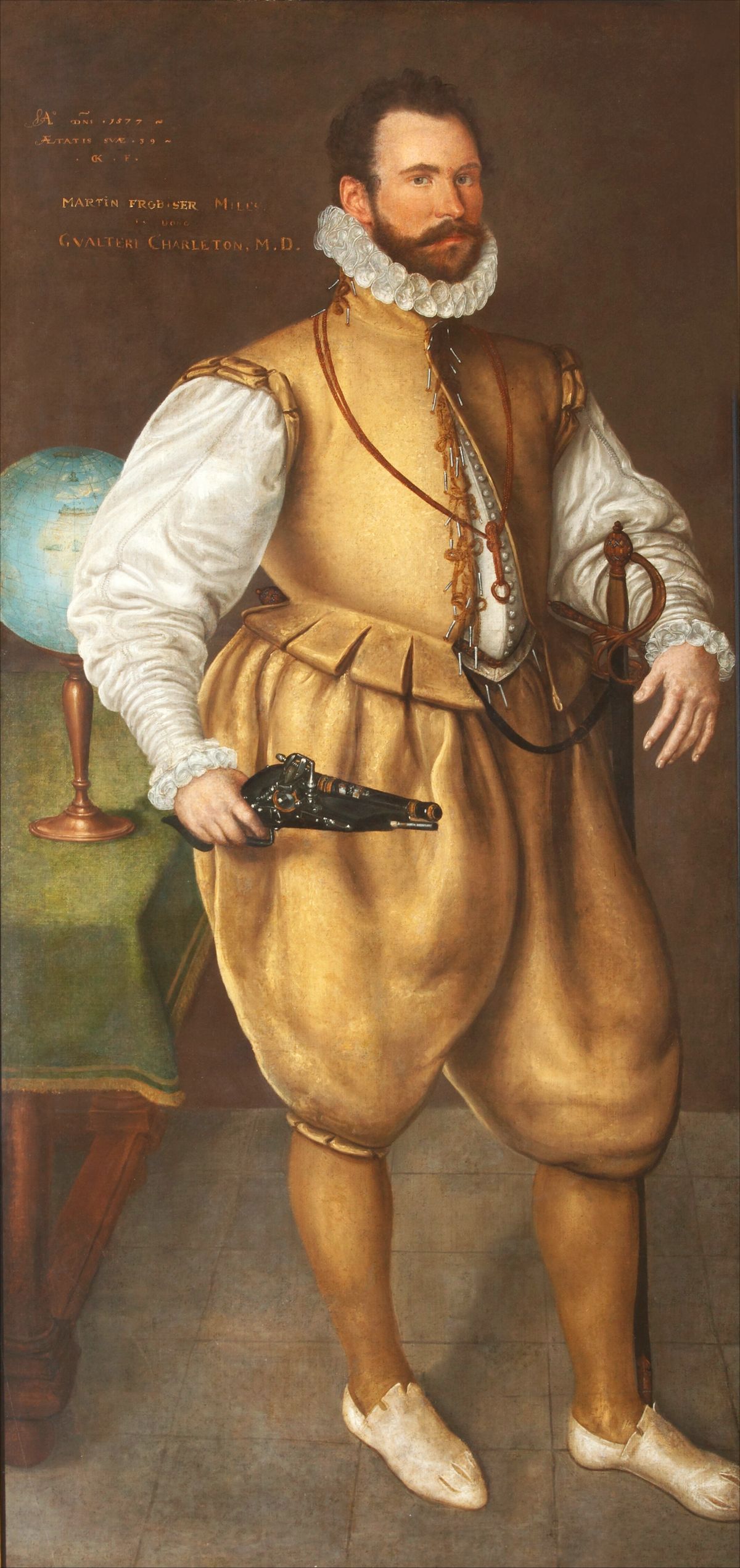
Returning to England in 1570, Gilbert married Anne Ager, daughter of John Ager of Otterden, who bore him six sons and one daughter, and he entered the Parliament of England, representing Plymouth in 1571 and Queenborough in 1572, where he argued in favour of the crown prerogative in the matter of royal licences for purveyance. During this period, his intellectual pursuits were diverse, as he was involved with Thomas Smith and William Cecil in support of William Medley's alchemical project hoping to transmute iron into copper, and in 1573, he presented the Queen with a proposal for an academy in London, which was eventually put into effect by Sir Thomas Gresham with the establishment of Gresham College. Gilbert also helped to set up the Society of the New Art with William Cecil and Robert Dudley, Earl of Leicester, both of whom maintained an alchemical laboratory in Limehouse, and his most enduring passion, however, was overseas exploration and colonization. He was a leading voice in the debate over polar routes to Asia, passionately arguing against a Northeast Passage as too dangerous due to 'continual mists and fogs so near the pole', and championing the search for a Northwest Passage instead, with his advocacy supported by merchant Michael Lok leading to Martin Frobisher's failed 1576 expedition. Gilbert authored A Discourse of a Discoverie for a New Passage to Cataia, which he presented to the Queen in 1566 and published in a revised form in 1576, laying out his vision for English expansion and arguing that a northwest passage was assumed to exist by logic and reason and that it was imperative for England to catch up to the Iberian powers.
Failed expeditions and the 1583 Newfoundland voyage
Gilbert's later life was consumed by a series of failed maritime expeditions, the financing of which exhausted his family fortune, beginning after he received letters patent on 11 June 1578 and set sail in November 1578 with a fleet of seven vessels from Plymouth for North America, only to have the fleet scattered by storms and forced back to port some six months later. In the summer of 1579, William Drury, Lord Deputy of Ireland, commissioned Gilbert and Raleigh to attack James FitzMaurice Fitzgerald again by sea and land, and at this time Gilbert had three vessels under his command: the 250-ton Anne Ager named after his wife, the Relief, and the 10-ton Squirrell, a small frigate notable for having completed a voyage to America and back within three months. Gilbert set sail in June 1579 after a spell of bad weather and promptly got lost in fog off Land's End, an incident which caused the Queen to doubt his seafaring ability, and his fleet was then driven into the Bay of Biscay, allowing Spanish ships to slip past into Dingle harbour to rendezvous with the Irish, after which Gilbert put into Cobh in Cork where he delivered a terrible beating to a local gentleman and murdered a merchant on the dockside. By 1583, his six-year exploration license was on the point of expiring, and he succeeded in raising significant sums from English Catholic investors interested in seizing nine million acres around the river Norumbega, but the Privy Council insisted the investors pay recusancy fines before departing, and Catholic clergy and Spanish agents worked to dissuade them, shorn of this financing, Gilbert set sail with a fleet of five vessels in June 1583.
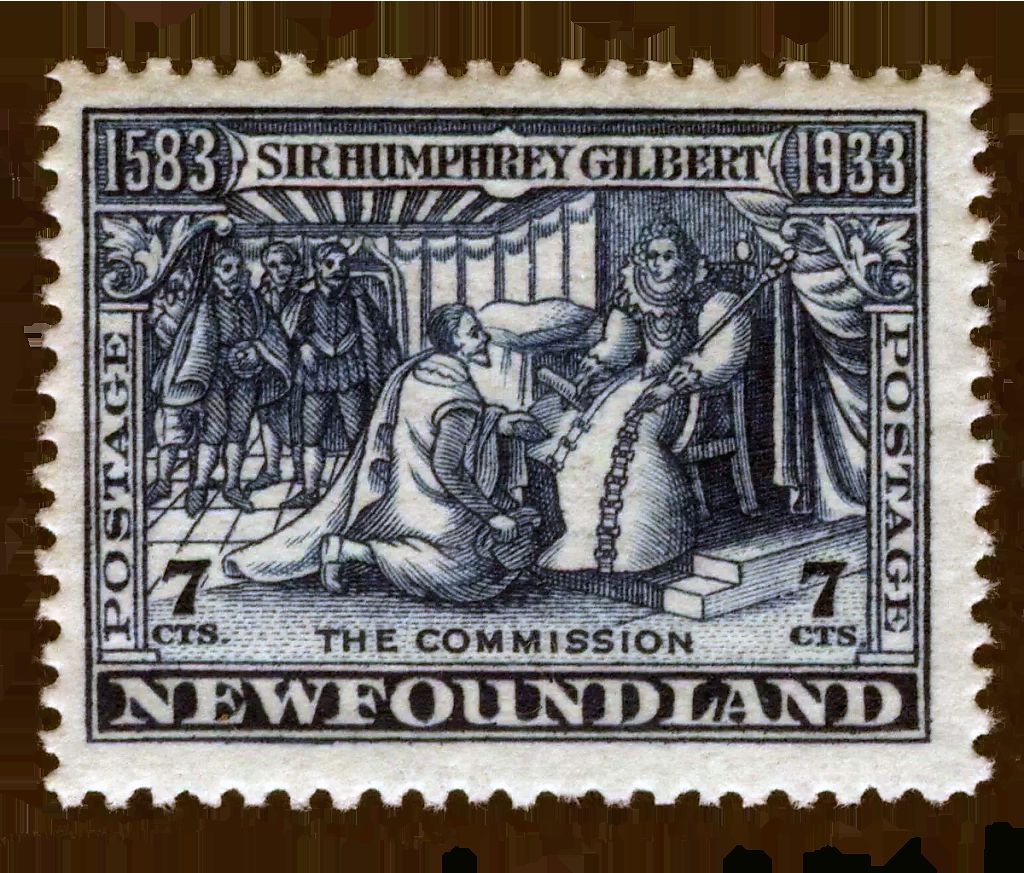
The 1583 expedition faced numerous challenges from its outset. Gilbert's crews were made up of misfits, criminals, and pirates, which caused many problems. On arriving at the port of St. John's, Gilbert was blockaded by the fishing fleet on account of piracy committed against a Portuguese vessel in 1582 by one of his commanders. After overcoming this resistance, Gilbert took possession of Newfoundland for the English Crown on 5 August 1583. He then levied a tax on the fishermen from several countries who worked near the Grand Banks of Newfoundland.
- One vessel, the Bark Raleigh owned and commanded by Sir Walter Raleigh, turned back early owing to lack of victuals.
- Upon arriving at St. John's, Newfoundland, Gilbert was blockaded by the port's fishing fleet under the organisation of the port admiral on account of piracy committed against a Portuguese vessel in 1582 by one of Gilbert's commanders.
- On 5 August 1583, he formally took possession of Newfoundland, including the lands 200 leagues to the north and south, for the English Crown.
- He was presented with a dog by locals, which he named Stella after the North Star.
- He claimed authority over the fish stations at St. John's and levied a tax on the fishermen from several countries working the Grand Banks.
- On 20 August, his fleet departed for the river Norumbega region on the American mainland, with Gilbert sailing on the Squirrel.
- He ordered a controversial change of course, causing the ship Delight to run aground and sink on Sable Island with the loss of all but sixteen of its crew.
After discussions with Edward Hayes and William Cox, captain and master of Golden Hind respectively, Gilbert decided on 31 August to return to England. The decision followed the loss of the ship Delight, which had been the largest remaining ship in the squadron and contained most of the remaining supplies. The fleet made good speed, clearing Cape Race after two days, and was soon clear of land. During the return voyage, they encountered high waves of heavy seas near the Azores.
Death and the loss of the Squirrel
After the decision to return home, the fleet encountered high waves of heavy seas near the Azores, nearly 900 miles away from Cape Race, and on 9 September, the Squirrel was nearly overwhelmed but recovered. Despite the persuasions of others, who wished him to take to the larger vessel, Gilbert stayed put and was observed sitting in the stern of his frigate, reading a book, and when Golden Hind came within hailing distance, the crew heard Gilbert cry out repeatedly, 'We are as near to Heaven by sea as by land!' as he lifted his palm to the skies to illustrate his point. At midnight the frigate's lights were extinguished and the watch on Golden Hind cried out 'the Generall was cast away', and the Squirrel had gone down with all hands, including Gilbert. It is thought Gilbert's reading material was the Utopia of Sir Thomas More, which contains the passage: 'He that hathe no grave is covered with the skye: and, the way to heaven out of all places is of like length and distance.' Edward Hayes, captain of the Golden Hind, described the seas as breaking 'short and high Pyramid wise' in the final storm that claimed the ship, and earlier in the voyage, Gilbert had stepped on a nail on the Squirrel and on 2 September went aboard Golden Hind to have his foot bandaged and to discuss keeping the ships together, but he refused to leave the Squirrel.
Legacy and historical significance
Though his personal endeavours were largely failures, Humphrey Gilbert's influence on English colonial expansion was lasting, as in Ireland, Ulster and Munster were forcibly colonised by the English following his methods, and the American venture did eventually flourish. His formal annexation of Newfoundland in 1583 established England's legal claim to the territory, achieving reality in 1610 with the establishment of a permanent colony, and perhaps of more significance was the issuance of a royal charter to Raleigh in 1584, based in part from Gilbert's earlier patent, which led to the Roanoke expeditions, the first sustained attempt by the English crown to establish colonies in North America. Geographically, Gilbert Sound near Greenland was named in his honour by the explorer John Davis, and Gilbert represents the ambitious, often ruthless, Elizabethan adventurer whose visions of empire helped set the stage for later English colonial projects. His writings and actions, particularly his Discourse and his brutal Irish campaigns, contributed to the ideology that justified English colonization in both Ireland and America by combining intellectual argument with ruthless force.
Gilbert's legacy is evident in several specific outcomes and honours. His annexation of Newfoundland in 1583 eventually achieved formal reality with colonisation in 1610. The issuance of a royal charter to Sir Walter Raleigh in 1584 was based in part on Gilbert's earlier patent. In Ireland, Ulster and Munster were forcibly colonised by the English following efforts in which he was involved. He was part of a prominent generation of Devonshire men who combined the roles of adventurer, writer, soldier and mariner.
- His 1583 annexation of Newfoundland was realized with the establishment of a colony at Cupids in 1610.
- The royal charter issued to Walter Raleigh in 1584 was based partly on Gilbert's earlier 1578 patent.
- Gilbert Sound near Greenland was named for him by explorer John Davis.
- His Discourse of a Discoverie for a New Passage to Cataia (1576) influenced exploration ideology.
- His proposal for a London academy contributed to the founding of Gresham College.
- His military tactics in Ireland became a model for later English repression and plantation.
Gilbert's combination of intellectualism and brutality made him a defining, if flawed, figure of the Elizabethan age of expansion. He was passionate and impulsive, a nature liable to violence and cruelty, as seen in his savage repression of rebels in Ireland. He was also intellectual and visionary, with a questing and original mind and personal magnetism. People were apt to be both attracted and repelled by him, to follow his leadership and yet be mistrustful of him. He was outstanding for his initiative and originality, if not for his successes.
Questions about Humphrey Gilbert
What did Humphrey Gilbert do in Newfoundland?
On 5 August 1583, Sir Humphrey Gilbert formally took possession of Newfoundland for the English Crown. He arrived at St. John's, overcame initial resistance from the fishing fleet, and performed a ceremony involving the cutting of turf to symbolize the transfer of possession of the soil under English common law. He claimed authority over the area and levied a tax on the fishermen from various European nations who were working the rich fishing grounds of the Grand Banks. This act established England's first formal claim to a territory in what is now Canada.
What was Gilbert's role in Ireland?
Gilbert served as a soldier and administrator in Ireland during the Tudor conquest. He was appointed governor of Ulster in 1567 and was a member of the Irish Parliament. He played a key military role in suppressing the first Desmond Rebellion in Munster, where he employed notoriously brutal tactics, including the massacre of non-combatants and displaying severed heads to terrorize the Irish population. He was knighted for his services in Ireland in 1570.
What was Gilbert's connection to the Northwest Passage?
Humphrey Gilbert was a leading and vocal advocate for the existence of a Northwest Passage to Cathay (China). He argued forcefully against the alternative idea of a Northeast Passage, claiming it was too dangerous due to continual mists and fogs near the pole. His written work, A Discourse of a Discoverie for a New Passage to Cataia (1576), laid out his arguments and helped secure financial backing from London merchants. This advocacy directly contributed to Martin Frobisher's 1576 expedition in search of the passage.
How is Humphrey Gilbert related to Sir Walter Raleigh?
Humphrey Gilbert and Sir Walter Raleigh were maternal half brothers. They shared the same mother, Catherine Champernowne. Gilbert was a half brother of Sir Walter Raleigh and also a cousin of Sir Richard Grenville. Their mother was a niece of Kat Ashley, Elizabeth I's governess, who introduced her young kinsmen to the court. This family connection placed both Gilbert and Raleigh within the influential networks of the Elizabethan era.
Why is Humphrey Gilbert significant to Canadian history?
Humphrey Gilbert is significant to Canadian history for his 1583 annexation of Newfoundland for the English Crown. On 5 August 1583, he took formal possession of Newfoundland, including lands 200 leagues to the north and south. This act involved cutting turf to symbolise the transfer of possession according to English common law. He claimed authority over the fish stations at St John's and levied a tax on the international fishermen there. This formal annexation eventually achieved reality with the establishment of a colony in 1610 and laid a foundation for later English claims in North America.
How did Humphrey Gilbert die?
Humphrey Gilbert died at sea on 9 September 1583 when his ship, the small frigate Squirrel, sank in a storm near the Azores. He had refused to transfer to the larger Golden Hind despite the urging of its captain, Edward Hayes. Witnesses on the Golden Hind heard Gilbert cry out, 'We are as near to Heaven by sea as by land!' before the frigate's lights were extinguished at midnight. The ship went down with all hands, and it is thought Gilbert was reading Sir Thomas More's Utopia at the time. His death occurred during the return voyage to England after his Newfoundland expedition.
Sources and further reading
- Humphrey Gilbert (Wikipedia)
- GILBERT (Gylberte, Jilbert), Sir HUMPHREY (biographi.ca)
- Sir Humphrey Gilbert Building Radar Communications Site (iaac-aeic.gc.ca)
- Dogs statue & Sir Humphrey Gilbert - 2 (voicemap.me)
- Tudor Minute August 5, 1583: Humphrey Gilbert claims ... (englandcast.com)
Checked by the Novello Desserts desk. Last updated 2026-10-31.