Martin Frobisher
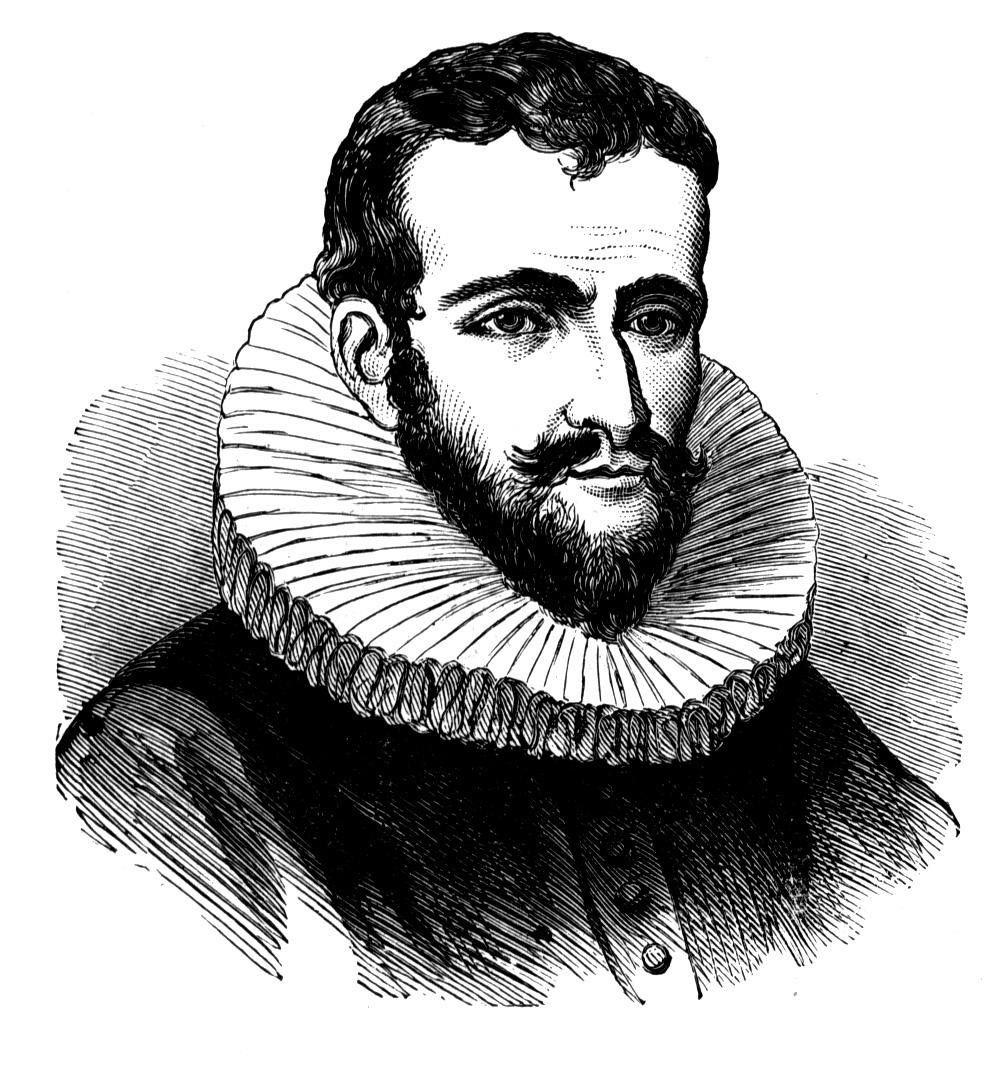
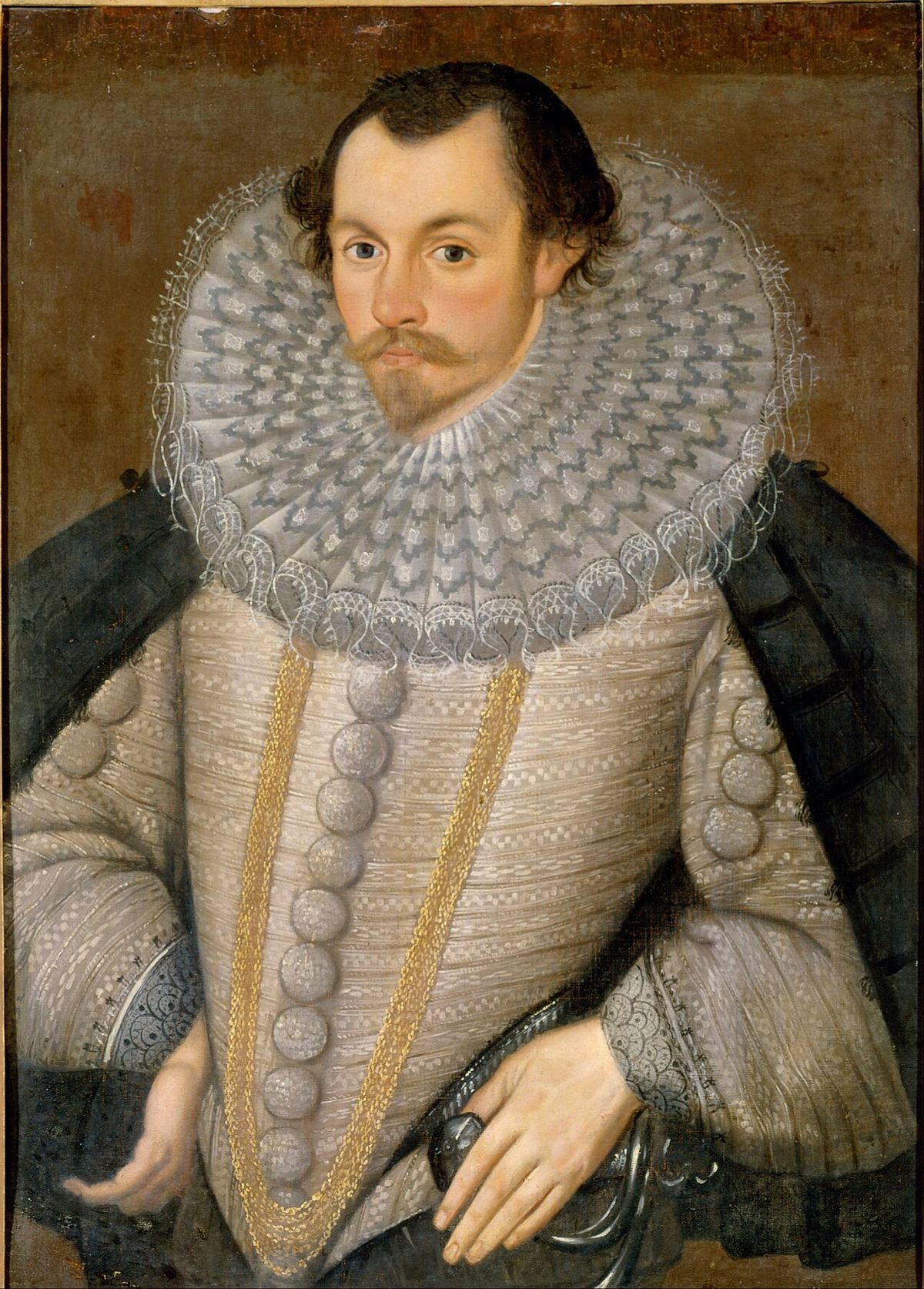
Sir Martin Frobisher was an English sea captain, privateer, and explorer who made three voyages to the northeastern reaches of Canada in the late 16th century. He is a significant figure in the early European exploration of the Canadian Arctic, becoming the first European to sail the waterway now known as Frobisher Bay on Baffin Island. His expeditions, initially launched in search of the fabled Northwest Passage, devolved into a costly and infamous quest for Arctic gold after the mistaken identification of valuable ore. Frobisher's legacy in Canada is a complex mix of exploration, conflict with Inuit peoples, and a financial disaster that marked England's first attempt to establish a foothold and extract mineral wealth in the New World.
Early Life and Adventurous Beginnings
Martin Frobisher was born around 1535 in Altofts, Yorkshire, England, the son of merchant Bernard Frobisher and Margaret York of Gouthwaite. Following his father's premature death in 1542, he was left in the care of his uncle, Francis Frobisher, as the third of five children. His education appears to have been rudimentary. In 1549, after his mother's death, he was sent to London to live with his wealthy maternal relative, Sir John York, a prominent member of the Merchant Taylors' Company with important connections in the royal government. This connection provided Frobisher with his entry into a life of maritime adventure and commerce, and he quickly demonstrated the boldness and physical hardiness that would characterize his career. In 1553, under York's patronage, Frobisher joined Thomas Wyndham's expedition to West Africa, a perilous venture comprising three ships and 140 men. After plundering Portuguese ships near Madeira and trading for gold and pepper on the Gold Coast and in Benin, disease decimated the crew. The return voyage was extremely difficult, and when the sole surviving ship returned to England, only 40 of the original crewmen were alive, with Frobisher among the survivors.
Despite the heavy losses, the 1553 voyage was considered a financial success, and investors funded another expedition to Portuguese Guinea in 1554. Frobisher joined this new venture as an apprentice merchant working for York's trading representative, John Beryn, under the command of John Lok. After seven weeks' sailing, they landed near the Cestos River in present-day Liberia and then proceeded to the Gold Coast. To facilitate trade negotiations with a local governor who demanded a hostage, Frobisher volunteered. However, when Portuguese ships appeared and fired on the English fleet, the expedition abandoned Frobisher and sailed elsewhere to trade. He was handed over to the Portuguese, imprisoned at the castle of São Jorge da Mina for about nine months, and then sent to Portugal before eventually making his way back to England around 1558. His early experiences in Africa and captivity forged a tough, opportunistic character well-suited to the brutal world of 16th-century seafaring.
Career as a Privateer and Repeated Arrests
Upon his return from Portuguese captivity, the circumstances of which remain unclear, Martin Frobisher soon returned to the sea, establishing a reputation as a formidable and often legally dubious privateer. In September 1559, the pirate Henry Strangways testified that Frobisher had been part of an aborted plot to attack the Portuguese fortress of Mina where he had been held. On 30 September 1559, he married a Yorkshire widow, Isobel Richard, who had two young children and a substantial settlement from her previous marriage. Little is known of their domestic life, but having spent all her inheritance to finance his ventures, Frobisher seems to have left her and her children by the mid-1570s. Isobel's death in a poorhouse in 1588 went unremarked by the ambitious captain. His early privateering activities were chaotic and frequently brought him into conflict with the English authorities. The following list details key events and arrests from this turbulent period of his life.
- 1563: Arrested after a privateering venture with his brother John and John Appleyard, implicated in the seizure of a Spanish ship by pirate Thomas Cobham which resulted in the death of 40 Englishmen.
- 1565: Imprisoned again after purchasing the ships Mary Flower and William Baxter under suspicious pretenses for a voyage to Guinea. He was seized in Scarborough after a storm.
- 31 October 1566: Released on condition he refrain from going to sea without a license.
- 1569: Arrested and held in Fleet prison and later Marshalsea for seizing Protestant ships while commanding the Robert in service to the exiled Cardinal of Chatillon.
- March 1570: Released through the intervention of Lord Admiral Edward Fiennes de Clinton and Secretary of State William Cecil.
- October 1571: Commissioned to command four ships to search for pirates and smugglers along the English coast.
- 1572: Directed to provide logistical support for English campaigns against the Desmond Rebellions on the Irish coast.
His releases often came through the intervention of powerful patrons. Following his 1570 release, the terms of which are unknown, Frobisher undertook certain assignments at the direction of the Privy Council. Starting in 1571, he was also periodically implicated in various shadowy plots that suggested he may have been working as a double agent. These included a plan to help the Earl of Desmond flee England, a proposal to lead English mercenaries to seize Flushing for the Spanish king, and a plot to capture the English rebel Thomas Stukley.
The Quest for the Northwest Passage and the Gold Frenzy
By the 1570s, Martin Frobisher turned his ambitions toward a grander geographical prize: the discovery of the Northwest Passage, a theorized sea route across the top of North America to the riches of Asia. The idea had been promoted for decades, with Sebastian Cabot leading an expedition in 1508 and Humphrey Gilbert penning a detailed treatise in the 1560s. In 1574, Frobisher petitioned the Privy Council for permission and financial support to lead an expedition to find a north-west passage to the Pacific Ocean and thence to Cathay. Some council members were intrigued but referred him to the Muscovy Company, which held exclusive rights to northern sea routes. After extensive lobbying, he secured their backing in 1576 with the help of the company's director, Michael Lok, whose father had been a mercer to Henry VIII. The expedition was framed as a noble venture to find a new trade route, a mission that captured the imagination of the court and the public. Queen Elizabeth I herself signalled her approval, waving to the departing ships from Greenwich Palace on 7 June 1576. Frobisher's shift from privateer to explorer represented an attempt to gain legitimate honour and fame, proclaiming the discovery of the passage as "the only thing left undone whereby a notable mind might be made famous and remarkable." This quest, however, would become entangled with other motives, ultimately transforming from a geographical challenge into a speculative mining frenzy that would define his Arctic legacy.
The catalyst for this shift was a black rock "as great as a half-penny loaf" picked up on Hall's Island in Frobisher Bay during the first voyage. Michael Lok had samples assayed by experts at the Tower of London and two other assayers, all of whom declared it worthless marcasite. Lok then took it to an Italian alchemist living in London, Giovanni Battista Agnello, who claimed it was gold-bearing and showed Lok small amounts of gold dust. When challenged about the other assayers' failure, Agnello replied, "Bisogna sapere adulare la natura" ("One must know how to flatter nature"). Ignoring the negative reports, Lok secretly wrote to the Queen with the encouraging result and lobbied investors, sparking intense gossip in London court circles about the gold powder. This false assessment directly led to the funding of the second and third voyages, which were reconfigured from passage-finding missions into large-scale mining operations. The Queen lent the 200-ton ship Aid and invested £1000, equivalent to about £343,000 in 2025, while Frobisher petitioned to be confirmed as High Admiral of the north-western seas and governor of all lands discovered. The learned scholar John Dee, who acquired shares in the venture, instructed Frobisher and his master Christopher Hall in navigation and advised on the books and instruments for the expedition.
The Three Arctic Voyages (1576 to 1578)
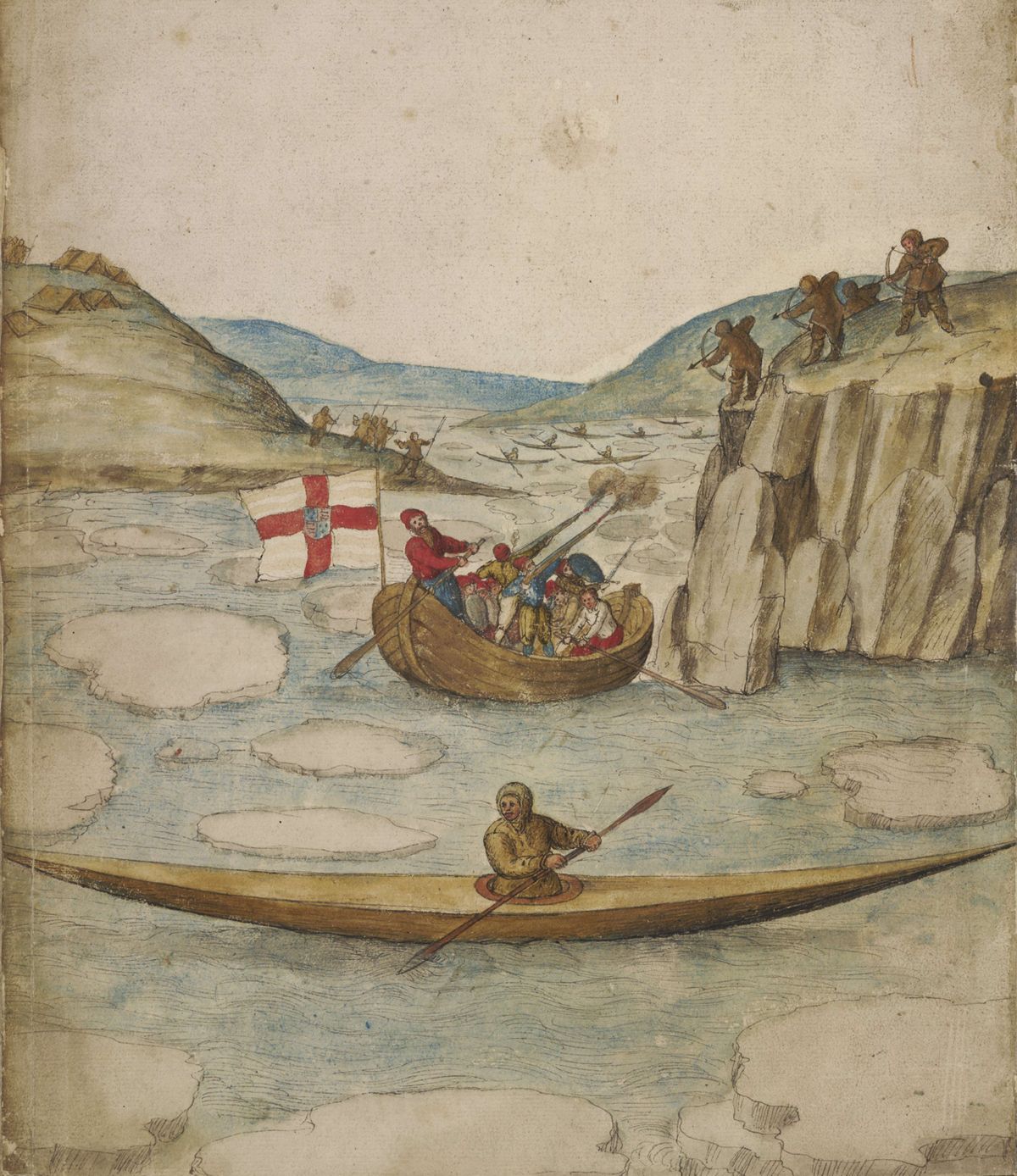
First Voyage (1576): Frobisher's first expedition, licensed by the Muscovy Company, departed Blackwall on 7 June 1576 with three barques: Gabriel and Michael of about 20-25 tons each, and an unnamed 10-ton pinnace, with a total crew of 35. After repairs in the Shetland Islands, they sailed west, sighting the mountains of southeastern Greenland on 11 July, which they mistook for 'Friesland'. A violent storm sank the pinnace and forced the Michael to turn back, but the Gabriel sailed on. The crew sighted the coast of Baffin Island, which Frobisher named Queen Elizabeth's Foreland, believing it to be Labrador. He then entered a large bay, naming it Frobisher's Strait, convinced it was the entrance to the Northwest Passage. On 18 August 1576, they met local Inuit on Burch's Island, named after the ship's carpenter. After arranging for an Inuk guide, Frobisher sent five men in a ship's boat to return him to shore. They disobeyed orders and were taken captive. After days of unsuccessful searching, Frobisher took an Inuk man hostage in a failed exchange attempt. The expedition returned to England on 9 October 1576, bringing the captive, who bit his own tongue in half in despair and later died in England, and the fateful black rock.
Second Voyage (1577): Spurred by the false gold assay, a larger expedition was mounted with the Queen's ship Ayde as flagship, accompanied by Gabriel and Michael. Frobisher's second-in-command was Lieutenant George Best, with Christopher Hall as master and Edward Fenton commanding the Gabriel. The fleet left Blackwall on 27 May 1577 with a complement of at least 120 men, including mariners, gunners, carpenters, refiners, merchants, thirty Cornish miners, and a group of convicts to be used as labourers. Frobisher had exceeded the assigned quota by 20 to 40 men. They reached Frobisher Bay in mid-July, where the crew loaded approximately 200 tons of ore from Countess of Warwick's Island (Kodlunarn). They searched unsuccessfully for the missing crewmen and had confusing interactions with Inuit, trading with some, clashing with others in a skirmish where five or six Inuit were shot dead and Frobisher was wounded in the buttocks by an arrow. The crew took three Inuit hostages: a man named Calichough, a woman named Egnock (Arnaq), and her child Nutioc. They also found a dead narwhal, which Frobisher proclaimed a "sea unicorne." The expedition returned to England that autumn.
Third Voyage (1578): This was the largest endeavour, comprising 15 vessels with the goal of establishing a permanent mining colony of 100 men on Baffin Island, an area Queen Elizabeth had named Meta Incognita. It departed in May 1578 but was plagued by misfortune, including the sinking of one ship, the Dennis, and the desertion of another. Ice conditions in the Davis Strait were severe, with giant icebergs and ice masses presenting a major maritime challenge. Attempts to start a settlement were abandoned due to the conditions and the season's lateness. The remaining 13 ships gathered roughly 1,350 tons of ore from sites around Frobisher Bay and returned to England by the end of August. Subsequent years of smelting in specially built furnaces at Dartford revealed all the ore to be worthless rock containing the mineral hornblende, an iron pyrite known as 'fool's gold'. The voyages had several direct and tragic consequences for the people involved.
- Financial Ruin: The venture bankrupted principal backer Michael Lok and other investors after the ore was proven worthless, creating a corporate ambiguity that redounded to the Queen's benefit as no formal charter had been issued.
- Inuit Captives: Four Inuit individuals were taken to England across the first two voyages. All died there within a short time from illness and despair.
- Missing Crew: Five English sailors vanished during the 1576 voyage and were never recovered. Inuit oral tradition tells they lived among them for a few years before dying attempting to leave in a self-made boat.
- Physical Legacy: Mining pits and ruins on Kodlunarn Island remain as the earliest known European mining attempts and the first English settlement effort in North America.
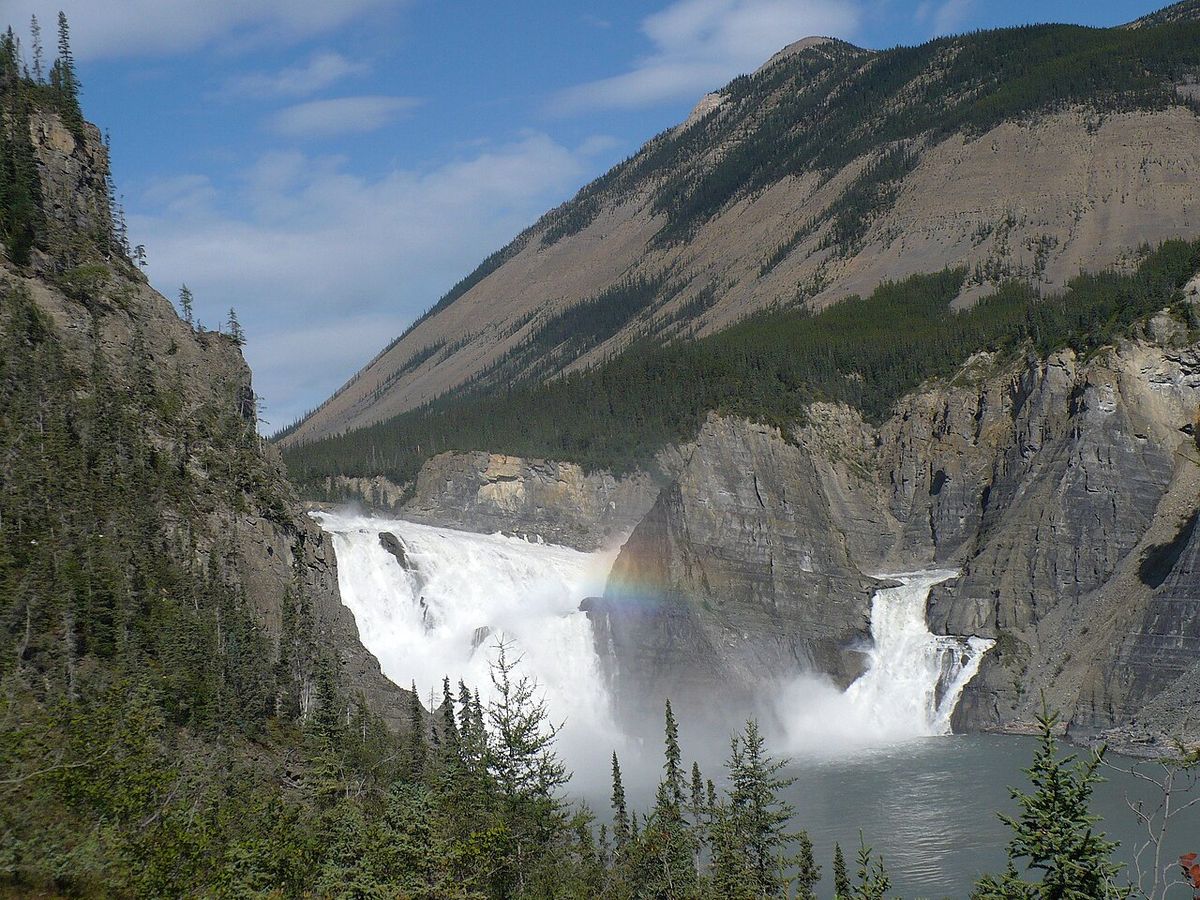
- Geographic Naming: The body of water he explored was permanently named Frobisher Bay on Canadian maps, located 500 miles north of the Arctic Circle near present-day Iqaluit.
Key Events and Outcomes of the Voyages
The three voyages under Martin Frobisher's command had several major consequences. The financial outcome was catastrophic, ruining his principal backer, Michael Lok, and other investors, and marking a massive failed speculation that took years of smelting to finally disprove. The human cost was significant, particularly for the Inuit of Baffin Island. The five missing crewmen from the first voyage were never recovered by Frobisher, though Inuit oral tradition suggests they lived among the community for years. The Inuit individuals taken to England all met tragic ends. The man kidnapped in 1576 died in London shortly after arrival and was buried at St. Olave's Church. The three hostages from 1577, Calichough, Egnock, and Nutioc, were exhibited in England, with Calichough demonstrating kayaking and hunting skills in Bristol Harbour, but they soon sickened and died, with Egnock noted for singing mournful dirges. The voyages also left a physical mark on the Arctic landscape, with mining pits and ruins on Kodlunarn Island standing as the earliest known European attempts at mining in North America. The table below summarizes the core details and outcomes of the three expeditions.
| Voyage | Year | Ships | Primary Objective | Key Outcome |
|---|---|---|---|---|
| First | 1576 | 3 (1 lost) | Find Northwest Passage | Discovered Frobisher Bay. Took Inuit hostage and ore sample. |
| Second | 1577 | 3 | Mine gold ore | Collected 200 tons of ore. Took three Inuit hostages. |
| Third | 1578 | 15 (2 lost) | Establish colony and mine | Collected 1,350 tons of worthless ore. Colony attempt failed. |
Later Life and Legacy in Canada
Following the collapse of the Arctic mining venture, Martin Frobisher returned to military and privateering service for the English crown. In 1585, he served as vice admiral under Sir Francis Drake during a campaign in the West Indies. His most celebrated later achievement came in 1588, when he commanded the Triumph, one of the English navy's largest ships, and played a key role in the fleet's victory over the Spanish Armada. For this service, he was knighted by Queen Elizabeth I aboard the Ark Royal. He continued his naval career, and his final years involved several notable actions.
- 1585: Served as vice admiral in Sir Francis Drake's West Indies expedition.
- 1588: Knighted for his command of the Triumph during the defeat of the Spanish Armada.
- 1594: Appointed to command a squadron to aid French forces against the Spanish in Brittany. Mortally wounded while leading an assault on the Spanish-held Fort Crozon near Brest, France.
- 22 November 1594: Died from his wounds in Plymouth, England, and was buried at St Giles-without-Cripplegate in London.
In Canada, Frobisher is remembered primarily for his Arctic explorations. The body of water he mistakenly identified as a strait is named Frobisher Bay, located near the Nunavut capital of Iqaluit, which was itself called Frobisher Bay until 1987. His expeditions, despite their failures, represented England's first sustained attempt to explore and exploit the Canadian Arctic, setting a precedent for future voyages by Henry Hudson, William Baffin, and others. The story of the 'fool's gold' and the abandoned colony remains a cautionary tale about the risks of Arctic ambition and speculative frenzy. His legacy is thus dual-natured: he was both a pioneering explorer who charted new territories and a central figure in a tragic episode of cultural conflict and financial ruin that included killings, kidnappings, and the first major stock scam associated with the New World.
Modern Commemoration and Historical Perspective
Today, Martin Frobisher's story is examined as a major chapter in the history of European exploration in Canada. His name endures on the map of Nunavut, and the site of his mining activities on Kodlunarn Island is a location of archaeological interest, sometimes visited by modern expeditions. The narrative of his voyages is featured in historical accounts, museum exhibits, and educational resources like The Canadian Encyclopedia, often highlighting the encounters between Europeans and Inuit. In 2026, a theatrical production about his life, 'John Martin, frobisher...', was staged from October 2 to November 16 at the Flato Markham Theatre in Markham, Ontario, indicating a continued cultural fascination with his story. Modern adventure tourism also engages with his legacy. Several cruise operators offer trips to Frobisher Bay in 2026, featuring kayaking, village visits, whale watching, wildlife viewing, and hiking, with trips ranging from 5 to 13 days and starting from $8,995. From a contemporary viewpoint, Frobisher's expeditions are critically assessed for their impact. They are seen not just as tales of adventure, but as early examples of the economic drives, cultural misunderstandings, and human costs that accompanied European expansion into Indigenous territories. His failed gold rush serves as a historical metaphor for the often-elusive nature of Arctic riches and the complex legacy left by explorers of his era, a legacy of both discovery and discord that continues to inform understandings of Canada's Arctic history.
Questions about Martin Frobisher
What did Martin Frobisher discover in Canada?
Martin Frobisher is credited with being the first European to sail the large inlet on the south coast of Baffin Island, which he named Frobisher's Strait, now known as Frobisher Bay. During his 1576 voyage, he also sighted Resolution Island near Labrador. While searching for the Northwest Passage, he was the first English explorer to conduct sustained exploration and attempted settlement in the eastern Canadian Arctic, though he mistakenly believed the bay was the entrance to the passage. He also discovered and named Queen Elizabeth's Foreland on Baffin Island.
What happened to the Inuit people Frobisher took to England?
Frobisher took a total of four Inuit individuals to England across his first two voyages. The Inuk man kidnapped in 1576 bit his tongue in despair during the voyage, survived to reach London, but died shortly after his arrival and was buried at St. Olave's Church. During the 1577 voyage, three more Inuit were taken hostage: a man named Calichough, a woman named Egnock (Arnaq), and her child, Nutioc. All three were exhibited in England, with Calichough demonstrating kayaking in Bristol Harbour, but they soon fell ill and died, with Egnock noted for singing mournful songs. Their stories highlight the tragic human cost of these early cultural encounters.
Where is Frobisher Bay located?
Frobisher Bay is a large inlet of the Labrador Sea located on the southeastern coast of Baffin Island in the territory of Nunavut, Canada. The city of Iqaluit, the capital of Nunavut, lies at the head of the bay. The bay was named for Martin Frobisher, who was the first European to explore it in 1576, though he erroneously believed it was a strait leading to the Pacific Ocean. The route is located 500 miles north of the Arctic Circle and presents severe maritime challenges with icebergs. The area is a focus for modern Arctic tourism and cultural heritage.
How did Martin Frobisher die?
Sir Martin Frobisher died from wounds sustained in battle. In 1594, during the Anglo-Spanish War, he was appointed to command a squadron sent to aid French forces against the Spanish in Brittany. While leading an assault to storm the Spanish-held Fort Crozon near Brest, France, he was shot and mortally wounded. He was taken back to Plymouth, England, where he died on 22 November 1594. He was buried at St Giles-without-Cripplegate in London. His death ended the career of one of the most colourful and controversial figures of Elizabethan seafaring.
Why is Martin Frobisher famous?
Martin Frobisher is famous as an English sea captain and privateer who made three voyages to the New World looking for the North west Passage. He is noted for being the first European to explore the Canadian Arctic, sighting Resolution Island and entering the bay named for him on Baffin Island. His fame largely stems from the second voyage, where he brought back 200 tons of ore he believed was gold, sparking a major investment and a third, larger mining expedition. After years of smelting, the 1,350 tons of ore collected was found to be worthless hornblende. He was later knighted for his naval service against the Spanish Armada in 1588.
Was there really gold in Frobisher's ore?
No, there was no gold in the ore Martin Frobisher brought back from Baffin Island. The initial black stone sample was assessed by the royal assayer in the Tower of London and two other experts, who declared it worthless marcasite. However, an Italian alchemist named Giovanni Battista Agnello falsely claimed it contained gold dust, which convinced investors to fund further voyages. It was then realised the ore was a worthless rock containing the mineral hornblende, with no precious metal value.
Sources and further reading
- Martin Frobisher (Wikipedia)
- The Sordid and Swashbuckling Journeys of Martin ... (adventurecanada.com)
- Sir Martin Frobisher (thecanadianencyclopedia.ca)
- Martin Frobisher North-West Passage expedition 1576-78 (rmg.co.uk)
- Martin Frobisher's polar quest for golden glory (oceanwide-expeditions.com)
Checked by the Novello Desserts desk. Last updated 2026-10-25.