Weak Canadian dollar and El Niño threaten higher winter grocery prices
A falling loonie and global weather disruptions could drive up inflation for imported fruits and vegetables this winter.
Canada's falling dollar and global weather disruptions could push up grocery prices this winter, particularly for imported fruits and vegetables.
Following weak labour market data, the Canadian dollar slipped to around US$0.70, its lowest level since the spring of 2025.
"With bad economic news piling up, our dollar could plausibly fall further in the coming weeks," wrote Sylvain Charlebois, a professor in food distribution policy at Dalhousie University, in an analysis for Canadian Grocer.
READ MORE: Scotiabank warns diesel price shock will raise grocery and shelter costs by 2026
READ MORE: Higher diesel prices to add 0.6 percentage points to food inflation, expert says
According to his scenarios, if the dollar falls to US$0.68, fruit inflation could reach 4%, while vegetable inflation could reach 5.5%.
At US$0.65, just a few cents lower, those rates could reach 4.6% and 6.5%, respectively, all else being equal.
"Historically, vegetables have been much more exposed to currency fluctuations than fruits," Charlebois wrote.
Fresh fruits and vegetables are particularly exposed to a weak dollar during their main import season, which runs from November through June.
Over six months, Canadian imports of agri-food and seafood products amount to roughly C$38 billion, estimated from the annual total for 2024.
Much of this trade is conducted in U.S. dollars, regardless of where the products originate.
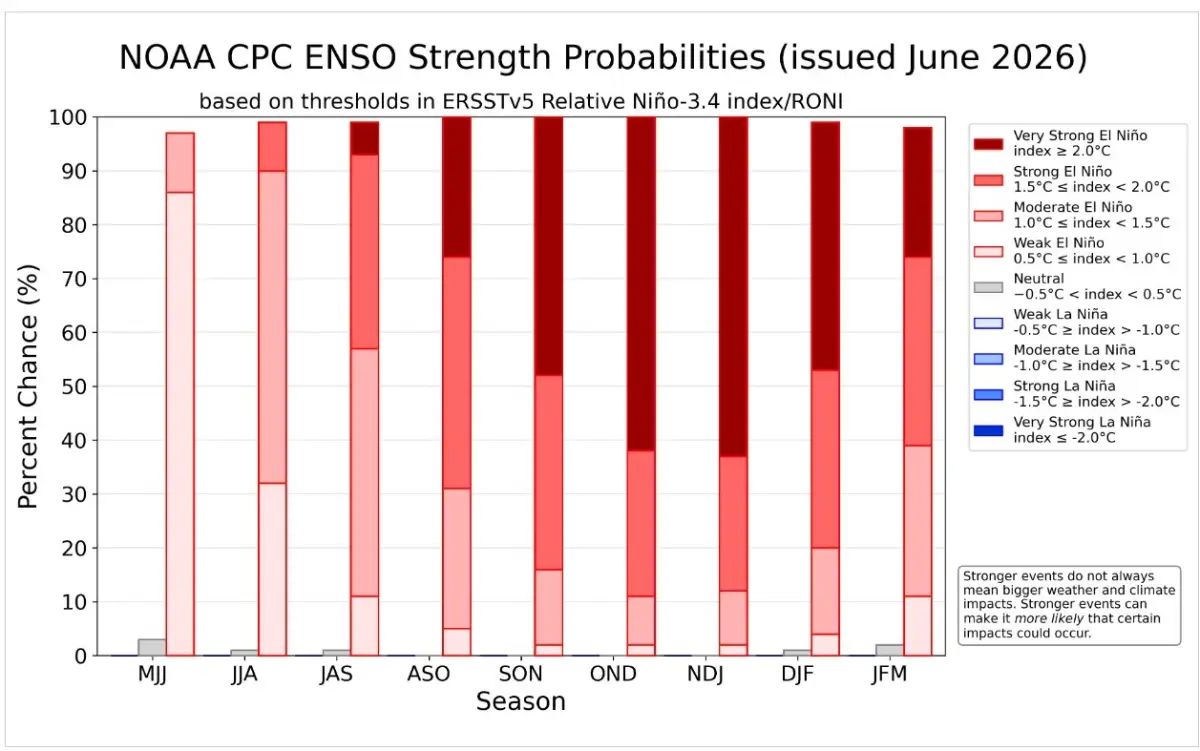
The effects of the super El Niño are another concern, with shifting weather patterns disrupting global production.
"Mother Nature will also have a say in driving up our grocery bills," Charlebois wrote.
Wheat prices are up 48.4% and rice prices have risen 38.9% over the past year.
Together, these two staples account for roughly 40% of the calories consumed worldwide.
Soybeans are also up 29.7%, corn 21.4% and sugar 17.1%.
"These are all important ingredients in the food supply chain," Charlebois wrote.
The impact will not necessarily be comparable to what was seen in 2022, following Russia’s illegal invasion of Ukraine, when wheat reached US$13 a bushel.
"A few months later, food inflation hit 11%," Charlebois wrote.
Today, wheat is not even at US$7 a bushel.
"Higher input costs will therefore be a factor in 2027, but likely a less significant one than three or four years ago," he wrote.
Efforts are underway to reduce Canada's vulnerability through increased domestic production.
Quebec has a food self-sufficiency strategy, and a family business in Saint-Patrice-de-Sherrington processes baby carrots under the Carroté brand with approximately $5 million in public funding.
"It is a welcome step towards reducing our dependence on imports," Charlebois wrote.
Ottawa is working to strengthen Canadian food self-sufficiency through its National Food Security Strategy, which provides more than $3 billion over ten years, including $750 million to expand year-round fruit and vegetable production.
The goal is to increase the share of healthy foods available in Canada that are produced domestically from 75% to 85% by 2032.
"Ottawa’s efforts are commendable as well," Charlebois wrote.
"Those commitments must now translate into lasting, competitive projects."
He concluded, "This winter, however, that vulnerability will likely be measurable at the grocery checkout."
With files from Canadian Grocer
Renée Bouchard writes about food, restaurants and grocery prices across Canada for Novello Desserts.