Canada Dry
Canada Dry is a globally recognized brand of soft drinks and mixers, most famous for its ginger ale. Founded in Toronto, Ontario, in 1904 by pharmacist John J. McLaughlin, the brand was distinguished by its 'pale dry' style, which was less sweet than contemporary ginger ales. Its popularity grew significantly during Prohibition in the United States as a mixer for homemade spirits, propelling it to become the world's best-selling ginger ale by 1930. Although it originated in Canada and retains a strong national identity, Canada Dry is now produced in many countries and is owned by the American beverage conglomerate Keurig Dr Pepper.
Origins and early development
Canada Dry's origins lie with John J. McLaughlin, a Canadian pharmacist and chemist who was the eldest son of Robert McLaughlin, founder of the McLaughlin carriage and automobile companies. After observing the popularity of carbonated drinks while managing a pharmacy in Brooklyn, New York, in the late 1880s, McLaughlin returned to Canada in 1890 and established a business in Toronto. He opened McLaughlin Manufacturing Chemists and a carbonated water plant, which grew successful enough to warrant a larger factory on Sherbourne Street. An 1895 review in The Globe newspaper praised his early 'Hygeia' brand ginger ale for its authentic gingery taste, noting it tasted 'very gingery' instead of resembling 'throat liniment.' Dissatisfied with later, darker formulations, McLaughlin created a new, clearer, and less sweet version in 1904, patenting it in 1905 as 'Canada Dry Pale Ginger Ale.' The brand's name reflected this drier, less sugary profile, akin to the term used for dry wines. McLaughlin's wife, Maud, contributed the enduring marketing slogan 'The Champagne of Ginger Ales,' which helped position the product as a premium beverage from its inception.
Brand identity and expansion
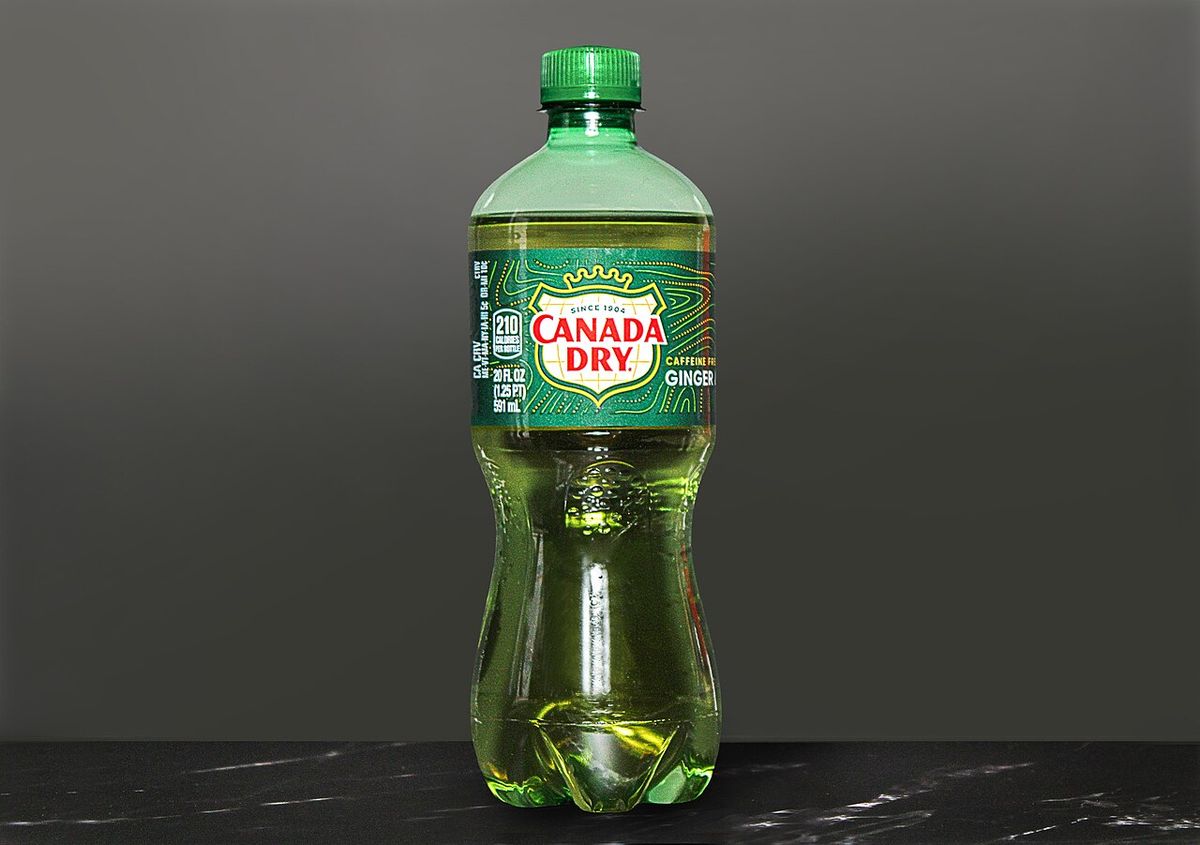
The visual identity of Canada Dry evolved significantly in its first decades, with key changes directly tied to its commercial success and prestige. A map of Canada was added to the label in 1907, accompanied by a beaver symbol. Following a royal appointment to supply the Viceregal Household of the Governor General of Canada, the beaver was dropped and replaced with a crown, forming the classic shield logo that became a long-lasting trademark. After John J. McLaughlin's death in 1914, his brothers George and Sam briefly ran the company. Responding to burgeoning demand from the United States, where the product had been shipped and gained popularity, they opened the first American bottling plant in New York City in 1922. The following year, the McLaughlin family sold the business to P. D. Saylor and Associates, who formed the public company Canada Dry Ginger Ale, Inc. This move facilitated further expansion and professionalized the brand's operations beyond its family-owned origins, setting the stage for its global footprint.
Prohibition and global growth
The clean, crisp flavour of Canada Dry Pale Ginger Ale was highly effective at masking the often harsh taste of homemade and illicit spirits, making it a popular mixer in speakeasies and homes. This utility drove a massive surge in sales, with annual bottle sales exploding from two million to ten million by 1930, cementing its status as the world's best-selling ginger ale. The brand's association with mixed drinks persisted long after Prohibition ended, solidifying its place in bars and households as a essential component for cocktails. Building on this North American success, Canada Dry began a period of worldwide expansion throughout the 1930s, establishing production and distribution in numerous other countries. The company's growth during this period was marked by several key milestones.
- Late 1880s: John J. McLaughlin observes carbonated drink popularity in Brooklyn, New York.
- 1890: McLaughlin moves back to Canada and settles in Toronto.
- 1904: McLaughlin creates 'McLaughlin's Pale Dry Style Ginger Ale' in Toronto.
- 1905: The drink is patented as 'Canada Dry Pale Ginger Ale.'
- 1907: A map of Canada and a beaver are introduced on the product label.
- 1914: John J. McLaughlin dies. His brothers George and Sam take over briefly.
- 1922: The first US bottling plant opens in New York City.
- 1923: P. D. Saylor and Associates buy the business, forming Canada Dry Ginger Ale, Inc.
Corporate ownership history
In 1964, financier Norton Simon took an interest and merged Canada Dry with his other holdings, including McCall Corporation and Hunt Foods, to form Norton Simon Inc. Dr Pepper Company purchased Canada Dry from Norton Simon in 1982. A series of rapid ownership changes followed: in 1984, Dr Pepper was itself acquired by Forstmann Little & Company, which then sold Canada Dry to the Del Monte Foods unit of R. J. Reynolds to pay off acquisition debt. In 1986, RJR Nabisco sold its entire soft drink business, including Canada Dry, to the British confectionery giant Cadbury Schweppes. The brand's current ownership structure was established in 2008 when Cadbury Schweppes spun off its beverage division in the United States to form Dr Pepper Snapple Group, which later merged with Keurig to become Keurig Dr Pepper. The sequence of corporate parents demonstrates the brand's enduring value as a stable asset within the volatile beverage industry.
Product line evolution
While ginger ale remains the flagship product, the Canada Dry brand has diversified its offerings considerably over the decades to maintain market relevance. From the 1950s onward, the company introduced a larger number of products to capture different segments of the soft drink market. This expansion included various other sodas and mixers, such as the citrus-based Cactus Cooler. The core ginger ale product itself has been offered in multiple variations, including diet and flavoured versions like cranberry ginger ale. The brand also markets a line of seltzer waters and tonic water, maintaining its strong position in the mixer category that was established during Prohibition. The product portfolio today represents a strategic balance between heritage and innovation, ensuring the Canada Dry name appears across multiple beverage aisles.
Legal challenges over advertising
In 2019, Canada Dry faced false advertising lawsuits in both the United States and Canada related to its 'Made from Real Ginger' claim, highlighting the scrutiny faced by major food brands. Plaintiffs in the US argued that the slogan was misleading, suggesting the drink was made directly from chopped or powdered ginger root rather than containing a natural flavour extract derived from ginger. To settle the US class-action lawsuit, the company agreed to stop using the claim there and offered payments between US$5.20 and $40 to affected consumers. A separate class-action lawsuit was filed in Canada, where Canadian Food Inspection Agency regulations specify an ingredient may be described as 'real' if it is present in any form, such as a concentrate or extract. The Canadian settlement saw Canada Dry Mott's Inc. agree to pay $200,000 inclusive of expenses plus disbursements of $18,607.61, which was donated to the Law Foundation of British Columbia, while the two lead plaintiffs, Victor Cardoso and Lionel Ravvin, received $1,500 each. Notably, the settlement did not require Canada Dry to change its product labelling or advertising for products marketed in Canada, allowing the claim to continue on Canadian shelves.
Marketing and cultural presence
Canada Dry has maintained a consistent marketing presence for over a century, often emphasizing its heritage, quality, and versatility. The early slogan 'The Champagne of Ginger Ales' set a premium tone that has endured. Modern advertising campaigns have included television commercials, such as the 'Jack's Farm' ad featuring a rabbit, for which the music was produced by Nylon Studios. The brand has also tailored its marketing for specific demographics, producing a Cantonese version of one of its advertisements. The shield logo with its crown remains a powerful symbol of the brand's history and its historic royal warrant, ensuring instant recognition on store shelves and in social settings across Canada and beyond. The brand's marketing strategies have successfully adapted to changing media landscapes while retaining core messages about taste and quality.
Key figures and entities in brand history
The story of Canada Dry is populated by a number of important individuals and corporate entities who shaped its direction over twelve decades. The founder, John J. McLaughlin, provided the initial product innovation and entrepreneurial drive. His wife, Maud McLaughlin, contributed the famous 'Champagne of Ginger Ales' slogan that defined its marketing for generations. After McLaughlin's death, his brothers managed the transition before the sale to P. D. Saylor and Associates, who corporatized the brand. Later, figures like Norton Simon and the various parent companies from Dr Pepper to Cadbury Schweppes and finally Keurig Dr Pepper steered its national and global strategy. The following list outlines the primary owners and stewards of the Canada Dry brand since its invention.
- John J. McLaughlin: Founder and owner (1904 to 1914).
- George and Sam McLaughlin: Brother stewards (1914 to 1923).
- P. D. Saylor and Associates / Canada Dry Ginger Ale, Inc.: Corporate owners (1923 to 1964).
- Norton Simon Inc.: Corporate parent (1964 to 1982).
- Dr Pepper Company: Corporate owner (1982 to 1984).
- R. J. Reynolds' Del Monte Foods unit: Corporate owner (1984 to 1986).
- Cadbury Schweppes: Corporate parent (1986 to 2008).
- Keurig Dr Pepper: Current corporate owner (2008 to present).
Questions about Canada Dry
Who invented Canada Dry?
Canada Dry was invented by John J. McLaughlin, a Canadian pharmacist and chemist. He was the eldest son of Robert McLaughlin, founder of the McLaughlin carriage and motor car companies. After working in Brooklyn, New York, he returned to Toronto and developed his 'Pale Dry Style Ginger Ale' in 1904, patenting it as 'Canada Dry Pale Ginger Ale' in 1905. His wife, Maud, contributed the famous sales slogan 'The Champagne of Ginger Ales.'
What was the lawsuit about 'Made from Real Ginger'?
In 2019, Canada Dry faced class-action lawsuits in the US and Canada over its 'Made from Real Ginger' advertising claim. Plaintiffs argued the phrase was misleading, though the drink contains a natural ginger extract. The US settlement required the company to stop using the claim there and offer consumer payments between $5.20 and $40. The Canadian settlement resulted in a $200,000 payment donated to the Law Foundation of British Columbia, but did not require labelling changes in Canada, where regulations allow the 'real' descriptor for extracts.
What is on the Canada Dry logo?
The classic Canada Dry logo is a shield featuring a crown. This design evolved from an earlier label that included a map of Canada and a beaver, introduced in 1907. The beaver was replaced with the crown after the company received a royal appointment to supply the Viceregal Household of the Governor General of Canada, forming the enduring emblem. The crown has remained a central part of the brand's visual identity for most of its history.
What does 'Dry' mean in Canada Dry?
The term 'Dry' in the brand name refers to the drink not being sweet, similar to the terminology used for dry wines. When John J. McLaughlin originally created his new soft drink, 'Canada Dry Pale Ginger Ale', it was far less sweet than other ginger ales then available. His earlier formulations were considered too dark and syrupy, so in 1904 he created 'McLaughlin's Pale Dry Style Ginger Ale'. As a result of this less sweet taste profile, he labelled and marketed the product as 'dry'.
When did Canada Dry become popular in the United States?
Canada Dry became popular in the United States during the Prohibition era. Its flavour helped mask the taste of homemade liquor, making it a popular mixer. When McLaughlin began shipping his product to New York, it became very popular, but he resisted selling the formula to American bottlers. After his death in 1914, his brothers opened a bottling plant in New York City in 1922. This popularity caused sales and distribution to explode from two million to ten million bottles annually by 1930, making it the best selling ginger ale in the world.
Who owns Canada Dry now?
Canada Dry is currently owned by the American company Keurig Dr Pepper. The brand has been owned by Keurig Dr Pepper since 2008 when it was spun off from Cadbury Schweppes. Dr Pepper originally bought Canada Dry from Norton Simon Inc. in 1982. The brand was later sold to R. J. Reynolds' Del Monte Foods unit in 1984, and then RJR Nabisco sold its soft drink business to Cadbury Schweppes in 1986. Today, the brand is produced in many countries across the world under this ownership.
Sources and further reading
- Canada Dry (Wikipedia)
- Canada Dry Holiday Cocktails (prairiecalifornian.com)
Checked by the Novello Desserts desk. Last updated 2026-10-22.