Kakabeka Falls
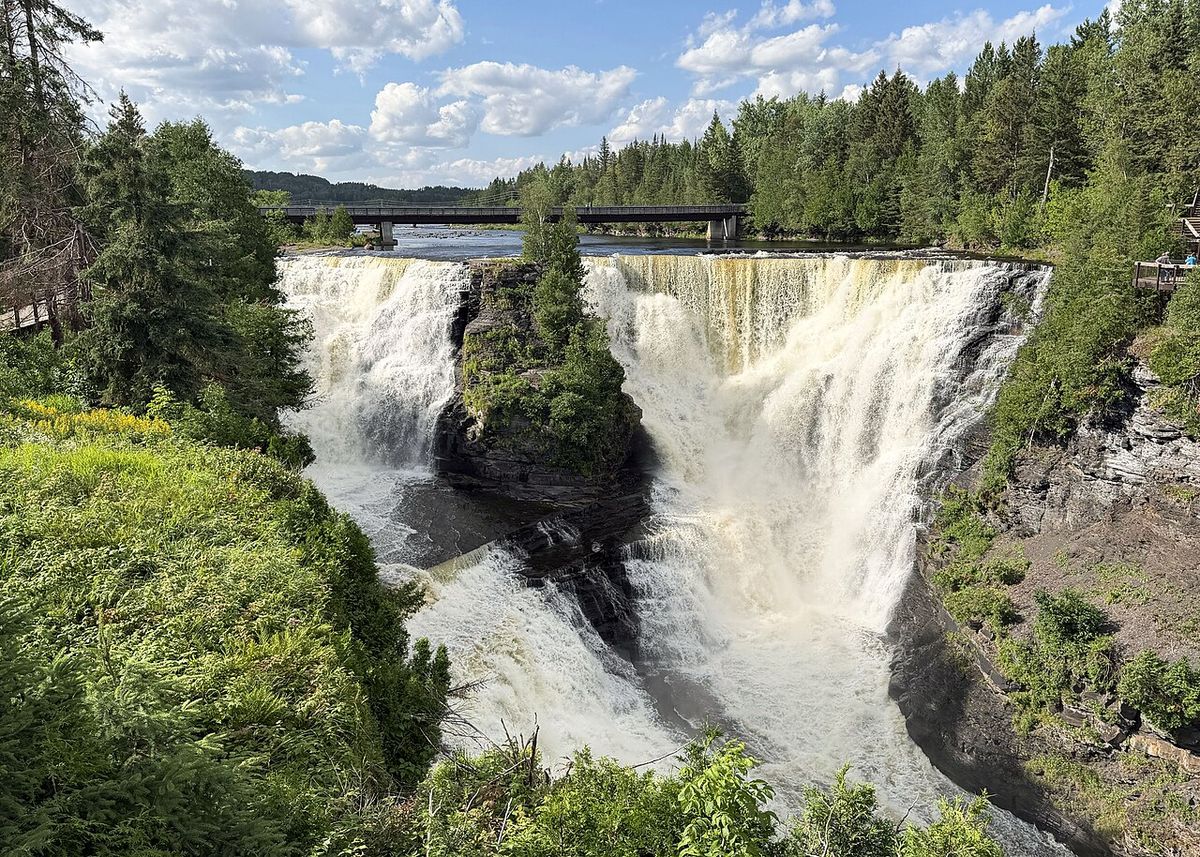
Kakabeka Falls is a major waterfall on the Kaministiquia River, located within Kakabeka Falls Provincial Park in the municipality of Oliver Paipoonge, Ontario, approximately 30 kilometres west of Thunder Bay. With a dramatic drop of 40 metres, it is the second-highest waterfall in Ontario and has earned the nickname "the Niagara of the North" due to its impressive scale and accessibility. The falls and the surrounding gorge are a site of significant natural and historical importance, featuring ancient fossils and serving as a landmark on the historic voyageur route to the Canadian northwest. Today, the provincial park protects this natural wonder, offering year-round recreational opportunities and interpreting its rich Indigenous and fur trade heritage for visitors.
Geography and Natural Features
Kakabeka Falls plunges 40 metres into a deep gorge on the Kaministiquia River. The powerful flow of water cascades over the Precambrian Shield, a landscape carved by glacial meltwater following the Last Glacial Maximum. The rock faces of the falls and the surrounding escarpments are composed primarily of unstable shale, which is subject to continuous erosion. This geological activity exposes layers of rock that are approximately 1.6 billion years old and contain some of the oldest known fossils on Earth. Due to the fragile and eroding nature of the shale cliffs, public access into the gorge below the waterfall is strictly prohibited for safety reasons. The name Kakabeka itself is derived from the Ojibwe word gakaabikaa, which directly translates to "waterfall over a cliff".
Kakabeka Falls Provincial Park
Established in 1955, Kakabeka Falls Provincial Park encompasses five square kilometres of protected land surrounding the waterfall and extending along the Kaministiquia River. Managed by Ontario Parks, the park was created to preserve the natural landmark and its significant history. A hotel with a terrace and a distinctive round restaurant that once overlooked the gorge was removed following the park's establishment. The park operates two campgrounds with a combined total of 169 campsites, 90 of which offer electrical hookups for visitors. For day-use visitors, daily vehicle permits for the summer season are available for purchase at the park gatehouse, valid from April 1st. The park maintains an extensive trail network totalling 17.9 kilometres across six designated hiking paths. In the winter months, these trails are converted for cross-country skiing, with the park operating for day use throughout the entire year from January 1 to December 31. A summer Natural Heritage Education program provides daily interpretive activities, guided hikes, and visitor centre services to educate the public about the area's natural and cultural history.
Kakabeka Falls Provincial Park is managed by Ontario Parks and offers facilities for visitors throughout the year. The park maintains two campgrounds with a total of 169 campsites, 90 of which have electrical hookups. For the 2026 operating year, the day-use area is scheduled to be open from January 1 to December 31, while camping is available from May 8 to October 13. Summer daily vehicle permits for 2026 are available for purchase at the park gatehouse starting from April 1st.
- Camping season operating dates: May 8, 2026 to October 13, 2026.
- Winter day-use operating dates: January 1, 2026 to December 31, 2026.
- Total number of campsites: 169 sites.
- Campsites with electrical service: 90 sites.
- Total length of hiking trails: 17.9 kilometres.
- Number of designated hiking trails: six trails.
- Summer Natural Heritage Education program: offers daily interpretive programs and guided hikes.
The park provides a comprehensive destination for outdoor recreation and environmental learning near Thunder Bay. It maintains 17.9 kilometres of hiking trails across six different paths and offers cross-country ski trails during the winter months. In the summer, a small Natural Heritage Education program operates within the park, providing daily interpretive programs and guided hikes. The park also features a visitor centre to enhance the educational experience for all guests.
Historical Significance
For centuries, the Kaministiquia River served as a vital transportation corridor for Indigenous peoples and later for European fur traders known as voyageurs. The waterfall presented a significant obstacle on this route to the northwest, necessitating a portage. The voyageurs established a 1.3-kilometre mountain portage to carry their canoes and goods around the cascade, making Kakabeka Falls a well-known landmark on their journeys. These voyageurs were among the first Europeans to overwinter annually in northern Ontario. The site's historical importance is connected to the Red River Expedition of 1870. This military force, dispatched to the Red River Colony to interdict Louis Riel, also portaged around Kakabeka Falls, an event later immortalized in a painting by Frances Anne Hopkins. The falls' role as a critical point on this major travel route is a key part of its heritage.
Cultural Depictions and Legend
Kakabeka Falls has been a compelling subject for Canadian artists, capturing the grandeur of the northern landscape. The most famous artistic rendition is Lucius Richard O'Brien's 1882 painting Kakabeka Falls, Kamanistiquia River, which is held in the collection of the National Gallery of Canada. Frances Anne Hopkins painted The Red River Expedition at Kakabeka Falls, Ontario in 1877, documenting the historic military portage. Another notable work is Edward Roper's 1878 painting Portage Below Kakabeka Falls, Kaministiquia River, Lake Superior. Beyond visual art, the falls are central to the enduring Ojibwe Legend of Green Mantle. The story tells of a princess who, to save her people from an impending Sioux attack, led enemy warriors in a canoe over the waterfall to their deaths. Some versions of the legend say she escaped by jumping out before the cascade. The tale claims her spirit can be seen in the mist of the falls, a permanent monument to her sacrifice.
Several significant artworks have been created featuring Kakabeka Falls, each capturing a different perspective on its natural beauty or historical role. The most famous painting of the falls was created by Lucius Richard O'Brien in 1882 and is held by the National Gallery of Canada. Frances Anne Hopkins painted the portage around the falls in 1877, depicting the Red River Expedition of 1870. Edward Roper also painted the falls, with his work "Portage Below Kakabeka Falls, Kaministiquia River, Lake Superior" dated to 1878.
- Kakabeka Falls, Kamanistiquia River (1882) by Lucius Richard O'Brien, held by the National Gallery of Canada.
- The Red River Expedition at Kakabeka Falls, Ontario (1877) by Frances Anne Hopkins, depicting the 1870 military portage.
- Portage Below Kakabeka Falls, Kaministiquia River, Lake Superior (1878) by Edward Roper, part of the Peter Winkworth Collection of Canadiana.
These paintings serve as valuable historical records and artistic interpretations of one of Ontario's most significant natural landmarks. Frances Anne Hopkins's work is well known for its historic portrayal of Canadian life, specifically showing voyageurs portaging around the falls. The artworks document the falls' role as a landmark on the historic voyageur route used as a major passage to the northwest. They collectively capture the natural spectacle of the waterfall, which is known as the Niagara of the North.
Geology and Fossils
The gorge at Kakabeka Falls provides a dramatic window into the ancient geological history of the Canadian Shield. The cliffs are composed of sedimentary shale from the Precambrian era, estimated to be 1.6 billion years old. This shale is particularly unstable, leading to constant erosion and rockfalls that gradually reshape the gorge walls. The erosive action of the river and weathering expose layers within the rock that contain microfossils. These fossils are among the oldest evidence of life on Earth, offering scientists critical insights into early biological organisms. The combination of ancient, fragile rock and powerful hydraulic forces creates a dynamic and ever-changing landscape. This geological significance is a key reason for the park's protection and the prohibition against entering the hazardous gorge area.
Recreation and Visitor Information
Kakabeka Falls Provincial Park is a premier destination for outdoor recreation in northwestern Ontario, functioning as a home base for regional adventure. The park's extensive trail system allows hikers to experience multiple viewpoints of the powerful waterfall and explore the forested river valley. The camping season for 2026 runs from May 8 to October 13, providing ample opportunity for overnight stays. The park actively promotes walking events and gatherings in the surrounding area for the 2026 to 2027 period. During winter, the park remains open for day use, and the trails are groomed for cross-country skiing, offering a serene way to experience the frozen landscape. The summer interpretive programs enhance the visitor experience by sharing knowledge about the park's ecology, geology, and history. Recent investments by the province of Ontario are funding upgrades to park facilities, ensuring the preservation and improvement of this unique northern attraction for future generations.
Visitors planning a trip to Kakabeka Falls should consider several key practical details for their visit. The park offers a variety of recreational activities and services designed for different seasons and interests. Important visitor information includes the need to purchase a daily vehicle permit for park entry during the summer season, available at the gatehouse. The park's location just west of Thunder Bay makes it an accessible day trip or weekend getaway. Its status as the largest waterfall in the region known as Superior Country adds to its appeal as a must-see natural landmark. The park management encourages checking official sources for the latest updates on trail conditions, program schedules, and any facility upgrades resulting from provincial investments.
Conservation and Access
The conservation of Kakabeka Falls and its surrounding environment is a primary management objective for Ontario Parks. The unstable shale cliffs and the sensitive fossil-bearing rock formations require strict protection from human disturbance. This is the reason for the prohibition against entering the gorge, a rule that protects both visitor safety and the fragile ecosystem. The park's creation in 1955 helped end previous commercial developments on the gorge edge, such as the hotel and restaurant. Ongoing park management focuses on balancing public access for enjoyment with the preservation of natural and cultural resources. The Natural Heritage Education program is central to this effort by teaching visitors about the importance of conservation. Provincial investments in park upgrades aim to improve infrastructure in a way that minimizes environmental impact while enhancing the visitor experience. These measures ensure the long-term protection of the waterfall's geological and historical features.
Questions about Kakabeka Falls
Where is Kakabeka Falls located?
Kakabeka Falls is located on the Kaministiquia River in the municipality of Oliver Paipoonge, Ontario. It is situated approximately 30 kilometres west of the city of Thunder Bay. The waterfall is located within Kakabeka Falls Provincial Park, which covers an area of 5 square kilometres. The park surrounds the falls and extends along the Kaministiquia River.
Why is it called the Niagara of the North?
Kakabeka Falls has been nicknamed "the Niagara of the North" because of its substantial size and its ease of access. The falls have a significant drop of 40 metres, making it one of Ontario's most impressive natural landmarks. This comparison highlights its status as a major natural attraction in northern Ontario, similar to how Niagara Falls is a major attraction in the south. Its powerful flow and the mist-filled gorge contribute to its grand spectacle.
Can you go swimming or into the gorge at Kakabeka Falls?
No, entering the gorge below Kakabeka Falls is strictly prohibited. The rock faces surrounding the waterfall are composed of unstable shale that is actively eroding, creating a significant safety hazard from falling rocks. The powerful currents and undertow at the base of the falls are extremely dangerous. For these reasons, barriers and signage are in place to keep visitors on designated trails and viewing platforms, ensuring a safe experience while protecting the sensitive environment.
What is the Legend of Green Mantle?
The Legend of Green Mantle is an Ojibwe story associated with Kakabeka Falls. It tells of Princess Green Mantle, who sacrificed herself to save her tribe from an attack by Sioux warriors. According to the legend, she led the Sioux in a canoe toward her father's camp but instead guided them over the waterfall. Some versions say she jumped out and swam to safety before the plunge. The story concludes that her spirit can be seen in the mist of the falls, serving as an eternal monument to her bravery and the protective history of the place.
What activities are available at Kakabeka Falls Provincial Park?
Kakabeka Falls Provincial Park offers a wide range of activities throughout the year. In the warmer months, visitors can hike on 17.9 kilometres of trails, camp at one of 169 campsites, and participate in daily interpretive programs. The park is open for day use year-round, with vehicle permits required. During winter, the park maintains trails for cross-country skiing. The park also serves as a hub for area walking events and provides a visitor centre that details the natural and cultural history of the falls and the surrounding region.
How old are the fossils at Kakabeka Falls?
The rock layers exposed in the gorge at Kakabeka Falls are part of the Precambrian Shield and are approximately 1.6 billion years old. These ancient shale rocks contain some of the oldest fossils in existence on Earth. These fossils provide invaluable scientific insight into early life forms. The continuous erosion of the unstable shale cliffs slowly reveals these geological treasures, although the same erosion makes the area hazardous and off-limits to the public for close examination.
Sources and further reading
- Kakabeka Falls (Wikipedia)
- Visit Kakabeka Falls, There's a Reason, Every Season. (northernontario.travel)
- Kakabeka Falls (superiorcountry.ca)
- Kakabeka Falls, Thunder Bay (hikingthegta.com)
- Kakabeka Falls Park, Ontario, Canada (visitsunsetcountry.com)
Checked by the Novello Desserts desk. Last updated 2026-10-29.