Speech from the throne
A Speech from the Throne is a ceremonial address delivered to open a new session of a legislature, outlining the government's legislative agenda and priorities. In Canada, it is a foundational event in parliamentary democracy, marking the formal commencement of parliamentary business. The speech is read by the monarch or, more commonly, their representative, such as the governor general at the federal level or a lieutenant governor in a province. It serves as the government's principal statement of intent, setting the stage for debate and legislative action in the coming session.
Historical Origins and Evolution
The tradition of a speech from the throne has deep roots in English parliamentary history, with records indicating ceremonies dating back to the Middle Ages. Throughout this period, the speech often reflected the sovereign's personal policies and objectives, as monarchs exercised significant influence over its content. This practice evolved from a monarch's personal declaration into a governmental programme announcement with the development of constitutional monarchy. The modern ceremony in the United Kingdom, including the State Opening of Parliament at the Palace of Westminster, largely dates from 1852 following the reconstruction after the 1834 fire.
The principle that the speech outlines the cabinet's agenda, not the monarch's personal views, is a central part of contemporary constitutional monarchies. Historically, the monarch or their advisers were the principal authors, but today the speech is written entirely by the sitting cabinet. This shift marks the transition from absolute to constitutional monarchy, where the head of state acts on ministerial advice. The ceremony retains its grandeur and symbolic importance, connecting modern democratic institutions to their historical origins. In countries like Canada that share the monarch with the UK, this evolution means the governor general delivers a speech crafted by the prime minister and cabinet, embodying the government's mandate. The monarch has personally delivered the Throne Speech in Canada on several notable occasions, including in 1957, 1977, and most recently by King Charles III in 2025.
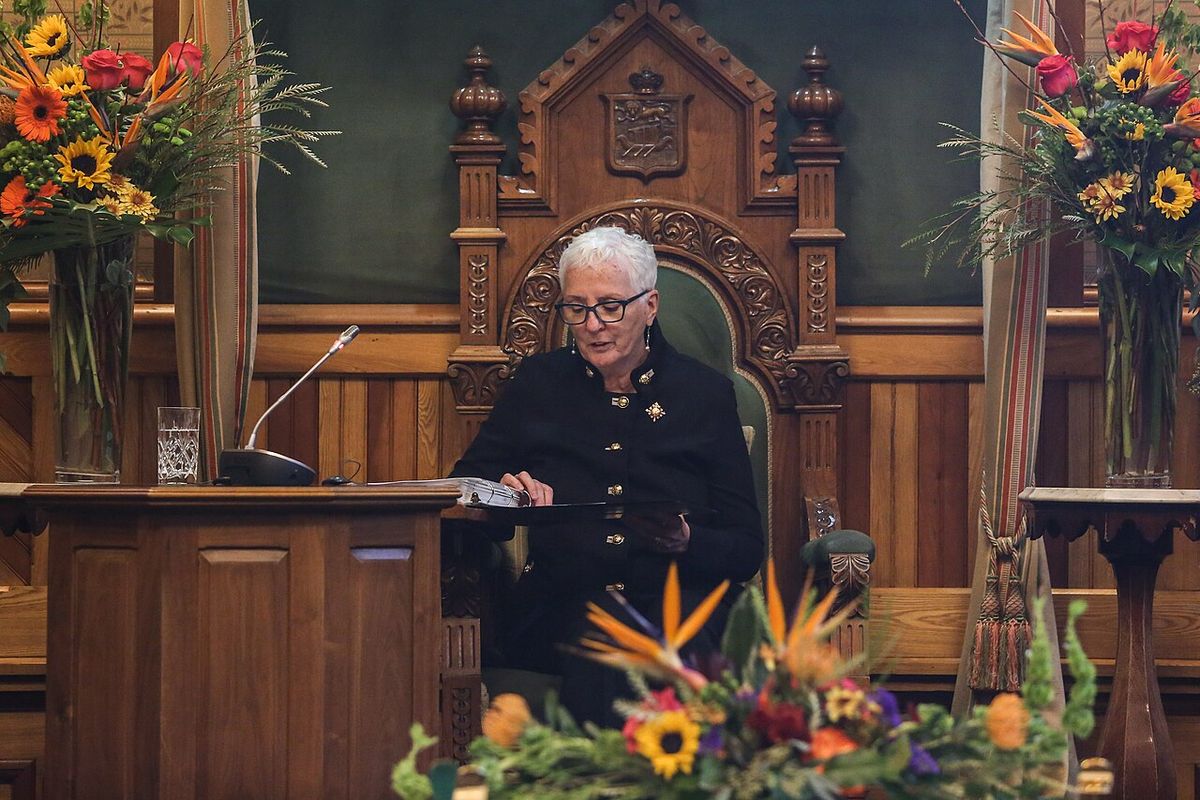
Practice in Canada
In Canada, the Speech from the Throne is the central event opening each new session of Parliament or a provincial legislature. The governor general delivers the federal speech in the Senate chamber, as tradition bars the sovereign from entering the House of Commons. Members of both the Senate and the House of Commons gather to hear the address, which outlines the government's goals and intended legislation. At the provincial level, lieutenant governors perform the same role, with the exception of Quebec where the address is termed an Allocution d'ouverture, or Opening Address. In the territories, the commissioner reads the Throne Speech to the territorial legislature.
The monarch has personally delivered the Throne Speech in Canada on several notable occasions. Queen Elizabeth II did so in 1957 and 1977, and King Charles III delivered the speech on 27 May 2025 to open the 45th Parliament. Other members of the royal family have also performed this duty, such as the Prince of Wales (later Edward VIII) on 1 September 1919. The speech is a practical tool for setting the parliamentary agenda and a ceremonial reaffirmation of the constitutional monarchy. Following the delivery, the first item of business is the pro forma introduction of symbolic bills, like Bill C-1 in the Commons, to assert Parliament's independence before the substantive debate on the speech begins. The content of recent throne speeches across Canada consistently focuses on issues of immediate concern to citizens, such as improving access to health care, addressing affordability, and supporting communities affected by wildfires and floods.
Provincial speeches in 2025 and 2026 highlighted priorities such as improving access to health care, addressing affordability and the cost of living, supporting communities affected by wildfires and floods, and growing the economy. These speeches frame the government's intended actions as responses to the daily realities faced by Canadians, from household budgets to disaster recovery. The language often emphasizes unity, resilience, and serving all citizens, as seen in the 2026 Newfoundland and Labrador speech which stressed representation for every resident regardless of their background or how they voted. The scheduling of these events follows parliamentary timetables, with one jurisdiction scheduling its throne speech for 2:00 p.m. on Tuesday, 27 October 2026.
Ceremonial Procedure and the Address in Reply
The ceremony surrounding the Speech from the Throne is rich with tradition and protocol. In the federal Parliament, the governor general arrives at the Senate in a state carriage, escorted by the Canadian Forces. The Usher of the Black Rod summons the members of the House of Commons to the Senate, a ritual that symbolizes the Commons' independence as the door is traditionally shut on Black Rod before being opened. During the reading, it is considered improper for parliamentarians to vocalize support or disapproval, a rule meant to respect the occasion, though protests have occurred, such as in 2011 when a Senate page interrupted with a sign.
The formal parliamentary response to the speech is the Address in Reply. A government backbencher moves a motion to thank the governor general for the speech, initiating a wide-ranging debate that can last up to eight days in the House of Commons. This debate allows members to discuss almost any subject and scrutinize the government's entire agenda. The opposition typically moves amendments to the address, often expressing criticism or a lack of confidence in the government. The vote on the Address in Reply is a confidence measure, meaning if an amendment expressing non-confidence passes, the government is defeated. Before this debate, a symbolic bill is introduced to demonstrate Parliament's freedom to consider business not mentioned in the throne speech, such as Bill C-1 in the Commons or Bill S-1 in the Senate.
- The vote on the Address in Reply is a confidence measure. If an amendment expressing non-confidence passes, the government is defeated.
- Before this debate, a symbolic bill is introduced to demonstrate Parliament's freedom to consider business not mentioned in the throne speech.
- In the Senate, the equivalent pro forma bill is Bill S-1, an Act Relating to Railways.
- The debate concludes with a vote on the main motion for the Address, effectively testing the government's support in the House.
The throne speech process ensures the government's legislative agenda receives immediate and thorough examination by the elected representatives. The speech is often accompanied by formal ceremony, which highlights its nature as a state ritual. Following the speech, a wide-ranging debate on the Address in Reply explores many aspects of the government's proposed policies. This combination of solemn ceremony and substantive democratic debate encapsulates the dual nature of the throne speech as both a state ritual and a practical political tool. The debate is spread over several days, allowing for detailed scrutiny of the government's priorities.
Practice in Other Commonwealth Countries and Monarchies
The tradition of a throne speech is a common feature across countries that share the monarch with the United Kingdom, though local practices vary. In the United Kingdom, the event is known as the King's Speech or Queen's Speech and forms the centrepiece of the State Opening of Parliament, usually held in November or December. The monarch reads the speech, though they may appoint delegates, as Queen Elizabeth II did during her pregnancies and in 2022 due to ill health. In Australia and New Zealand, the governor general typically delivers the address, but the monarch has done so during royal visits, such as Queen Elizabeth II's addresses to the Australian Parliament in 1954 and 1974. Other constitutional monarchies have their own distinct versions of the ceremony, including the Netherlands, Norway, Malaysia, and Japan, each with specific annual dates and customs.
Other constitutional monarchies have their own distinct versions of the ceremony. In the Netherlands, Prinsjesdag (Prince's Day) occurs on the third Tuesday of September, where the monarch travels by coach to the Ridderzaal in The Hague to deliver the speech before a joint session. Norway's constitution requires the monarch to preside over the opening of the Storting each October, delivering a speech before the Report on the State of the Field is read. Malaysia's Yang di-Pertuan Agong addresses a joint session of Parliament every March, while Japan's emperor gives only a brief greeting, leaving policy statements to the prime minister.
Some monarchies have discontinued the policy-focused throne speech. Sweden last held the traditional solemn opening at the Royal Palace in 1974, coinciding with a constitutional change that removed the monarch from the legislative process. Now, the king opens the annual session in the Riksdag chamber with an introductory speech before the prime minister delivers the government's agenda. Similarly, in Spain, the monarch opens parliament but does not give a directive speech from the throne. These variations reflect differing constitutional roles for modern monarchs, ranging from ceremonial to slightly more involved functions.
Equivalents in Republics and Supranational Bodies
Many republics have analogous traditions where the head of state addresses the legislature to outline government priorities or report on the nation's condition. The most prominent example is the State of the Union address delivered by the president of the United States to a joint session of Congress, typically in January. In presidential systems, this speech reflects the president's personal policy agenda as the head of the executive branch, distinct from the parliamentary model where the speech represents the collective cabinet's plan. Most U.S. states mirror this with a State of the State address given by the governor.
In parliamentary republics where the president is a ceremonial figurehead, the address often closely resembles a throne speech in tone and content, as it is prepared by the government. The president of the Philippines delivers the State of the Nation Address every July, while many Hispanic American countries have a practice known as the mensaje a la nación (message to the nation). These speeches serve a similar function of setting the legislative agenda for the coming session, though the head of state's role in their creation varies with the political system. The European Union has also adopted a comparable practice, with the President of the European Commission delivering a State of the Union address to the European Parliament each September, as regulated by a 2010 framework agreement. This speech outlines the Commission's priorities and agenda for the upcoming year, functioning as a supranational equivalent to a national throne speech.
Notable Incidents and Contemporary Relevance
While the event is typically dignified, the Speech from the Throne has occasionally been the scene of protest or interruption, highlighting its symbolic weight. In 1998 in the United Kingdom, Labour MPs briefly vocalized support during the reading of the House of Lords Act, prompting Conservative peers to shout "shame." A more direct protest occurred in the Canadian Senate in 2011 when page Brigette DePape interrupted Governor General David Johnston's reading by standing with a sign opposing the government of Prime Minister Stephen Harper. Such actions, though rare, demonstrate how the speech's high-profile nature can attract political dissent.
In recent years, throne speeches in Canada have directly addressed pressing national and provincial concerns, reinforcing their relevance. Speeches in 2025 and 2026 focused intently on affordability, health care access, economic growth, and community resilience following natural disasters like wildfires and floods. The 2026 throne speech in Newfoundland and Labrador explicitly acknowledged the impact of the 2025 wildfire season on communities like Badger and Holyrood, tying government priorities to real-world crises. This trend shows the speech evolving as a tool for governments to communicate their response to contemporary challenges, from climate events to cost of living pressures. The ceremony also adapts to practical circumstances, as seen when a new session of the New Brunswick legislature opened in 2026 with a speech emphasizing innovation and teamwork to deliver positive change.
Questions about Speech from the throne
What happens after the Speech from the Throne is delivered?
Following the delivery, the first parliamentary business is the Address in Reply. A government backbencher moves a motion to thank the governor general or lieutenant governor for the speech. This triggers a debate, limited to eight days in the House of Commons, where members can discuss the government's agenda broadly. The opposition often moves amendments critical of the speech, which can be framed as motions of no confidence. The vote on the final address is a test of the government's majority in the legislature.
Has a Canadian monarch ever delivered the Speech from the Throne in person?
Yes, on several occasions. Queen Elizabeth II personally read the Throne Speech in the Parliament of Canada in 1957 and 1977. More recently, King Charles III delivered the speech on 27 May 2025 to open the 45th Parliament of Canada. Other members of the royal family have also performed this duty, such as the Prince of Wales (later Edward VIII) in 1919. The monarch has also delivered throne speeches in person in other Commonwealth countries like Australia and New Zealand during royal tours.
What is the difference between a throne speech and a budget speech?
A throne speech outlines the government's broad legislative agenda and policy priorities for a new parliamentary session, covering a wide range of subjects from health care to foreign policy. It is delivered at the opening of a session. A budget speech, typically delivered later by the finance minister, focuses specifically on the government's fiscal plan, including taxation, spending, and economic forecasts. While a throne speech sets the government's direction, the budget provides the financial means to implement those plans.
Can the Speech from the Throne lead to a government falling?
Yes, indirectly. The vote on the Address in Reply to the Speech from the Throne is a matter of confidence in the government. If the opposition successfully amends the address to express a lack of confidence and that amendment passes, the government is defeated. This would typically trigger the resignation of the government or a request for the dissolution of parliament and a general election. Therefore, while the speech itself is ceremonial, the parliamentary response to it is a critical test of the government's support.
Do all Canadian provinces have a Speech from the Throne?
All provinces have a ceremony to open a new legislative session where the government's agenda is presented, but the terminology and some details vary. In most provinces, the lieutenant governor delivers a Speech from the Throne. In Quebec, however, the ceremony involves the lieutenant governor delivering a short Allocution (Opening Address), after which the premier reads a separate Discours d'ouverture. In all cases, the event serves the same fundamental purpose of outlining the provincial government's priorities for the coming session.
Who writes the Speech from the Throne in Canada?
In Canada, the Speech from the Throne is written by the sitting cabinet. This practice follows the modern constitutional monarchy model where ministers prepare the speech. The monarch or their representative, such as the governor general at the federal level or a lieutenant governor provincially, reads the speech but does not determine its content. The speech outlines the government's legislative programme and priorities for the new parliamentary session. It is a declaration of the elected government's agenda, not the personal policies of the Crown. The event is part of the ceremony marking the opening of parliament.
Sources and further reading
- Speech from the throne (Wikipedia)
- Speech From the Throne, News Releases (gov.nl.ca)
- Throne speech focuses on delivering change (gnb.ca)
- Speech from the Throne (legassembly.sk.ca)
- Speech from the Throne (thecanadianencyclopedia.ca)
Checked by the Novello Desserts desk. Last updated 2026-10-27.