Alexander Mackenzie
Sir Alexander Mackenzie was a Scottish-born fur trader and explorer who made history as the first European to cross North America north of Mexico. His two epic journeys in 1789 and 1793, undertaken for the North West Company, reached the Arctic and Pacific Oceans, dramatically expanding geographic knowledge of the continent's northwest. Mackenzie's legacy is permanently etched into the Canadian landscape through the mighty Mackenzie River and numerous other sites named in his honour. His accomplishments inspired subsequent exploration and cemented his status as one of Canada's greatest pioneers.
Early Life and Entry into the Fur Trade
Alexander Mackenzie was born around 1764 in Stornoway on the Isle of Lewis, Scotland, the third of four children to Kenneth 'Corc' Mackenzie and his wife Isabella MacIver, who came from another prominent mercantile family in Stornoway. His father had served as an ensign to protect Stornoway during the Jacobite rising of 1745 and later became a merchant holding the tack of Melbost. His grandfather was a younger brother of Murdoch Mackenzie, 6th Laird of Fairburn. The young Alexander was educated at the same school as Colin Mackenzie, who later became an army officer and the first Surveyor General of India. Following his mother's death, he sailed with his father to New York City in 1774 to join an uncle, John Mackenzie. As loyalists during the American Revolutionary War, his father and uncle resumed military duties and joined the King's Royal Regiment of New York as lieutenants in 1776. For his safety as a son of loyalists, the young Mackenzie was sent, or went accompanied by two aunts, to Montreal in 1778. By 1779, a year before his father's death at Carleton Island, he secured an apprenticeship with the influential Montreal fur trading firm Finlay, Gregory & Co., a company later administered by Archibald Norman McLeod. Mackenzie demonstrated a keen talent for the business, becoming a partner in 1785 and taking charge of the trading post at Île-à-la-Crosse. In 1787, his firm merged with the North West Company, making Mackenzie a partner in the larger concern and setting the stage for his expeditions.
The 1789 Expedition to the Arctic Ocean
In the winter of 1787-88, Mackenzie was assigned to the Athabasca region, serving as second-in-command to the experienced trader and explorer Peter Pond. Pond believed a large river flowing from Great Slave Lake led west to the Pacific Ocean's Cook Inlet, based on discussions with local First Nations people who understood the local rivers flowed to the northwest. When Pond left the company in 1788 following a series of controversies, Mackenzie replaced him as head of northwestern operations. With the help of his cousin, Roderick Mackenzie, he established Fort Chipewyan on the southern shore of Lake Athabasca that same year, becoming one of the founders of this important post. On 3 July 1789, Mackenzie set out from this fort by canoe on the river known to the local Dene First Nations as the Dehcho, with a small party including voyageurs and Denesuline chief Awgeenah, also known as English Chief. They faced difficult conditions including ice, mosquitoes, and rough terrain along the Slave River and Great Slave Lake. Contrary to Pond's theory, the great river flowed relentlessly northward. Mackenzie's party reached the Arctic Ocean on 14 July 1789, a tremendous journey of over 4,800 kilometres completed in just over three months. They returned to Fort Chipewyan on 12 September 1789. Although a geographic triumph, Mackenzie was disappointed at not finding a Pacific route, and later in a letter to his cousin Roderick he called the waterway "the River Disappointment," since the river did not prove to be the Northwest Passage for which he had hoped, though this story is considered apocryphal as his own and contemporary records refer to it simply as the "Grand River." The river later came to be known as the Mackenzie River in his honour.
The 1793 Expedition to the Pacific Ocean
Undaunted, Mackenzie planned a second attempt to reach the Pacific. In 1791, he returned to Great Britain to study the new advance in the measurement of longitude, seeking to improve the accuracy of his explorations. After the Nootka Crisis with Spain, he returned to Canada in 1792, and set out to find a route to the Pacific. In October of that year, he moved from Fort Chipewyan to a new post built on the Peace River, arriving at a fork on 1 November where he and his cohorts built a fortification that they resided in over the winter. This later became known as Fort Fork. His party, which included his cousin Alexander MacKay, six Canadian voyageurs (Joseph Landry, Charles Ducette, François Beaulieu, Baptiste Bisson, Francois Courtois, Jacques Beauchamp), two native guides including one named Cancre, and a dog simply referred to as "our dog," departed Fort Fork on 9 May 1793. They followed the Peace, Parsnip, and McGregor Rivers, crossed the Continental Divide, and found the upper Fraser River by June 1793, but he mistook it for the Columbia River. Advised by local Carrier people that the lower Fraser Canyon to the south was unnavigable and populated by belligerent tribes, they turned back. Following a "grease trail" used for indigenous trade, the group ascended the West Road River, crossed the Coast Mountains and descended the Bella Coola River to the sea. On 20 July 1793, Mackenzie reached the Pacific coast at Bella Coola, British Columbia, on North Bentinck Arm, an inlet of the Pacific Ocean, having unknowingly missed meeting Captain George Vancouver there by 48 days. Hostility from the Heiltsuk people in war canoes prevented him from continuing westward to the open ocean. Before turning back, on 22 July he used a paint made of vermilion and bear grease to inscribe his famous message on a rock near the water's edge of Dean Channel. His party returned the way they had come, arriving at Fort Chipewyan on 24 August 1793. In his journal from this journey, Mackenzie made the first European record of the Carrier language, an Athabaskan language, contributing to early linguistic knowledge.
The members of Mackenzie's 1793 expedition party included his cousin Alexander MacKay and two native guides, one named Cancre. The party also included six Canadian voyageurs named Joseph Landry, Charles Ducette, François Beaulieu, Baptiste Bisson, Francois Courtois, and Jacques Beauchamp. A dog, simply referred to as "our dog", also accompanied the group. They left Fort Chipewyan on 10 October 1792, travelling via the Pine River to the Peace River.
- Alexander MacKay, Mackenzie's cousin
- Joseph Landry, voyageur
- Charles Ducette, voyageur
- François Beaulieu, voyageur
- Baptiste Bisson, voyageur
- Francois Courtois, voyageur
- Jacques Beauchamp, voyageur
- Two native guides, one named Cancre
- A dog referred to simply as "our dog"
Later Career, Publications and Political Life
After his return, Mackenzie spent the winter of 1793 at Fort Chipewyan working in the fur trade before travelling to Montreal the next year. He soon travelled to the United States and then to London to pursue his ambitions for the fur trade. After he returned to Montreal, he became one of the leading partners in the North West Company, leveraging his experience and reputation. Mackenzie left the company in 1799 to travel to London to lobby on behalf of the Canadian fur trade, aiming to break the monopoly positions of the Hudson's Bay Company and the East India Company. In 1800, he returned to Canada and aided in the formation of the New North West Company, also known as the XY Company, creating new competition in the industry. Mackenzie's journals of his explorations were published in London in 1801 under the title Voyages from Montreal, and they became a bestseller at the time and were later reprinted. He was knighted in 1802 for his achievements, becoming Sir Alexander Mackenzie. Returning to Canada as a knight, he was lionized and entered politics, serving as a member of the Legislature of Lower Canada for Huntingdon County from 1804 to 1808. During this period, he presented a detailed plan titled "Preliminaries to the Establishment of a Permanent British Fishery and Trade in Furs etc. on the Continent and West Coast of North America" to the British government, though the government, at the time predicting conflict with Napoleon, took no action. Later explorers like Simon Fraser and David Thompson would work to extend the Canadian fur trade and prevent U.S. incursion in the region Mackenzie had pioneered.
Personal Life, Family and Death
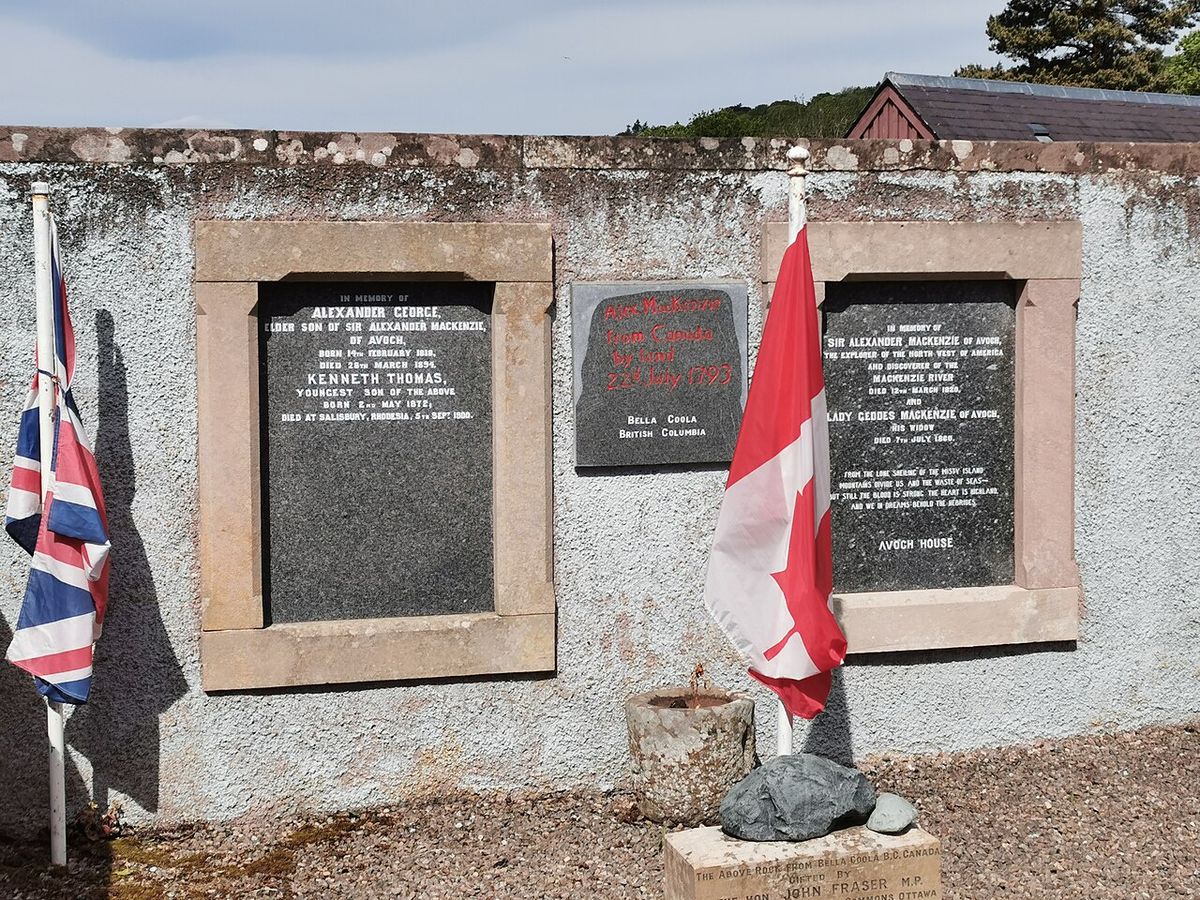
In 1801, the same year his journals were published, Mackenzie returned to London and began focusing on his personal life and business ventures. In 1812, at approximately 48 years of age, he returned to Scotland where he married 14-year-old Geddes Mackenzie, a twin heiress of the Avoch estate. Her grandfather, Captain John Mackenzie of Castle Leod, a great-grandson of George Mackenzie, 2nd Earl of Seaforth, had purchased the estate of Avoch with money left to him by his first cousin and brother-in-law, Admiral George Geddes Mackenzie. The couple had two sons and a daughter, and the Mackenzies lived alternately in Avoch and London, managing their affairs between Scotland and the capital. Lady Mackenzie's father was a first cousin of the father of George Simpson, who later became the influential Governor of the Hudson's Bay Company, linking two significant families in the history of the North American fur trade. Mackenzie died on 12 March 1820, from Bright's disease, at about the age of 56, as his exact date of birth remains unknown. He was buried at Avoch on the Black Isle in Scotland, leaving behind a family and a considerable legacy from his explorations.
Legacy and Commemoration
Alexander Mackenzie's legacy is deeply woven into the map and culture of Canada, with his name attached to some of the country's most significant geographic features. The Mackenzie River, the country's longest river system, is his most monumental namesake, a vital waterway he followed to the Arctic Ocean. Numerous other geographic features bear his name, including Mount Sir Alexander in British Columbia, Mackenzie Bay, and the district municipality of Mackenzie, British Columbia. His historic 1793 route is commemorated by the Alexander Mackenzie Heritage Trail, a rugged 420-kilometre hiking path from Quesnel to Bella Coola that takes about three weeks to complete and includes sections in Tweedsmuir Provincial Park, following the grease trails used by Indigenous traders. The site of his Pacific coast inscription is preserved within Sir Alexander Mackenzie Provincial Park, approximately 65 kilometres northwest of Bella Coola, which is designated the First Crossing of North America National Historic Site. In 2016, Mackenzie himself was designated a National Historic Person by the Government of Canada, a formal recognition of his contributions to the nation's history.
His influence extends into education, horticulture, and popular culture, with many institutions and projects created to honour his memory. Several schools across Canada are named for him, serving as daily reminders of his journey for thousands of students. A rose cultivar from Agriculture and Agri-Food Canada's Explorer Series, developed in 1985, was named the Alexander Mackenzie rose in his honour, blending natural beauty with historical commemoration. Between 1989 and 1993, Lakehead University organized the Mackenzie Bicentennial Sea-to-Sea Expeditions, a segmented re-enactment of his journey between Montreal and Bella Coola, but it was unable to complete the final overland 350-kilometre Grease Trail when its First Nation owners refused permission, highlighting the ongoing importance of Indigenous stewardship. His story continues to inspire historical works, appearing as a running theme in contemporary literature such as the 2025 novel Boundary Waters by Tristan Hughes, and he is referenced in the 1981 folk song "Northwest Passage" by Stan Rogers, which has become a Canadian cultural staple.
Notable places named in honour of Alexander Mackenzie include the Mackenzie River and Mount Sir Alexander. Other places named for him are Mackenzie Bay and the municipality of Mackenzie in British Columbia. The site of his Pacific arrival is now Sir Alexander Mackenzie Provincial Park and is designated the First Crossing of North America National Historic Site. Several schools across Canada also bear his name.
- The Mackenzie River, Canada's longest river system, which he explored in 1789.
- Mount Sir Alexander, a mountain in the Canadian Rockies of British Columbia.
- Mackenzie Bay, a body of water in the Arctic.
- The municipality of Mackenzie, British Columbia, a district municipality.
- Sir Alexander Mackenzie Provincial Park, BC, the site of his rock inscription.
- The Alexander Mackenzie Heritage Trail, a 420 km hiking route from Quesnel to Bella Coola.
- Sir Alexander Mackenzie Senior Public School in Toronto, Ontario.
- Sir Alexander Mackenzie Elementary School in Vancouver, British Columbia.
- Sir Alexander Mackenzie Elementary School in St. Albert, Alberta.
- Sir Alexander Mackenzie School in the Bella Coola Valley, British Columbia.
Places to Explore Mackenzie's History
For those wishing to engage with Mackenzie's story firsthand, several key sites across Canada offer a tangible connection to his explorations and the era of the fur trade. The most direct is Sir Alexander Mackenzie Provincial Park on the central coast of British Columbia, where visitors can see the inscribed rock that was permanently carved by surveyors under Captain R.P. Bishop in 1923, creating a permanent monument to the 1793 journey. The Alexander Mackenzie Heritage Trail provides an adventurous multi-week hike for experienced trekkers seeking to retrace the final, rugged overland segment of his route along historic Indigenous trade networks. In Alberta, the region around Fort Chipewyan on Lake Athabasca is significant as his departure point for both major expeditions, though the original fort site is historical. Artifacts from Mackenzie's life, along with those of fellow explorer David Thompson, are held in the collection of the Canadian Museum of History, allowing for scholarly and public engagement with original materials. While not directly related to the explorer, the Mackenzie King Estate in Gatineau Park, Quebec, is a popular historic site that shares part of his surname. It was the 231-hectare country estate of Prime Minister William Lyon Mackenzie King and features magnificent English and French gardens, historical ruins, and museums that are open to the public seasonally from May to September, though the main cottage, Moorside, was closed for repairs for the 2026 season. This estate, a favourite on the Chemins d'eau tourist route, represents a different chapter of Canadian history but shows the enduring use of the Mackenzie name in the national narrative.
Questions about Alexander Mackenzie
What did Alexander Mackenzie discover?
Alexander Mackenzie did not 'discover' lands new to humanity, as Indigenous peoples had inhabited the regions for millennia and he relied heavily on their guides and existing trade networks. He was, however, the first recorded European to cross the continent of North America north of Mexico, reaching the Pacific Ocean at Bella Coola in 1793, twelve years before the American Lewis and Clark expedition. His 1789 expedition was the first by a European to follow the Mackenzie River to the Arctic Ocean, dramatically expanding European geographic knowledge of Canada's northwest. His journeys provided crucial information about western geography, including the first European record of the Carrier language, and he accurately mapped latitudes using skills he learned in Britain in 1791.
What is written on the Alexander Mackenzie Rock?
On 22 July 1793, using a reddish paint made of vermilion and bear grease, Mackenzie inscribed on a rock at Dean Channel: "Alexander Mackenzie, from Canada, by land, the twenty-second of July, one thousand seven hundred and ninety-three. The inscription commemorated his overland journey from Montreal, with 'Canada' at the time referring specifically to the former French territory in what is now southern Quebec and Ontario. The words, partly abbreviated, were later permanently inscribed into the rock by surveyors under Captain R.P. Bishop and his team in 1923 to preserve the message. The site is now within Sir Alexander Mackenzie Provincial Park and is designated the First Crossing of North America National Historic Site.
How long is the Alexander Mackenzie Heritage Trail?
The Alexander Mackenzie Heritage Trail is approximately 420 kilometres long, representing a rugged and challenging wilderness hiking route. It runs from Quesnel to Bella Coola in British Columbia, retracing the final overland segment of Mackenzie's 1793 journey along a historic grease trail used by Indigenous traders to bring fish oil from the coast. The trail includes sections through Tweedsmuir Provincial Park and typically takes about three weeks to complete, requiring significant preparation and backcountry skills. It is not a continuous, manicured path but a sign of the difficult terrain Mackenzie and his party crossed with the guidance of local Indigenous peoples.
What river is named after Alexander Mackenzie?
The Mackenzie River, the longest river system in Canada, is named in his honour. Mackenzie followed this river, known to the Dene as the Dehcho, to its mouth at the Arctic Ocean during his 1789 expedition. Although he reportedly called it the "River Disappointment" in a private letter to his cousin Roderick for not leading to the Pacific, this name is considered apocryphal as his own and contemporary records refer to it simply as the "Grand River. His journey on this river covered over 4,800 kilometres round trip from Fort Chipewyan in just over three months, a monumental feat of endurance and exploration.
Was Alexander Mackenzie knighted?
Yes, Alexander Mackenzie was knighted in 1802 by King George III. This honour was in recognition of his historic explorations and the publication of his journals, Voyages from Montreal, in London in 1801, which became a bestseller. His knighthood was a rare honour for a fur trader and explorer at the time, lifting his status and allowing him to use the title Sir Alexander Mackenzie. He returned to Canada after his knighthood and was lionized, later serving in the Legislature of Lower Canada from 1804 to 1808 as a respected public figure.
Where is Alexander Mackenzie buried?
Sir Alexander Mackenzie is buried in Scotland at the Avoch estate on the Black Isle. He died on 12 March 1820 near Dunkeld from Bright's disease, a historical term for kidney disease, at about the age of 56. His final resting place is on the estate he owned through his marriage to Geddes Mackenzie, the twin heiress of Avoch. The Mackenzies had lived alternately at Avoch and in London after their marriage in 1812, and he was buried there following his death, leaving a legacy that stretches across the Atlantic to Canada.
Sources and further reading
- Alexander Mackenzie (Wikipedia)
- Sir Alexander Mackenzie (Explorer) (thecanadianencyclopedia.ca)
- Alexander Mackenzie Rock (sailinginnisfree.com)
Checked by the Novello Desserts desk. Last updated 2026-10-27.