Haskell Free Library and Opera House
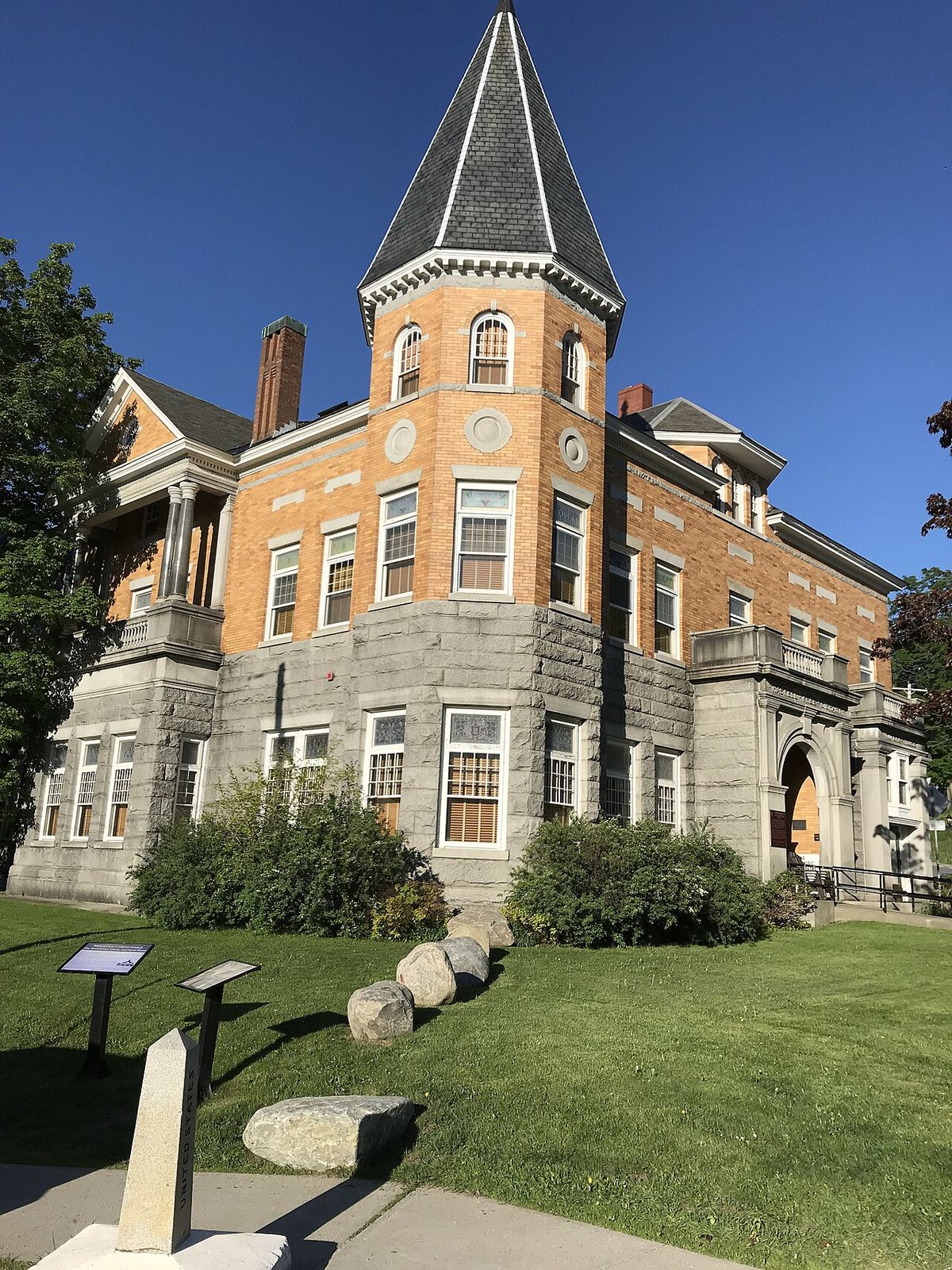
The Haskell Free Library and Opera House is a unique Victorian building that straddles the international border between Stanstead, Quebec, and Derby Line, Vermont. It was constructed in 1904 as a gift from Martha M. Haskell and her son Horace Stewart Haskell to the binational community, deliberately built on the border. The building incorporates a library with over 20,000 books and a 400-seat theatre, with the library collection and theatre stage in Canada and the main entrance and most seats in the United States. It was designated a National Historic Site in Canada in 1985 and has been listed on the United States National Register of Historic Places since 1976, also being recognized as a provincial heritage site in Quebec since 1977.
Architecture and Design
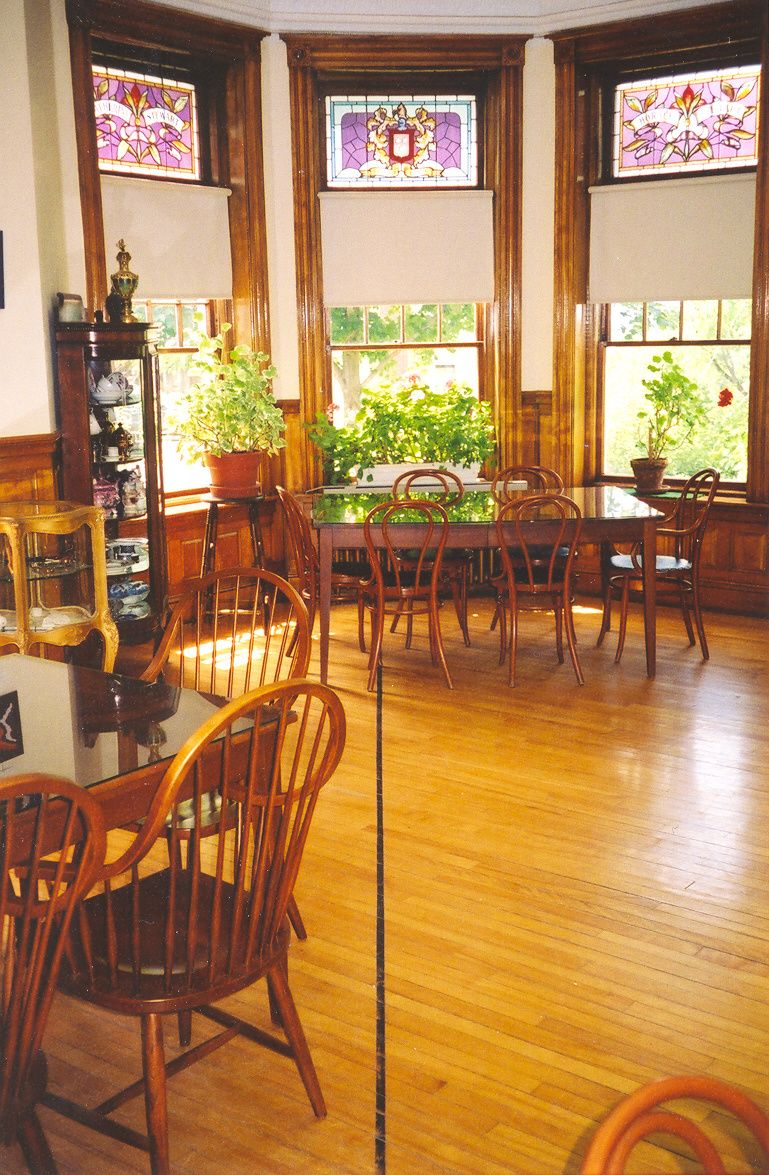
The Haskell Free Library and Opera House is a three-storey Victorian structure built in the Queen Anne Revival style by architect James Ball. Its construction utilized local granite from Stanstead, forming walls two feet thick. The building's most distinctive feature is its deliberate placement across the Canada-United States border, a decision made by its founders to ensure equal access for residents of both nations. A thick black line runs diagonally across the library floor and through the opera house above to mark the precise location of the international boundary. The first floor houses the library's reading rooms and collections, while the second and third floors contain the theatre, creating a physical and cultural layering within a single edifice. The building has two official addresses and postal codes: 93 Caswell Avenue in Derby Line, Vermont, and 1 rue Church in Stanstead, Quebec, reflecting its dual nationality.
The opera house auditorium is noted for its ornate plaster scrollwork and cherubs, crafted in Boston, and its original painted scenery. A drop curtain featuring a scene of Venice and four other backdrops were created by artist Erwin Lamoss in 1901. The stage and half of the theatre's 400 seats are located in Canada, while the remainder of the auditorium, including the main entrance and balcony, is in the United States. This unusual configuration has led to the building being humorously referred to as the only opera house in the United States with no stage, as the performance area is situated in Quebec. The deliberate split means the library collection and the theatre stage are in Stanstead, Quebec, but the main entrance and most theatre seats are in Derby Line, Vermont.
Library Operations and Collection
The library on the ground level maintains a collection of more than 20,000 volumes in both English and French, reflecting the bilingual character of the region. It operates as a free public library five days a week for residents within a 50-kilometre or 30-mile radius, who must provide proof of address such as a utility bill to obtain a membership card. The collection is organized with English and French books shelved separately due to different printing conventions for spine titles. English-language titles are typically printed to be read top-to-bottom, while most French-language titles are printed bottom-to-top. This organizational method addresses a practical difference between the two language traditions served by the library. For over a century, access for Canadian patrons was facilitated by a special arrangement allowing them to use the main entrance in Vermont without formally reporting to U.S. Customs, provided they followed a prescribed route along the Church Street sidewalk and returned directly to Canada upon exiting.
This changed in October 2025 when the United States government permanently closed that sidewalk access for security reasons. In response, the library initiated a major project to create a dedicated Canadian entrance, which opened in April 2026. The new entrance, constructed from a former emergency exit, provides direct access from Quebec, though it initially required using multiple flights of stairs through the opera house. The library's own project page indicated the Canadian Door project began in October 2025 and was scheduled for completion in May 2026. Library staff have implemented various security measures over the years and provide advance notice to both U.S. and Canadian officials regarding large gatherings held within the building.
Founding and Early History
The building was a gift from Martha Stewart Haskell and her son, Colonel Horace Stewart Haskell, of Derby Line, Vermont, constructed in memory of Martha's parents, Catherine and Horace Stewart, and her husband, Carlos Freeman Haskell. Construction began in 1901 with the explicit intention of creating a shared resource for the neighbouring communities. The opera house opened on June 7, 1904, and the library began operations the following year. The Haskell family later donated the building to the towns of Derby Line and Rock Island, which is now part of Stanstead. Since its inception, it has been governed by a private board of trustees consisting of four American and three Canadian directors, ensuring binational oversight. The reported construction cost was approximately $25,000 in 1904, which is equivalent to about $895,833 in 2025 dollars.
The building's heritage significance was formally recognized in both countries starting in the 1970s. It was added to the United States National Register of Historic Places in 1976. In Canada, it was declared a provincial heritage site in 1977 and was designated a National Historic Site of Canada in 1985. These designations acknowledge its unique architectural value and its historical role as a deliberately cross-border community institution. The building is a physical reminder of a period of more open relations and shared local identity between the two nations. The Haskells chose the open border site specifically so Canadians and Americans would have equal access to the library and opera house, fulfilling their philanthropic vision.
Recent History and Border Policy Changes
The library's status as a border-straddling building has made it a focal point during periods of changing international security policy. In the 2010s, it briefly served as a site for cross-border family reunions following travel restrictions implemented in January 2017. A 2018 court case revealed that the building's bathroom had been used in a handgun smuggling scheme between 2010 and 2011, where individuals hid firearms purchased in the U.S. to bring them into Canada. The most significant operational changes began in the 2020s. In January 2025, a visit by then U.S. Homeland Security Secretary Kristi Noem drew criticism after she stepped onto the Canadian side of the library and referred to Canada as the 51st state, prompting a petition from border residents for an apology.
In March 2025, the United States government announced that, effective October 1, 2025, Canadian patrons could no longer use the main Vermont entrance unless they first cleared U.S. Customs. This effectively closed the historic shared entrance to most Canadian visitors and tourists, though library staff and cardholders retained access for a time. The sidewalk connecting the two countries beside the building was permanently closed. American officials cited security concerns for the change, despite acknowledging there had been very few security or smuggling issues. This policy shift ended a century-old tradition of informal cross-border movement within the building and necessitated a fundamental change in how the institution operated from the Canadian side. In the interim period before the new Canadian entrance was built, the only Canadians permitted to use the main entrance were staff and existing library card holders, while visitors and tourists were excluded.
- January 2017: The library sees use for international reunions following travel bans.
- January 2018: A Montreal man pleads guilty to using the library in a handgun smuggling scheme from 2010 to 2011.
- January 2025: U.S. Homeland Security Secretary Kristi Noem's visit and comments spark controversy.
- March 2025: U.S. announces restriction on Canadian use of main entrance, effective October 1, 2025.
- October 2025: Sidewalk access closed. Library launches fundraiser for a Canadian entrance.
- March 2026: A joint U.S.-Canadian protest occurs outside the building criticizing United States Immigration and Customs Enforcement and the escalation of the Middle Eastern crisis.
- April 2026: New permanent Canadian entrance opens to the public.
- June 10, 2026: Official ribbon-cutting ceremony for the new entrance is held, officiated by the mayor of Stanstead.
The New Canadian Entrance Project
Faced with the loss of access for its Canadian patrons, the library's board launched an urgent project to create a dedicated entrance on the Quebec side of the building. The project, dubbed the Canadian Door, began in October 2025. Officials initially aimed to raise CA$100,000 but launched a crowdsourcing campaign that garnered overwhelming support. Author Louise Penny made a major donation, and the fundraiser reached CA$170,000 within a week. By early April 2025, an emergency door was repurposed as a temporary public entrance, though it required visitors to climb three flights of stairs, cross the upstairs opera house, and then walk down three more flights to reach the library level. This temporary solution allowed visiting non-members to access the library from the Canadian side while the permanent structure was planned and built.
The permanent entrance project was far more extensive. The final cost was approximately C$700,000, funded by over $350,000 from the public campaign and the balance from the library's building fund. The new entrance, reported as open in April 2026, was officially inaugurated with a ribbon-cutting ceremony on June 10, 2026, officiated by the mayor of Stanstead. The president of the library's board of trustees stated the project cost C$700,000, with the overall cost noted to be in excess of $500,000. This significant capital project ensured the library's continued service to its Canadian community while adapting to new border enforcement realities. The success of the fundraiser demonstrated the deep affection and support the institution commands on both sides of the border, transforming a security challenge into a community achievement.
Cultural Role and Programming
The Haskell Opera House functions as a vital community cultural centre, hosting a variety of performances, events, and guided tours. The 400-seat theatre is used for concerts, plays, lectures, and community gatherings. Guided tours of the historic building are offered to the public for a fee of $10 per adult, with free admission for children under a certain age. The library also serves as a venue for book launches and other literary events, including a Louise Penny book launch as promoted on its website. Its programming strives to reflect and serve the binational community, even as physical access patterns have shifted. The building remains a powerful symbol of shared culture, attracting tourists interested in its unique architecture and geopolitical story. The institution describes itself as a community cultural centre hosting events and rents out the opera house venue for private functions.
The institution's cultural significance has inspired artistic works, including the play A Distinct Society by Kareem Fahmy, which is based on family reunions that once took place at the library. The building's very existence challenges conventional notions of borders and community. While security protocols have changed, the library and opera house continue to operate as a single entity, managing the complexities of its location through cooperation between its American and Canadian directors. It is an enduring example of the vision of its founders who sought to create a common ground for education and the arts. As a heritage building and a cultural centre, the Haskell Free Library and Opera House plays a role in enriching the lives of its members and the wider community on both sides of the border.
Governance and Finances
The Haskell Free Library and Opera House is operated by a private, binational board of trustees, a structure established when the building was donated to the two communities. The board comprises four directors from the United States and three from Canada, ensuring representation from both nations in all operational decisions. This governance model is essential for managing the legal, regulatory, and financial complexities of running a building that exists in two jurisdictions. The library is funded through a combination of private donations, fundraising campaigns, rental income from the opera house, and likely municipal support or grants, though it offers free membership to local residents. Major projects, such as the construction of the new Canadian entrance, are funded through dedicated campaigns. The table below outlines key financial figures related to recent capital projects and operational context.
| Item or Project | Cost (CAD) | Timeframe / Notes |
|---|---|---|
| Original Construction | ~$25,000 (1904) | Equivalent to ~$895,833 in 2025 |
| New Canadian Entrance Fundraising Goal | $100,000 | Initial target in October 2025 |
| Amount Raised in First Week | $170,000 | Exceeded initial goal |
| Final Project Cost | $700,000 | As reported by board president in 2026 |
| Crowdfunding Contribution | Over $350,000 | Part of the final $700,000 cost |
| Cost Noted as 'In Excess Of' | $500,000 | Alternative figure reported for the new entrance |
The library's financial resilience, demonstrated by the rapid fundraising for the new entrance, highlights its strong community support. Ongoing operational costs are managed by the board, which must address maintenance for a historic building and programming expenses while respecting the laws and regulations of two countries. The library's ability to raise substantial funds quickly for a necessary capital improvement shows its continued relevance and the value placed on it by the public. The financial model relies on this active community engagement and philanthropic support to maintain its unique binational mission.
Comparable International Sites
The Haskell Free Library and Opera House is one of several structures worldwide built across an international boundary. These sites share the peculiar characteristic of existing in two legal jurisdictions simultaneously, often creating unique administrative and social situations. The building is sometimes categorized as a line house, a term for a building that straddles an international boundary. Other famous examples include the Hotel Arbez in La Cure, a village divided between Switzerland and France, which is bisected by the border along with at least two residences and a pub. In Europe, the intertwined municipalities of Baarle-Nassau (Netherlands) and Baarle-Hertog (Belgium) feature a complicated borderline with numerous enclaves where buildings are split.
In North America, other border-straddling communities exist, such as Estcourt Station, Maine, and Pohénégamook, Quebec. The Collins-Valentine line is the surveyed boundary between Quebec and the states of Vermont and New York, established in the early 1770s. A different type of transnational building is the Paul VI Audience Hall in Vatican City, which is located partially in Vatican City and mostly in Rome, Italy, with the Italian part treated as an extraterritorial area of the Holy See. While each of these sites has its own history, the Haskell is distinct for being deliberately built on the border as a philanthropic gift intended to serve two national communities equally from its inception.
Questions about Haskell Free Library and Opera House
Can you cross the border inside the Haskell Free Library?
Yes, the international border is marked by a black line on the floor inside the building. Historically, visitors could physically step from one country to the other. However, since October 2025, Canadian visitors are no longer permitted to use the main U.S. entrance to cross into the building without first reporting to U.S. Customs. The library has since opened a dedicated entrance on the Canadian side, so crossing the border inside is no longer a routine part of access for Quebec patrons, though the line remains visible as a historical feature. Family reunions and cross-border visits within the building are explicitly no longer allowed, and entrances are monitored by both government border agencies.
Why was the Haskell Library built on the border?
The founders, Martha and Horace Haskell, deliberately chose the border site to ensure that residents of both Derby Line, Vermont, and Rock Island (Stanstead), Quebec, had equal access to the cultural and educational resources. They wanted to create a shared community institution that would serve neighbours on both sides of the then-open border. The building was a gift in memory of Martha Haskell's parents and husband, intended to foster binational goodwill and shared cultural life. The Haskells explicitly wanted Canadians and Americans to have equal access to the Library and Opera House, which led to the decision to build directly on the international boundary.
What happened to the library's access in 2025?
In March 2025, the United States government announced that, starting October 1, 2025, Canadian patrons could no longer use the library's main entrance in Vermont unless they first cleared U.S. Customs and Border Protection. The sidewalk connecting the countries beside the building was permanently closed. This change was based on cited security concerns. It effectively ended the long-standing practice of informal cross-border access for Canadian visitors and tourists, prompting the library to create a new entrance exclusively on the Quebec side. In the interim, only Canadian staff and library card holders were allowed to use the main entrance, while general visitors were precluded.
How much did the new Canadian entrance cost?
The project to construct a permanent, accessible entrance on the Canadian side cost approximately C$700,000 according to the board president. Funding was secured through a successful crowdsourcing campaign that raised over $350,000, with the remainder coming from the library's building fund. The fundraiser initially aimed for $100,000 but surpassed that goal within a week, thanks in part to a major donation from author Louise Penny and widespread community support. The overall cost was also noted to be in excess of $500,000, reflecting the complexity of modifying a heritage structure.
Is the Haskell Opera House still used for performances?
Yes, the 400-seat opera house remains an active theatre and community venue. It hosts a variety of cultural events, including concerts, plays, and lectures. Guided tours of the historic theatre are also offered to the public for a fee. The stage is located in Canada, while most of the seats are in the United States, creating a unique performance environment. The venue can be rented for events, and it continues to be a central part of the institution's cultural programming. The opera house is described as a remarkable theatre and is actively promoted for events on the library's official website.
How do I get a library card at the Haskell?
Membership is free for individuals who live within a 50-kilometre or 30-mile radius of the library. To obtain a card, you must provide documentation confirming your address, such as a utility bill. The library serves a binational community, so eligible residents from both Quebec and Vermont can join. The collection features over 20,000 books in English and French, organized separately due to different printing conventions for spine titles. The free membership and geographic restriction are designed to serve the immediate cross-border community that the building was originally gifted to benefit.
Sources and further reading
- Haskell Free Library and Opera House (Wikipedia)
- Watch: US-Canada border library gets new Quebec-only ... (bbc.com)
Checked by the Novello Desserts desk. Last updated 2026-10-29.