Inuksuk
An inuksuk (plural inuksuit) is a traditional stone landmark or cairn built by Inuit peoples across the North American Arctic, including northern Canada, Greenland, and Alaska. These structures, whose name means 'that which acts in the capacity of a human,' have historically served practical purposes such as navigation, marking travel routes, hunting grounds, and food caches. In contemporary times, the inuksuk has evolved into a powerful cultural symbol for Inuit and a widely recognized emblem of Canada, featuring on the flag of Nunavut and as the logo for the 2010 Vancouver Winter Olympics. Its presence from ancient communal constructions to modern artistic installations reflects a deep connection to the land and a symbol of guidance and unity.
Historical Significance and Construction
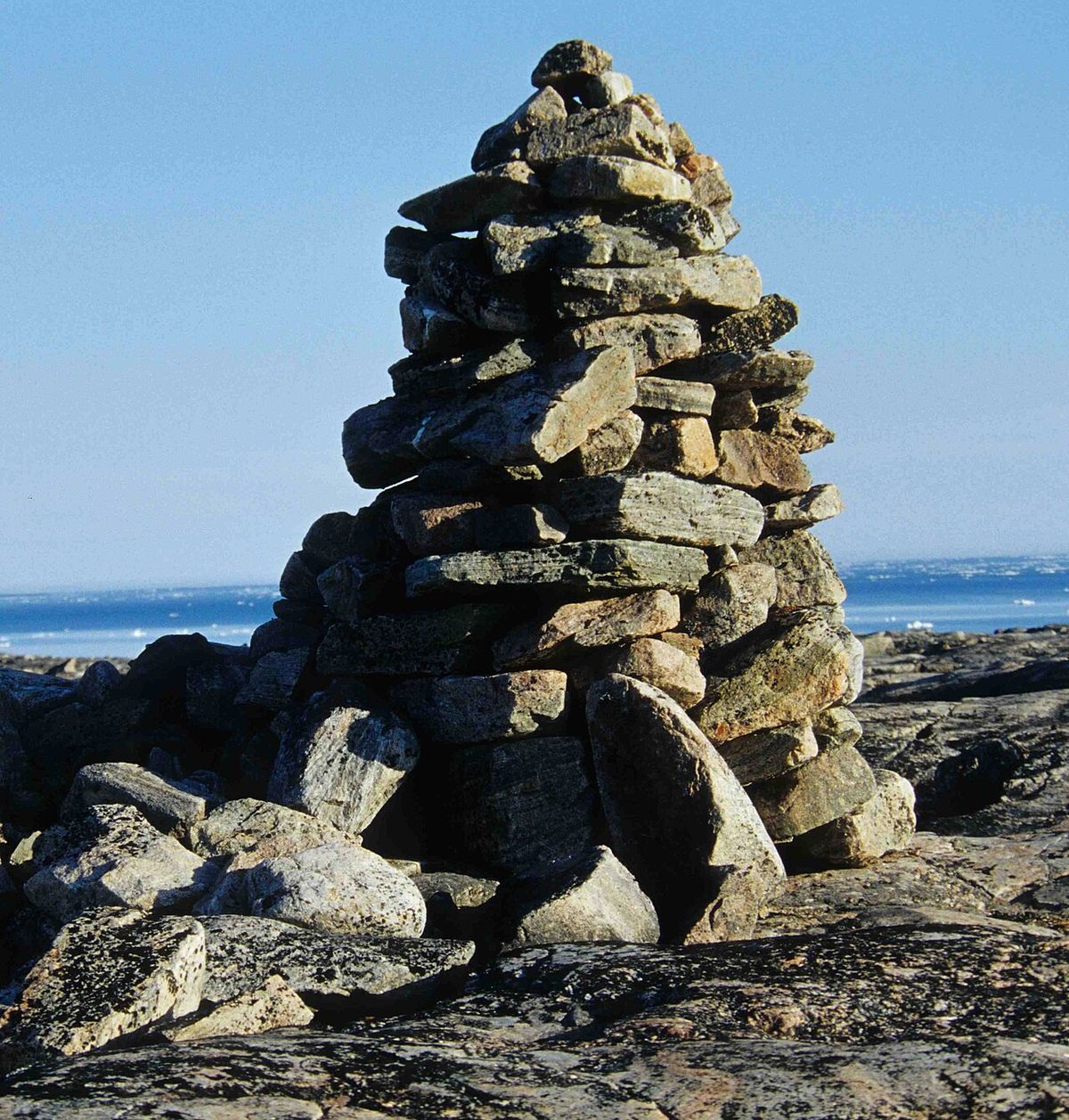
The inuksuk has ancient roots in Inuit culture, serving as a vital tool for survival and orientation in the vast, landmark-sparse tundra biome north of the Arctic Circle. These structures were built by various Inuit groups, including the Iñupiat, Kalaallit, and Yupik, for a multitude of practical purposes. Historically, inuksuit functioned as navigational aids, markers for travel routes and fishing places, indicators of hunting grounds or camps, and as signs to mark food caches or places of veneration. The Iñupiat in northern Alaska notably used them as part of drift fences to assist in herding caribou into contained areas for hunting, demonstrating a specific hunting application. The simplest form is a single upright stone, while larger, more complex formations were often communal projects, with the size of some suggesting the coordinated effort of many people working together.
Inuksuit are typically built stone upon stone, with their shapes and sizes varying significantly based on their intended function and available materials. A key site for understanding their historical prevalence is Inuksuk Point (Enukso Point) on Baffin Island, Nunavut, which contains a remarkable concentration of over 100 inuksuit. This site's cultural importance was formally recognized when it was designated a National Historic Site of Canada in 1969, protecting it for future study. Another notable formation, the Hammer of Thor on the Ungava Peninsula in Quebec, is considered by researchers to be a likely inuksuk rather than an artifact of Viking origin, which further points to the widespread use of these structures across the Arctic landscape by its Indigenous peoples.
Terminology and Distinctions
The word inuksuk means 'that which acts in the capacity of a human'. It comes from the morphemes inuk, meaning 'person', and -suk, meaning 'ersatz, substitute'. The pronunciation is inutsuk in Nunavik and the southern part of Baffin Island for linguistic reasons. While the predominant English spelling is inukshuk, both the Government of Nunavut and the Government of Canada promote the Inuit-preferred spelling inuksuk. A structure similar to an inuksuk is called an inunnguaq, which means 'imitation of a person' and is meant to represent a human figure.
The inunnguaq, though widely familiar to non-Inuit and particularly prevalent in Greenland, is not the most common type of traditional inuksuk used for wayfinding or hunting. It is a specific subtype distinguished from the broader category of inuksuit, which encompasses all stone landmarks built for the various practical purposes previously described. This distinction became a point of public discussion during the adoption of an inunnguaq-style figure as the emblem for the 2010 Vancouver Winter Olympics, highlighting the importance of precise terminology in cultural representation. The debate made clear that while the inunnguaq is a powerful symbol, it represents only one form within a much wider and older tradition of stone building.
Evolution into a National Symbol
While remaining a central Inuit cultural symbol, the inuksuk, particularly the inunnguaq form, has been adopted as a mainstream Canadian national symbol over recent decades. Its official prominence is clearest in the Canadian territory of Nunavut, where an inuksuk is the centrepiece of both the flag and the coat of arms, and in the flag of the Inuit region of Nunatsiavut. This symbolic adoption extends to institutions like Inuksuk High School in Iqaluit, named directly for the landmark. The landmark's symbolic weight was leveraged internationally in 1999 for the 'Inukshuk' International Arctic Art & Music Project by ARBOS, which staged events across Quebec, Ontario, Nunavik, Nunavut, Greenland, Austria, Denmark, and Norway, spreading its image.
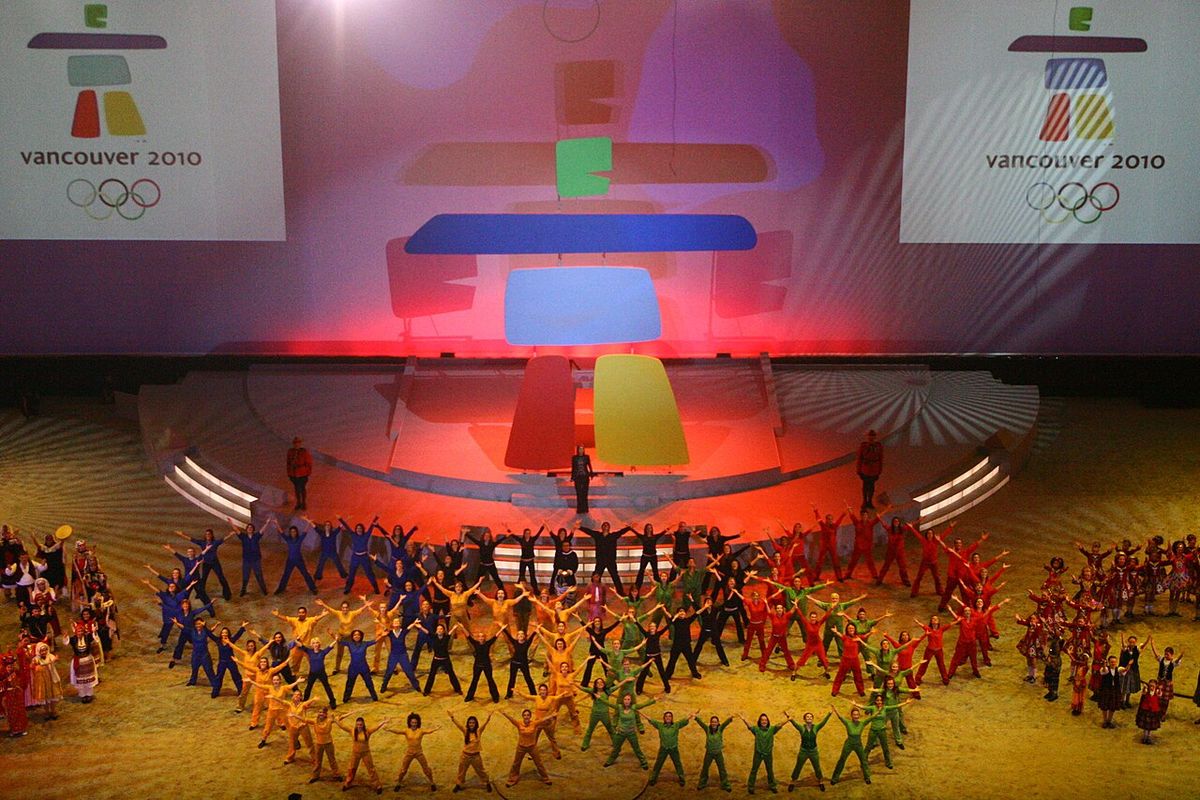
The inuksuk's role in asserting Canadian sovereignty was demonstrated on July 13, 2005, when Canadian military personnel erected one on Hans Island alongside a plaque and flag during the territorial dispute with Denmark known as the Whiskey War. Domestically, large inuksuit have been erected as gateways to tourist regions, such as a 9-metre (30-foot) tall structure in Toronto's Battery Park commemorating World Youth Day 2002. The most significant boost to its global recognition came from its selection as the basis for the logo of the 2010 Winter Olympics in Vancouver, designed by artist Elena Rivera MacGregor. Although its use was controversial among some Inuit and First Nations groups in British Columbia, the design was said to pay tribute to the inuksuk built by Alvin Kanak at English Bay in 1986, with both structures symbolizing friendship and welcome to visitors from around the world.
Global Presence and Contemporary Installations
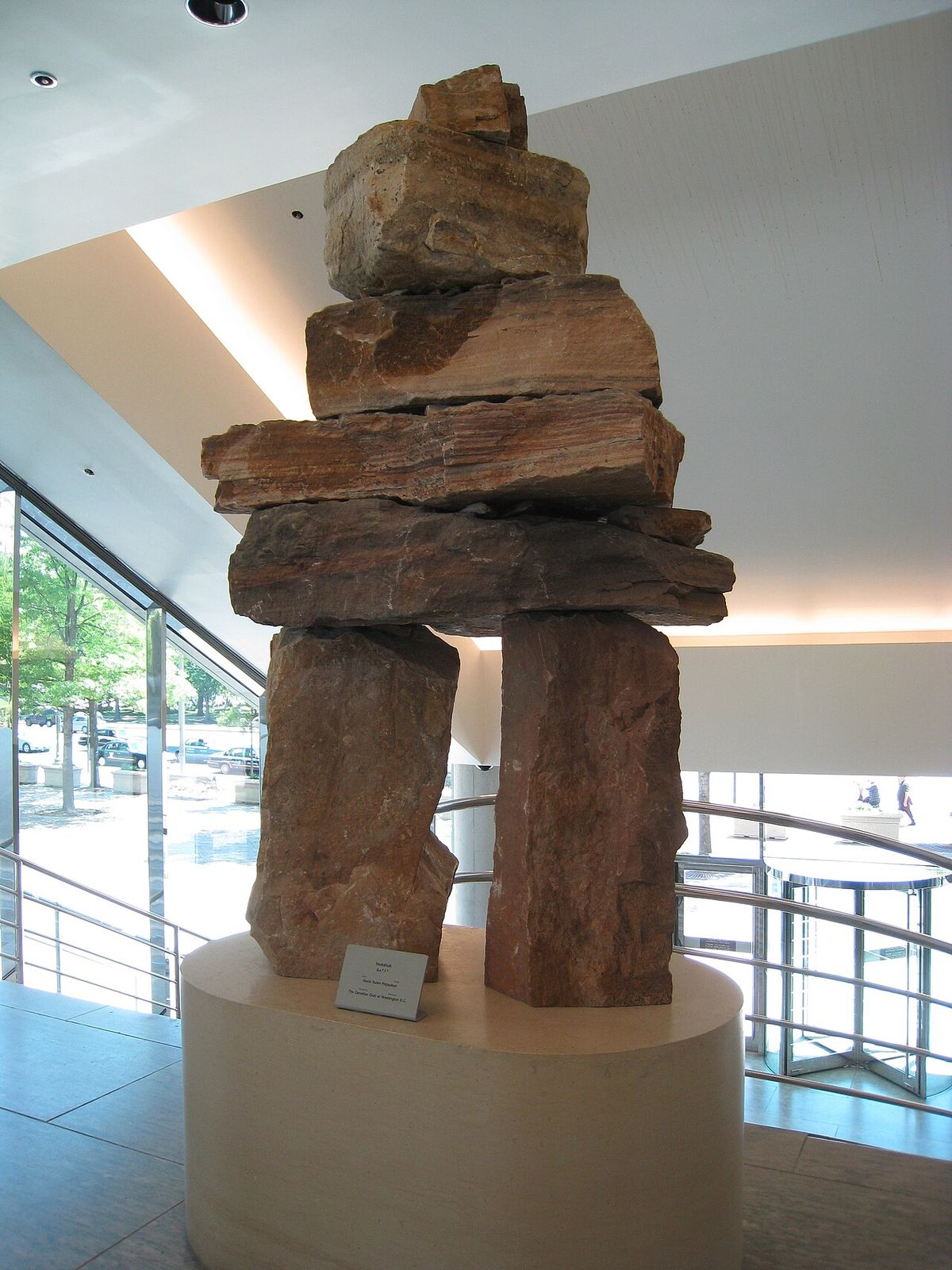
There are five authentic inuksuit which were donated to other jurisdictions by the government of Canada. They are located in Brisbane, Australia, Monterrey, Mexico, Oslo, Norway, Washington, D.C., United States, and Guatemala City, Guatemala. A Canadian-donated inuksuk was built in Monterrey, Mexico, in October 2007 by the Inuvialuk artist Bill Nasogaluak. The sculpture was presented as a gift from the Monterrey chapter of the Canadian Chamber of Commerce in Mexico and the Government of Canada to mark the chamber's 10th anniversary. Nasogaluak personally chose the rocks for the structure from a local quarry near Monterrey. The inuksuk contains two rocks which the artist took to Mexico from Canada, one from the high Arctic and another from his home town of Toronto, and together they form the inuksuk's heart.
Beyond government projects, the form has been used in activism and personal expression across the country. In 2015, a group near Hamilton, Ontario, constructed 1,181 inuksuit on the Chedoke Rail Trail to memorialize Missing and Murdered Indigenous Women and spur government action, contributing to the momentum for a national inquiry that was launched that year. The inuksuk has also been used for official commemorations, such as when Canadian Minister of Justice Jody Wilson-Raybould donated one to the International Criminal Court in The Hague on March 7, 2018, to mark the 20th anniversary of the Rome Statute. According to Guinness World Records, the tallest inuksuk is located in Schomberg, Ontario, standing 11.377 metres (37.33 ft) tall and built in 2007, holding a global record for its scale.
Controversies and Management
The popularization of the inuksuk has led to management challenges in Canadian wilderness areas, where park officials routinely dismantle inuksuit built by hikers and campers. These unofficial structures can misdirect visitors away from official trail markers and cairns, creating potential safety hazards and environmental impact. The proliferation became so pronounced in Killarney Provincial Park on Georgian Bay, Ontario, that the park issued a formal notice in 2007 urging visitors to 'stop the invasion' of inuksuit to protect the park's integrity. Similarly, a large number have been built along sections of the Trans-Canada Highway, such as Highway 69 between Sudbury and Parry Sound, where a journalist counted 93 inuksuit in 2010 and found one builder who described it as a spontaneous act following a family funeral.
The adoption of the inunnguaq figure for the 2010 Vancouver Olympics logo sparked cultural controversy that received significant media attention. While organizers cited themes of friendship and welcome, the design was questioned by some Inuit and First Nations in British Columbia who felt it appropriated and simplified a specific cultural symbol without adequate consultation. This debate highlighted the tension between the inuksuk's role as a unifying national emblem and its origins as a functional and culturally specific object of the Inuit. The discussion made clear the importance of understanding the distinction between an inunnguaq and other inuksuit forms, and pointed to the need for respectful engagement with Indigenous cultural intellectual property in national projects.
Notable Sites and Structures
At Inuksuk Point on Baffin Island, there are more than 100 inuksuit and the site was designated a National Historic Site of Canada in 1969. According to Guinness World Records, the tallest inuksuk is in Schomberg, Ontario, Canada, built in 2007 and standing 11.377 metres tall. On July 13, 2005, Canadian military personnel erected an inuksuk on Hans Island as part of Canada's dispute with Denmark over the island. A 9 metre inuksuk stands in Toronto on the shores of Lake Ontario, commemorating the World Youth Day 2002 festival.
- Inuksuk Point (Enukso Point), Baffin Island, Nunavut: This National Historic Site of Canada, designated in 1969, contains one of the largest known collections of ancient inuksuit, with over 100 structures used for navigation and communication.
- Alvin Kanak's Inuksuk (1986), English Bay, Vancouver, British Columbia: This inunnguaq-style inuksuk became a local landmark and was cited as an inspiration for the 2010 Winter Olympics logo promoting themes of welcome.
- 2010 Winter Olympics Logo, Vancouver: Designed by Elena Rivera MacGregor, this emblem based on an inunnguaq brought the symbol to a global audience of billions, albeit with associated cultural controversy.
- Tallest Inuksuk (2007), Schomberg, Ontario: Recognized by Guinness World Records, this structure stands 11.377 metres (37.33 ft) tall and represents a modern interpretation of the form.
- Battery Park Inuksuk, Toronto, Ontario: A 9-metre (30-foot) tall inuksuk erected to commemorate the World Youth Day 2002 festival held in the city in July of that year.
- Monterrey Inuksuk (2007), Monterrey, Mexico: Created by artist Bill Nasogaluak, this was a diplomatic gift featuring stones from Canada and Mexico, standing over the Santa Lucía Riverwalk.
- International Criminal Court Inuksuk (2018), The Hague, Netherlands: Donated by Canada as a symbol of support for the ICC and commitment to reconciliation with Indigenous peoples.
Inuksuit continue to serve as an Inuit cultural symbol and are increasingly serving as a mainstream Canadian national symbol. A large number of inuksuit have been built in some areas along the Trans-Canada Highway, including Northern Ontario. Officials in various wilderness parks throughout Canada routinely dismantle inuksuit constructed by hikers and campers for fear that they could misdirect park visitors. In 2015, a small group of women near Hamilton, Ontario, constructed 1,181 inuksuit on the Chedoke Rail Trail to memorialize the issue of Missing and Murdered Indigenous Women.
Cultural and Functional Legacy
The lasting importance of the inuksuk lies in its combination of practical utility and strong symbolism developed over a long period of time. For millennia, these stone structures were essential tools for survival in the Arctic, enabling navigation, communication, and successful hunting in an environment with few natural landmarks. This deep-rooted functional history is what gives the symbol its authentic weight and respect among Inuit communities and scholars alike. The transition from a tool of physical survival to an emblem of cultural identity and national unity illustrates how its message of guidance, reference, and human presence can be understood across different cultures and contexts.
Today, the inuksuk serves multiple roles simultaneously, functioning as a marker of identity, a diplomatic gift, and a subject of public debate. For Inuit, it remains a vital cultural symbol, representing ingenuity, tradition, and a connection to the land, as officially embodied in the symbols of Nunavut and Nunatsiavut. For Canada as a whole, it has been adopted as a marker of northern identity, hospitality, and resilience, appearing on everything from Olympic logos to highway welcome signs. Its use in events like the Summit of the Americas for its connotations of 'guidance and unity ... towards common goals' shows its application in formal diplomatic contexts. However, its popularity also requires ongoing education about its origins and respectful use, balancing its status as an open symbol with its specific cultural heritage, a process that continues as new inuksuit are built and old ones are studied.
Questions about Inuksuk
What is the difference between an inuksuk and an inunnguaq?
An inuksuk is a stone landmark or cairn built and used by Inuit peoples of the North American Arctic for purposes like navigation or marking locations. An inunnguaq is a specific type of structure meant to represent a human figure, translating to 'imitation of a person'. While an inunnguaq is a kind of inuksuk, it is not the most common type. The inunnguaq has become widely familiar to non Inuit, particularly in Greenland, but it is distinguished from inuksuit in general.
Where is the largest collection of inuksuit in Canada?
The largest collection is at Inuksuk Point, also known as Enukso Point, on Baffin Island. This site contains more than one hundred inuksuit. These stone structures have ancient roots in Inuit culture and vary in shape and size. Due to its cultural and historical significance, the site was designated a National Historic Site of Canada in 1969.
Why was the inuksuk chosen for the 2010 Vancouver Olympics logo?
An inunnguaq, a type of inuksuk shaped like a human figure, is the basis for the logo of the 2010 Winter Olympics, designed by Vancouver artist Elena Rivera MacGregor. The emblem was intended to convey friendship and the welcoming of the world, meanings also associated with an earlier inuksuk at English Bay. However, its use was controversial among some Inuit and First Nations groups in British Columbia. Some people believe the design pays tribute to Alvin Kanak's 1986 inuksuk at English Bay in Vancouver.
Are you allowed to build an inuksuk in a Canadian provincial park?
No, officials in various wilderness parks throughout Canada routinely dismantle inuksuit built by hikers and campers. They do this because these unofficial stone piles could misdirect visitors away from official trail markers and cairns. Due to the widespread practice, Killarney Provincial Park in Ontario issued a notice in 2007 urging visitors to stop building these structures. The park framed its request as an effort to stop an invasion of inuksuit.
What is the tallest inuksuk in the world?
According to Guinness World Records, the tallest inuksuk in the world is located in Schomberg, Ontario, Canada. This large structure was built in the year 2007. It reaches a height of 11.377 metres, which is approximately 37.33 feet. This record holding inuksuk is an example of the modern use and recognition of these traditional Inuit landmarks.
How has the Canadian government used inuksuit internationally?
The Canadian government has donated authentic inuksuit to several other countries as symbols of guidance and unity. There are five such inuksuit located in Brisbane, Australia, Monterrey, Mexico, Oslo, Norway, Washington, D.C., United States, and Guatemala City, Guatemala. For example, an Inuvialuk artist built one in Monterrey in 2007 as a gift marking an anniversary. In 2018, the Minister of Justice also donated an inuksuk to the International Criminal Court in The Hague to mark support for the court and commitment to reconciliation.
Sources and further reading
- Inuksuk (Wikipedia)
- Inuksuk | Arts and Heritage Foundation St. Albert (artsandheritage.ca)
Checked by the Novello Desserts desk. Last updated 2026-10-23.