Smarties
Smarties are a brand of dragée-style, candy-coated milk chocolate confections produced globally by the Swiss food and beverage conglomerate Nestlé. Originally created by the British confectioner Rowntree's in 1937, the product is characterized by its small, oblate spheroid shape and its array of eight colours. In Canada, Smarties hold a significant cultural presence, manufactured domestically at Nestlé's Toronto facility and enjoyed as a staple treat in Halloween bags, lunchboxes, and family celebrations. The brand has evolved through notable changes in its colour palette, packaging, and ingredients, including a shift to natural colourings and the introduction of recyclable paper packaging. Smarties are distinct from the identically named hard tablet candy produced in the United States by the Smarties Candy Company, a separate entity.
Origins and historical development
The Smarties product lineage traces back to "Chocolate Beans" produced by Rowntree's of York, England, as early as 1882. The brand as known today was formally launched in 1937 when Rowntree's rebranded these sweets as "Smarties Chocolate Beans," later shortening the name to simply "Smarties." A major shift occurred in packaging strategy around this time. Previously sold loose, the chocolates began to be marketed in the now-familiar cardboard tubes following successful test marketing in Scotland. This format was chosen to build a strong brand identity and capitalized on the tube's popularity for other Rowntree's products. The early tubes featured collectible plastic caps stamped with letters of the alphabet, enhancing their appeal to children. A significant commercial agreement in 1947 between Rowntree's and Mars Inc. had lasting implications for the brand's global distribution. In exchange for the rights to manufacture Mars bars for the Canadian, Irish, and South African markets, Rowntree's agreed to keep Smarties out of the United States market to avoid direct competition with Mars's M&Ms. This historical pact explains the continued absence of Nestlé Smarties from the American market, where the "Smarties" trademark is held by a different company.
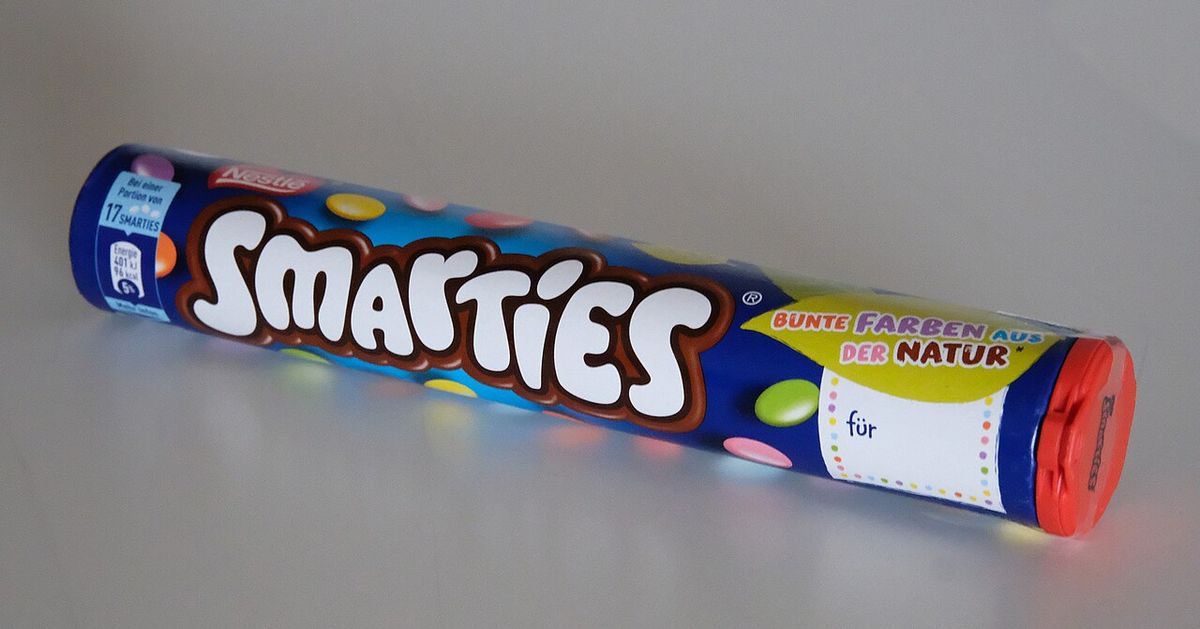
Ownership of the Rowntree's company, and thus the Smarties brand, transferred to the Swiss multinational Nestlé in 1988 following a contentious takeover. Production of Smarties remained centred in York for decades, but by 2007, Nestlé consolidated European manufacturing, moving all production to a facility in Hamburg, Germany. For the Canadian and wider North American market, Smarties have long been produced domestically at Nestlé's factory on Sterling Road in Toronto's Junction Triangle neighbourhood. This facility, originally built for Cowan Cocoa and Chocolate in 1905, has been operated by Nestlé since 1918 and remains a key production site. The brand's packaging has seen notable updates, including a shift from the classic round tube to a lighter, more compact hexagonal design in February 2005, which featured a cardboard hinge and a clip closure.
Product characteristics and evolution
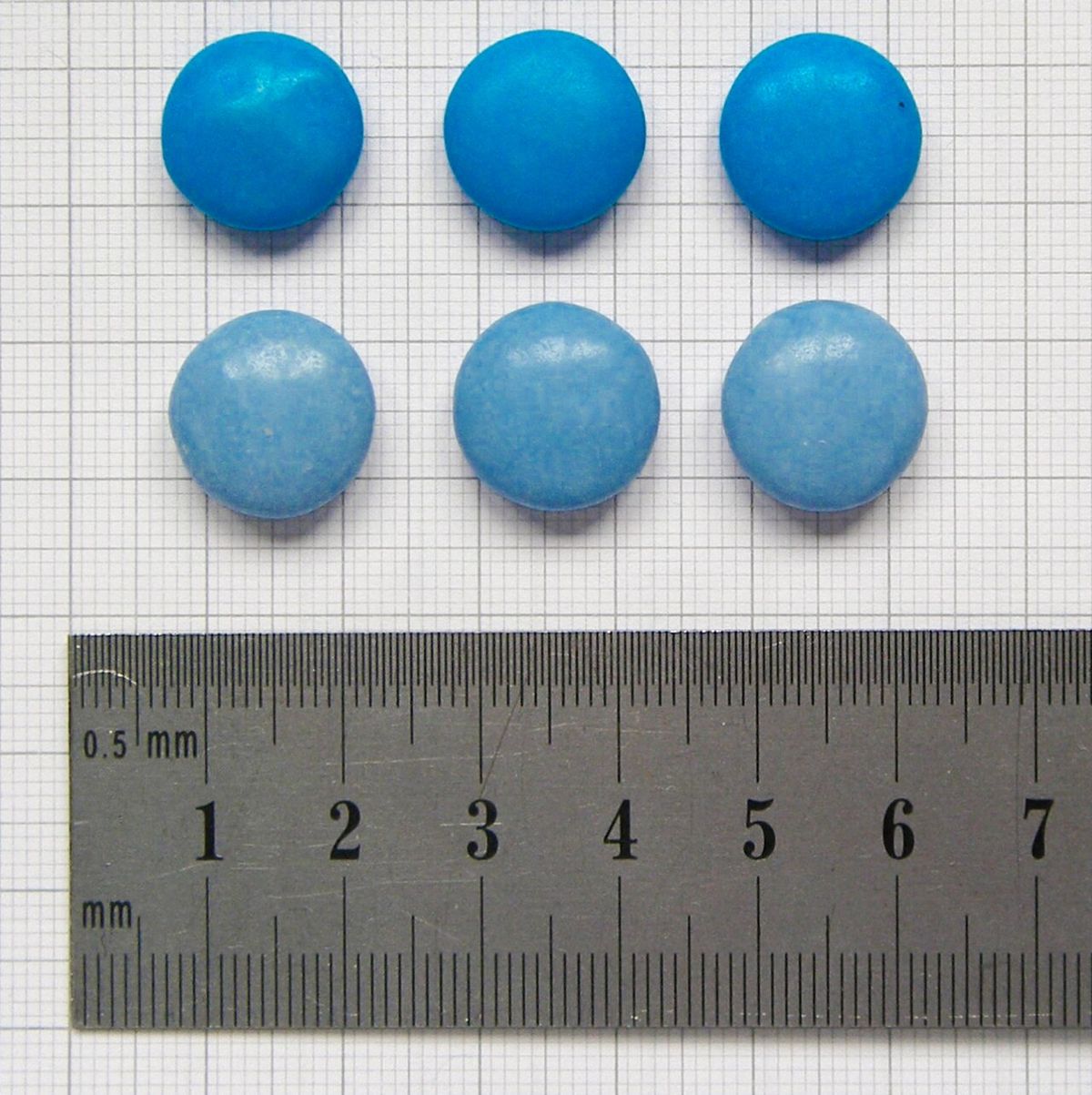
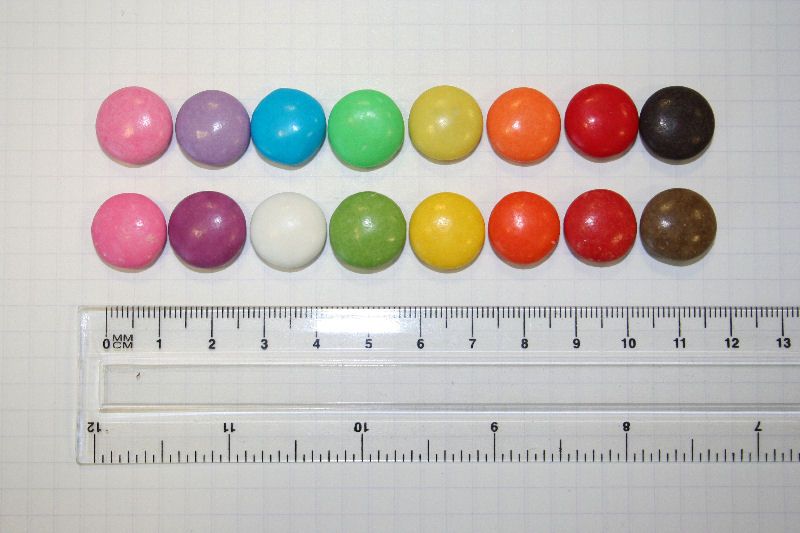
Smarties are small, oblate spheroid candies, approximately 5 mm on their minor axis and 12 mm on their major axis. Each piece consists of a milk chocolate centre encased in a hard sugar shell. The defining feature of Smarties is their colourful coating, which has seen considerable evolution since the brand's launch. When coloured Smarties were introduced in 1937, the original palette included red, orange, yellow, green, mauve, pink, dark brown, and light brown. For the first two decades, the brown Smarties offered variety beyond just colour, as the dark brown ones contained dark chocolate and the light brown ones were coffee-flavoured. By 1958, this differentiation was phased out, and all Smarties adopted a standard milk chocolate centre, with the exception of orange-flavoured orange Smarties sold in the United Kingdom.
The colour lineup underwent its first major change in 1988 when light brown Smarties were discontinued and replaced by blue ones. This introduction was part of a promotional campaign during Nestlé's acquisition of Rowntree Mackintosh. Nestlé announced the removal of all artificial colours from Smarties in the United Kingdom in 2006. This process presented technical challenges, particularly in sourcing a natural blue dye. Consequently, blue Smarties were temporarily replaced with white ones in the UK from 2006 to 2008 and in Canada from March 2009 to May 2010. The natural blue colour was eventually derived from spirulina, a cyanobacterium. The reformulation also led to the replacement of the artificial mauve colour with a violet shade achieved using natural sources. The red colourant, once derived from cochineal insects, was changed to plant-based alternatives, using red cabbage extract in the UK and red beet extract in Canada. Today, the standard colour assortment in Canada and other markets consists of eight hues.
- 1937: Coloured Smarties introduced with red, orange, yellow, green, mauve, pink, dark brown, light brown.
- 1958: Coffee-flavoured light brown and dark chocolate dark brown varieties discontinued.
- 1988: Light brown Smarties replaced by blue Smarties.
- 2006 to 2008: Artificial colours removed in UK. Blue replaced by white temporarily.
- 2009 to 2010: Artificial colours removed in Canada. Blue replaced by white temporarily.
- 2010: Blue Smarties reintroduced in Canada using natural spirulina dye.
- 2026: Brand announces it is the first global confectionery to switch to fully recyclable paper packaging.
Manufacturing and Canadian production
Global production of Nestlé Smarties is managed from facilities in Europe, primarily Hamburg, Germany, and in North America from Toronto, Canada. The Toronto factory at 72 Sterling Road is a central part of Nestlé's Canadian operations and has a deep historical connection to the chocolate industry. The building was originally constructed in 1905 for the Cowan Cocoa and Chocolate Company. Nestlé acquired the plant in 1918 and has operated it continuously since, making it one of the company's oldest manufacturing sites in the country. This facility produces Smarties for the Canadian and wider North American market, ensuring a consistent supply distinct from the European product. The choice to maintain local production supports Nestlé's supply chain efficiency and caters to regional tastes and regulatory standards, such as the specific timeline for adopting natural colourings.
The production process involves enrobing milk chocolate centres with layers of coloured sugar coating in a rotating pan, a method typical for dragée candies. Quality control and consistency in colour and size are paramount. In recent years, sustainability initiatives have influenced manufacturing and packaging decisions. In 2026, Nestlé announced that the Smarties brand had become the first global confectionery to complete a full transition to recyclable paper packaging, eliminating plastic from its primary packaging. This move aligns with broader corporate environmental goals and responds to consumer demand for more sustainable products. The cardboard tube, now made from recyclable paper, remains a key part of the brand's identity while reducing its environmental footprint.
Market presence and distinction from U.S. Smarties
Smarties are sold across Canada, the United Kingdom, Europe, Australia, and many other global markets, but they are notably absent from the United States except via parallel import. This market division stems directly from the 1947 agreement between Rowntree's and Mars. The "Smarties" trademark in the United States is owned and defended by the Smarties Candy Company, based in Union, New Jersey. This American company produces a completely different product: a fruit-flavoured, pressed dextrose tablet candy sold in cellophane rolls. The U.S. Smarties are a hard, tangy sweet with no chocolate component. The coexistence of two distinct products under the same name in neighbouring countries is a classic case of trademark territoriality and often leads to confusion among consumers.
The American Smarties Candy Company operates independently of Nestlé and has its own product innovations and marketing strategies. In May 2026, the U.S. company announced the launch of a new Blue Raspberry flavour in its Mega Smarties line, marking the first-ever blue tablet in its product range and responding to long-standing consumer requests. This product was slated for a nationwide rollout in July 2026 following a debut at the Sweets & Snacks Expo. The U.S. company also markets products like Smarties Squashies Sours and runs promotional campaigns, such as a Valentine's-themed "Smarties x Casper Giveaway" in February 2026. These activities highlight the parallel but separate evolution of the two Smarties brands. In contrast, Nestlé focuses its Smarties marketing on the chocolate product's colourfulness, connection to creativity, and, increasingly, its sustainability credentials.
Cultural significance and promotions
In Canada, Smarties are embedded in popular culture as a common and beloved candy. They are a standard inclusion in Halloween candy assortments, children's party bags, and are often used in baking and dessert decoration. The tactile experience of pouring them from the tube and the activity of sorting them by colour are familiar childhood rituals. The brand leverages this nostalgic connection through marketing that emphasizes colour, play, and imagination. Phrases like "How Do You Smarties?" invite consumer interaction and personalization. The brand also engages in promotional partnerships and limited-time campaigns to maintain relevance, particularly around holidays.
Nestlé has established October 2 as National Smarties Day, a date recognized in promotional materials for 2026. This day is used to celebrate the candy's legacy and, in recent years, to highlight its achievements, such as the move to recyclable paper packaging. The brand's association with creativity is further illustrated by initiatives like the Nestlé Smarties Book Prize, a UK-based literary award for children's books. The classic packaging, especially the collectible lettered lids of the past, remains a point of fond memory for many adults, demonstrating the product's multi-generational appeal. Smarties' presence in Canada is bolstered by its local manufacturing, which reinforces its status as a domestic treat despite its international ownership.
Composition and ingredients timeline
The formulation of Smarties has undergone several significant changes throughout its history, primarily concerning the colours and flavours used in the candy shell. The core milk chocolate recipe has remained relatively consistent, made from sugar, cocoa butter, cocoa mass, and milk solids. The most substantial revisions have involved the replacement of artificial dyes with natural alternatives. The removal of artificial blue dye (Brilliant Blue FCF or E133) was particularly challenging, leading to the temporary substitution of blue Smarties with white ones until a stable natural alternative from spirulina was perfected.
The timeline of these changes varies by market due to different supply chains and regulatory environments. The Canadian market transitioned to natural colours in March 2009, slightly later than the UK change in 2006. The current colourants are derived from sources like spirulina (blue), red cabbage or beet (red), turmeric (yellow), and carotenes (orange). The following table outlines the key changes to Smarties' composition and colours over the decades.
| Period | Key Colour/Ingredient Changes | Market Notes |
|---|---|---|
| 1988 to 2005 | Light brown replaced by blue (artificial dye). | Blue Smarties introduced. |
| 2006 to 2008 | Artificial colours removed. Blue replaced by white. Mauve becomes violet. | UK market transition. |
| 2009 to 2010 | Artificial colours removed. Blue replaced by white temporarily. | Canadian market transition. |
| 2010-Present | Blue reintroduced with natural spirulina dye. All colours from natural sources. | Current standard formulation in Canada. |
| 2026 | Full transition to recyclable paper packaging completed. | Global packaging sustainability initiative. |
Questions about Smarties
Are Smarties made in Canada?
Yes, Smarties for the Canadian and North American market are manufactured at the Nestlé factory located at 72 Sterling Road in Toronto, Ontario. This facility has been producing Nestlé products since 1918 and is a key production site for the brand. Production for other markets, particularly in Europe, was consolidated to Hamburg, Germany, in 2007. The Canadian-made Smarties ensure the product is readily available on store shelves across the country and conforms to Canadian food regulations.
Why are there no blue Smarties sometimes?
Nestlé committed to removing all artificial colourings from Smarties. Finding a natural blue dye that was stable, safe, and provided the right hue was a significant technical challenge. Initially, this led to blue Smarties being replaced by white ones in the United Kingdom from 2006 to 2008 and in Canada from March 2009 to May 2010. The company eventually sourced a suitable natural blue colourant derived from spirulina, a type of cyanobacteria, which allowed blue Smarties to be reintroduced.
What is the difference between Canadian Smarties and American Smarties?
Canadian Smarties, produced by Nestlé, are candy-coated milk chocolate pieces sold in a cardboard tube. American Smarties, produced by the Smarties Candy Company, are a completely different product: they are fruit-flavoured, tangy, pressed dextrose tablets with no chocolate, sold in cellophane rolls. The two companies are separate, and the U.S. trademark for the name "Smarties" is held by the American firm. This is why Nestlé's chocolate Smarties are not sold in the United States, a situation dating back to a 1947 business agreement.
Have Smarties changed their packaging?
Smarties packaging has evolved over time. The most recognizable change was in February 2005 when the classic round tube was replaced with a lighter, more compact hexagonal design featuring a cardboard hinged lid. More recently, in 2026, Nestlé announced that Smarties had become the first global confectionery brand to complete a full switch to recyclable paper packaging. This initiative removed plastic components from the primary packaging, aligning the tube with modern environmental sustainability standards while maintaining its familiar form and function.
What flavours are the different coloured Smarties?
With the exception of orange Smarties sold in the United Kingdom, which are orange-flavoured, all modern Smarties colours have the same plain milk chocolate centre. The colour of the shell does not indicate a different flavour. Historically, from 1937 to 1958, brown Smarties did have different centres: dark brown ones contained dark chocolate and light brown ones were coffee-flavoured. Since 1958, however, the colour variety has been purely visual, with all shells having a standard sweet, sugary taste that complements the uniform milk chocolate inside.
What is National Smarties Day?
National Smarties Day is an annual observance celebrated on October 2. In 2026, the day was noted for celebrating the sweet legacy of the well-known candy. It was used by the brand to highlight its achievement as the first global confectionery brand to switch to fully recyclable paper packaging. The day serves as a promotional event to engage consumers and connect the candy to themes of colour, imagination, and continuous learning, often referencing 'smarty pants' people. It functions as a marketing tool to reinforce brand recognition and innovation.
Sources and further reading
- Smarties (Wikipedia)
- Smarties Introduces New Blue Raspberry Flavor in Mega ... (nombase.com)
- Smarties x Casper Giveaway Official Contest Rules (smarties.com)
- Nestle Smarties 38g (blightys.com)
Checked by the Novello Desserts desk. Last updated 2026-10-24.