First sunrise
The first sunrise of the new year is a global tradition of observing the dawn of January 1st, often imbued with cultural, spiritual, and personal significance. In Canada, this practice connects to broader human customs of marking renewal and hope, while also intersecting with the nation's scientific understanding of solar phenomena. From the Japanese hatsuhinode to Indigenous Arctic rituals and personal annual pilgrimages by Canadians, watching the first sunrise serves as a moment of reflection and celebration. The tradition highlights both a shared human desire for new beginnings and the fascinating astronomical mechanics that dictate the precise timing of sunrise throughout the year.
Cultural and Religious Origins
The custom of observing the first sunrise of the year is deeply rooted in the spiritual practices of numerous cultures around the world, particularly those with traditions of sun worship. In Japan, the practice known as Hatsu-Hinode is part of the traditional Shinto worship of Amaterasu, the sun goddess, and was historically observed on the first day of the old lunar calendar. Today, it remains a popular tradition, with travel agencies organizing trips to the easternmost Ogasawara Islands to witness the earliest first sunrise on the Gregorian calendar. Across the Sea of Japan, in Korea, watching the first sunrise on either the traditional Korean calendar or the new calendar is a common practice, often accompanied by making a wish for the new year. Popular viewing locations in Korea include the coastal areas of Pohang Homigot, Ulleung County, and Jeongdongjin, where large crowds gather and free tteokguk (rice cake soup) is sometimes distributed.
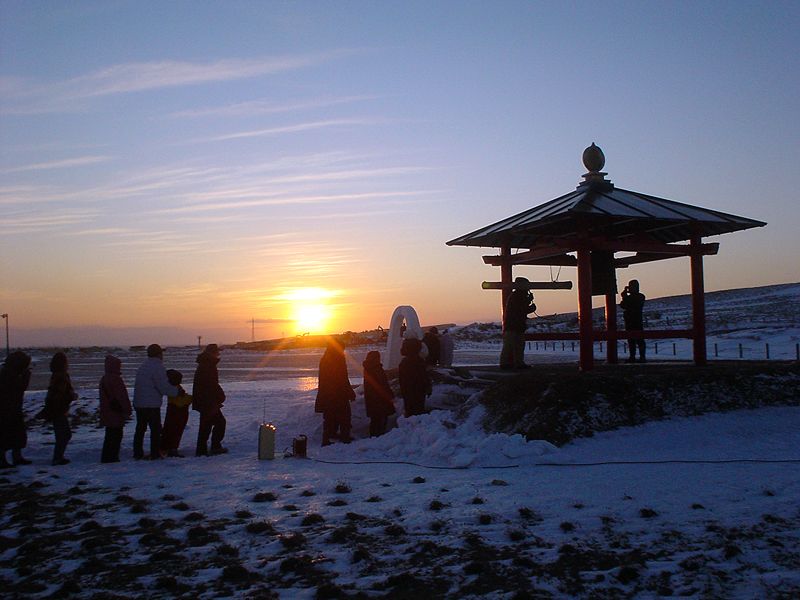
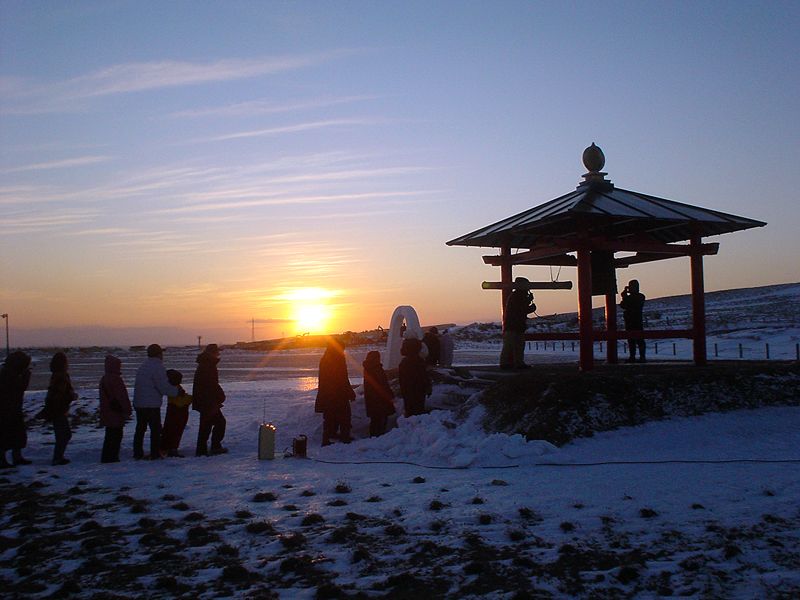
In Mongolia and surrounding regions like the Altai Republic, Buryatia, and Tuva, the custom is tied to the Mongolian lunisolar New Year celebration of Tsagaan Sar and involves observing the first sunrise from a mountain top, reflecting shamanistic influences. The most extensive traditions are found among Indigenous peoples across the Arctic Circle and Siberia. Groups including the Inuit, Yupik, Aleut, Chukchi, Iñupiat, Koryaks, Evenki, Dolgans, and Yakuts observe the first sunrise with ceremonies that involve extinguishing and then relighting three qulliqs (stone lamps) or bonfires. This ritual, performed on the first day of the year, is a significant act of honouring the sun and moon, symbolizing renewal and the return of light. These diverse practices show the first sunrise as a nearly universal symbol of hope, luck, and divine connection at the year's commencement.

The Tradition in Modern Canadian Life
While Canada does not have a single, unified national custom for the first sunrise, the practice has been adopted by many individuals as a personal ritual for marking the new year. Inspired by global traditions or a simple desire for a meaningful start, Canadians travel to coastlines, mountains, and open fields to witness the dawn of January 1st. Personal accounts describe the tradition beginning on a whim, such as a 2013 decision to drive through the night with a friend to photograph the sunrise, which then evolved into a consecutive annual practice spanning over a decade. For these practitioners, the ritual becomes a form of reset and reflection, a quiet moment of peace before the year begins in earnest. The act of planning the location, often starting as early as November, and enduring cold temperatures is viewed not as a chore but as a vital act of self-care and celebration.
The experience in Canada often contrasts with the crowded, communal celebrations seen in countries like Korea, offering a more solitary or intimate gathering. However, the core feeling remains the same: a sense of witnessing something special and meaningful. The tradition also serves as a connection to personal history, with individuals noting they use the same jacket, car, or camera year after year, creating a tangible link to past iterations of the ritual. For some Canadians, the practice is a bittersweet homage to time spent abroad, such as teaching English in Korea, where they first adopted the custom.
Astronomical Timing and the "Earliest Sunrise"
A fascinating astronomical fact often surprises those who observe sunrises: the earliest sunrise of the year does not occur on the summer solstice, the longest day of the year. Instead, for much of the Northern Hemisphere, including Canada, the earliest sunrise happens approximately a week before the June solstice. Earth moves faster in its orbit during perihelion (closest approach to the Sun) in early January than at aphelion (farthest point) in July. This variable orbital speed, along with the tilt, causes the Sun's apparent position in the sky at a fixed clock time to trace a lopsided figure-8 pattern over the course of a year, known as an analemma.
The analemma's shape directly influences solar noon, the time when the Sun is highest in the sky. Because solar noon shifts slightly later by the clock each day around the June solstice, the times of sunrise and sunset also shift. Consequently, the clock time for sunrise reaches its earliest point before the solstice, while the clock time for sunset reaches its latest point after the solstice. The exact dates vary significantly by latitude. For a location at 40 degrees north latitude, which passes near cities like New York, Denver, and Madrid, the earliest sunrise in 2026 is on June 14, with the summer solstice on June 21. The latest sunset at that latitude occurs around June 27. This separation means the longest period of daylight is centred on the solstice, but the earliest light and the latest dark happen on different days.
Latitudinal Variations in Sunrise and Sunset
The timing of the year's earliest sunrise and latest sunset is not uniform across Canada or the globe. It is heavily dependent on an observer's latitude. The general rule is that the higher the latitude, the smaller the gap between the earliest sunrise and the summer solstice. For instance, at 60 degrees north, near Anchorage, Alaska, or Oslo, Norway, the earliest sunrise occurs closer to June 17. At lower latitudes, such as 25 degrees north near Miami or Mexico City, the earliest sunrise can happen as early as June 4. This latitudinal effect is mirrored in the winter, when the earliest sunset and latest sunrise bracket the winter solstice. At 40 degrees north, the earliest sunset occurs around December 8, the solstice is on December 21, and the latest sunrise is around January 5.
The difference in sunrise and sunset times is often more noticeable in winter. This explains why December evenings feel very dark, while January mornings stay dark well after the winter solstice. At a latitude of 40 degrees north, the earliest sunset occurs around December 8. The latest sunrise occurs around January 5. The winter solstice itself, with the least daylight, is around December 21. These dates are not the same due to the Earth's elliptical orbit and axial tilt.
| Latitude (North) | Earliest Sunrise (approx.) | Summer Solstice | Latest Sunset (approx.) |
|---|---|---|---|
| 25° (e.g., Miami) | June 4 | June 21 | Early July |
| 40° (e.g., Toronto, Denver) | June 14 | June 21 | June 27 |
| 60° (e.g., Anchorage) | June 17 | June 21 | Late June |
This variation means the earliest sunrise and latest sunset happen on different dates. At 40 degrees north latitude, the earliest sunrise is around June 14, which is about a week before the summer solstice. The latest sunset is around June 28, which is about a week after the solstice. The exact dates drift depending on your latitude. Understanding this pattern connects the act of watching a sunrise to the mechanics of Earth's orbit.
Scientific Explanation: Solar Time vs. Clock Time
The misalignment between the solstices and the earliest or latest sunrises and sunsets stems from the difference between true solar time and the mean civil time kept by our clocks. A solar day, the interval between one solar noon and the next, is not always exactly 24 hours long due to Earth's elliptical orbit and axial tilt. In December and January, the Sun runs 'slow' compared to the uniform 24-hour clock, meaning solar noon occurs slightly later each day by clock time. As a result, the time of sunset begins to shift later in the afternoon earlier than expected, making the earliest sunset occur in early December. Conversely, the time of sunrise continues to shift later into the morning until early January, creating the latest sunrise.
A similar, though less extreme, effect occurs around the summer solstice. The Sun runs 'fast' in June and July, causing solar noon to occur earlier by the clock on successive days. This advances the clock time of sunrise, making it peak in mid-June, before the solstice. The clock time of sunset is also advanced, but the effect delays the arrival of the latest sunset until after the solstice. These explanations, while simplified, clarify why the darkest and lightest periods of the year are not perfectly symmetrical around the solstices. The perceived darkness of winter is thus prolonged on both ends, with early sunsets in early December and late sunsets in early January framing the shortest day.
Global First Sunrise Viewing Locations
Certain locations around the world have gained fame as premier destinations for observing the first sunrise of the new year, often due to their easternmost geography or cultural significance. In Japan, the Ogasawara Islands, being the country's easternmost territory, are marketed as the place to see the very first Hatsu-Hinode of the Gregorian year. Travel agents organize special trips and events for this purpose. Korea has several well-known coastal spots where massive crowds gather, creating a festive atmosphere. The beach at Homigot in Pohang is famous for its 'Hand of Harmony' sculpture reaching into the sea, while the train station at Jeongdongjin is noted for its proximity to the ocean, allowing visitors to watch the sun rise directly from the platform or nearby beach.
Beyond East Asia, the tradition of seeking the first sunrise has led people to remote islands like Caroline Island (Kiribati) in the Pacific, which is often one of the first points on land to see the sun each day. While not all these locations are practical for most Canadians, they illustrate the global reach of the custom. The pursuit often blends tourism with spirituality or personal challenge. For individuals, any local vantage point with a clear eastern horizon can become a special site for their annual ritual. Common choices in Canada include east-facing ocean beaches on the Atlantic coast, lookout points in mountainous regions like the Rockies, the shores of the Great Lakes, urban parks with unobstructed views, frozen lakeshores in northern communities, and historical sites like Cape Spear in Newfoundland, the easternmost point in North America. The choice of location is deeply personal, often balancing the desire for a beautiful view with practical considerations like accessibility and crowd levels, and for many, the annual search for the perfect spot is an integral part of the tradition itself.
Personal and Psychological Significance
For those who practice it, observing the first sunrise transcends mere custom. It becomes a deeply personal psychological anchor for the year. Individuals report that the ritual provides a sense of reset, clarity, and peaceful intention-setting. The act of waking early, often in cold and darkness, to witness the transition from night to day is framed as an active form of self-care and mindfulness. It creates a tangible marker of the passage of time, a quiet moment of celebration before the busyness of the year begins. The consistency of the practice, sometimes maintained for over a decade with the same companions or equipment, builds a unique personal history and a thread of continuity through the years. The experience is frequently described as moving and meaningful, with the beauty of the sunrise serving as a reminder of new beginnings, boundless possibilities, and, for some, a connection to the divine or the natural world.
Social media posts describe the first sunrise as a symbol of joy, love, laughter, and new beginnings. The ritual fosters community, such as among crowds on a Korean beach sharing free tteokguk soup. It also connects people virtually through shared photographs and live streams. For many individuals, watching the first sunrise becomes an important personal tradition and ritual. Ultimately, it offers a moment of hope and wonder at the start of a new year.
Key Astronomical Dates for 2026
The precise timing of solar events is central to the tradition of the first sunrise. Astronomical calculations define key dates for the solar cycle. For example, the earliest sunrise in 2026 at 40 degrees north is on June 14. The latest sunrise in winter at that latitude is around January 5. The summer solstice, the longest day, is around June 21. These dates explain the shifting patterns of daylight throughout the year.
- Perihelion (Earth closest to Sun): January 3, 2026 at 12:15 pm Toronto time.
- Latest sunrise in Toronto: January 2 or January 3, 2026.
- Earliest sunrise at 40° North latitude: June 14, 2026.
- Summer solstice (longest day): June 21, 2026.
- Latest sunset at 40° North latitude: approximately June 27, 2026.
- Earliest sunset at 40° North latitude: approximately December 8, 2026.
- Winter solstice (shortest day): December 21, 2026.
These dates show an asymmetry in the solar cycle. The solstices mark the extremes of total daylight, but not the extremes for sunrise and sunset times. The earliest sunrise happens about a week before the summer solstice. The latest sunset happens about a week after the summer solstice. This pattern is due to Earth's elliptical orbit and its axial tilt.
Indigenous Groups with First Sunrise Traditions
The first sunrise holds particular spiritual importance for numerous Indigenous groups across the circumpolar north and Siberia, where the return of light after the long winter darkness is a powerful event. These cultures have developed specific rituals to honour the sun at the start of the new year, often involving fire or light. The ceremony typically involves extinguishing existing flames and relighting new ones as a symbolic act of renewal and prayer for good fortune. The following list details some of the many Indigenous peoples for whom the first sunrise is a significant cultural practice, as noted in anthropological records.
- Inuit (across the Arctic regions of Canada, Greenland, and Alaska)
- Yupik (Alaska and Siberia)
- Aleut (Aleutian Islands)
- Chukchi (Siberian Russia)
- Iñupiat (Northern Alaska)
- Koryaks (Kamchatka Krai, Russia)
- Evenki (Siberia and northern China)
- Dolgans (Siberia, Russia)
- Yakuts (Sakha Republic, Siberia)
For these Arctic and Siberian communities, the ritual is a participatory act. Groups like the Inuit, Yupik, Aleut, Chukchi, Iñupiat, Koryaks, Evenki, Dolgans, and Yakuts observe the first sunrise. They extinguish and then relight three qulliqs (oil lamps) or bonfires. This act honours the sun and moon. It makes the first sunrise a deeply communal and spiritual beginning to the year.
Questions about First sunrise
What is the Japanese term for the first sunrise of the year?
The Japanese term for the first sunrise of the year is Hatsu-Hinode (初日の出). This tradition originates from Shinto worship of the sun goddess Amaterasu and was historically observed on the first day of the old lunar calendar. Today, it is a popular custom on January 1st, with many Japanese people travelling to eastern locations like the Ogasawara Islands to witness the earliest possible first sunrise. The practice symbolizes renewal and good fortune for the coming year.
When is the earliest sunrise of the year in Canada?
The date of the earliest sunrise in Canada varies by latitude. For a location at about 40 degrees north latitude, similar to the southern parts of Ontario, the earliest sunrise in 2026 occurs on June 14. This is approximately one week before the summer solstice on June 21. The exact date becomes later as you move north. At 60 degrees north, near parts of the Yukon and Northwest Territories, the earliest sunrise happens closer to June 17. This separation occurs due to astronomical factors involving Earth's orbit and axial tilt.
How do Indigenous peoples in the Arctic observe the first sunrise?
Indigenous groups across the Arctic Circle and Siberia, including the Inuit, Yupik, Aleut, and Chukchi, observe the first sunrise of the new year with a ceremonial ritual. The custom involves extinguishing three qulliqs (traditional stone lamps) or bonfires and then relighting them. This act is performed to honour the sun and moon, marking the return of light and praying for good luck in the coming year. The practice is a significant cultural and spiritual tradition that shows the deep connection these communities have with the solar cycle in their environment.
Why isn't the earliest sunrise on the longest day of the year (the summer solstice)?
The earliest sunrise does not coincide with the summer solstice because of the difference between solar time and clock time, driven by Earth's elliptical orbit and axial tilt. Earth's variable orbital speed causes the solar noon (when the sun is highest) to shift slightly later by the clock each day around the solstice. This shift means the clock time for sunrise reaches its earliest point before the solstice, while sunset reaches its latest point after it. Consequently, the longest day (most daylight hours) is on the solstice, but the earliest light and latest dark occur on separate dates about a week apart at mid-northern latitudes.
Where are popular places to watch the first sunrise in Korea?
In Korea, popular places to watch the first sunrise on New Year's Day include Pohang Homigot, Ulleung County, and Jeongdongjin. These locations are famously crowded for the event. It is common for people to make a wish while watching the sunrise there. Volunteers sometimes distribute free tteokguk, a traditional rice cake soup, at these popular viewing spots.
What is the significance of the latest sunrise in winter?
The latest sunrise of the year occurs in early January, about two weeks after the winter solstice in late December. This astronomical fact explains why January mornings can feel darker than those in late December, even though the days are technically getting longer after the solstice. The delay is caused by the Sun running 'slow' compared to clock time in December and January, pushing sunrise later by the clock each day. At 40 degrees north latitude, the latest sunrise occurs around January 5. This phenomenon, paired with the earliest sunset in early December, creates an extended period of perceived darkness around the shortest day of the year.
Sources and further reading
- First sunrise (Wikipedia)
- Hatsuhinode • First sunrise of the new year (yearofthesunrise.com)
- Seeing the First Sunrise Makes Each Year Feel Special (autostraddle.com)
- When is The Earliest Sunrise of the Year? - Farmers' Almanac (farmersalmanac.com)
- Sunrise and Sunset Times Near the Solstices (aa.usno.navy.mil)
Checked by the Novello Desserts desk. Last updated 2026-10-30.