UFO sightings in Canada
UFO sightings in Canada represent a persistent and documented aspect of the nation's cultural and historical landscape, with reports spanning from the early 20th century to the present day. The phenomenon gained formal attention from the Canadian government in 1947 and has since been tracked through official channels and independent research, most notably the annual Canadian UFO Survey. These sightings, which include some of the country's most famous unexplained events like the 1967 Falcon Lake incident, reflect widespread public curiosity and occasional official concern. The topic remains relevant as reports continue to be filed annually, with over a thousand sightings documented in recent years, engaging citizens, researchers, and even Parliament.
Early Sightings and Government Interest
According to a Department of National Defence memo, sightings of unidentified flying objects occurred throughout the first half of the twentieth century in Canada. The Canadian government did not begin systematically collecting information on these reports until 1947, marking the start of official, though often discreet, interest. One of the earliest well-documented cases involved a U.S. Navy aircraft near Gander, Newfoundland, on 10 February 1951, which reported a near-collision with a large, orange, circular object. A decade later, in June 1960, prospectors near Clan Lake in the Northwest Territories reported seeing a hovering object roughly four to six feet wide that struck the lake's surface, prompting an RCMP investigation that found no physical evidence. These early incidents established a pattern of civilian reports followed by official inquiries, often concluding without definitive explanation. The government's role evolved from passive note-taking to eventually directing all UFO reports to a single civilian researcher, Chris Rutkowski of Ufology Research, as of 2007.
Landmark Cases of the 1960s and 1970s
The 1960s and 1970s produced several of Canada's most famous and enduring UFO narratives, many of which have been commemorated in popular culture. The 1967 Falcon Lake incident in Manitoba, involving prospector Stefan Michalak's claim of being burned by a flying saucer, is considered by ufologists to be one of the most documented stories in the country, though skeptics have proposed alternative explanations involving an accident. Later that same year, in October, an object was reported to have crashed into Shag Harbour, Nova Scotia, an event that remains officially unexplained. The following decade saw the 1974 Langenburg, Saskatchewan, case where farmer Edwin Fuhr reported five rotating saucers that left distinct circles in a slough, circles later confirmed by the RCMP. From 1975 to 1976, southern Manitoba experienced a wave of sightings of a red, glowing object nicknamed "Charlie Redstar" by the public. Another significant event occurred in Clarenville, Newfoundland and Labrador, on 26 October 1978, when twelve individuals, including an RCMP officer, observed an oval-shaped object with a fin hover over the water for up to two hours, reportedly reacting to the officer's headlights.
- 19 May 1967: Stefan Michalak's alleged encounter near Falcon Lake, Manitoba.
- October 1967: The purported UFO crash into Shag Harbour, Nova Scotia.
- 1 September 1974: Edwin Fuhr's sighting of five saucers near Langenburg, Saskatchewan.
- 1975 to 1976: Multiple sightings of "Charlie Redstar" in southern Manitoba.
- 26 October 1978: The Clarenville, Newfoundland and Labrador, sighting witnessed by twelve people.
Reports from the 1980s to the 2000s
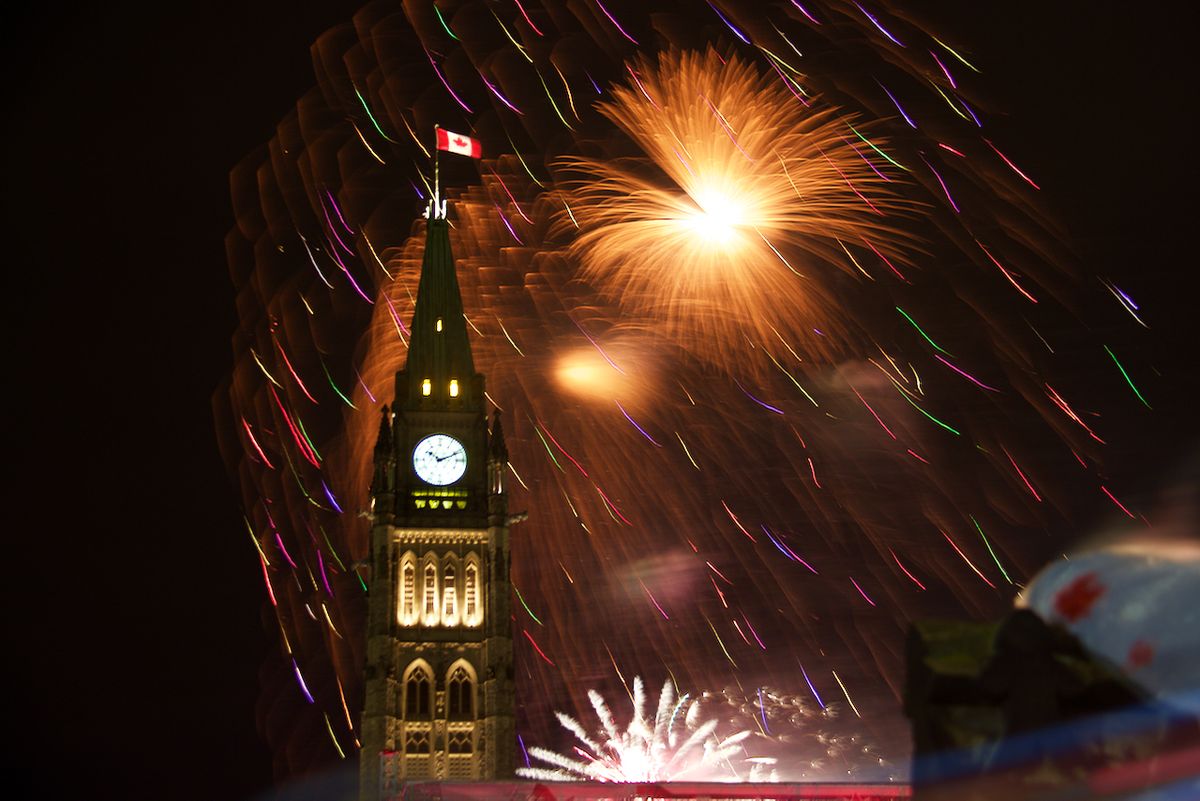
Sightings continued across Canada in the latter part of the 20th century, with reports often involving multiple witnesses and sometimes occurring in urban centres. In November 1989, two sisters in Campbellton, New Brunswick, witnessed three silent, triangular UFOs over Sugarloaf Mountain. A year later, on 7 November 1990, a large, round metallic object was reported over the rooftop pool of Montreal's Bonaventure Hotel, with the phenomenon lasting approximately three hours and being witnessed by many, some of whom speculated about extraterrestrial visitation in media reports. On Canada Day in 1997, at least two women in Trail, British Columbia, independently reported seeing three small lights zigzagging just above the Columbia River before a fireworks display. The new millennium brought incidents that prompted official responses, such as the multiple UFO reports in Harbour Mille, Newfoundland and Labrador, on 25 January 2010, which led to RCMP and NORAD statements and political criticism from MP Gerry Byrne regarding government transparency. These cases illustrate the diversity of reports, from silent triangles to prolonged urban displays, that characterize the modern Canadian UFO record.
Contemporary Sightings and the Canadian UFO Survey
In the 2010s and 2020s, UFO reporting has been shaped by technology like smartphones and social media, while being systematically tracked by researchers. Notable cases include John Sheppard's cellphone video of unusual lights over Kensington, Prince Edward Island, in June 2014, which was investigated by MUFON, and multiple reports of flashing lights in North York, Ontario, in July 2014 that were witnessed by police and citizens alike. The primary source for quantifying this phenomenon is the annual Canadian UFO Survey, published by Ufology Research. The survey for 2025 documented 1,052 UFO reports across Canada, a slight increase from the 1,008 reports in 2024 and the highest number since 2020. Of these 2025 reports, 3.42 per cent were classified as unexplained after analysis. The survey also found the average duration of a sighting in 2025 was 47 minutes, a significant increase from previous years. Geographically, Ontario accounted for 30 per cent of the 2025 reports, followed by Quebec at 20 per cent, British Columbia at 13.5 per cent, and Alberta at 11 per cent, with notable increases noted in Manitoba and Nova Scotia.
The distribution of reports by major city in 2025 highlights urban centres as frequent locations for sightings. Toronto led with 53 reports, followed by Vancouver with 45, Montreal with 30, Calgary with 28, and Edmonton with 23. Researcher Chris Rutkowski has noted that reporting patterns have shifted, with peaks now occurring in late summer and winter months rather than just the summer, suggesting factors beyond weather influence observation rates. He also estimates that approximately one in ten Canadians believes they have seen a UFO. The survey relies on data from participating private organizations and social media, reflecting how modern communication tools have changed the reporting landscape. The consistent annual data collection since 1989 provides a unique long-term perspective on UFO sightings as a Canadian phenomenon.
Official and Political Responses
The Canadian government's approach to UFOs has involved both investigation and delegation over the decades. Historically, agencies like the RCMP and Department of National Defence would look into reports, as seen in cases from Clan Lake to Harbour Mille. Since 2007, the federal government has directed all UFO sighting reports to civilian researcher Chris Rutkowski of Ufology Research. Political interest has surfaced periodically, most notably in March 2022 when Larry Maguire, the Member of Parliament for Brandon-Souris, raised concerns in Parliament about UFOs over Canadian nuclear sites. He questioned the minister of natural resources, John Hannaford, about receiving such reports, though Hannaford had not. This inquiry followed increased global attention on the topic spurred by revelations of U.S. government programs. Maguire later issued a statement advocating for greater public transparency regarding what the government knows about UFOs. These events indicate that while the Canadian government no longer maintains a dedicated public investigation program, the subject retains enough significance to occasionally enter political discourse, often driven by public curiosity and media coverage of American developments.
Cultural Commemoration and Public Fascination
Canada's most famous UFO cases have been immortalized in various cultural forms, demonstrating their hold on the public imagination. The Royal Canadian Mint's Canada's Unexplained Phenomena series of commemorative $20 silver coins has featured several landmark sightings. The series began in 2018 with a coin depicting the 1967 Falcon Lake incident, followed by a glow-in-the-dark coin for the 1967 Shag Harbour event in 2019. The 1978 Clarenville sighting was featured on a coin in 2020, and the 1990 Montreal sighting was commemorated in 2021. In 2024, the Mint released a coin for the 1974 Langenburg case. Beyond numismatics, books have been written about specific events, such as the Falcon Lake encounter. The phenomenon also regularly features in news coverage, documentaries, and on social media, where videos and reports are widely shared. This cultural footprint reflects a enduring national fascination with the possibility of the unknown in Canadian skies, blending folklore, mystery, and a desire for explanation.
- 2018: Royal Canadian Mint coin for the 1967 Falcon Lake incident.
- 2019: Glow-in-the-dark coin for the 1967 Shag Harbour event.
- 2020: Glow-in-the-dark coin for the 1978 Clarenville sighting.
- 2021: Glow-in-the-dark coin for the 1990 Montreal sighting.
- 2024: Commemorative coin for the 1974 Langenburg, Saskatchewan, case.
Common Characteristics and Explanations
Analysis of thousands of reports through the Canadian UFO Survey reveals common patterns in the descriptions of unidentified flying objects. Witnesses frequently report lights, often in formations, with colours ranging from white and orange to red. Common shapes include orbs, discs, cylinders, and triangles, with many objects described as silent or moving in unconventional ways. The vast majority of reported sightings are eventually identified as conventional phenomena. These include astronomical objects like stars and planets, aircraft, satellites, drones, Chinese lanterns, and atmospheric events like bolides or weather balloons. The small percentage that remains unexplained after investigation typically involves cases with multiple credible witnesses, photographic or video evidence, and descriptions that do not match known aircraft or natural phenomena. Researchers like Chris Rutkowski emphasize that most witnesses are reporting genuine observations of something they cannot identify, rather than fabrications, and that careful investigation is required to separate the truly anomalous from the misidentified.
Recent Reporting Trends and Data
The Canadian UFO Survey provides detailed annual statistics on sightings. According to the 2002 survey, a typical UFO sighting lasted approximately 15 minutes. The city of Toronto had the largest number of sightings in 2002 with 34 reports, followed by Vancouver with 31, and Terrace, B.C., with 25. A new study in 2018 stated there were more than 1,000 UFO sightings reported in Canada in 2017. More recent reports indicate that over 1,000 UFO sightings were also reported in 2025, showing a slight increase from the previous year.
| Year | Reported Sightings |
|---|---|
| 2025 | 1,052 |
| 2024 | 1,008 |
| 2023 | 570 |
| 2022 | 768 |
| 2021 | 722 |
| 2020 | 1,243 |
| 2019 | 849 |
The data indicates a peak in reports during 2020, likely linked to more people being at home during the COVID-19 pandemic, followed by a dip and a recent resurgence. The 2025 total of 1,052 reports represents the highest count since that 2020 peak. The average duration of sightings has shown a notable increase, rising from 13 minutes in 2022 to 47 minutes in 2025, which researchers note is a significant clue for investigation. Provincial breakdowns for 2025 show Ontario, Quebec, British Columbia, and Alberta as the leading sources of reports, consistent with their populations, but with unexpected increases in Manitoba and Nova Scotia suggesting regional variations in reporting behaviour or possibly in phenomena observed.
Questions about UFO sightings in Canada
What is the most famous Canadian UFO case?
The 1967 Falcon Lake incident in Manitoba is considered one of the most documented UFO stories in Canada. Stefan Michalak claimed he was burned by one of two flying saucers on 19 May 1967. Ufologists claim images show a grid of burn marks on his chest and shirt. The event has been the subject of books and sceptical analysis. In April 2018, the Royal Canadian Mint released a $20 silver coin depicting the alleged event as the first of its Canada's Unexplained Phenomena series.
Which Canadian city has the most UFO sightings?
Based on the 2025 Canadian UFO Survey, Toronto had the highest number of reported sightings with 53. Vancouver followed with 45 reports, then Montreal with 30, Calgary with 28, and Edmonton with 23. This ranking generally correlates with population centres, as more people in urban areas lead to a higher number of potential witnesses. Historically, Toronto has frequently topped the list, also leading reports in the 2002 survey with 34 sightings.
Has the Canadian government ever investigated UFOs?
Yes, the Canadian government has investigated UFO reports. According to a Department of National Defence memo, the government began taking interest in collecting information on sightings in 1947. The Royal Canadian Mounted Police has investigated specific reports, such as the 1960 Clan Lake sighting and the 1974 Langenburg sighting. As of 2007, the Canadian Federal Government directs all UFO sightings to Chris Rutkowski of Ufology Research of Manitoba.
What are the most common explanations for UFO sightings in Canada?
The vast majority of reported UFO sightings in Canada are eventually identified as conventional objects or phenomena. Common explanations include astronomical bodies like bright stars or planets, aircraft, satellites, drones, Chinese lanterns, kites with lights, and atmospheric events such as meteors or bolides. Misidentifications often occur due to unusual lighting conditions, perspective, or a lack of familiarity with celestial objects. The Canadian UFO Survey finds that only a small single-digit percentage of reports each year defy conventional explanation after analysis.
What was the first major UFO sighting in Canada?
The first major UFO sighting in Canada occurred on 10 February 1951 in Gander, Newfoundland. A U.S. Navy aircraft reported a near collision with a large, orange, circular UFO that almost literally flew circles around the American aircraft. According to a memo by the Department of National Defence, sightings occurred throughout the first half of the twentieth century, but the Canadian government did not take interest in collecting information until 1947. This 1951 incident is one of the earliest well documented cases from that period. It set a precedent for official military interest in such reports.
How many UFO sightings are reported in Canada each year?
According to the annual Canadian UFO Survey, 1,052 UFO sightings were reported in Canada in 2025. This number represents a slight increase from the 1,008 reports in 2024 but is lower than the peak of 1,243 reports documented in 2020. Of all reports in 2025, only 3.42 percent were classified as unexplained after investigation. The survey also notes that one in ten Canadians believe they have seen a UFO, with reports coming from all demographics and regions across the country.
Sources and further reading
- UFO sightings in Canada (Wikipedia)
- UFO sightings rising in Canada (winnipeg.citynews.ca)
- Reports of UFO sightings in Canada jumped last year. ... (globalnews.ca)
- The Truth Behind UFO Sightings over Canada's Nuclear ... (thewalrus.ca)
Checked by the Novello Desserts desk. Last updated 2026-10-30.