Canadarm
The Canadarm, officially known as the Shuttle Remote Manipulator System (SRMS), was a series of robotic arms integral to NASA's Space Shuttle program. Developed and built by Canada's Spar Aerospace (now MDA) under a 1975 agreement with NASA, the arm was used to deploy, manoeuvre, and capture payloads in orbit. Its success on over 90 shuttle missions cemented Canada's reputation as a leader in space robotics and paved the way for advanced successors on the International Space Station. The Canadarm remains a celebrated symbol of Canadian technological innovation and international cooperation in space exploration.
Origins and Development
Canada's involvement in the Space Shuttle program began in 1969 when NASA extended an invitation for participation, though the specific role was not yet defined. The manipulator system was soon identified as a key component, and NASA's attention was drawn to a robotic refuelling system for CANDU reactors developed by the Canadian company DSMA ATCON. This interest led to a formal memorandum of understanding in 1975 between NASA and Canada's National Research Council (NRC), committing Canada to develop and construct the robotic arm. The NRC awarded the main contract to Spar Aerospace, which would build three systems: an engineering model for design testing, a qualification model for environmental testing, and a flight unit for actual space missions.
The design of the critical end effector, the device at the arm's tip for grappling payloads, was inspired by engineer Anthony Zubrzycki's observation of an elastic band around his fingers. He formally presented the concept to NASA, and Frank Mee of Spar's mechanical development laboratory built the first prototype based on this idea. This three-wire crossover design was selected over competing claw or iris-style mechanisms. Control algorithms were developed by Spar and subcontractor Dynacon Inc. of Toronto, while CAE Electronics Ltd. in Montreal supplied the control panels and hand controllers for the shuttle's flight deck.
The structural graphite composite booms were produced by General Dynamics in the United States, and the engineering model end effector was built by Dilworth, Secord, Meagher and Associates, Ltd. in Toronto before Spar produced the final flight units. An acceptance ceremony was held at Spar's Toronto facility on 11 February 1981, where NRC head Larkin Kerwin, using a term coined by Dr. Wally Cherwinski, gave the system its enduring informal name: Canadarm. Project Manager Dr. Art Hunter collaborated with NASA and Spar to add Canadian flag decals and wordmarks to the arm. The first unit was delivered to NASA in April 1981, with astronaut Judith Resnik developing the critical onboard operating software and procedures. The Space Shuttle flight software for monitoring and controlling the arm was developed by IBM's Federal Systems Division in Houston, Texas.
Technical Design and Capabilities
The Canadarm was a 15.2-metre-long, 38-centimetre-diameter robotic arm with six degrees of freedom, mimicking the joints of a human arm with shoulder, elbow, and wrist pitch, yaw, and roll movements. It weighed 410 kilograms, though its motors could not support its own weight in Earth's gravity, necessitating a separate training model at NASA's Johnson Space Center. Originally capable of handling payloads up to 65,000 pounds in the weightlessness of space, its control system was upgraded in the mid-1990s to support the massive components of the International Space Station, increasing its capacity to 586,000 pounds. While able to manoeuvre the mass of a loaded bus in orbit, the arm was designed for zero-gravity operations only.
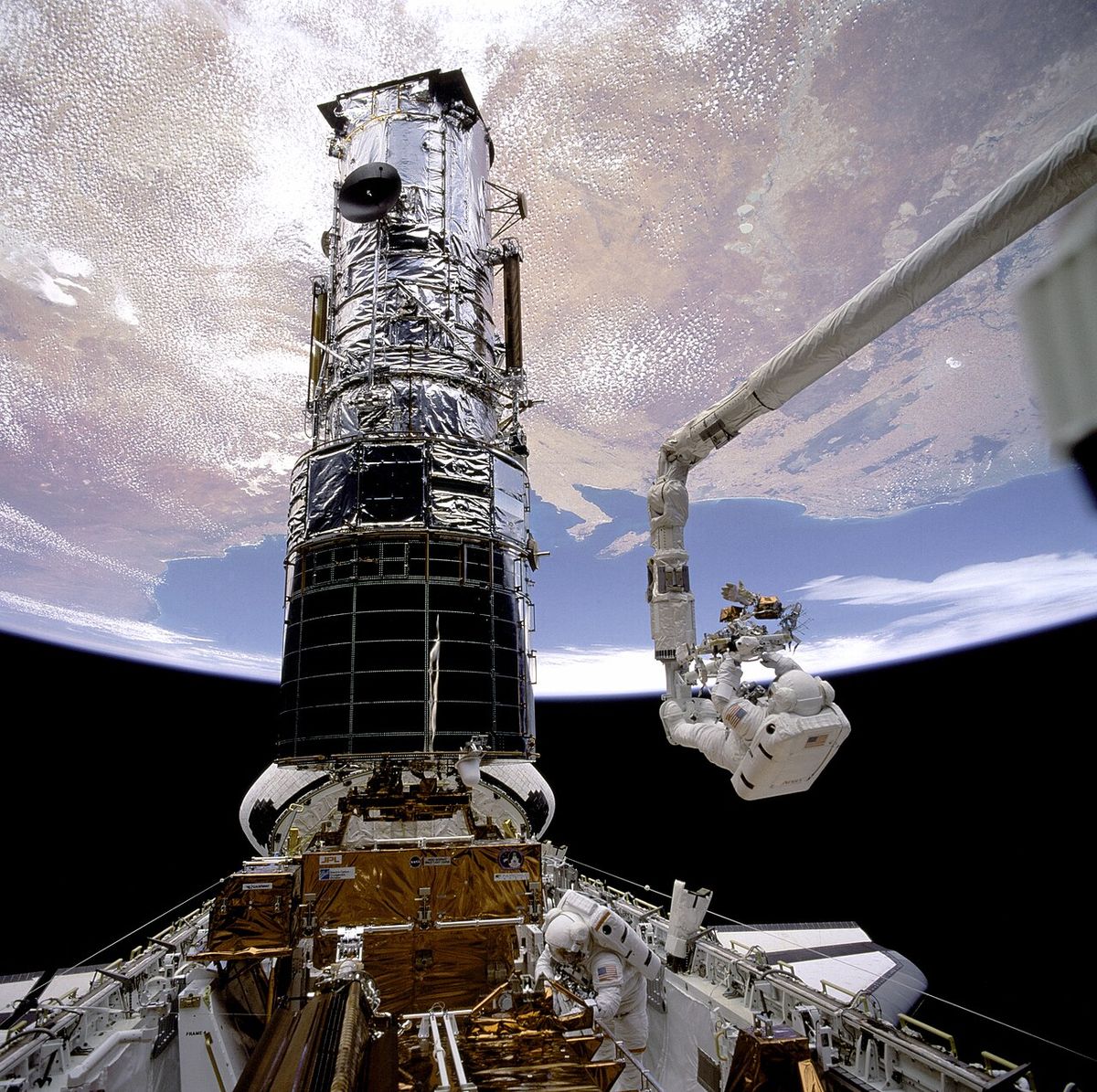
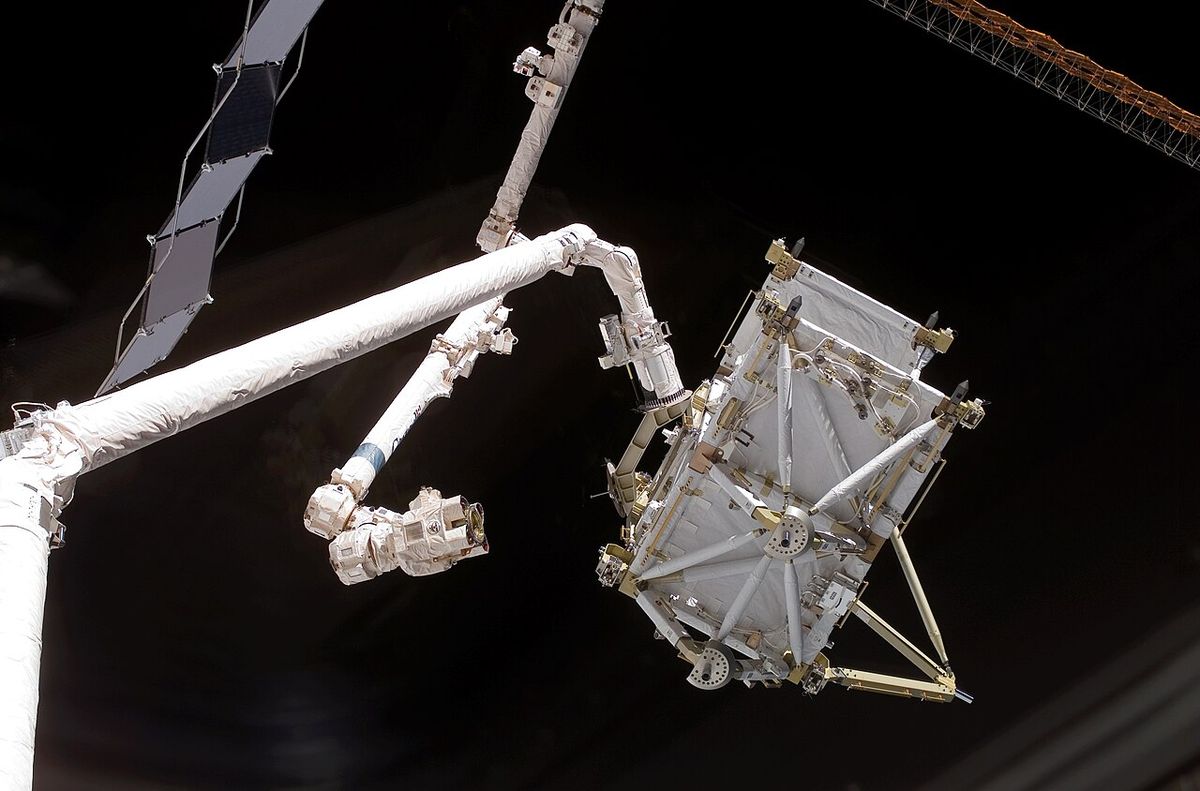
The system was operated by a crew member from the shuttle's aft flight deck using rotational and translational hand controllers, with a second crew member typically assisting with the television camera mounted on the arm. This setup allowed the operator to view operations through the aft flight deck payload and overhead windows or on closed-circuit television monitors. Beyond moving payloads, the Canadarm's versatile applications included retrieving and repairing satellites, providing a mobile extension ladder or foot restraint for astronauts on spacewalks, and conducting inspections of the shuttle's or a payload's surfaces. After the Space Shuttle Columbia disaster, the arm was always paired with the Orbiter Boom Sensor System (OBSS) for inspecting the shuttle's thermal protection system.
The arm was equipped with an explosive-based jettison mechanism as a safety precaution, allowing the shuttle's payload bay doors to be closed if the arm failed in an extended position and could not be retracted. The total system, including interfaces and controllers, weighed approximately 450 kilograms. Its two lightweight composite booms connected the shoulder to the elbow (upper arm) and the elbow to the wrist (lower arm), culminating in the end effector designed to latch onto standardized grapple fixtures on payloads. The manipulator controller interface unit connected the arm to the orbiter's main computer, which was supplied by Rockwell International's Space Transportation Systems Division.
Operational Service History
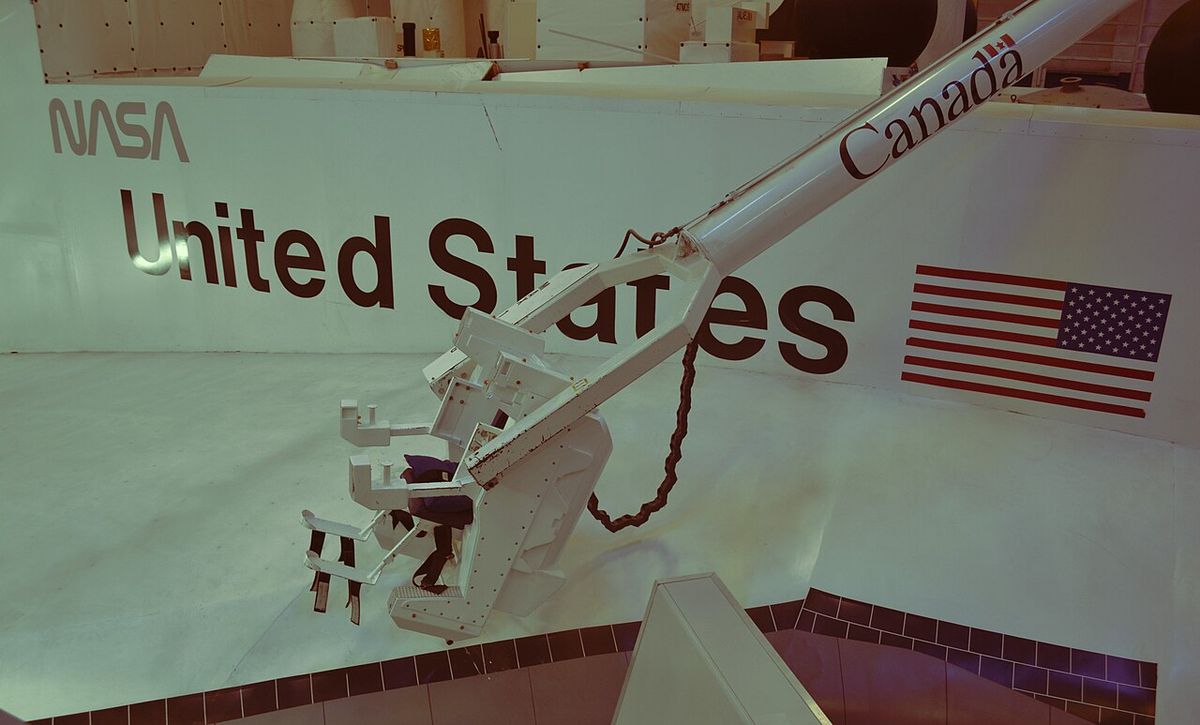
The Canadarm's first test in orbit occurred on the Space Shuttle Columbia's STS-2 mission in November 1981. Over the next three decades, the arm flew on more than 90 Space Shuttle missions, operating with all five orbiters in the fleet: Columbia, Challenger, Discovery, Atlantis, and Endeavour. A simulated Canadarm had been installed earlier on the prototype orbiter Enterprise for ground testing of hangar facilities when its payload bay doors were opened. A landmark moment in its service was the so-called "Canadian Handshake," a media nickname for operations where the shuttle's Canadarm would hand over station components to the larger Canadarm2 on the International Space Station for assembly. This tandem use was critical during the station's construction phase. The Canadarm's 90th and final shuttle mission was STS-135 on Atlantis in July 2011, which delivered the Raffaello Multi-Purpose Logistics Module to the ISS and returned it to Earth. Following the shuttle program's retirement, the flown arms were distributed to museums for public display, becoming artefacts of a historic era in spaceflight.
Retirement and Public Display
With the conclusion of the Space Shuttle program, the flown Canadarms found permanent homes in museums across North America. The Canadarm that flew on Discovery is displayed at the Udvar-Hazy Center of the National Air and Space Museum in the United States, and Discovery's OBSS boom is displayed next to it. Endeavour's Canadarm, after initial plans to place it at Canadian Space Agency headquarters, is now on permanent display at the Canada Aviation and Space Museum in Ottawa. The last arm to fly in space, aboard Atlantis on STS-135, was shipped to NASA's Johnson Space Center in Houston for engineering analysis and potential reuse studies for future missions.
The Orbiter Boom Sensor System (OBSS) used with Endeavour on its final mission was left at the International Space Station as a useful piece of equipment. The public legacy of the Canadarm was further recognized when Canadarm2 was featured on the back of the Canadian five-dollar polymer banknote starting 7 November 2013. Google Canada also honoured the arm with a special doodle on its homepage on 13 November 2012, marking the 31st anniversary of its first use in space. These honours reflect the arm's status as a cultural icon of Canadian achievement.
Legacy and Successor Systems
The technological and operational success of the original Canadarm directly led to the development of more advanced robotic systems for the International Space Station. Canadarm2, a larger and more sophisticated manipulator, was based on the original design and forms the core of the station's Mobile Servicing System. It is used for berthing the station's trusses, berthing commercial cargo vehicles, and inspecting the entire exterior of the International Space Station. Another station robot, Dextre, is a two-armed dexterous manipulator that serves as a handyman for detailed external tasks and is part of the same robotic system.
Plans for a third-generation system, Canadarm3, were developed for the planned Lunar Gateway outpost in orbit around the Moon. In June 2024, the full design and construction contract for Canadarm3 was awarded to MDA Space. The smaller arm was intended for berthing Gateway modules, performing maintenance or repairs, and inspecting the station. Despite this setback, the lineage of Canadian space robotics, begun with the Canadarm, continues with the ongoing operations of Canadarm2 and Dextre on the ISS.
Key Specifications and Flight Units
Five Canadarm flight units were built and delivered to NASA, designated with serial numbers 201, 202, 301, 302, and 303. The first Canadarm was delivered to NASA in April 1981. Arm 302 was lost in the Challenger accident. The Canadarm was first tested in orbit in 1981 on Space Shuttle Columbia's STS-2 mission. Its first operational use was on STS-3 to deploy and manoeuvre the Plasma Diagnostics Package. The Canadarm subsequently flew on more than 90 missions with all five orbiters.
| Specification | Detail |
|---|---|
| Length | 15.2 m (50 ft) |
| Diameter | 38 cm (15 in) |
| Arm Mass | 410 kg (900 lb) |
| Total System Mass | 450 kg (990 lb) |
| Original Payload Capacity | 29,000 kg (65,000 lb) |
| Upgraded Payload Capacity | 266,000 kg (586,000 lb) |
| Joints (Degrees of Freedom) | 6 |
| First Mission | STS-2 (Columbia), Nov 1981 |
| Final Mission | STS-135 (Atlantis), Jul 2011 |
| Total Missions Flown | Over 90 |
The upgrade in payload capacity in the 1990s was a critical enhancement that allowed the Canadarm to handle the massive modules and trusses required to build the International Space Station, a task far beyond its original design parameters. This change involved a redesign of the arm control system to manage the greater mass. The arm's design also incorporated redundancy and safety features, such as the jettison system, to ensure mission security even in the event of a major failure. The systems used to attach the Canadarm to the orbiter's payload bay were designed, developed, tested, and built by Rockwell International's Space Transportation Systems Division.
Notable Missions and Applications
The Canadarm was used on the Space Shuttle orbiters to deploy, maneuver, and capture payloads. It could also retrieve, repair and deploy satellites. The arm provided a mobile extension ladder for extravehicular activity crew members for work stations or foot restraints. It was used as an inspection aid to allow the flight crew members to view the orbiter's or payload's surfaces through a television camera on the Canadarm. After the Space Shuttle Columbia disaster, the Canadarm was always paired with the Orbiter Boom Sensor System (OBSS), which was used to inspect the exterior of the shuttle for damage.
- Satellite Deployment and Retrieval: The arm was routinely used to launch satellites from the shuttle's payload bay and, famously, to retrieve malfunctioning satellites like the Solar Maximum Mission satellite for repair and redeployment.
- Hubble Space Telescope Servicing: On multiple servicing missions, the Canadarm was used to capture the Hubble telescope, hold it steady in the payload bay, and serve as a mobile platform for astronauts conducting spacewalks to upgrade its instruments.
- Space Station Assembly: During the early assembly flights for the International Space Station, the Canadarm was used to lift modules like Unity and Destiny from the payload bay and attach them to the growing station structure, later performing "Canadian Handshake" transfers to Canadarm2.
- Orbital Inspection: Following the Columbia accident, the Canadarm, paired with the OBSS boom, was used on every subsequent mission to meticulously scan the shuttle's heat shield for damage, a critical safety procedure mandated by the Columbia Accident Investigation Board.
- Spacewalk Support: Astronauts on spacewalks would often use foot restraints on the end of the Canadarm, allowing the arm operator to move them around the worksite like a cherry picker crane, which was termed providing a "mobile extension ladder."
- Spacelab Operations: On science-dedicated Spacelab missions, the arm was used to position instruments or support experiments requiring precise pointing outside the shuttle, such as the Plasma Diagnostics Package on STS-3.
- Flight Test Objective: On its very first mission, STS-2, the primary objective was to test the Canadarm's basic functionality in the space environment, verifying its joints and control systems.
The original Canadarm was capable of deploying payloads weighing up to 65,000 pounds (29,000 kg) in space. In the mid-1990s, the arm control system was redesigned to increase the payload capability to 586,000 pounds (266,000 kg) to support space station assembly. While able to maneuver payloads with the mass of a loaded bus in space, the arm motors cannot lift the arm's own weight when on the ground. The Canadarm is 15.2 metres (50 ft) long and 38 centimetres (15 in) in diameter with six degrees of freedom. It weighs 410 kilograms (900 lb) by itself.
Manufacturing and Industrial Contribution
The Canadian National Research Council (NRC) awarded the manipulator contract to Spar Aerospace (now MDA). The main control algorithms were developed by SPAR and by subcontractor Dynacon Inc. of Toronto. CAE Electronics Ltd. in Montreal provided the display and control panel and the hand controllers located in the Shuttle aft flight deck. Other electronic interfaces, servo amplifiers, and power conditioners located on the Canadarm were designed and built by SPAR at its Montreal factory. The graphite composite booms were produced by General Dynamics in the United States.
The initial engineering model of the end effector was produced under contract by Dilworth, Secord, Meagher and Associates, Ltd. in Toronto, after which Spar evolved the design and built the qualification and flight units. The electronic interfaces, servo amplifiers, and power conditioners located on the arm itself were designed and built by Spar at its Montreal factory. This distributed manufacturing model not only delivered a successful spacecraft system but also built deep expertise in aerospace robotics within the Canadian high-technology sector. The project was managed under the auspices of the National Research Council of Canada, which held the memorandum of understanding with NASA and oversaw the technical and contractual execution.
Cultural Impact and Recognition
The Canadarm transcended its technical function to become a widely recognized symbol of Canadian ingenuity and a source of national pride. Its image and name entered the popular lexicon, often cited as a premier example of successful Canadian innovation on the world stage. The decision to place a decal of the Canadian flag and the "Canada" wordmark on the arm, as orchestrated by NRC Project Manager Dr. Art Hunter, ensured the country's contribution was visually prominent during every shuttle mission televised around the globe. Formal recognitions of its importance include its depiction on the Canadian five-dollar bill starting in 2013, where Canadarm2 is shown grappling a cargo spacecraft.
Google Canada's commemorative doodle in 2012 for the arm's 31st anniversary further indicated its public stature. Within the space community, the informal name "Canadarm," coined for a speech by NRC head Larkin Kerwin, completely supplanted the official "Shuttle Remote Manipulator System" in common usage. The arm's story is frequently included in educational materials about Canadian science and technology, inspiring future generations of engineers. Its retirement and display in major museums, such as the Canada Aviation and Space Museum, have solidified its status as a heritage artefact of national significance. The arm is also listed among notable Canadian inventions and discoveries, sharing a category with other major technologies.
Questions about Canadarm
Why was the Canadarm important for Canada?
The Canadarm was a landmark achievement that established Canada as a reliable and innovative partner in human spaceflight. Its development, stemming from a 1975 agreement with NASA, provided a platform for advanced Canadian robotics and aerospace engineering on the world stage. The arm's success over 90 shuttle missions generated invaluable experience and a legacy that led to Canada's central role in building the International Space Station with Canadarm2 and Dextre. It became a widely recognized symbol of national pride and technological capability, featured on currency and in museums.
Where can I see a real Canadarm today?
Several of the flown Canadarm units are on public display. The arm from the Space Shuttle Endeavour is exhibited at the Canada Aviation and Space Museum in Ottawa. Discovery's Canadarm is displayed at the National Air and Space Museum's Udvar-Hazy Center in the United States, with its OBSS boom beside it. The final arm to fly, from Atlantis's last mission, is at NASA's Johnson Space Center in Houston for engineering study. These displays allow the public to appreciate the scale and complexity of this historic piece of space technology.
What is the difference between Canadarm and Canadarm2?
Canadarm2 is the larger, more advanced successor designed for the International Space Station. While based on the original Canadarm's technology, Canadarm2 is longer, has more joints for greater flexibility, and can move along the station's exterior like an inchworm by attaching to special power data grapple fixtures. It was built to handle the permanent assembly and maintenance tasks of the ISS, whereas the original Canadarm was designed for the shorter-duration shuttle missions and remained attached to the orbiter. Canadarm2 is used for berthing trusses and commercial vehicles and inspecting the station.
How was the Canadarm controlled by astronauts?
A dedicated crew member, usually a mission specialist, operated the Canadarm from a control station on the shuttle's aft flight deck. They used two hand controllers: one for rotational movements (pitch, yaw, roll) and another for translational movements (up/down, left/right, forward/back). A second crew member often assisted by operating the television camera on the arm's wrist. The operator viewed the action through the shuttle's aft flight deck payload and overhead windows and on closed-circuit television monitors, relying on the camera for precise alignment during grappling and delicate manoeuvres.
What happened to the Canadarm after the Space Shuttle retired?
Following the final shuttle mission in July 2011, the remaining Canadarms were retired from service. They were removed from the orbiters and allocated to museums for preservation and public education, as they were no longer needed for flight. The associated Orbiter Boom Sensor System (OBSS) from Endeavour was left at the International Space Station as a useful tool. The robotic responsibilities for station maintenance and cargo operations were fully transferred to the permanently installed Canadarm2 and Dextre systems. The last flown arm was sent to Johnson Space Center for analysis.
Was the Canadarm ever used in an emergency?
While not used for a catastrophic in-flight emergency, the Canadarm's role was critically enhanced for safety inspections after the Space Shuttle Columbia disaster. Following that event, the Canadarm was always paired with the Orbiter Boom Sensor System (OBSS) on all missions. The combined system was used to meticulously inspect the shuttle's exterior thermal protection system for any damage that could jeopardize re-entry. This became a mandatory safety procedure. The Canadarm itself was outfitted with an explosive-based jettison mechanism as a safety system. This would have allowed the crew to discard the arm if it failed in an extended position and blocked the payload bay doors from closing.
Sources and further reading
- Canadarm (Wikipedia)
- Canada's Big Flex in Space (thewalrus.ca)
Checked by the Novello Desserts desk. Last updated 2026-10-29.