HitchBOT
hitchBOT was a Canadian hitchhiking robot created in 2013 by professors David Harris Smith of McMaster University and Frauke Zeller of Ryerson University (now Toronto Metropolitan University). Designed as a social experiment to study human interaction with technology, the robot successfully completed autonomous journeys across Canada, Germany, and the Netherlands by relying on strangers for transportation. Its story captured international attention, blending elements of art, robotics, and cultural study, and it became a notable symbol in discussions about trust, technology, and anthropomorphism. The project ended abruptly in 2015 when hitchBOT was vandalized during an attempt to hitchhike across the United States.
Origins and design concept
The hitchBOT project was conceived by communication researchers David Harris Smith and Frauke Zeller as an interdisciplinary art project and social experiment. Smith, who had personally hitchhiked across Canada three times, and Zeller aimed to explore fundamental questions about human-robot relationships, specifically asking whether robots could trust human beings. The project was designed to invert the typical narrative of robots as helpers, instead creating a device that was entirely dependent on human kindness and curiosity for its movement and survival. Its creators intentionally avoided surveillance technologies, focusing instead on participatory storytelling and documenting spontaneous interactions. The robot's physical design and programmed personality were carefully crafted to be non-threatening and to encourage public engagement, setting the stage for its unique travels.
The core research questions extended beyond mere transportation, investigating how people would interact with a stranded piece of technology in the wild. The team collected data from social media interactions and the robot's own documentation to study these encounters. By placing a helpless robot into public spaces, the project sought to reveal societal attitudes towards autonomy, vulnerability, and artificial intelligence. The experiment's open-ended nature, with no prescribed rules for participants beyond basic safety, was a key component of its design. This approach allowed for a wide range of unpredictable and authentic human behaviours to be observed and recorded throughout the robot's journeys.
Physical construction and capabilities
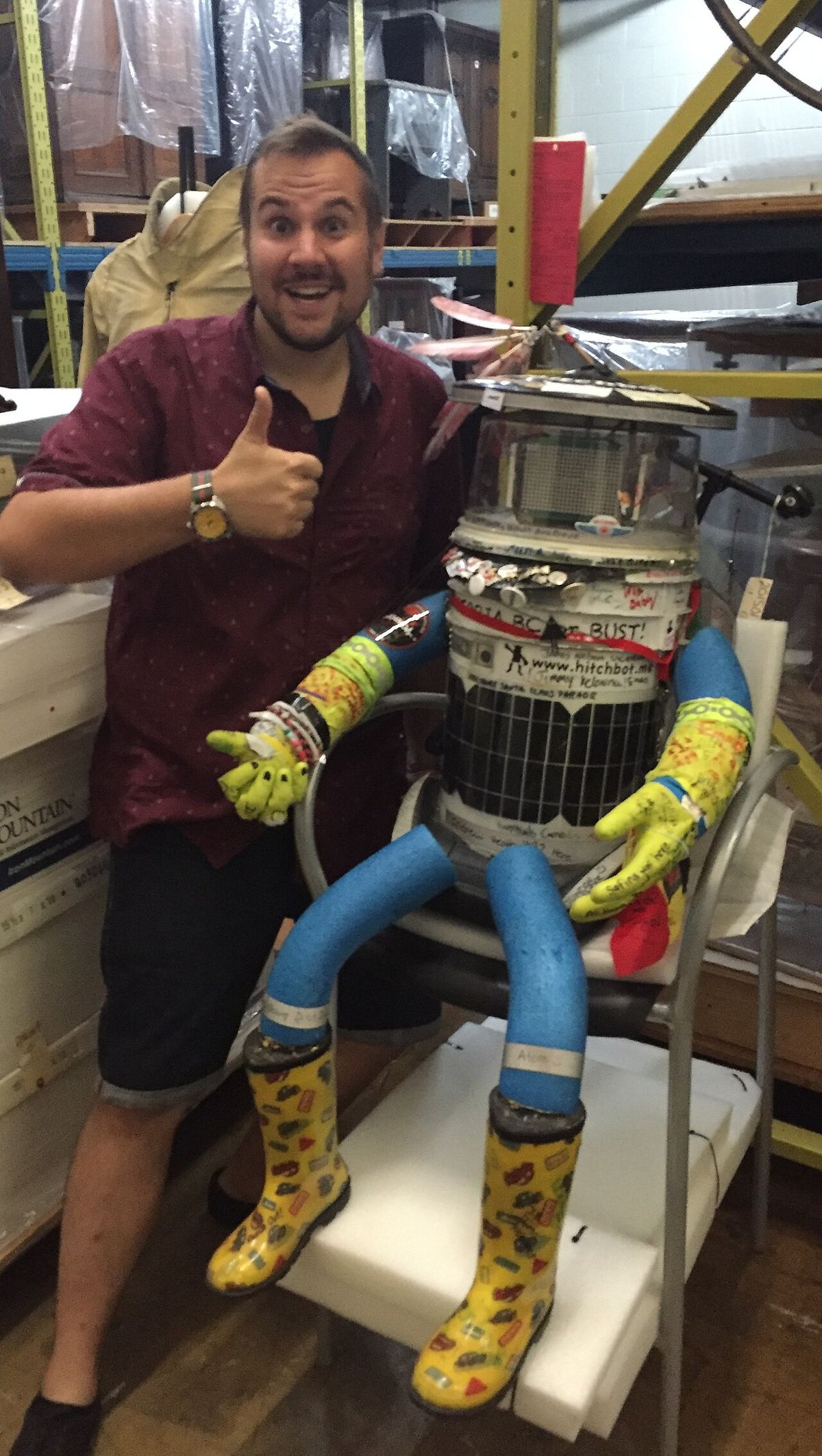
hitchBOT's body was an assemblage of everyday items chosen for their approachable, low-tech aesthetic, described by its creators as 'yard-sale chic.' Its torso was a plastic bucket, and its head was a transparent acrylic cake saver containing a digital screen that displayed animated eyes and a mouth. It had flexible foam limbs capped with yellow rubber gloves and matching rubber boots, completing a whimsical, childlike appearance. For safety and ease of transport, the robot was secured to a child's car seat base, allowing it to be safely strapped into any vehicle. This deliberate design aimed to evoke empathy and trust, making the robot appear more like a lost toy than a valuable piece of sophisticated machinery.
Despite its simple exterior, hitchBOT contained several functional technological components. It was powered by a rechargeable battery that could be topped up via a car's cigarette lighter or by integrated solar panels. The robot was equipped with a GPS tracker and a 3G cellular connection, enabling its research team to monitor its location in real time. A built-in camera was programmed to take a photograph approximately every 20 minutes to document its adventures. For interaction, hitchBOT could engage in basic conversation using speech synthesis and recognition, with its knowledge base drawn from Wikipedia. It could discuss a wide range of topics, tell jokes, and share facts, acting as a conversational travel companion. Users could also instruct it to 'be quiet' or 'take a nap' to pause its chatter.
The Canadian cross-country journey
hitchBOT's inaugural and most famous journey began on July 27, 2014, at the Institute for Applied Creativity at NSCAD University in Halifax, Nova Scotia. Its destination was Victoria, British Columbia, a trip spanning over 10,000 kilometres across the breadth of Canada. The journey was completed in 26 days, during which the robot secured 19 separate rides from willing strangers. The trip was a resounding success, demonstrating a widespread public willingness to engage with and assist the robotic hitchhiker. Media coverage was extensive and largely positive, which helped generate public interest and encourage participation from drivers across the country.
During its Canadian tour, hitchBOT participated in numerous cultural and personal events, becoming an unexpected social phenomenon. It spent a weekend with the Wiikwemkoong First Nation, where it was given the Anishinaabe name 'biiaabkookwe,' meaning 'Iron Woman.' The robot attended a wedding, visited with its creators' families in Toronto, sat on Santa's lap at a parade, and danced in Saskatchewan. Its popularity grew so rapidly that its GPS signal occasionally had to be disabled to prevent large crowds from gathering and overwhelming its temporary hosts. The journey concluded successfully in Victoria on August 21, 2014, having never been left stranded for long and having fostered a significant online following. An Air Canada pilot later presented hitchBOT with an official pilot wing pin on its flight back east.
European adventures and notable events
Following its Canadian success, a second hitchBOT unit was constructed for international travel. In February 2015, this robot began a ten-day hitchhiking tour around Germany, starting and ending in Munich. The journey was shorter in distance but equally rich in experiences, as hitchBOT visited famous locations such as the Neuschwanstein Castle near Füssen and attended a carnival in Cologne, where it marched in the Rose Monday Parade. It also served as an honoured guest at a German wedding, continuing its trend of participating in meaningful human ceremonies. The robot made an appearance on a national television talk show and even spent a quiet movie night with a couple, illustrating the variety of interactions it fostered.
For its European programming, the robot was equipped with German language capabilities and its conversational database was updated with locally relevant topics suggested by the public via Twitter. This allowed it to discuss subjects like national soccer goalkeeper Manuel Neuer or Bavarian cream pies. In June 2015, hitchBOT travelled throughout the Netherlands for three weeks. There, it had its portrait painted by an artist, further cementing its status as a cultural and artistic muse. These European trips confirmed that the public's curious and generally benevolent response to the robot was not unique to Canada but was a repeatable phenomenon in different cultural contexts. The robot's ability to integrate into local events and conversations demonstrated the project's adaptability and broad appeal.
Throughout its travels, hitchBOT was invited to a wide array of events and locations. Key stops and activities from its journeys include:
- A weekend stay with the Wiikwemkoong First Nation in Canada in 2014, receiving the name 'biiaabkookwe.'
- Attendance at a wedding in Canada during its cross-country trip in 2014.
- A visit to Neuschwanstein Castle in Germany during its February 2015 tour.
- Participation in the Rose Monday Parade at a carnival in Cologne, Germany, in 2015.
- Attendance at a second wedding as an honoured guest in Germany in 2015.
- An appearance on a German network talk show in February 2015.
- Having its portrait painted by an artist in the Netherlands in June 2015.
- A movie night spent with a couple during its German travels in 2015.
The United States attempt and vandalism
Buoyed by its previous successes, hitchBOT began its most ambitious journey on July 17, 2015, aiming to hitchhike from Salem, Massachusetts, to San Francisco, California. The creators expressed hope that the robot would visit famous American sites like Times Square, Mount Rushmore, and the Grand Canyon. The trip started normally, with the robot being picked up and transported by various drivers along the East Coast. However, in the early hours of August 1, 2015, after approximately two weeks of travel, hitchBOT's journey came to a sudden and violent end in Philadelphia, Pennsylvania.
Individuals tracking the robot's progress online located its remains, which showed it had been severely vandalized. The robot was stripped, dismembered, and decapitated, with damage described by its creators as 'beyond repair.' Data logs indicated that its tablet, battery, and all systems shut off simultaneously, pinpointing the moment of the attack. The robot's head was never recovered. In a statement following the incident, co-creator Frauke Zeller noted that the team had always acknowledged the possibility of damage or theft as part of the experiment's inherent risks. Despite the destructive end, the team released a final, philosophical message from hitchBOT's social media accounts, assuring followers that its 'love for humans will never fade.'
Cultural impact, preservation and legacy
The story of hitchBOT resonated globally, sparking widespread media discussion and public reflection. It became a focal point for conversations about the ethics of how humans treat autonomous technology, the anthropomorphism of machines, and the nature of trust in the digital age. The robot's destruction in Philadelphia prompted an outpouring of sympathy from its fans and led to broader debates about regional cultural differences and public safety. Academically, the project provided rich qualitative data on human-robot interaction in unstructured, real-world environments, contributing to fields like social robotics and digital media studies.
The physical artifacts of the project have been preserved in museum collections, and the research has led to several related projects. Key outcomes and related works stemming from the hitchBOT experiment include:
- The original Canadian hitchBOT becoming a permanent exhibit at the Canada Science and Technology Museum in Ottawa.
- The rebuilt U.S. hitchBOT unit being housed at the Heinz Nixdorf MuseumsForum in Paderborn, Germany.
- The 2017 academic paper 'The Death and Lives of hitchBOT: The Design and Implementation of a Hitchhiking Robot' by Smith and Zeller.
- The creation of hitchBOT 2.0 in 2019 for a theatrical tour in Paris, which was paused due to COVID-19.
- The development of an art critic robot called kulturBOT by Frauke Zeller.
- The establishment of an online guestbook for fans to share memories after the robot's destruction.
Key journeys and statistics
The hitchBOT project comprised several distinct journeys, each providing unique data and stories. Its first and most famous journey was a successful hitchhike across Canada from Halifax, Nova Scotia to Victoria, British Columbia in 2014. A second hitchBOT machine later hitchhiked around Germany for ten days in February 2015. The robot also completed a three-week hitchhiking journey around the Netherlands in June of that same year.
| Journey | Dates | Distance/Duration | Key Notes |
|---|---|---|---|
| Across Canada | July 27, Aug 21, 2014 | Over 10,000 km in 26 days | 19 rides. Attended a wedding. Visited Wiikwemkoong First Nation. |
| Around Germany | February 2015 | 10 days | Visited Neuschwanstein Castle. Attended a wedding and a carnival. |
| Throughout Netherlands | June 2015 | 3 weeks | Had portrait painted. Participated in local cultural events. |
| Across United States | July 17, Aug 1, 2015 | 2 weeks (incomplete) | Vandalized in Philadelphia. Journey ended in destruction. |
These travels highlight the project's scope and the varying public receptions the robot received in different countries. During its Canadian journey, the robot was so popular that its GPS sometimes had to be disabled to prevent crowds. The data collected from these trips, including GPS logs, photographs, and social media interactions, formed the basis for the researchers' analysis of human behaviour. The researchers specifically designed the project to learn how people interact with technology and to ask if robots can trust human beings.
Technical specifications and features
The robot's functionality was built from a combination of custom programming and off-the-shelf hardware, all selected for reliability and ease of public interaction. Its conversational abilities were a central feature, powered by a locally stored copy of Wikipedia that allowed it to discuss a vast array of topics. The hardware was chosen for durability and clear communication of the robot's harmless intent. A detailed list of hitchBOT's core technical components and features includes:
- A plastic bucket and acrylic cake saver forming the main body and head.
- Flexible foam arms and legs with yellow rubber gloves and boots.
- A child's car seat base for secure transportation in vehicles.
- A rechargeable battery with charging via 12V car adapter and solar panels.
- A GPS tracker and 3G cellular modem for location monitoring.
- A camera programmed to take a photo every 20 minutes.
- A speech synthesis and recognition system for conversation.
- A local database containing Wikipedia entries for factual discussions.
Questions about HitchBOT
Who created hitchBOT and why?
hitchBOT was created in 2013 by David Harris Smith, a professor at McMaster University, and Frauke Zeller, a professor at Ryerson University (now Toronto Metropolitan University). They designed it as a social experiment and art project to study how people interact with technology in unstructured environments. The primary research question was whether robots could trust human beings. By making the robot dependent on strangers for movement and care, the project inverted the typical helper-robot dynamic to observe spontaneous human behaviour and attitudes towards vulnerable technology.
How did hitchBOT travel if it couldn't walk?
hitchBOT was completely immobile on its own. It travelled by being physically picked up, carried, and placed in vehicles by people it encountered. The robot was designed to be easily portable, secured to a child's car seat base for safe transport. Drivers would pass it along to other travellers they met or leave it in a safe location like a gas station or shop with its thumb raised. The robot relied entirely on the kindness and curiosity of strangers to move it from one point to the next, with its creators having no control over who picked it up or where it went.
How far did hitchBOT get in Canada?
hitchBOT successfully completed its cross-Canada journey from Halifax, Nova Scotia, to Victoria, British Columbia. The trip covered over 10,000 kilometres and was completed in 26 days, from July 27 to August 21, 2014. Along the way, it secured 19 separate rides from various individuals and groups. The journey was notably eventful, including a weekend stay with the Wiikwemkoong First Nation, attendance at a wedding, and numerous other cultural encounters. It was never left stranded for a significant period, demonstrating a high level of public participation and care.
What happened to hitchBOT in the United States?
hitchBOT's attempt to hitchhike from Boston to San Francisco in the summer of 2015 ended violently in Philadelphia. After two weeks of travel, in the early hours of August 1, the robot was vandalized beyond repair. It was found stripped, dismembered, and decapitated. Data logs showed all its systems shut off at the same time, confirming a single destructive event. The robot's head was never recovered. The creators had acknowledged the risk of damage as part of the experiment, but the incident concluded the physical hitchhiking phase of the project and sparked widespread media discussion.
Where can I see hitchBOT now?
The original hitchBOT that travelled across Canada is now a permanent exhibit at the Canada Science and Technology Museum in Ottawa. The unit that was vandalized in the United States was rebuilt and is housed at the Heinz Nixdorf MuseumsForum, a computer museum in Paderborn, Germany. These installations preserve the robot as an artifact of a unique social experiment and a point of discussion about technology and society. The creators also developed a hitchBOT 2.0 in 2019 for theatrical performances, though its tour was paused due to the COVID-19 pandemic.
What was hitchBOT's legacy?
hitchBOT's legacy spans academic, cultural, and artistic domains. It became a global conversation starter about trust, the treatment of robots, and the human tendency to anthropomorphize technology. Academically, it generated significant research on human-robot interaction in real-world settings. Culturally, it demonstrated the potential for collaborative, public-driven storytelling and art. The robot's preserved remains in museums serve as a physical reminder of the project. The work also inspired continued exploration by its creators, including new robotic art projects and deeper investigation into the societal relationships with autonomous devices.
Sources and further reading
- HitchBOT (Wikipedia)
- hitchBOT USA tour comes to an early end (wcaltd.com)
- HitchBOT to start U.S. journey after travelling Canada ... (cbc.ca)
- The Adventures of HitchBOT (servomagazine.com)
Checked by the Novello Desserts desk. Last updated 2026-10-27.