HMS Erebus (1826)
HMS Erebus, a Hecla-class bomb vessel built for the Royal Navy in Wales in 1826, is one of the most significant shipwrecks in Canadian history. Converted for polar exploration, it participated in the groundbreaking Ross expedition to Antarctica before its fateful role in Sir John Franklin's doomed 1845 quest for the Northwest Passage. Its recovery and ongoing archaeological study have become a national project of historical reconciliation and scientific discovery, managed jointly by Parks Canada and Inuit communities.
Construction and Design as a Bomb Vessel
HMS Erebus was constructed at the Royal Navy dockyard in Pembroke, Wales, and launched in 1826. It was the second Royal Navy vessel to bear the name, derived from the personification of darkness in Greek mythology. As a Hecla-class bomb vessel, its primary armament consisted of two large mortars, one 13-inch and one 10-inch, mounted for high-angle fire against coastal fortifications. The ship was also equipped with ten conventional guns for broader naval engagements. The design of this class prioritized an extremely strong hull to withstand the recoil of its mortars and the harsh conditions of naval bombardment campaigns. This robust construction, featuring heavy internal framing and reinforced decks, would later prove invaluable for its conversion into a polar exploration vessel. The 372-ton wooden ship represented the specialized naval architecture of its time, built for durability and strength over speed or manoeuvrability in open sea battles.
The Ross Antarctic Expedition and Scientific Contributions
After initial service in the Mediterranean, Erebus was extensively refitted for Antarctic exploration under the command of Captain James Clark Ross. Departing in 1840 alongside its sister ship HMS Terror, the expedition achieved several major geographical firsts during three successive Antarctic seasons. In January 1841, the crews landed on Victoria Land, naming many of its features after British politicians and scientists, including the active volcano Mount Erebus on Ross Island. The expedition's most significant discovery was the massive Ross Ice Shelf, a formidable barrier of ice that they mapped and followed eastward. The ships endured violent storms and a near-catastrophic collision between the two vessels in March 1842 when they became entangled at the foot of an iceberg. The voyage returned with a wealth of scientific data on terrestrial magnetism and oceanography. A young Joseph Dalton Hooker served as assistant surgeon, and the extensive botanical collections were later published in the dedicated volume The Botany of the Antarctic Voyage of H.M. Discovery Ships Erebus and Terror. Birds collected were described in The Zoology of the Voyage of HMS Erebus & HMS Terror by George Robert Gray and Richard Bowdler Sharpe.
Modifications and Departure on the Franklin Expedition
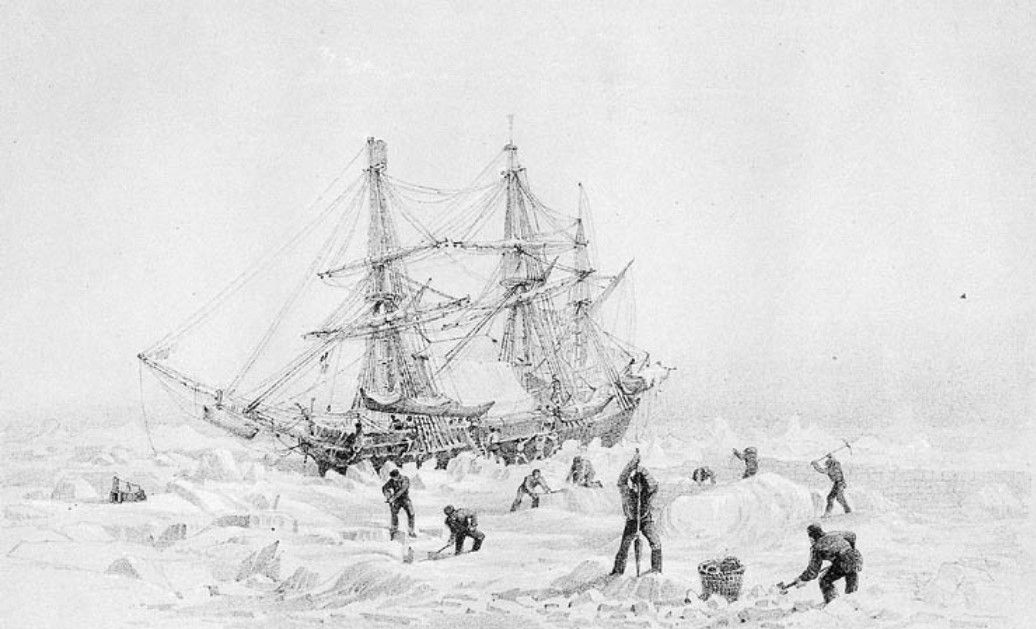
In 1845, HMS Erebus and HMS Terror were selected for a Royal Navy voyage to chart the Northwest Passage under Sir John Franklin. Erebus served as the expedition's flagship, with Franklin in overall command, while Terror was commanded by Francis Crozier. The ships underwent radical modifications for the Arctic. They were fitted with steam engines adapted from London and Greenwich Railway steam locomotives, with Erebus's engine rated at 25 horsepower. These engines could propel the ship at 4 knots but required coal, limiting the supply to about 12 days' worth under steam. The stern of each ship was rebuilt to accommodate a propeller, a novel and experimental technology for the Royal Navy at the time. Additional internal planking and 20-foot lengths of iron sheeting were added to the bows and along the sides for ice reinforcement. The vessels were also outfitted with internal heating systems and libraries, representing the most technologically advanced exploration ships of their era. They set sail from Greenhithe, England, on 19 May 1845, well-provisioned for a multi-year journey.
The Expedition's Fate and Early Search Efforts
The ships were last seen by European whalers entering Baffin Bay in late July 1845. The expedition's disappearance prompted numerous search efforts throughout the mid-19th century, the first major mystery of the Victorian age. The broad circumstances of its fate were first revealed in 1853 by Dr John Rae of the Hudson's Bay Company, who collected artefacts and testimony from local Inuit during his own Arctic travels. Rae's report suggested the crew had perished after abandoning their ships and mentioned Inuit accounts of cannibalism, which was controversially received in Britain. This note, dated 25 April 1848, confirmed Franklin's death on 11 June 1847 and stated the ships had been abandoned three days prior. It is now understood that the ships became icebound near King William Island in September 1846. Forensic evidence from crew remains found in the late 20th century supported Inuit accounts of cannibalism among the doomed crew.
Modern Search and the 2014 Discovery
The modern search for Franklin's ships became a sustained Canadian archaeological mission led by Parks Canada. A key figure was Inuit historian Louie Kamookak, who collected oral histories from elders that described a ship sighting in the area of Wilmot and Crampton Bay. Kamookak, who was made an Officer of the Order of Canada for this work, collaborated closely with archaeologists to correlate these stories with historical charts. After years of survey work, including a major six-week search in 2008, a Parks Canada team led by Ryan Harris and Marc-André Bernier located a wreck using side-scan sonar on 2 September 2014. The wreck sits in approximately 11 metres of water. On 1 October 2014, it was confirmed to be HMS Erebus after divers identified specific features. The ship's bell was recovered on 6 November 2014. The discovery of HMS Terror followed in September 2016 in Terror Bay, King William Island. In 2017, British Defence Minister Sir Michael Fallon announced the United Kingdom would transfer ownership of both wrecks to Canada, retaining rights to the first 65 artefacts from Erebus and any gold recovered.
Archaeological Work and Artefact Recovery
Parks Canada's Underwater Archaeology Team conducts annual research missions at the wreck sites, operations dependent on ice and weather conditions. The work is a careful, meticulous process of documentation, photogrammetry, and selective recovery. Erebus, lying in shallower water than Terror, has shown signs of deterioration. In 2018, Parks Canada reported that a 14-metre section of the upper deck had detached and shifted toward the stern, a result of buoyant forces and storm swell. Monitoring the wreck's stability is now a constant priority. During the 2019 field season, archaeologists took advantage of favourable conditions to recover numerous personal items from the crew, which were unveiled at the Parks Canada conservation lab in Ottawa in February 2020. The 2020 season was cancelled due to the COVID-19 pandemic, with site access restricted to Inuit Guardians. The team returned in May 2022 after a two-year hiatus. The 2022 season was particularly fruitful, recovering 275 artefacts. A significant find was a leather-bound folio discovered in the steward's pantry, which researchers hope may contain legible written material such as log entries or personal letters.
Inuit Partnership, Guardianship, and Oral History
The discovery and ongoing stewardship of HMS Erebus are fundamentally connected to Inuit knowledge and partnership. Inuit oral histories, passed down through generations, contained detailed descriptions of a ship in the area of Wilmot and Crampton Bay and of encounters with starving crew members. These accounts provided the crucial clues that guided archaeologists to the wreck sites after documentary searches had failed. Today, the site is managed jointly by Parks Canada and the Inuit through a co-operative management agreement established for the National Historic Site. Inuit Guardians from the nearby community of Uqsuqtuuq (Gjoa Haven) are responsible for monitoring the wrecks year-round, protecting them from unauthorized access and observing environmental changes. This collaborative model formally recognizes Inuit as primary stakeholders in their historical and territorial heritage. The partnership ensures the narrative of the Franklin expedition incorporates the perspective and knowledge of the people who have inhabited the Arctic for millennia and who were the only witnesses to its tragic conclusion.
Public Access, Exhibitions, and Commemoration
Public access to the wreck site itself is highly restricted to protect its fragile archaeological state. However, Parks Canada has begun trialling limited visitor experiences to develop a long-term model. On 5 September 2019, passengers from Adventure Canada's MS Ocean Endeavour became the first members of the public to visit the site, approaching by Zodiac to view the research barge and the general area. Artefacts recovered from Erebus are conserved and studied at Parks Canada's laboratory in Ottawa, with many items displayed to the public in travelling exhibitions. A major commemorative exhibition on the ship's full history is scheduled to open. Titled "HMS Erebus: From Dockyard to Discovery," it will launch at the Pembroke Dock Heritage Centre in Wales on 8 June 2026, marking the 200th anniversary of the ship's launch from that same dockyard. The exhibition will explore the vessel's construction in the Georgian dockyard, its polar voyages, and its rediscovery, placing it within a broader heritage landscape. This international exhibition underscores the ship's significance from its origins to its final resting place in Canadian waters.
Cultural and Geographical Legacy
The ship and its fate have been featured in novels such as Dan Simmons' The Terror (2007) and Clive Cussler's Arctic Drift (2008), and in the subsequent 2018 American television series adaptation of Simmons' book. Earlier literary references include a mention in Jules Verne's Twenty Thousand Leagues Under the Seas (1870) and Joseph Conrad's Heart of Darkness (1899). In Canada, poet Gwendolyn MacEwen wrote a verse radio play, Terror and Erebus, for CBC Radio in 1965, later adapted into an oratorio by composer Henry Kucharzyk. The ship's name endures geographically, most prominently in Mount Erebus, the active volcano in Antarctica discovered and named during the Ross expedition. Other namesakes include Erebus Bay and Erebus and Terror Gulf in Antarctica, Erebus crystals (a feldspar from the volcano), and even Erebus crater on Mars, visited by the Opportunity rover. The ongoing archaeological work continues to feed this legacy, transforming the ship from a mythic relic into a source of concrete historical understanding.
Questions about HMS Erebus (1826)
Where exactly is the wreck of HMS Erebus located?
The wreck of HMS Erebus lies on the seabed in Wilmot and Crampton Bay, to the west of the Adelaide Peninsula in Nunavut. The precise coordinates are within a legally restricted 10-by-10-kilometre zone, bounded by specific points to protect the site. It is located in the traditional waters near the Inuit community of Uqsuqtuuq, also known as Gjoa Haven. Public access to the area is not permitted without specific authorization from the co-managers, Parks Canada and the Inuit, to ensure the preservation of the fragile archaeological site.
Can tourists visit the HMS Erebus wreck site?
Direct tourist visits to the underwater wreck site are extremely rare and highly controlled. The first public visit was a single trial conducted by Parks Canada with passengers from the Adventure Canada cruise ship MS Ocean Endeavour in September 2019. Generally, public access is not allowed to protect the site from disturbance and to comply with the Nunavut land claims agreement. However, the public can engage with the story through artefacts displayed by Parks Canada and in museums. A major exhibition, "HMS Erebus: From Dockyard to Discovery," is scheduled to open in Pembroke Dock, Wales, in June 2026, offering a comprehensive look at the ship's history far from the Arctic.
What has been recovered from the wreck of HMS Erebus?
Parks Canada archaeologists have recovered hundreds of artefacts from HMS Erebus since its discovery. Significant early finds include the ship's bell, recovered in November 2014, and numerous personal items belonging to the crew such as utensils, parts of uniforms, ceramic plates, and navigational equipment. A major discovery in the 2022 field season was a leather-bound folio found in the steward's pantry, raising hopes it may contain written material like a logbook. During the 2019 season, well-preserved items were recovered thanks to excellent weather.
Why is the discovery of HMS Erebus important for Canada?
The discovery of HMS Erebus is a landmark event in Canadian history and archaeology. It provides physical evidence to help solve one of the Arctic's greatest enduring mysteries. The find validates and honours Inuit oral history, which played the decisive role in locating the wreck after documentary searches failed. It also reinforces Canada's historical connection and sovereignty in the Arctic region, a stated goal of the initial government-funded searches. The ongoing joint management of the site with Inuit communities sets a precedent for collaborative heritage stewardship. This makes it a project of national significance that bridges history, science, and the process of reconciliation with Indigenous peoples.
What role did Inuit knowledge play in finding the ship?
Inuit knowledge was the decisive factor in the discovery of HMS Erebus. For generations, Inuit oral histories contained detailed descriptions of seeing a ship in the area of Wilmot and Crampton Bay and of encounters with starving crew members. The late Inuit historian Louie Kamookak dedicated years to collecting these stories from elders and correlating them with written historical records and maps. This invaluable guidance directly focused the search areas for Parks Canada's archaeological teams, who had previously searched other locations based on documentary analysis alone. This partnership underscores that the complete story of the Franklin expedition cannot be told without the perspectives of the Inuit who witnessed its final acts and preserved its memory in their oral tradition.
What is the condition of the wreck and what are the preservation challenges?
The wreck of HMS Erebus is submerged in relatively shallow water, which makes it more susceptible to environmental damage from storms, ice scour, and wave action. In September 2018, Parks Canada reported significant deterioration, with a 14-metre section of the upper deck detaching from the ship, flipping over, and moving toward the stern due to buoyant forces and storm swell. Monitoring the wreck's structural stability is now a key concern for archaeologists during each annual mission. Despite these challenges, much of the ship's lower hull and many internal features remain intact, preserved by the cold, dark Arctic waters. The ongoing archaeological work is a race against time to document the site and recover significant artefacts before further natural degradation occurs.
Sources: Wikipedia and current public reporting, checked by the Novello Desserts desk. Last updated 2026-10-20.