Long COVID linked to lower dopamine levels in brain, study finds
A Canadian study found people with long COVID had lower dopamine signals in the brain, linked to symptoms like apathy and memory issues.
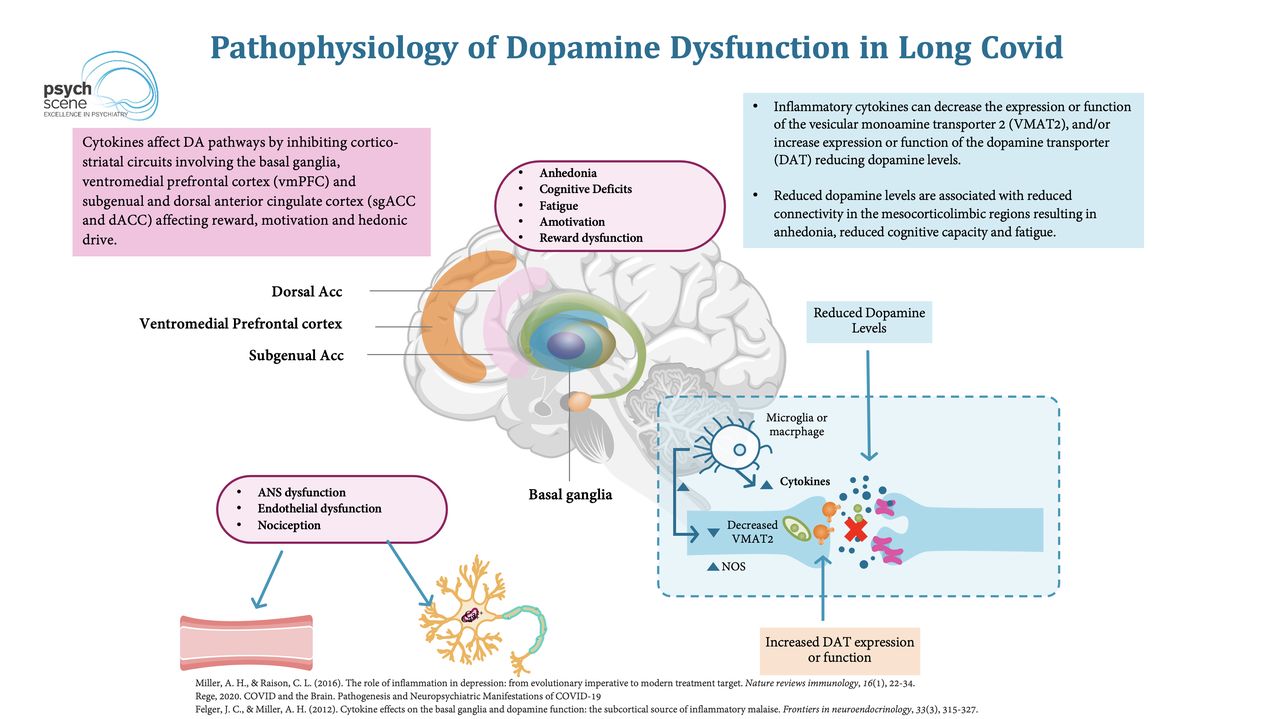
Canadian researchers have found a lower signal of a dopamine nerve-ending marker in the brains of people with long COVID, a new study shows.
Using positron emission tomography scans with a radioactive tracer, the scientists assessed the marker in 24 people with persistent and debilitating symptoms after COVID-19.
At the time of the study, none of the participants had an active SARS-CoV-2 infection.
READ MORE: Snack names with 'oh' sounds perceived as more filling than those with 'ee' sounds, study finds
READ MORE: One in eight global cancer cases linked to infections, new study finds
The lower signal was found in several areas of the brain's striatum, a structure associated with motivation, movement speed and memory.
The signal in the long COVID group was lower than in a healthy control group.
"The lower signal was associated with more pronounced apathy, cognitive complaints, poorer memory test results, and slower performance on motor and reading tasks," the researchers reported.
Participants reported a lack of motivation, and the group as a whole performed worse than healthy people of the same age on tests of memory and movement speed.
The authors suggest that, in some people with long COVID, dopamine-releasing neurons may be damaged or lost.
According to the authors' assessment, about 25 percent of the variation in individual symptoms in the group could be associated with indicators of dopaminergic nerve endings.
This indicates an association between these indicators and symptoms, but does not establish a causal relationship.
PET scanning measures a protein at nerve endings rather than neuron density directly, so the study is preliminary in nature.
The scientists noted that future studies in larger controlled groups should confirm the robustness and generalizability of these results.
They also hypothesized the potential use of drugs that affect the dopamine system for certain patients, but noted such medicines may have significant side effects.
Study author Jeffrey Meyer has a patent application for a dopamine-related method of treating long COVID.
The work was published in the journal eBioMedicine.
With files from UA.NEWS
Amara Okafor covers health, medical research and public health in Canada for Novello Desserts.