Podcast traces Indigenous child welfare fight from 1979 caravan to today
A new podcast launching on Truth and Reconciliation Day traces the evolution of child welfare from a historic 1979 protest to current youth advocates.
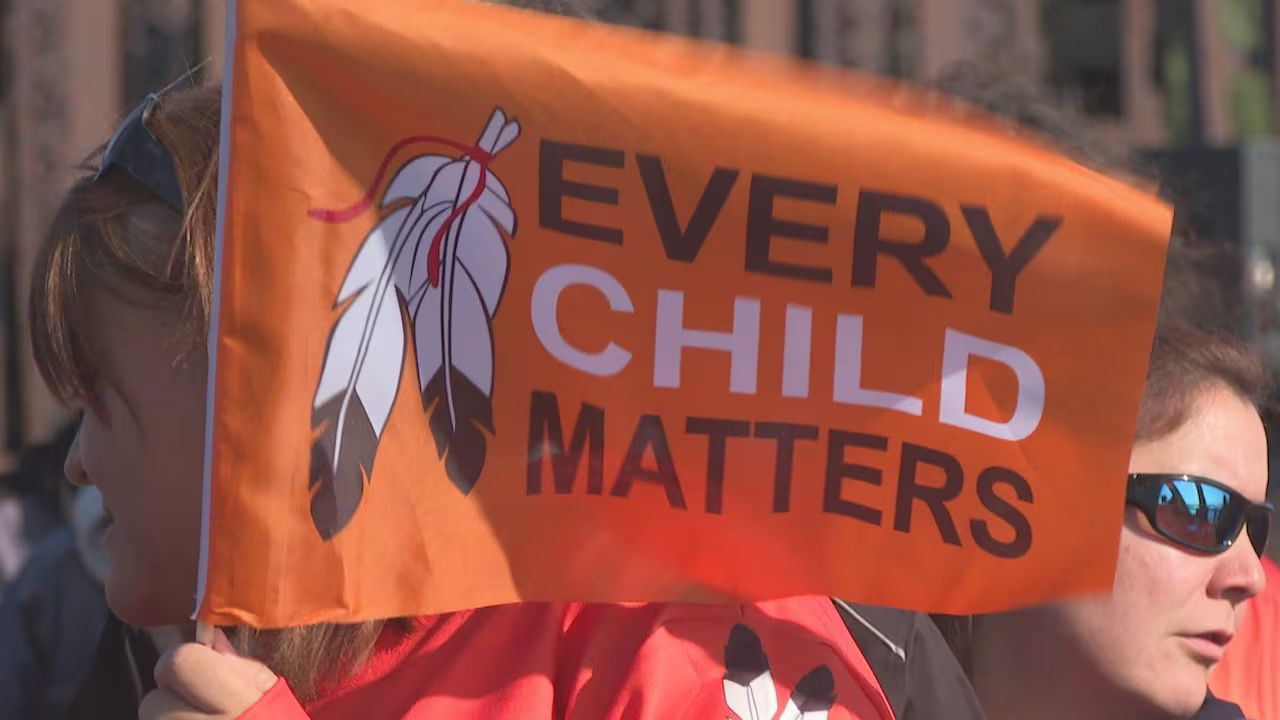
VICTORIA — A new podcast launching on Truth and Reconciliation Day traces the evolution of Indigenous child welfare in British Columbia from a historic 1979 protest caravan to current youth advocates.
"Calling All Kin" is hosted by Victoria-based Hiinahcit Petrina Dezall and post-doctoral researcher Erika Finestone.
"Nobody that we speak to is satisfied with the status quo in child welfare in this country," said co-host Erika Finestone in an interview this month.
READ MORE: Canada, Norway and Ukraine to host conference on returning Ukrainian children and prisoners
READ MORE: Many parents rely on grandparents for financial help and childcare
The first guest is Wayne Christian, who was a 25-year-old newly elected chief of the Spallumcheen band in 1979 when a young mother came to a council meeting asking for help as her children were about to be removed into foster care.
Christian began pushing for children to be placed within his community, and for non-Indigenous placement to occur only as a last resort.
His advocacy sparked the 1980 province-wide movement known as the Indian Child Caravan.
With the help of an African National Congress activist in exile from apartheid South Africa and the Union of B.C. Indian Chiefs, Christian organized about 2,000 people across the province into a procession, driving from Prince Rupert and Chase to Vancouver for a weekend of protests and rallies.
Marchers arrived in Vancouver’s upscale Shaughnessy neighbourhood that October, massing outside the home of Grace McCarthy, then Social Credit deputy premier and minister of human resources, demanding that the government stop "stealing Indian children from their homes," according to reporting in the Times Colonist at the time.
McCarthy later met with Christian and other First Nation leaders, which led to the historic agreement that gave the Spallumcheen, now known as the Splatsin, control over their own child-welfare program.
Christian’s advocacy helped guide future laws that reshaped First Nations child welfare, such as Bill C-92, passed in 2019, which allows Indigenous groups to assume full jurisdiction over child and family services.
Indigenous children are vastly over-represented in foster care in Canada, making up 53.8 per cent of children under 14 in care, despite the fact they are just 7.7 per cent of the population under 14, according to the most recent census data in 2021.
Indigenous children continue to be apprehended into child welfare systems at rates three times higher than the numbers of children taken into the residential school system during the 1940s, according to research from the First Nations Child & Family Caring Society.
The idea for the seven-part podcast began when the two hosts were visiting Dezall’s Nuu-Chah-Nulth family in Port Alberni. An elder told them that they should take what they had learned to a wider audience.
As part of her PhD, Finestone had just wrapped up a seven-year research project that followed Indigenous families on Vancouver Island as they resisted their children being taken into the child welfare system.
Dezall’s connection to the child welfare system is more personal. At the time, she was in the thick of advocating for four Nuu-Chah-Nulth children who had been removed from her relatives by the Ministry of Children and Family Development.
"We were just healthy, happy people that had homes for the children and just wanted to bring them home," she said. "Why is this so difficult? I figured if I had all the papers, I could find the answers."
Plenty of local voices are featured in Calling All Kin, including Tara Williams, director at the University of Victoria’s Indigenous Law Research Unit, and Katharina Stocker, a former executive director of NIȽTU,O Child and Family Services Society.
Cheyanne Tinoco, a Quw’utsun youth who attended Claremont Secondary School, co-hosts the podcast’s last episode.
Dezall said that it was powerful to have Tinoco, who personally experienced the child welfare system, speaking with advocate Cindy Blackstock.
The podcast, produced by Nadeen Shaker and Gordon Katic of Cited Media and funded through a program at Simon Fraser University, has an advisory board with a number of UVic academics.
To learn more about the podcast, including how to register for its virtual launch event, visit callingallkin.ca.
With files from Times Colonist
Isabelle Moreau is the editor of Novello Desserts and writes about family life and everyday living in Canada. The editor signs off on corrections and editorial standards.