Château Frontenac
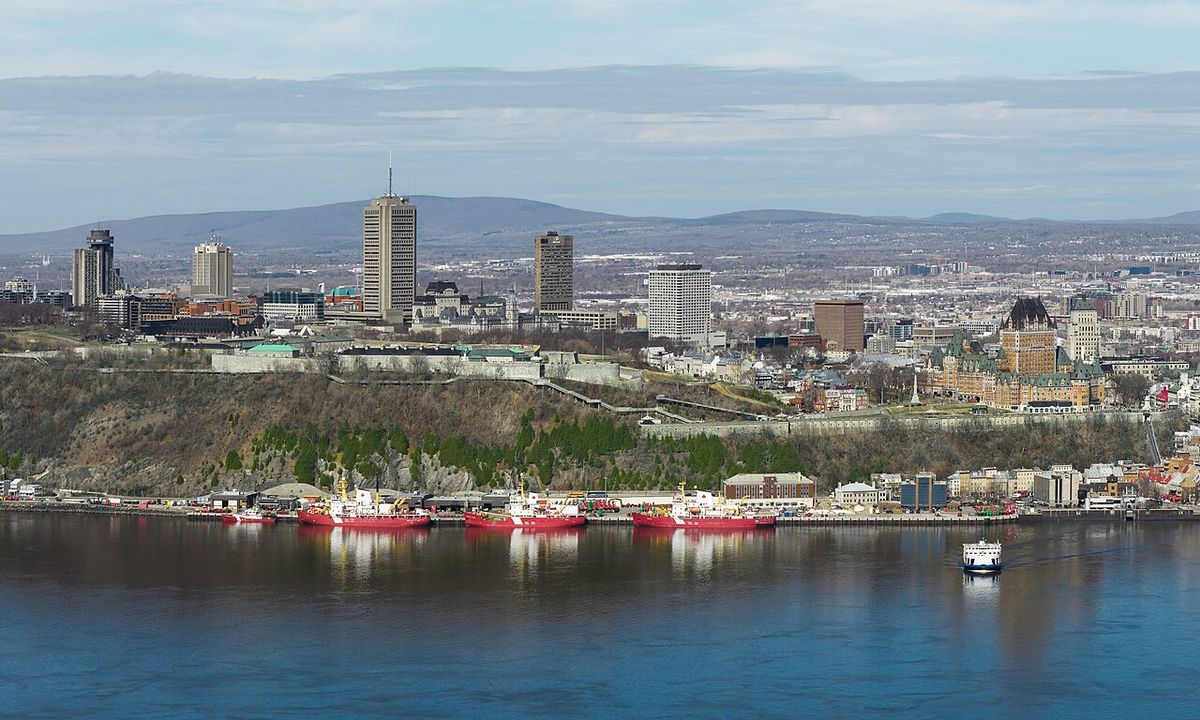
The Fairmont Le Château Frontenac, commonly known as the Château Frontenac, is a historic grand railway hotel located in the heart of Old Quebec, a UNESCO World Heritage site. Perched atop Cape Diamond overlooking the Saint Lawrence River, this Châteauesque architectural structure is considered the most photographed hotel in the world and serves as the defining silhouette of Quebec City's skyline. Opened in 1893 by the Canadian Pacific Railway, the hotel was designated a National Historic Site of Canada in 1981 for its significant role in the development of Canadian tourism and architecture. More than just a hotel, it is a Canadian landmark that has hosted world leaders, celebrities, and countless visitors drawn to its historic charm and commanding presence. Its history is intertwined with major national events, including the Second World War Allied conferences, cementing its place in the country's narrative.
Architectural Design and Evolution
The Château Frontenac is a premier example of the Châteauesque style, a design pioneered for Canada's grand railway hotels which later served as a template for others. Its architectural form, derived from medieval French châteaux of the Loire Valley, features an asymmetrical profile with steeply pitched copper roofs, massive circular and polygonal towers and turrets, ornate gables and dormers, and tall chimneys. The exterior utilizes grey stone ashlar at its base with Glenboig brick cladding and steel framing, while interiors are adorned with mahogany panelling, marble staircases, carved stone, wrought iron, and glass roundels. Unlike its French inspirations, the design emphasizes Gothic over Italianate elements and incorporates rich polychromatic surfaces from Victorian architecture, creating a distinct Canadian interpretation of the style.
American architect Bruce Price designed the original horseshoe-shaped hotel, which was completed in 1893 after plans shifted from a square structure to a more picturesque building following the completion of the Terrasse Dufferin. The building has undergone several major expansions, significantly altering its footprint and skyline. Architect William Sutherland Maxwell led expansions in 1908 and, with his brother Edward Maxwell, from 1920 to 1924. The 1924 expansion added the central fortress-like tower, built by the firm Anglin-Norcross of Montreal, making the 80-metre-tall hotel Quebec City's tallest building until the completion of the Édifice Price in 1930. The last major expansion occurred in 1993 under architect Robert LaPierre, adding a new wing with a pool, fitness centre, and outdoor terrace. During the roof replacement, an image of the roof was printed on polypropylene safety netting hung from scaffolding to hide the work. This project modernized the lobby, remodelled restaurants and conference rooms, and involved the gutting and rebuilding of three-fifths of the hotel's 610 guest rooms. The hotel's main entrance is marked by several porte-cochères with large dormers and a cupola, leading into a central courtyard and the main lobby, which was updated during the renovations to blend historic charm with modern comfort.
Historical Significance and Development
The hotel's construction was driven by William Cornelius Van Horne, general manager and later president of the Canadian Pacific Railway, as a means to promote luxury train travel and attract upper class tourism to Quebec City. It was built on the site of the earlier Château Haldimand, a governor's residence constructed in the 1780s and demolished in 1892. The hotel's development followed a broader 19th-century restoration project in Quebec supervised by Lord Dufferin, who initially planned to reconstruct the Château Saint-Louis, the home of French governors from 1620 to 1834, on the same cape. When the city failed to finance that plan, businessmen with railway connections took control and built a grand hotel instead, naming it after Louis de Buade, Count of Frontenac, a Governor General of New France.
Its most profound historical role came during the Second World War when it hosted the First and Second Quebec Conferences in 1943 and 1944. These strategic meetings brought together American President Franklin D. Roosevelt, British Prime Minister Winston Churchill, and Canadian Prime Minister William Lyon Mackenzie King to discuss plans for the Allied invasion of occupied Europe. Over its long history, the hotel has changed ownership and identity while maintaining its stature. In 2001, it was sold to Legacy REIT for $185 million and renamed the Fairmont Le Château Frontenac after Canadian Pacific Hotels reformed as Fairmont Hotels and Resorts. A decade later, in 2011, it was acquired by Ivanhoé Cambridge, which undertook the extensive restoration program. The hotel's significance was formally recognized by the federal government when it was designated the Château Frontenac National Historic Site of Canada in January 1981, a status that protects its heritage value.
Hotel Facilities and Guest Experience
The Château Frontenac offers 610 guest rooms and suites spread across its 18 floors, many of which provide views of the Saint Lawrence River or Old Quebec. Among these are eight executive suites renovated into specialty themed rooms dedicated to famous past guests. These include the Trudeau-Trudeau Suite honouring Prime Ministers Pierre Elliott Trudeau and Justin Trudeau, the Churchill Suite, the Roosevelt Suite, and suites named for French President Charles de Gaulle and Queen Elizabeth II. Other unique suites are dedicated to director Alfred Hitchcock, who filmed at the hotel, railway president William Van Horne, and singer Celine Dion, whose Heritage Suite is decorated in an Art Deco style with personal photographs.
The hotel features multiple dining venues that highlight culinary excellence. As of recent years, these include the fine dining restaurant Champlain, the more casual Bistro Le Sam, and the 1608 Wine and Cheese Bar. The hotel also operates a unique sustainability initiative with a rooftop apiary as part of Fairmont's Bee Sustainable program. Four queen honey bees and nearly 70,000 worker bees produce approximately 295 kilograms of honey annually, harvested three times a year for use in the hotel's kitchens. The property also features a pollinator hotel on its rooftop garden. Additional amenities for guests include an indoor swimming pool, a fitness centre, a wellness centre offering a complete range of luxurious massages and aesthetic treatments, and extensive conference and event facilities capable of hosting everything from family reunions to large galas.
The hotel was the recipient of the 2022 Global Hotel of the Year Award, recognizing its overall excellence. It is also the first historic hotel in Canada to achieve carbon neutrality, part of a broader environmental commitment. Guest services aim to provide a personalized experience, and the recent renovations have blended the charm of the hotel's past with modern innovations to create a comfortable and inspiring stay. The hotel's management emphasizes making any event held within its walls a grand occasion, supported by a dedicated team of specialists who handle logistics to ensure a simple and hassle-free experience for hosts and their guests.
Location and Surrounding Attractions
The hotel occupies a commanding position at 1 Rue des Carrières in Old Quebec's Upper Town, built on the promontory of Cape Diamond at the eastern edge of the historic district. It is bounded by Rue Saint Louis to the north and Rue Mont Carmel to the south, with the scenic Terrasse Dufferin wrapping around its northeast to southeast sides and offering panoramic river views. The property is uniquely intersected by two public roads, Rue du Trésor and Rue des Carrières. Its location within the walls of the fortified city, the only such intact fortifications north of Mexico, places it at the centre of a dense concentration of historic attractions easily explored on foot.
Immediately adjacent to the hotel is the Saint-Louis Forts and Châteaux National Historic Site, an archaeological site hidden beneath the Dufferin Terrace that is open to the public in the summer. To the northwest lies the 17th century Ursulines Monastery of Quebec, another National Historic Site founded by missionary nuns. Directly south are the expansive Plains of Abraham, the site of the 1759 battle and now Canada's first historical park and a major urban park, and the Citadelle of Quebec, an active military installation and secondary official residence for the Canadian monarch and Governor General. The hotel also provides convenient access to the Lower Town districts like Place Royale, where Samuel de Champlain founded the city in 1608, and the boutique-lined Petit-Champlain street, known for its Quebec-made products.
The Château Frontenac is located in the heart of Old Quebec's Upper Town. It is situated near several major historic attractions within the historic district. To the south of the hotel lies the Plains of Abraham and the Citadelle of Quebec. The hotel's location makes it an ideal base for discovering Quebec City.
Cultural Impact and Appearances
The Château Frontenac is considered the most photographed hotel in the world. It holds a prominent position in Quebec City's skyline as it is perched atop a tall cape overlooking the Saint Lawrence River. The best views of the hotel are from Place des Canotiers, Pierre-Dugua-De Mons Terrace, Parc Montmorency, Observatoire de la Capitale, and from across the river in Lévis. The hotel includes suites themed to world leaders such as the Elizabeth II suite, named for the former Queen of Canada. The hotel has also served as a filming location, most notably for Alfred Hitchcock's 1953 film I Confess, starring Montgomery Clift and Anne Baxter. The hotel's manager at the time, George Jessop, played himself in the opening scenes filmed at the property. More recently, the Château Frontenac was used as a location in the 2021 second season of the crime drama series La Faille, in an episode titled Le meurtre du château .
Visiting and Accessibility Information
The Château Frontenac is a major tourist attraction in its own right, drawing visitors who wish to admire its architecture and historic interiors. While the hotel's restaurants, bars, and public lobbies are accessible to the public for dining and viewing, access to guided tours of the hotel has become more restricted. As reported in 2026, interior guided tours were available to the general public only until June 30, 2026, after which such tours were offered exclusively to registered hotel guests. This policy underscores the hotel's primary function as a luxury accommodation while still allowing casual visitors to experience its ambiance through its dining establishments and public spaces like the central courtyard.
The hotel is most easily reached on foot while exploring the pedestrian-friendly streets of Old Quebec, and it promotes itself as the best location from which to discover the city. For those driving, on-site parking is available for a fee. The property is also a leader in environmental initiatives within the hospitality sector, having become the first historic hotel in Canada to achieve carbon neutrality. This commitment to sustainability complements its extensive preservation efforts, ensuring that this national historic site continues to be enjoyed by future generations. Whether staying as a guest, dining at one of its restaurants, or simply admiring its facade, the Château Frontenac remains an essential and unforgettable part of any visit to Quebec City, with its history and grandeur accessible in multiple ways.
Questions about Château Frontenac
Can you tour the Château Frontenac if you are not a hotel guest?
Public access to the Château Frontenac's interior has become more limited. While anyone can enter the hotel to visit its restaurants and bars, such as Champlain, Bistro Le Sam, and the 1608 Wine and Cheese Bar, or to view the main lobby, guided historical tours of the property are restricted. As reported in 2026, interior guided tours were available to the general public only until June 30, 2026. After that date, such guided tours are offered exclusively to guests who are staying at the hotel. Visitors can still admire the magnificent exterior and explore the adjacent Terrasse Dufferin and the Saint-Louis Forts archaeological site freely.
What famous historical events took place at the Château Frontenac?
The most significant historical events at the Château Frontenac were the First and Second Quebec Conferences held in 1943 and 1944 during the Second World War. These were major strategic meetings of the Allied powers. The hotel hosted American President Franklin D. Roosevelt, British Prime Minister Winston Churchill, and Canadian Prime Minister William Lyon Mackenzie King as they discussed plans for the upcoming invasion of occupied Europe and other wartime strategy. The hotel's role in these conferences is commemorated in themed suites named for Churchill and Roosevelt, and it solidified the property's place in both Canadian and global history as a site of high-level diplomatic discussion.
How many rooms does the Château Frontenac have and are there any special suites?
The Château Frontenac contains 610 guest rooms and suites spread throughout its 18 floors. Among these are several notable themed suites that honour famous individuals associated with the hotel. These include the Trudeau-Trudeau Suite for Prime Ministers Pierre and Justin Trudeau, the Churchill Suite, the Roosevelt Suite, and suites named for French President Charles de Gaulle and Queen Elizabeth II. Other unique suites are dedicated to director Alfred Hitchcock, who filmed I Confess there, railway president William Van Horne, and singer Celine Dion. The Celine Dion Heritage Suite is decorated in an Art Deco style with personal photographs from the singer's family photographer.
What is the best way to get to the Château Frontenac and is there parking?
The hotel is located at 1 Rue des Carrières in the heart of Old Quebec, a UNESCO World Heritage site and a primarily pedestrian area. The best and most scenic way to arrive is on foot during a stroll through the historic district, as promoted by the hotel and tourism sources. For visitors travelling by car, the hotel does offer on-site parking, which is available for a fee. Given the narrow, historic streets and limited parking in Old Quebec, using the hotel's parking facility or utilizing public transit and walking is highly recommended for a convenient visit.
What are some major attractions near the Château Frontenac?
The hotel's prime location places it within steps of Quebec City's most important historic sites. Immediately adjacent is the Terrasse Dufferin and the Saint-Louis Forts and Châteaux archaeological site underneath, open in summer. Just south are the Plains of Abraham battlefields park, the site of the 1759 battle, and the Citadelle of Quebec, an active military installation. The historic Ursulines Monastery is to the northwest. A short walk downhill leads to Old Quebec's Lower Town, including the birthplace of the city at Place Royale and the boutique-filled Petit-Champlain district. The commercial street Rue Saint-Jean and the Saint-Roch neighbourhood are also nearby for dining and shopping.
What sustainable practices does the Château Frontenac employ?
The Château Frontenac is a leader in hotel sustainability and was the first historic hotel in Canada to achieve carbon neutrality. A key initiative is its rooftop apiary, part of Fairmont's Bee Sustainable program. The hotel hosts four queen honey bees and nearly 70,000 worker bees in hives on its rooftop garden, producing about 295 kilograms of honey annually harvested three times a year for use in its restaurants. The apiary also includes a pollinator hotel to support local insect populations. These efforts are part of a broader commitment to environmental stewardship that complements the hotel's extensive heritage preservation and renovation work funded by its owner.
Sources: Wikipedia and current public reporting, checked by the Novello Desserts desk. Last updated 2026-10-20.