Prince Edward Viaduct
The Prince Edward Viaduct, widely known as the Bloor Viaduct, is a historic truss arch bridge system in Toronto, Ontario. It spans the Don River Valley, connecting Bloor Street East with Danford Avenue and carrying both vehicular traffic and the Toronto Transit Commission's Bloor-Danforth subway line. The structure is celebrated for its forward-thinking design, which included a dedicated lower deck for a future subway, a feature that saved millions of dollars when the line finally opened in 1966. The complete viaduct system also includes the Rosedale Valley Bridge and an embankment extending Bloor Street from Sherbourne Street.
History and Construction
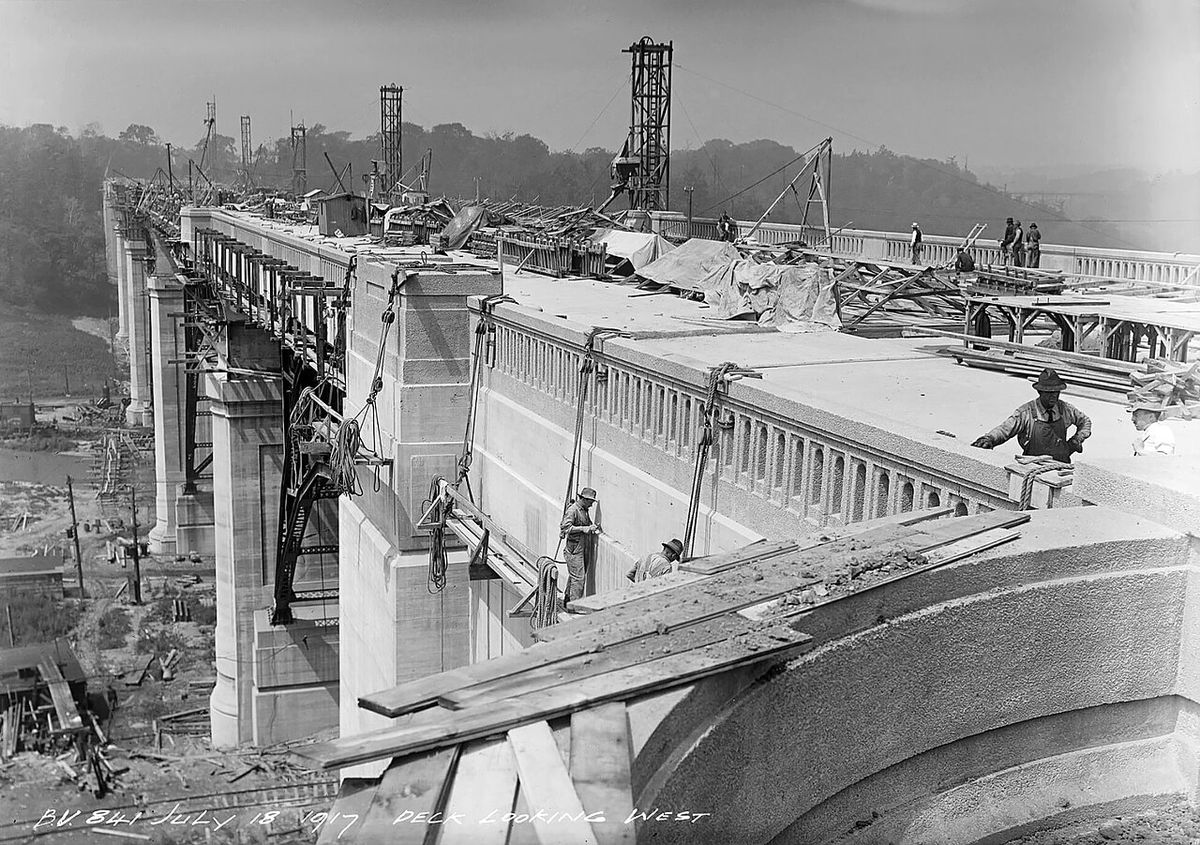
City residents voted on its construction in referendums held annually from 1910 to 1913, rejecting the plan by a narrow margin of 59 votes in 1912 before approving it the following year by a decisive 9,236 votes. The projected cost escalated over this period, rising from an initial estimate of CA$759,000 in 1910 to CA$2.5 million by 1913. The final construction cost came in at CA$2,480,349.05, which is equivalent to approximately $45.8 million in 2025 dollars. Upon its completion in 1918, the structure was named in honour of Prince Edward, Prince of Wales, who later became King Edward VIII. The viaduct's construction, led by general contractor Quinlan and Robertson of Montreal with structural steel from Hamilton Bridge Works, directly spurred more rapid development in the eastern portions of Toronto lying beyond the Don Valley.
A visionary aspect of the viaduct's design was its inclusion of a lower deck intended for a future rapid transit line, an addition championed by the Commissioner of Public Works, R.C. Harris. This feature was controversial at the time due to its substantial additional cost but ultimately proved its worth decades later. When the Bloor-Danforth subway line was extended across the viaduct in 1966, the city saved an estimated millions of dollars in construction costs, with the specific adaptation of the existing lower deck costing less than $420,000. This foresight rendered the original Bloor streetcar line on the upper deck obsolete, leading to its abandonment shortly after the subway opened. Notably, the Rosedale Valley phase of the viaduct system was not used for the subway due to sharp curves in the roadway. A separate subway bridge was constructed just west of Castle Frank station to traverse that ravine.
Design and Engineering
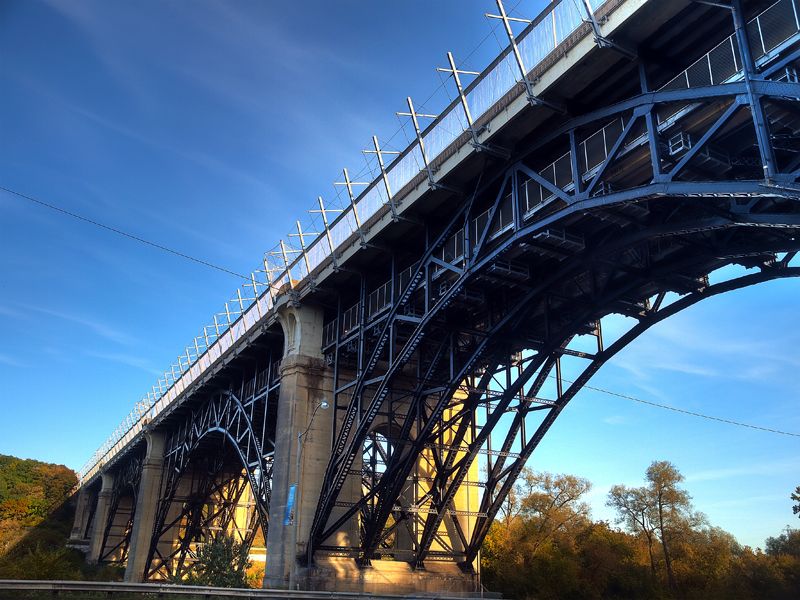
The Prince Edward Viaduct is a three-hinged concrete-steel arch bridge designed by engineer Thomas Taylor of the Toronto Department of Works, with consulting architect Edmund W. Burke contributing to its aesthetic form. The most prominent Don Valley phase has a total span of 494 metres, standing 40 metres above the valley floor. Its central arch spans 85.8 metres, flanked by two spans of 73.6 metres and two end spans of 48.2 metres each. The structural system efficiently transfers loads from the deck, made of transverse beams and I-girders, down through column supports to the steel trusses within the arches, and finally through large hinges to massive concrete piers anchored in the ground. The bridge's design reflects a combination of the Beaux-Arts architectural style promoted by Burke and the functional engineering approach of Taylor.
This synthesis makes the viaduct a signature project of Commissioner R.C. Harris, who oversaw Toronto's public works from 1912 to 1945. The structure's roadway currently accommodates five lanes of vehicular traffic and includes a dedicated bicycle lane in each direction. The complex environment beneath its spans includes the Don River, the Don Valley Parkway, Bayview Avenue, two railway lines, an electrical transmission line, and a bicycle trail. In recognition of its engineering significance, the Canadian Society for Civil Engineering designated the Prince Edward Viaduct a National Historic Civil Engineering Site in 1986. The steel for the construction was provided by the Dominion Bridge Company, completing the major industrial effort.
The Luminous Veil Suicide Barrier
For decades, the Prince Edward Viaduct was tragically known as a frequent site for suicide, gaining a reputation as the most fatal standing structure in Canada and the second most in North America after San Francisco's Golden Gate Bridge. By 2003, nearly 500 suicides had occurred from the bridge, with the rate peaking in 1997 at an average of one death every 22 days. The falling bodies also posed a serious risk to traffic on the roadways and railways below. This public safety crisis prompted Toronto City Council to approve the construction of a preventive barrier in 1998, though funding concerns delayed the project for several years, during which an estimated 48 to 60 more lives were lost. Construction of the barrier, named the Luminous Veil, was finally completed in 2003 at a cost of CA$5.5 million.
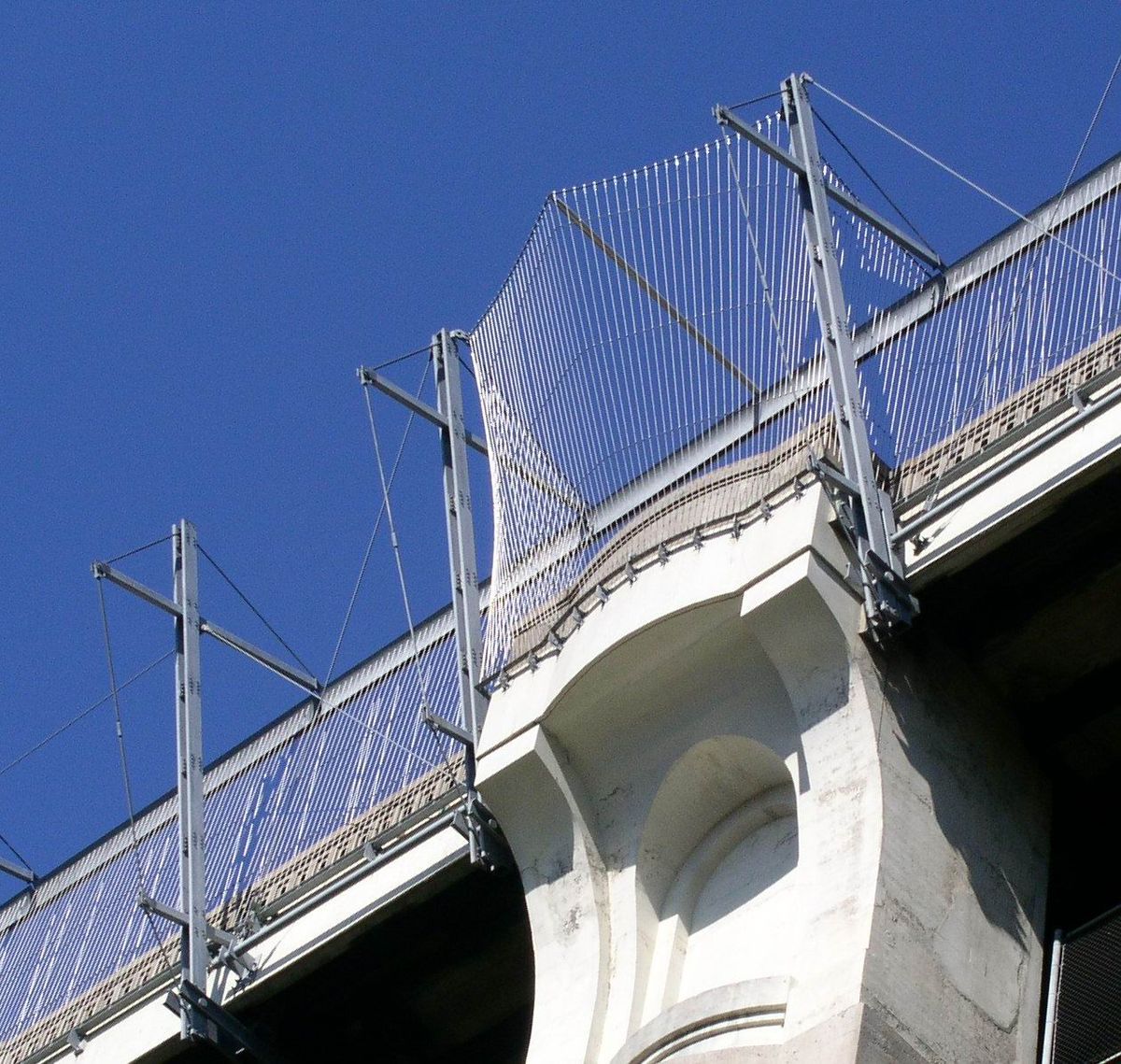
The city contributed CA$2.5 million from taxpayers, with the remainder raised through a public fundraising campaign. Designed by architect Dereck Revington and engineers at Halcrow Yolles, the structure consists of over 9,000 vertical steel rods spaced 12.7 centimetres apart, standing five metres high and cantilevered from the bridge's parapets. The innovative tensile design required complex analysis and testing at the University of Toronto. The Luminous Veil received a Canadian Architect Award of Excellence in 1999, and its planned lighting system was fully installed in July 2015. A 2010 study initially found the barrier prevented suicides from the viaduct but did not change overall suicide-by-jumping rates in Toronto, while a follow-up 2017 study by the same lead author concluded that suicide-by-jumping in Toronto declined over the long term after the barrier's installation with no associated increase in suicide by other means.
- Writer Joe Fiorito noted the barrier's impact in a 2013 anthology, observing, "We jump elsewhere now."
- The barrier has made the pedestrian experience across the viaduct significantly less intimidating for the general public.
- The council originally approved a CA$2.5 million budget, but the minimum construction bid was CA$5.5 million.
- People who have survived a jump from the bridge have suffered severe consequences including paralysis, organ damage, and broken bones.
Role in Toronto's Transit Network
The Prince Edward Viaduct is a critical piece of infrastructure in Toronto's transit system, uniquely integrating both road and subway services. Its upper deck originally carried the Bloor streetcar line, serving as a major east-west surface transit corridor. The inclusion of the lower deck, a contentious but prescient decision, provided a dedicated right-of-way for what would become the Bloor-Danforth subway line. This integration meant that when the subway opened in 1966, trains could run directly across the Don Valley without the need for expensive new bridge construction or disruptive surface alignments. The subway level of the viaduct connects Broadview station in the east with Castle Frank and Sherbourne stations to the west.
The viaduct's location makes it easily accessible by transit. Visitors can take the Bloor-Danforth subway to Broadview Station and walk 400 metres west, or to Castle Frank Station and walk 100 metres east to reach the structure. This efficient connection has cemented the viaduct's role as a vital link in the city's daily commute, carrying thousands of passengers and vehicles across a major geographical barrier. The foresight in its design facilitated the growth and connectivity of Toronto's east end, demonstrating how infrastructure planning can shape urban development for generations. The viaduct system also includes the Rosedale Valley Bridge and the Sherbourne Phase embankment, which extend Bloor Street to the ravine from Sherbourne Street.
Cultural Significance and Appearances
The Prince Edward Viaduct holds a prominent place in Canadian cultural memory, particularly through its depiction in literature. Michael Ondaatje's celebrated 1987 novel, In the Skin of a Lion, fictionalizes the lives of the immigrant labourers who built Toronto in the early 1900s, with the construction of the viaduct serving as a central narrative element. The bridge has also been referenced in contemporary music, appearing in the Barenaked Ladies song "War on Drugs" and the Great Lake Swimmers song "The Great Exhale." Its distinctive form and engineering scale have made it a recognizable part of Toronto's cityscape. The viaduct's dramatic appearance has attracted the film industry, most notably for the production of Resident Evil: Apocalypse in 2004.
Filming required the complete shutdown of the bridge for three days, during which it was depicted as the only escape route from a doomed city. Beyond popular culture, the structure is a point of civic pride and historical interest. A commemorative plaque installed by the Canadian Society for Civil Engineering is located on the south face of the abutment parapet at the northwest corner of the viaduct, detailing its historical and engineering significance for visitors and passersby. The plaque text notes the key figures of Commissioner R.C. Harris and Engineer Thomas Taylor, and the construction dates of 1915 to 1919. In 1957, a child accidentally fell from the viaduct's railing but survived the incident.
Visiting the Viaduct
For visitors to Toronto, the Prince Edward Viaduct is an accessible and impressive site that exemplifies the city's industrial heritage and architectural ambition. The best way to experience it is on foot, walking across its broad deck to take in the panoramic views of the Don Valley below. The surrounding area offers several vantage points in the parks and trails of the ravine system. The nearby Prince Edward Viaduct Parkette provides a green space from which to contemplate the structure, though visitors are advised to contact the facility or the city's 311 service prior to a visit to confirm accessibility needs. The most straightforward access is via Toronto's subway system.
Taking the Bloor-Danforth line to either Broadview or Castle Frank station places you within a short walk of the bridge. From Broadview, a 400-metre walk west along Bloor Street leads to the eastern end of the viaduct. From Castle Frank station, a 100-metre walk east leads to its western approach. This ease of access makes it a convenient stop on a tour of Toronto's architectural landmarks. While there, observers can note the details of its steelwork, the modern intervention of the Luminous Veil, and the constant flow of subway trains passing on the lower deck, confirming the foresight of its creators. The site's specific geographic coordinates are 43.6751797 degrees north and -79.3658286 degrees west.
Questions about Prince Edward Viaduct
What is the Luminous Veil and why was it built?
The Luminous Veil is a suicide prevention barrier installed on the Prince Edward Viaduct in 2003. It consists of over 9,000 vertical steel rods that extend five metres above the bridge's parapets. It was built because the viaduct had become a frequent site for suicide, with nearly 500 deaths recorded by 2003, posing a severe public safety risk. The barrier was designed to save lives and has been effective in preventing suicides from that location.
Why is it called the Prince Edward Viaduct?
The viaduct was named upon its completion in 1918 for Prince Edward, Prince of Wales, who later became King Edward VIII. The naming was a common practice for honouring members of the royal family. The structure is also commonly referred to as the Bloor Viaduct. It was constructed between 1915 and 1919. The plaque on the bridge confirms it was named for the Prince of Wales.
How do you get to the Prince Edward Viaduct using public transit?
You can take the Toronto Transit Commission's Bloor Danforth subway line to Broadview Station and walk approximately 400 metres west. Alternatively, you can take the same subway line to Castle Frank Station and walk about 100 metres east. The subway level of the viaduct itself connects these stations. The site's geographic coordinates are 43.6751797 latitude and 79.3658286 longitude.
Did the viaduct really have a subway deck built from the beginning?
Yes, the original design included a lower deck for a potential future rapid transit line. This controversial feature was advocated for by the bridge's designer and the commissioner of public works, R C Harris. The foresight proved invaluable when the Toronto Transit Commission's Bloor Danforth subway opened in 1966, saving millions in construction costs. However, the Rosedale Valley span was not used for the subway due to sharp curves, requiring a separate subway bridge there.
Has the Luminous Veil been effective in reducing suicides?
A 2017 study found that suicide by jumping in Toronto declined over the long term after the barrier's installation, with no associated increase in suicides by other means. The barrier, completed in 2003, completely eliminated suicide attempts from the viaduct itself. A 2010 study initially found no change in overall city jumping rates, but the later 2017 study provided more conclusive long term data. The viaduct had been a magnet for suicide, with nearly 500 deaths by 2003.
Is the Prince Edward Viaduct considered a historic site?
Yes, it is a designated National Historic Civil Engineering Site. It was recognized by the Canadian Society for Civil Engineering in 1986. A plaque on the south face of the abutment parapet commemorates this status. The viaduct is a signature project of Roland C Harris, Commissioner of Works for Toronto from 1912 to 1945. Its design combines the beaux arts style of architect Edmund W Burke with the functional aesthetic of engineer Thomas Taylor.
Sources and further reading
- Prince Edward Viaduct (Wikipedia)
- Prince Edward Viaduct (legacy.csce.ca)
Checked by the Novello Desserts desk. Last updated 2026-10-30.