Ice wine
Ice wine is a luxurious dessert wine produced from grapes that have frozen naturally on the vine. The process concentrates sugars and acids, yielding a small quantity of intensely sweet yet refreshingly balanced wine. Canada is the world's largest producer of ice wine, with Ontario's Niagara Peninsula accounting for over 90% of the nation's output. The wine, often called Canada's "liquid gold," has achieved significant international acclaim and is a celebrated symbol of Canadian viticultural ingenuity, particularly suited to the country's reliably cold winters.
Production Process and Challenges
The creation of authentic ice wine is a high-risk endeavour dictated entirely by nature. Grapes, typically Riesling, Vidal, or Cabernet Franc, are left hanging on the vine long after the normal autumn harvest. Vintners wait for a sustained hard freeze, which in Canada must reach at least -8 °C (18 °F) by law. This freeze must occur while the grapes are still healthy and free of botrytis or noble rot, which distinguishes ice wine from other late-harvest dessert wines. The frozen grapes are then harvested, often at night or in the pre-dawn hours to ensure they remain solid, and pressed immediately while still frozen.
During pressing, the water content remains as ice crystals, resulting in a tiny yield of highly concentrated, sugary must. This low yield is a primary reason for ice wine's high cost, as one vine typically produces only enough juice for a single 375 mL bottle. The fermentation of this dense must is slow, often taking months compared to weeks for table wine, and requires special yeast strains. The entire process demands precise timing and a ready labour force, as the harvest must be completed within a few hours on the first adequately cold day to prevent spoilage once the grapes thaw.
To protect the valuable crop during the long wait for frost, vineyards often use netting to deter birds and other wildlife. Some also employ technological aids like portable generators for lighting during night harvests and remotely controlled temperature alarms. The physical act of pressing rock hard frozen grapes presents its own challenges. Vineland Estates Winery in Ontario once broke their pneumatic press in the 1990s while pressing the frozen grapes because they were too hard in temperatures close to -20 °C (-4 °F). This combination of climatic gamble, intensive labour, and low yield defines the premium nature of true ice wine.

History and Development
References to wine made from frozen grapes exist from Roman times, but the method was later forgotten. The first documented post-Roman ice wine, or Eiswein, was produced in Franconia, Germany, in 1794. A better-recorded harvest occurred in Rheinhessen in 1830 after a harsh winter. Systematic production became more feasible in the latter half of the 20th century with technological advancements like the pneumatic bladder press, which could effectively press frozen grapes.
Ice wine was introduced to Canada by German immigrant Walter Hainle in the Okanagan Valley of British Columbia in 1972, following an unexpected frost. The first commercial Canadian ice wine was produced in 1984 by Inniskillin winery in Niagara, Ontario, under winemaker Karl Kaiser, who used nets to protect his Vidal grapes. This pioneering effort laid the groundwork for an industry that would leverage Canada's reliably cold winters. The international breakthrough for Canadian ice wine came in 1991 when Inniskillin's 1989 Vidal ice wine won the Grand Prix d'Honneur at the Vinexpo exhibition in France. This award placed Canadian ice wine on the global stage and spurred rapid growth in production and reputation.
By the early 2000s, Canada had become the world's largest producer of ice wine, a position it maintains today. The industry's standards are enforced by provincial authorities like the Vintners Quality Alliance (VQA) in Ontario and British Columbia, which set strict rules for natural freezing and minimum sugar levels. The European Union formally recognized the equivalency of Canadian ice wine standards in 2001, allowing for its import. The modern era of ice wine production is thus a story of German origin, Canadian adaptation, and global recognition.
Canadian Ice Wine Industry
Canada's climate, particularly in the Niagara Peninsula and the Okanagan Valley, provides consistently freezing winter conditions ideal for large-scale ice wine production. The country now produces a greater volume of ice wine than all other nations combined. Ontario is the dominant force, responsible for approximately 90% of Canadian output, producing about 800,000 litres in 2016. British Columbia, Quebec, and Nova Scotia also contribute to national production. The industry is a significant agricultural and tourism asset, centred around events like the annual Niagara Icewine Festival in January.
Canadian ice wine is subject to rigorous provincial regulations. The VQA mandates that grapes must freeze naturally on the vine at -8 °C or below and requires a minimum must weight of 35 degrees Brix, which is higher than the German standard. Must that fails to meet this sugar level cannot be labelled as ice wine and is often sold as a "Special Select Late Harvest" wine. These strict rules protect the integrity and quality of the product. Several Canadian wineries have gained international renown for their ice wines.
- Inniskillin Wines: Widely considered the pioneer and most famous producer, especially after its 1991 Vinexpo victory.
- Pillitteri Estates Winery: Emerged in the 2000s as the world's largest estate producer of ice wine.
- Henry of Pelham: A prominent Niagara producer known for a range of ice wine styles.
- Peller Estates Winery: Notable for culinary integration and experiences.
- Royal DeMaria: Gained attention in 2006 for releasing a Chardonnay ice wine priced at $30,000 for a half-bottle.
The industry continues to innovate, with wineries experimenting beyond traditional white varieties to produce ice wines from red grapes like Cabernet Franc, Merlot, and Shiraz. Pillitteri Estates Winery from Niagara on the Lake, Ontario, claims to be the first winery in the world producing Shiraz ice wine with the 2004 vintage. Canadian ice wine quickly became popular with domestic consumers and reviewers after establishing a commercial footing. The international breakthrough came in 1991 when Inniskillin's 1989 Vidal ice wine won the Grand Prix d'Honneur at Vinexpo. Its success is built on a foundation of quality standards and a climate uniquely suited to the demanding production method.
Global Production and Regulations
While Canada leads in volume, ice wine is produced in several other cold climate regions around the world, each with its own traditions and regulations. Germany remains the historic home of Eiswein, producing some of the world's most famous and expensive examples under the Prädikatswein quality classification, with a minimum harvest temperature of -7 °C (19 °F). Austria, Luxembourg where it is called Vin de glace, and other European nations like Hungary, Slovenia, and the Czech Republic also have smaller productions. China has grown to become the second largest global producer of ice wine, accounting for approximately 40 percent of the world's supply, with key regions in Gansu and Liaoning provinces.
In the United States, production is focused in northern Michigan, the Niagara Escarpment region of New York, and areas near Lake Erie in Pennsylvania and Ohio. American law strictly requires grapes to be frozen naturally on the vine for a product to be labelled "icewine." The use of cryoextraction, or mechanical freezing, is permitted in some countries but the resulting product cannot be sold as true ice wine in regulated jurisdictions like Canada, Germany, or the U.S., where it may be labelled as "icebox wine" or similar. These legal distinctions are crucial for consumers seeking the authentic product made by traditional methods.
| Country/Region | Key Term | Minimum Temp. | Minimum Must Weight |
|---|---|---|---|
| Canada (VQA) | Icewine | -8 °C (18 °F) | 35° Brix (153.5° Oechsle) |
| Germany | Eiswein | -7 °C (19 °F) | 110-128° Oechsle |
| Austria | Eiswein | -7 °C (19 °F) | 25° KMW (127° Oechsle) |
| Luxembourg | Vin de glace | -7 °C (19 °F) | 120° Oechsle |
| United States | Icewine | Varies (natural freeze required) | No federal standard |
Characteristics and Sensory Profile
Ice wine is celebrated for its intense sweetness balanced by notable, high acidity. The residual sugar content typically ranges from 180 to as high as 320 grams per litre, with an average around 220 g/L. This high sugar is countered by titratable acidity levels almost always above 10 g/L, which prevents the wine from tasting cloying and provides a refreshing, clean finish. Alcohol content is generally moderate, often between 8% and 13% in Canadian versions, while some German Riesling Eisweins can be as low as 6%. The sensory profile varies significantly between white and red ice wines.
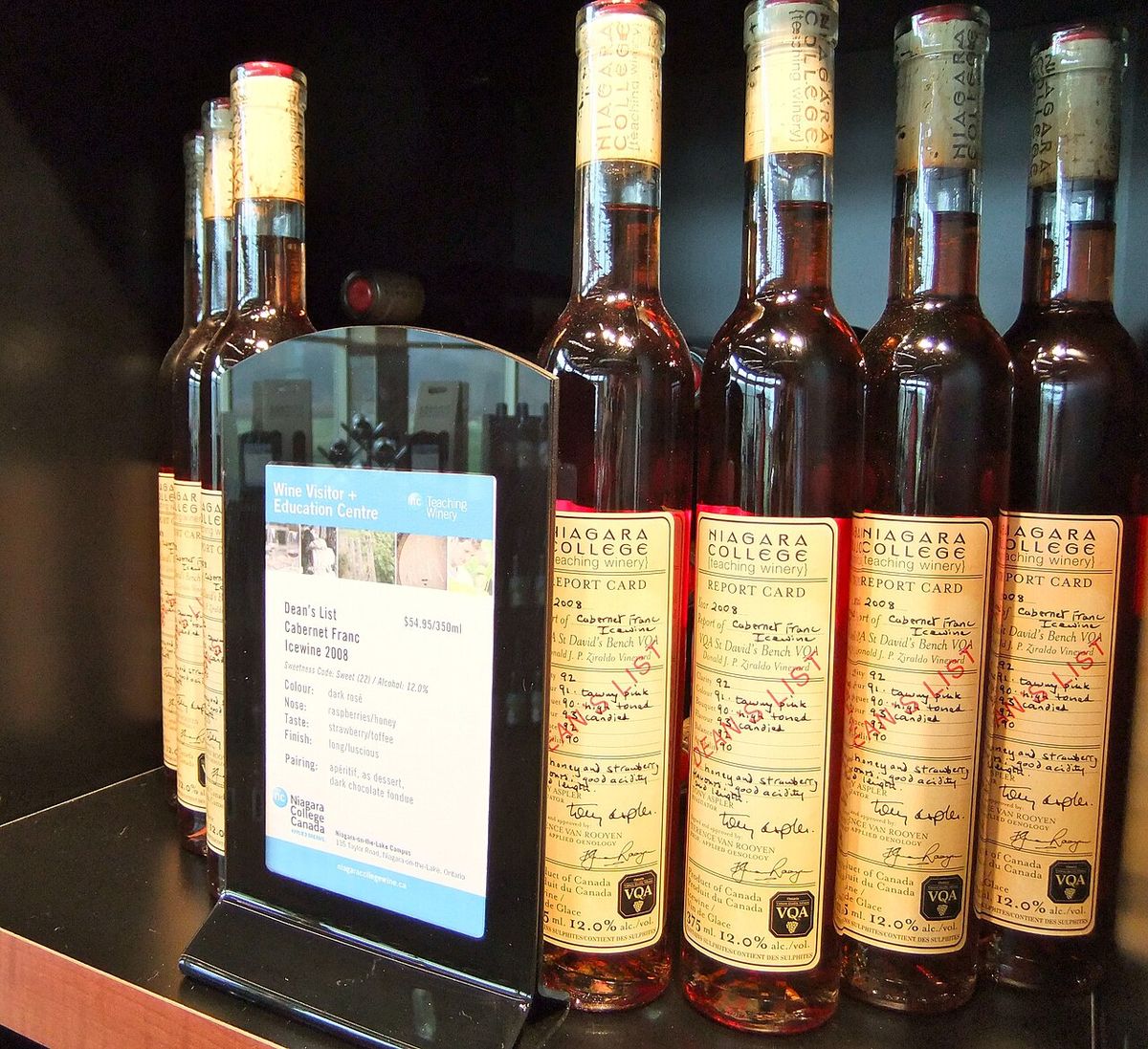
White ice wines, primarily from Vidal or Riesling, exhibit aromas and flavours of tropical fruits, lychee, apricot, honey, peach, and mango, often with notes of candied citrus and spice. They are pale yellow or light gold when young and can develop deep amber-golden colours as they age. Red ice wines, made from varieties like Cabernet Franc, offer distinct aromas of strawberry, raspberry, and rhubarb, with flavours of red berries. Their colour is typically a light burgundy or rosé hue, as extended skin contact is not possible during the pressing of frozen grapes. The wine's luxurious, velvety texture and complex flavour profile make it suitable for slow sipping.
Ice wine is very refreshing due to its high acidity which balances its high residual sugar content. The titratable acidity in ice wine is almost always above 10 grams per litre. Even though it is normal for residual sugar content to run from 180 grams per litre up to as high as 320 grams per litre, the wine is not cloying. This balance of power and finesse is the defining feature of a well made ice wine, whether from the historic vineyards of Germany or the expansive Canadian estates.

Culinary Uses and Pairings
While exquisite on its own as a dessert, ice wine's high acidity and sweetness make it a remarkably flexible partner for food and a creative ingredient in the kitchen. It is traditionally served well-chilled in small portions. Classic pairings focus on complementing or contrasting its intense sweetness. It pairs wonderfully with rich, creamy desserts like crème brûlée, cheesecake, or fruit tarts, and is a classic accompaniment to a selection of strong, pungent cheeses, such as blue cheese or aged cheddar. Savoury matches include foie gras, pâtés, and dishes with fruit-based sauces like duck with cherry or glazed ham.
In recent years, ice wine has become a secret weapon for chefs and home cooks, who value its complex sweetness and acidity as a flavour enhancer. It can be reduced into a syrup for drizzling over desserts, incorporated into salad vinaigrettes, used to deglaze pans for sauces, or mixed into cream cheese frosting. Its use in cocktails has also grown in popularity, particularly during celebrations like the Niagara Icewine Festival. Mixologists use it in spritzes blended with sparkling wine and tonic, or in more inventive cocktails with spirits like cachaça, where it adds unique fruity sweetness. These applications help extend the enjoyment of a single bottle.
- Dessert Pairing: Crème brûlée, vanilla ice cream, tiramisu, fresh fruit salad.
- Cheese Pairing: Blue cheese, aged Gouda, sharp cheddar, goat cheese.
- Savoury Pairing: Foie gras, chicken liver parfait, duck breast with berry sauce, olive tapenade.
- Culinary Ingredient: Salad vinaigrette, dessert sauces, glazes for meat, ice wine jelly, marshmallows.
- Cocktail Use: Ice wine spritz, additions to sparkling cocktails, sweet component in spirit-forward mixes.
Ice wine is often sold in half bottle volumes of 375 millilitres or the even smaller 200 millilitre bottle. New World wineries in particular sometimes bottle 200 millilitre and 50 millilitre gift packages. The high sugar level in the must leads to a slower than normal fermentation which may take months to complete. This adaptability has helped cement its place not just as a luxury sipping wine, but as a dynamic component of modern gastronomy.
Questions about Ice wine
Why is ice wine so expensive?
Ice wine is expensive due to the high risk and extremely low yields involved in its production. Grapes are left on the vine for months, vulnerable to wildlife and rot, until a perfect freeze occurs. The harvest is labour-intensive, often done at night, and the frozen grapes yield only a tiny amount of concentrated juice, often just one bottle per vine. The slow fermentation and strict quality regulations add to the cost, making it a premium product.
What is the difference between ice wine and other sweet dessert wines?
The key difference is how the grapes are concentrated. Ice wine grapes are concentrated by natural freezing on the vine, and the grapes must be free of noble rot (botrytis). In contrast, other famous dessert wines like Sauternes or German Trockenbeerenauslese rely on botrytis to shrivel and sweeten the grapes. Ice wine's flavour profile is marked by pure, intense fruit sweetness balanced by very high acidity, rather than the honeyed, complex notes derived from fungal development.
When is ice wine harvested in Canada?
Ice wine in Canada is harvested when the grapes are frozen naturally on the vine. The grapes must only be picked when the temperature is -8 °C (18 °F) or below. This can occur after the New Year on a northern hemisphere calendar, in extreme cases. The harvest must be completed within a few hours on the first morning that is cold enough, often requiring pickers to work at night or very early in the morning.
What are the best food pairings for ice wine?
Ice wine pairs excellently with both sweet and savoury foods. Classic sweet pairings include crème brûlée, fruit tarts, and vanilla ice cream. For savoury matches, it complements strong cheeses like blue cheese or aged cheddar, rich pâtés, and foie gras. It also works well with main dishes that incorporate fruit sauces, such as duck with cherry glaze or glazed ham. The wine's acidity cuts through richness, while its sweetness contrasts with salty or pungent flavours.
How should ice wine be served and stored?
Ice wine should be served well-chilled, typically between 6°C and 10°C, in small dessert wine glasses. An opened bottle can be recorked and stored in the refrigerator for several weeks without significant degradation due to its high sugar and acid content. Unopened bottles should be stored on their side in a cool, dark, and humidity-controlled environment, like any fine wine. It is commonly sold in 375 mL or 200 mL bottles, reflecting its role as a sipping wine rather than a table wine.
Can ice wine be made from red grapes?
Yes, red grape varieties are increasingly used to produce ice wine. Cabernet Franc is the most prominent red variety, producing wines with aromas of strawberry and rhubarb. Other reds used include Merlot, Pinot Noir, and even Shiraz, with Pillitteri Estates claiming the first Shiraz ice wine in 2004. These red ice wines have a light burgundy or rosé colour because the skins are not steeped during pressing, and they offer a different, berry-focused flavour profile compared to traditional white ice wines.
Sources and further reading
- Ice wine (Wikipedia)
- Celebrating Niagara Ice Wines with Ice Wine Cocktails! (liqculture.com)
- 5 Things to do with Icewine, other than drink it! (ontarioculinary.com)
- Liquid Indulgence: Ice Wine (cheeseconnoisseur.com)
- Niagara Icewine Festival (triuswines.com)
Checked by the Novello Desserts desk. Last updated 2026-10-27.