Rubus parviflorus
Rubus parviflorus, commonly known as thimbleberry or western thimbleberry, is a deciduous shrub native to the temperate regions of North America. It is a widespread and familiar plant across much of western Canada, particularly in British Columbia, where it thrives in forest understories, clearings, and along waterways. The plant is distinguished by its large, soft, maple-like leaves, showy white flowers, and distinctive red aggregate fruit that resembles a shallow raspberry. While its soft berries are not commercially viable, they are a cherished seasonal wild food for foragers and an important resource for wildlife, contributing to the plant's ecological and cultural significance in Canadian landscapes.
Description and Identification
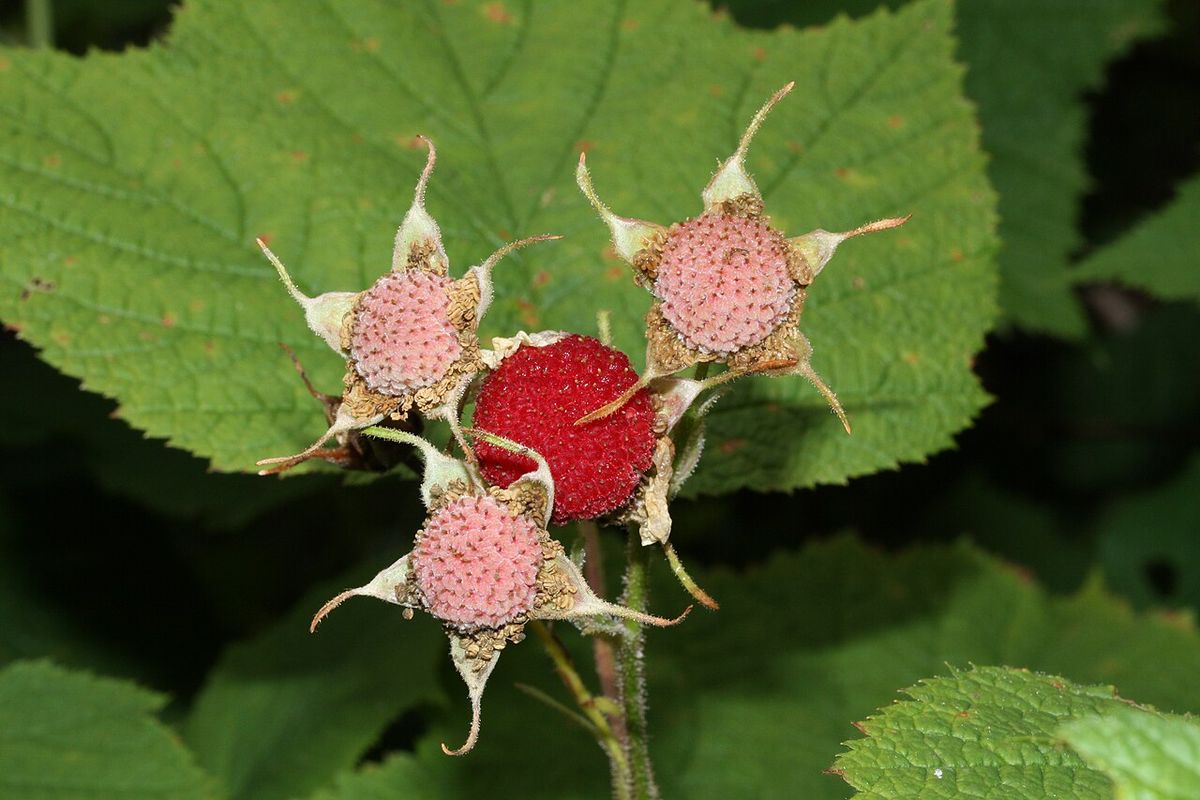
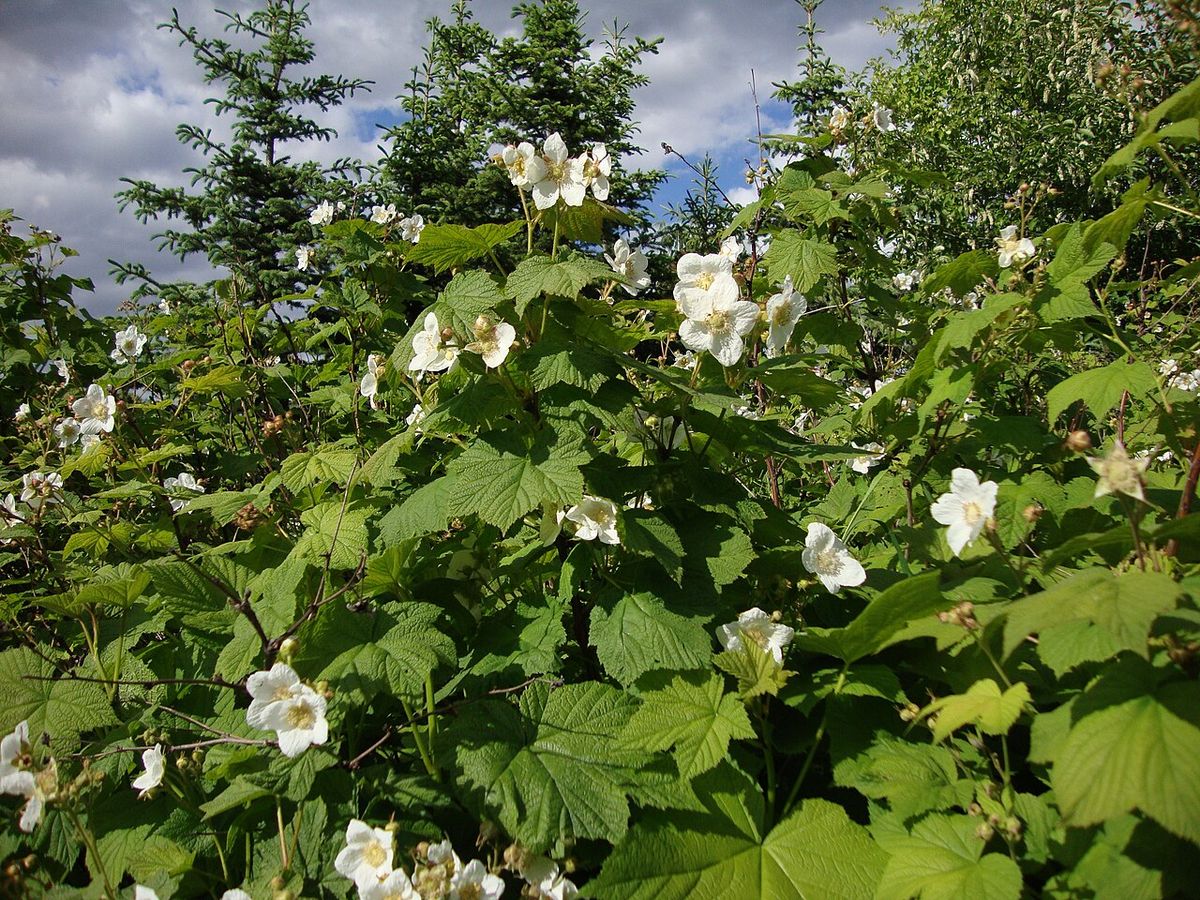
Rubus parviflorus is a dense, thicket-forming shrub that typically grows between 1.5 and 2.5 metres tall, spreading via underground rhizomes to form large clonal patches. Its canes are flexible and no more than 1.5 centimetres in diameter, and they notably lack the prickles common to many other brambles in the Rubus genus, making it a friendly plant for gardeners and foragers. The leaves are one of its most striking features, being palmate with five lobes and growing up to 20 centimetres across, which is significantly larger than the leaves of most other Rubus species. These leaves have a soft, velvety texture, often described as fuzzy or hairy, and turn a bright golden yellow in the autumn. The flowers are exceptionally large for the genus, measuring 2 to 6 centimetres in diameter with five white petals and numerous pale yellow stamens, creating a showy display in late spring. The fruit is a composite of many small drupelets, forming a bright red, thimble-shaped aggregate that is about one centimetre wide. This fruit is structurally similar to a raspberry but is flatter, softer, and more fragile, detaching easily from its central core when ripe, which is the likely source of the common name thimbleberry.
The plant can be distinguished from similar species by several key characteristics. The eastern relative, purple-flowering raspberry (Rubus odoratus), has purple flowers and an easterly distribution. Wild red raspberry (Rubus idaeus) has much smaller flowers, prickles on its stems, and compound leaves with three or five leaflets. Black raspberry (Rubus leucodermis) has recurved thorns, small white flowers with sepals longer than the petals, compound leaves, and black fruits. Thimbleberry's bark is gray and flaky, and its strong, flexible stems support the large foliage. The Concow tribe of California uses the name wä-sā’ for this plant in the Konkow language.
Distribution and Habitat in Canada
In Canada, thimbleberry has a broad and continuous distribution in western provinces and a more limited, disjunct presence in the east. It is widespread throughout British Columbia, including coastal regions and interior forests, and extends into Alberta. Eastern populations are confined to the shores of Lake Superior and Lake Huron in Ontario. The plant's range reflects a preference for cool, moist conditions, and it is considered a nitrophytic shrub, indicating nitrogen-rich soils. Thimbleberry commonly inhabits forest understories, particularly in the humid coastal forests of the Pacific Northwest, and is a pioneer species in disturbed areas such as roadsides, railroad tracks, and forest clearings following logging or fire. Its habitat often includes riparian zones, where it is found on floodplains and stream banks with well-drained soils. The plant's distribution is largely constrained by aridity, avoiding extremely dry sites, and it grows from sea level in coastal areas up to elevations of 3,000 metres in the southern parts of its range.
Key habitat associations and site characteristics for thimbleberry in Canada include common understory association in Coastal Western Hemlock and Douglas-fir forest zones, frequent presence in seepage habitats and on moist, north-facing slopes, and a role as an early successional species in clear-cut and burned areas. It often grows alongside flora such as coastal woodfern (Dryopteris arguta), trillium (Trillium ovatum), and false Solomon's seal (Smilacina racemosa). Thimbleberry thrives in full sun to full shade but produces more fruit with increased sunlight. Its presence is strongly linked to sites with fresh, moist soils and limited flooding frequency. In British Columbia, its occurrence increases with greater elevation and continentality within boreal, temperate, and mesothermal climates, though it is sensitive to extremely cold winters, short growing seasons, and extreme summer moisture stress.
Specific ecological studies detail its habitat preferences. Along riparian sites in second-growth forests in Washington's central Cascade Range, thimbleberry had an importance value of 20 on low floodplains inundated at least every two years, 24 on high floodplains flooded less than every 50 years, 4 on terraces above the 100-year flood stage, and 0 on hilltops. In northwestern Oregon, it was found at 0 to 1 metre above the high water line of streams on shallow cobbly silts or sands and at 0.6 to 3 metres above the high water line of rivers on deep, gravelly sands. In the Lake Tahoe Basin, thimbleberry was most common along highly sinuous streams in wide valleys and rare along V-shaped, high-gradient streams.
Ecology and Wildlife Value
Thimbleberry plays a significant role in native ecosystems, providing food and habitat for a wide array of wildlife. The bright red fruits are a crucial seasonal food source for many birds, including various songbirds, and mammals such as black bears, which readily consume them. Black-tailed deer and other herbivores browse the young leaves and stems. The plant's large, nectar-rich flowers are highly attractive to pollinators, offering substantial value to native bees, honeybees, bumblebees, and butterflies. It also serves as the larval host and a nectar source for the yellow-banded sphinx moth. Several insect species form specialized relationships with the plant, including the thimbleberry gallmaker wasp (Diastrophus kincaidii), whose larvae develop in large, swollen galls on the stems, and an aphid of genus Masonaphis and a midge of genus Dasineura that induce galls on the leaves and petioles respectively. By forming dense thickets, thimbleberry provides cover for small animals and birds, and its extensive rhizome network helps stabilize soil and prevent erosion on slopes and riparian areas.
The plant's value extends throughout the growing season. In spring, the emerging leaves and flowers provide early resources, while the summer fruits offer a high-energy food. The thicket structure provides nesting sites and protection from predators. This combination of resources makes Rubus parviflorus a species of high habitat value in restoration projects and wildlife gardens. Its ability to quickly colonize disturbed areas also aids in soil stabilization and initiates ecological succession, preparing the site for other plant species to establish.
Cultivation and Gardening Use
Thimbleberry is cultivated by specialty native plant nurseries and is increasingly valued in ornamental horticulture for its aesthetic appeal, wildlife benefits, and low maintenance requirements. It is used in traditional gardens, native plant gardens, natural landscaping designs, and habitat restoration projects. The plant is remarkably adaptable, thriving in a range of soil conditions from moist to relatively dry and tolerating full sun to full shade, though it performs best with some moisture and light. Gardeners should provide ample space, as it naturally forms expansive clonal patches over time. Propagation is most successfully achieved by planting dormant rhizome segments, though it can also be grown from seeds or stem cuttings. Selected cultivars are primarily chosen for ornamental traits such as fragrant flowers or attractive fall foliage. A notable double-flowered form was discovered near Squamish, British Columbia, by Iva Angerman, and while not commercially available, it is grown in the Botanic Garden of the University of British Columbia and the Native Plant Garden of the Royal British Columbia Museum in Victoria.
Key considerations for gardening with thimbleberry include planting in a location with room to spread, as it forms thickets, and it is ideal for erosion control on hillsides and in dappled shade. The shrub requires virtually no special care once established and provides multi-season interest with large leaves in spring, white flowers in late spring, red fruit in summer, and golden yellow fall colour. It is an excellent choice for creating wildlife-friendly gardens and supporting pollinators. The plant's oversized, soft-textured leaves make a bold contrast in the garden, and it is especially attractive on hillsides where it can help control erosion. Beekeepers value it for its support of honeybees, and its thornless nature makes it safe for areas frequented by children and pets.
For those propagating from seed, understanding natural dormancy mechanisms is required. The seeds have built-in dormancy that protects them from germinating before killing frosts or in drought, and successful cultivation involves unlocking this dormancy with the correct conditions. Native plant nurseries like Satinflower Nurseries in Saanich and Metchosin, British Columbia, work to propagate and make this species available to the public, operating on the Coast Salish Territories of the W̱SÁNEĆ, Scia'new, T’Sou-ke, and lək̓ʷəŋən Peoples. The plant's cultivation supports local biodiversity and connects gardens to regional ecology.
- Propagation Method: Most successful via dormant rhizome segments. Also from seeds or stem cuttings.
- Light Requirements: Full sun, part sun/part shade, full shade.
- Size at Maturity: 4-6 feet tall, 3-6 feet wide.
- Notable Cultivar: Double-flowered form discovered near Squamish, B.C.
- Public Display Locations: UBC Botanic Garden (Vancouver) and RBCM Native Plant Garden (Victoria).
- Nursery Example: Satinflower Nurseries, with locations at 2716 Dooley Rd, Saanich and 4286 Metchosin Rd, Metchosin.
- Special Value: To native bees, honeybees, and bumblebees.
Culinary and Traditional Uses
The fruit of the thimbleberry is edible and has a flavour often described as tart and reminiscent of a mild raspberry, though its texture is much softer and more delicate. This fragility means the berries do not pack or ship well, precluding large-scale commercial cultivation. However, they are a prized wild harvest, eaten fresh off the plant, dried, or processed into preserves. In some regions, such as the Keweenaw Peninsula of Michigan, thimbleberry jam is sold as a local delicacy. The Washington State Department of Transportation's website has noted a particularly tasty dish by First Peoples. Beyond the fruit, young thimbleberry shoots have been used in salads, and recipes exist for items like thimbleberry cheesecake. The water content of ripe thimbleberries is quite variable, which can affect their consistency when used in cooking or preserving.
Historically, many Indigenous peoples across its range utilized various parts of the plant for medicinal purposes. Teas made from the leaves or roots were used as treatments for wounds, burns, acne, and digestive ailments, while a tea from the canes was considered a diuretic. The large, soft leaves also served a practical purpose as a substitute for toilet paper in wilderness settings. Modern clinical research or practice as of 2019 has not produced evidence that Rubus parviflorus is effective for treating any disease, so these uses remain part of historical folk medicine. The plant continues to be valued for its edible fruit and its role in traditional ecological knowledge.
- Edible Forms: Eaten raw, dried, or made into jam.
- Commercial Limitation: Too soft for packing and shipping, rarely cultivated commercially.
- Notable Product: Thimbleberry jam, a local delicacy in the Keweenaw Peninsula of Upper Michigan.
- Medicinal Uses (Historical): Tea from leaves/roots for wounds, burns, acne, digestion. Tea from canes as a diuretic.
- Practical Use: Leaves used as a wilderness substitute for toilet paper.
- Modern Status: No clinical evidence supports its efficacy for disease treatment (as of 2019).
Botanical Classification and Hybrids
Rubus parviflorus belongs to the large and diverse genus Rubus within the rose family, Rosaceae. The genus name is Latin for "bramble." The specific epithet parviflorus, meaning "small-flowered," is considered a misnomer given the plant's notably large blossoms, which are among the largest in the genus. Two botanical varieties are recognized. Rubus parviflorus var. parviflorus is the widespread variety found across the plant's entire range from Alaska to Mexico and east to the Great Lakes. Rubus parviflorus var. velutinus has a more restricted distribution, occurring only in California. The plant can hybridize with related species where their distributions overlap, including with purple-flowering raspberry (R. odoratus), evergreen blackberry (R. laciniatus), and red raspberry (R. idaeus). Such hybrids are frequently sterile. In some older botanical references, the plant has been classified under the synonym Rubacer parviflorum. The common name "thimbleberry" is derived from the shape of its hollow fruit, which resembles a thimble when the drupelets are removed from the central core.
The discontinuous nature of its North American range is notable. It is widespread in western North America but has disjunct populations in the Black Hills of South Dakota and the Great Lakes region. In Alaska, it occurs only in coastal regions of the extreme southeast, while in California it extends as far south as San Diego County. In Nevada, it is found only in the northwestern counties of Washoe, Carson City, and Douglas. In the southwestern United States, it is restricted to the border region of western New Mexico and eastern Arizona. This pattern reflects its avoidance of aridity and preference for specific mesic conditions. The plant's distribution in Canada and the United States includes the following states and provinces.
- Canadian Provinces: Alberta (AB), British Columbia (BC), Ontario (ON).
- United States: Alaska (AK), Arizona (AZ), California (CA), Colorado (CO), Iowa (IA), Idaho (ID), Illinois (IL), Massachusetts (MA), Michigan (MI), Minnesota (MN), Montana (MT), New Mexico (NM), Nevada (NV), Oregon (OR), South Dakota (SD), Utah (UT), Washington (WA), Wisconsin (WI), Wyoming (WY).
- Variety velutinus Range: Occurs only in California.
- Eastern Disjunct Populations: Black Hills of South Dakota. Shores of Lake Superior and Lake Huron in Ontario.
- Southern Limit in California: San Diego County.
- Hybrid Species: Purple-flowering raspberry (R. odoratus), evergreen blackberry (R. laciniatus), red raspberry (R. idaeus).
Conservation, Availability, and Role
Thimbleberry is not considered a species at risk. Its populations are generally large and stable across its western North American range. In Canada, it is common in suitable habitats in British Columbia and Alberta. Its eastern populations in Ontario are more localized but not currently threatened. The plant is increasingly available for purchase from nurseries specializing in native plants, which promotes its use in ecological landscaping and gardening. Sourcing plants or seeds from local, ethical native plant nurseries ensures genetic adaptation to regional conditions and supports conservation efforts. Growing thimbleberry from seed requires understanding its natural dormancy mechanisms, which protect it from germinating at unfavourable times. For gardeners and restoration practitioners, this native shrub represents a resilient, multifunctional species that enhances biodiversity, supports wildlife, and connects cultivated landscapes to the natural ecological fabric of Canadian regions.
Its role in landscaping extends beyond aesthetics. As a fuss-free, thicket-forming deciduous shrub, it offers maximum habitat value. It thrives in moist or dry soil, from full sun to full shade, making it exceptionally versatile. Gardeners are encouraged to sacrifice part of a yard to this plant for generous rewards of abundant blooms, wildlife benefits, and edible berries. In commercial settings, some native plant nurseries have extended hours, such as staying open until 6pm on Thursdays and Fridays in 2026, to accommodate plant enthusiasts. The plant's status as a nitrogen indicator also makes it a useful species for assessing soil conditions in both wild and managed landscapes. Its value in supporting pollinators and stabilizing soil confirms its importance in sustainable horticulture and ecosystem management.
Questions about Rubus parviflorus
Can you eat thimbleberries?
Yes, thimbleberries are edible and can be eaten raw, straight from the plant. They have a tart, raspberry-like flavour but are much softer and more fragile. Due to this delicate texture, they are not suitable for commercial shipping but are enjoyed as a wild harvest. They can also be used to make jams, jellies, and other preserves, which are sometimes sold as local specialties in areas where the plant is abundant. The berries can be dried, and their variable water content affects their use in recipes.
Where does thimbleberry grow in Canada?
Thimbleberry is widespread in western Canada, particularly throughout British Columbia and into Alberta. In eastern Canada, it has a much more limited and disjunct distribution, found only along the shores of Lake Superior and Lake Huron in Ontario. It thrives in a variety of habitats, including forest understories, clearings, roadsides, and especially in moist, nitrogen-rich soils along streams and rivers in coastal and interior regions. Its range extends from sea level up to 3,000 metres in elevation in the southern parts of its distribution.
Is thimbleberry the same as raspberry?
No, thimbleberry is a different species within the same genus (Rubus) as raspberries. While the fruit is structurally similar, both are aggregate fruits of drupelets, thimbleberries are flatter, softer, and more fragile than raspberries. The plant itself is easily distinguished by its large, maple-like, velvety leaves and complete lack of thorns or prickles, unlike most raspberry canes which are thorny. Thimbleberry flowers are also much larger than those of red raspberries.
How do you grow thimbleberry?
Thimbleberry is a low-maintenance, thicket-forming shrub that adapts to a wide range of conditions. It grows well in full sun to full shade and prefers moist, well-drained soil but is quite drought-tolerant once established. The easiest method of propagation is by planting dormant rhizome segments, though it can also be grown from seeds or stem cuttings. It requires ample space to spread and is excellent for naturalizing areas, controlling erosion on slopes, and creating wildlife habitat. It is readily available from native plant nurseries, and cultivars are selected for ornamental qualities like fall colour.
What wildlife does thimbleberry support?
Thimbleberry supports a diverse array of wildlife. Its flowers are a major nectar source for native bees, honeybees, bumblebees, and butterflies, and it is a larval host for the yellow-banded sphinx moth. The fruits are eaten by numerous birds and mammals, including bears. The leaves and stems are browsed by deer. Several insect species, including the thimbleberry gallmaker wasp, aphids, and midges, form galls on its stems and leaves. Its dense thickets provide shelter for small animals and birds, making it a high-value habitat plant.
Was thimbleberry used by Indigenous peoples?
Yes, many Indigenous groups within thimbleberry's range used the plant for both food and medicine. The berries were consumed fresh or dried. Medicinally, teas made from the leaves or roots were used to treat wounds, burns, acne, and digestive problems, while tea from the canes was used as a diuretic. The large, soft leaves also had a practical use as a wilderness substitute for toilet paper. The Concow tribe called the plant wä-sā’. These uses are part of traditional knowledge, and modern clinical research has not validated its efficacy for disease treatment.
Sources and further reading
- Rubus parviflorus (Wikipedia)
- Thimbleberry (Rubus parviflorus) (sparrowhawknativeplants.com)
- Rubus parviflorus (fs.usda.gov)
- Rubus parviflorus (Western thimbleberry) | Native Plants of ... (wildflower.org)
- Rubus parviflorus (Thimbleberry) (satinflower.ca)
Checked by the Novello Desserts desk. Last updated 2026-10-29.