Igopogo
The Igopogo is a legendary aquatic creature said to inhabit Lake Simcoe in Ontario, Canada. Part of the country's rich folklore of lake monsters, it is often described as a large, serpentine or seal-like animal with a dog or horse-like head. The creature is a prominent figure in local lore, particularly in communities around Lake Simcoe such as Barrie and Beaverton, where it has inspired public art and become a part of regional identity. While no scientific evidence confirms its existence, reported sightings over two centuries have sustained the Igopogo's place in Canadian cryptozoology and popular culture.
Origins and naming
The Igopogo's name is a direct nod to its more famous western Canadian counterpart, the Ogopogo of Lake Okanagan in British Columbia. The name also plays on the title of the 1952 comic book 'I Go Pogo', a phrase that entered popular vernacular. Locally, the creature has acquired nicknames tied to specific areas of Lake Simcoe, reflecting its regional integration into community stories. It is known as 'Beaverton Bessie' in the vicinity of Beaverton, Ontario, situated on the lake's northeastern shore. Around the deep waters of Kempenfelt Bay, which extends into the city of Barrie, the creature is sometimes called 'Kempenfelt Kelly'. This practice of local naming mirrors the way other Canadian lake monsters are identified with their specific bodies of water, creating a network of regional myths across the country. The name Igopogo itself shows how one legendary creature can inspire similar stories in distant regions, adapting to local geography and community identity.
Reported sightings and evidence
Alleged encounters with the Igopogo span nearly two centuries, with the first recorded sighting attributed to early settler David Soules in 1823. Soules reported seeing a long creature while tending sheep, noting both a wake in the water and a trail in the mud. A significant 1952 sighting involved four witnesses, including Wellington Charles, then chief of the Georgina Island First Nation. That same year, a man named David Luu reported to The Globe and Mail that he witnessed a 'huge gray thing' that leaped while he was boating on the lake. The newspaper also recounted the experience of a local fishing guide named Charles, who described a marine animal with a neck like a stovepipe and a face resembling a boxer dog.
In 1983, sonar operator William W. Skrypetz reported detecting a large animal with a long neck, though skeptics later suggested the reading could have been a school of fish. A 1991 video recording allegedly showed 'a large, seal-like animal' moving in the water. In 2016, John Kirk of the British Columbia Scientific Cryptozoology Club claimed on The Shirley Show to possess a tape of the creature, though he did not air it. These accounts, while varied, consistently describe an anomalous, large animal in Lake Simcoe. The most detailed physical description comes from a report by E. J. Delaney, who depicted it as having two long antennae, four octopus-like arms, three pairs of legs, and six gill-like appendages with feathers, though this description is an outlier among the more common reports. The persistence of sightings, from 1903 and 1906 to the modern era, demonstrates the legend's enduring hold on the local imagination.
- 1823: David Soules gives the first alleged account.
- 1952: Multiple witnesses, including Chief Wellington Charles, report a sighting. David Luu reports a leaping creature.
- 1983: Sonar operator William Skrypetz reports an anomalous reading.
- 1991: A video recording captures an unidentified large animal.
- 2016: Cryptozoologist John Kirk claims to have audio evidence.
Common descriptions and appearance
While descriptions vary, a common physical profile of the Igopogo has emerged from the majority of alleged sightings. Cryptozoological writer George M. Eberhart synthesizes reports to describe it as a grey, seal-like animal measuring between 12 and 70 feet in length. The creature is frequently said to possess a head resembling that of a dog or horse, with prominent eyes and a gaping mouth. Many accounts mention a long, slender neck, with one witness comparing it to a stovepipe. The body is often described as having dorsal fins and terminating in a fishlike tail. This general phenotype of a large, elongated aquatic animal with mammalian facial features is consistent across many reports, solidifying its image in local folklore despite the lack of concrete proof. The wide range in reported length, from 12 to 70 feet, indicates either a highly variable creature or significant differences in witness perception and estimation under often brief viewing conditions.
Cultural impact and recognition
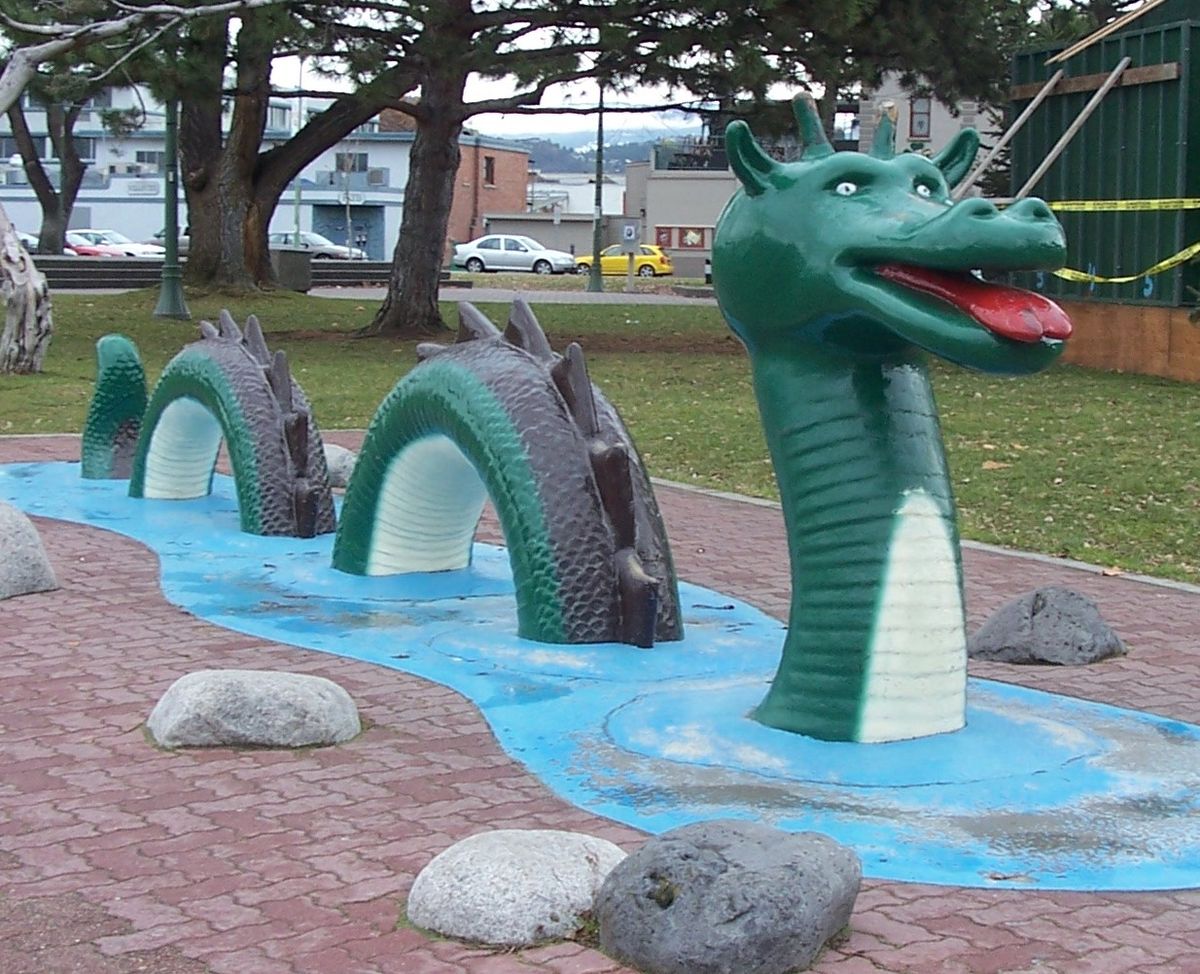
The Igopogo has transcended oral tradition to become a recognized symbol of the Lake Simcoe region. Its most tangible manifestation is 'The Sea Serpent' sculpture, erected by the city of Barrie at its waterfront as a representation of the legendary creature. This public art installation serves as a tourist attraction and a point of local pride, physically anchoring the myth in the community. The creature's story is a staple of regional media and is often featured in discussions of Canadian folklore and cryptozoology. The Igopogo is frequently mentioned alongside other Canadian lake monsters, such as Manitoba's Manipogo and Quebec's Memphre, forming a national narrative of mysterious aquatic beings. This grouping highlights a shared cultural fascination with the unknown depths of Canada's vast inland waters. The creature's integration into local identity is similar to how the Ogopogo functions in Kelowna, British Columbia, where it appears as a waterfront statue and a mascot for the local WHL hockey team.
Scientific and sceptical perspectives
From a scientific standpoint, the Igopogo is considered a cryptid, a creature whose existence is suggested by anecdotal reports but not verified by scientific evidence. Biologists and sceptics have proposed several plausible explanations for the sightings that form the basis of the legend. A leading theory suggests witnesses may have encountered known aquatic mammals, such as seals or large otters, which are not native to Lake Simcoe but could potentially wander into the waterway. Other common misidentifications include large sturgeon, floating logs, unusual wave patterns caused by wind or currents, or groupings of swimming deer. The subjective nature of perception, especially under conditions of poor visibility or surprise, is also cited as a key factor in these reports. No physical evidence, such as bones, clear photographs, or carcasses, has ever been produced to substantiate the existence of an unknown large animal in the lake. The debate around the Igopogo reflects a broader pattern in cryptozoology, where eyewitness testimony contends with a lack of empirical proof.
The Igopogo in a national context
The Igopogo is part of a broader Canadian tradition of lake monster legends, each with its own regional characteristics and history. The most famous is British Columbia's Ogopogo, or Nx̌aʔx̌ʔitkʷ, which has deep roots in Syilx/Okanagan Indigenous spirituality as a protector of the lake. Unlike the often-monstrous portrayal in settler folklore, the Syilx understand Nx̌aʔx̌ʔitkʷ as a sacred spirit of the water. This contrast highlights how Indigenous narratives were sometimes misinterpreted or sensationalized by European settlers, who transformed a protective spirit into a creature needing animal sacrifices for safe passage. In Manitoba, Lake Manitoba is said to be home to Manipogo, while Lake Memphremagog in Quebec is the reported domain of Memphre. British Columbia also has the Seelkee, said to live in the swamps of the Chilliwack area. These stories collectively speak to a human desire to explain the unknown and infuse majestic natural landscapes with mystery and wonder. They also serve as cultural and economic touchstones, inspiring tourism, local art, and community events across the country.
Comparisons with the Ogopogo phenomenon
The relationship between the Igopogo and the Ogopogo provides a clear example of how lake monster legends evolve and spread. The Ogopogo legend gained significant popular traction in the 1980s when the Okanagan region's tourism association offered a one million dollar reward for proof of the creature's existence. The environmental group Greenpeace even declared it an endangered species, requesting it be captured only on film. This level of mainstream attention and commercialization, including features on American television shows like 'In Search Of' and 'Unsolved Mysteries', created a template for how such cryptids enter popular culture. The Igopogo, while a distinct entity, benefits from this broader cultural awareness of lake monsters. The Ogopogo's reported dwelling in a cave more than 700 feet below water level near Rattlesnake Island adds a layer of specific geography to its myth, similar to how the Igopogo is associated with Kempenfelt Bay. Both creatures, in their modern interpretations, blend Indigenous spiritual concepts with settler-era folklore and contemporary tourism.
Folklore and community identity
The enduring legend of the Igopogo plays a role in shaping community identity around Lake Simcoe. Events like Ontario Culture Days in 2026, which featured themes connecting to ancestral stories and the spirit of place, illustrate how modern communities engage with folklore. Such events celebrate the 'spiritual map' of a region, inviting people to look past urbanity and see deeper ancestral realities. The Igopogo, as a local legendary being, contributes to this sense of place and shared story. The creature's narrative allows residents and visitors to connect with the lake not just as a body of water, but as a space of potential mystery and history. This function of folklore to unite communities and provide a shared point of reference is evident in how the Igopogo is claimed by different towns with different nicknames, yet remains a singular legend for the entire lake. It becomes a part of the local cultural heritage, passed down through generations and reinforced by occasional new reports or media stories.
Questions about Igopogo
Where is the Igopogo supposed to live?
The Igopogo is a legendary creature said to dwell in Lake Simcoe, Ontario. It is specifically associated with Kempenfelt Bay, which extends from the lake into the city of Barrie, giving rise to the nickname Kempenfelt Kelly. Another common nickname, Beaverton Bessie, links it to the town of Beaverton on the lake's shores. The creature's legend is firmly rooted in the folklore of this particular Ontario lake.
When was the first Igopogo sighting?
The first alleged Igopogo sighting is credited to early settler David Soules in 1823. While tending his sheep, Soules reportedly saw a long creature leaving a wake in the water and a trail in the mud along the shore. This early account established the creature in local lore. Numerous other sightings have been reported since, including notable ones in 1903, 1906, and 1952.
What does the Igopogo look like?
Descriptions of the Igopogo vary, but common reports describe a grey, seal-like animal stretching 12 to 70 feet in length. It is often said to have a dog- or horse-like face with prominent eyes and a gaping mouth. Many accounts mention a long, slender neck compared to a stovepipe, along with dorsal fins and a fishlike tail. Writer George M. Eberhart summarizes these typical phenotypic characteristics found in most alleged sightings.
Is there a statue of the Igopogo?
Yes, there is a statue representing the Igopogo. The city of Barrie, Ontario, erected a public sculpture called The Sea Serpent at its waterfront on Kempenfelt Bay. This artwork was created to represent the legendary creature of local folklore. The statue serves as a tangible tribute to the myth and its connection to the Barrie area.
How does the Igopogo compare to the Ogopogo?
The Igopogo is directly named after the more famous Ogopogo of Lake Okanagan in British Columbia. Both are legendary creatures in Canadian folklore, said to inhabit specific lakes. The name Igopogo is also ostensibly based on the title of the 1952 comic book 'I Go Pogo'. Like its western counterpart, the Igopogo is part of a family of similar Canadian lake monster legends, including Manipogo in Manitoba and Memphre in Quebec.
What are some logical explanations for Igopogo sightings?
Some writers have proposed logical explanations for Igopogo sightings based on its commonly described appearance. They speculate that witnesses may have actually seen known aquatic animals. Specifically, pinnipeds such as seals or mustelids such as otters are suggested as possible candidates. These animals could be mistaken for a larger, more mysterious creature under certain viewing conditions on the lake.
Sources and further reading
- Igopogo (Wikipedia)
- Canada's mysterious lake monster (bbc.com)
Checked by the Novello Desserts desk. Last updated 2026-10-28.