Citadelle of Quebec
The Citadelle of Quebec, also known as La Citadelle, is an active military installation and a historic fortress situated atop Cap Diamant in Quebec City. It serves as the secondary official residence of the governor general of Canada and, by tradition, of the Canadian monarch when in Quebec. Constructed by the British between 1820 and 1850, the star-shaped citadel is the largest British-built fortress in North America and remains the home station of the Royal 22e Régiment. As a National Historic Site of Canada and a key component of the Fortifications of Quebec National Historic Site, it forms part of the Historic District of Old Quebec, a UNESCO World Heritage Site, attracting approximately 200,000 visitors annually.
Historical Development
The strategic importance of Cap Diamant was recognized by Samuel de Champlain when he founded Quebec City at its base in 1608. The first significant fortification was a palisade completed in 1690 under Governor General Louis de Buade, sieur de Frontenac. French engineers, including Josué Boisberthelot de Beaucours and Jacques Levasseur de Néré, developed more elaborate plans in the early 18th century, with substantial work on battlements directed by Gaspard-Joseph Chaussegros de Léry after 1745. Following the British conquest of New France, Lieutenant Governor James Murray identified the city's defensive weaknesses but, like the French before, the British government initially deemed a large fort too costly. A smaller, wooden citadel was constructed instead. The site witnessed conflict during the American Revolutionary War when American forces led by Richard Montgomery and Benedict Arnold failed to capture Quebec in December 1775.
Fears of American invasion and rebellion in British North America prompted a review of defences in the 1790s under engineer Gother Mann. While ramparts and four martello towers on the Plains of Abraham were completed before the War of 1812, plans for a full citadel were postponed. The experience of that war finally shifted opinion, leading to the construction of the present fortress as part of wider defence improvements coordinated by the Duke of Richmond. Under the direction of Lieutenant-Colonel Elias Walker Durnford of the Royal Engineers, the citadel was built between 1820 and 1850, incorporating a section of the 1745 French enceinte and based on a design by the famed French military engineer Sébastien Le Prestre de Vauban. The fort was somewhat anachronistic upon completion but served its purpose of securing Quebec City. After Canadian Confederation in 1867, the British garrison departed in 1871, transferring the site to the Canadian government.
From 1871, the Citadelle housed batteries of the Royal Canadian Artillery and an artillery school. Governor General the Marquess of Dufferin and Ava intervened to preserve the fortifications and established the Citadelle as a vice-regal residence in 1872. Since 1920, it has been the home station of the Royal 22e Régiment. The fortress played a notable role in the Second World War as the location for the Quebec Conferences of 1943 and 1944, where Allied leaders including Winston Churchill and Franklin D. Roosevelt discussed strategy. The Historic Sites and Monuments Board of Canada designated the Citadel a national historic site in 1946, with the fortress receiving formal National Historic Site of Canada designation in 1980.
Architecture and Layout
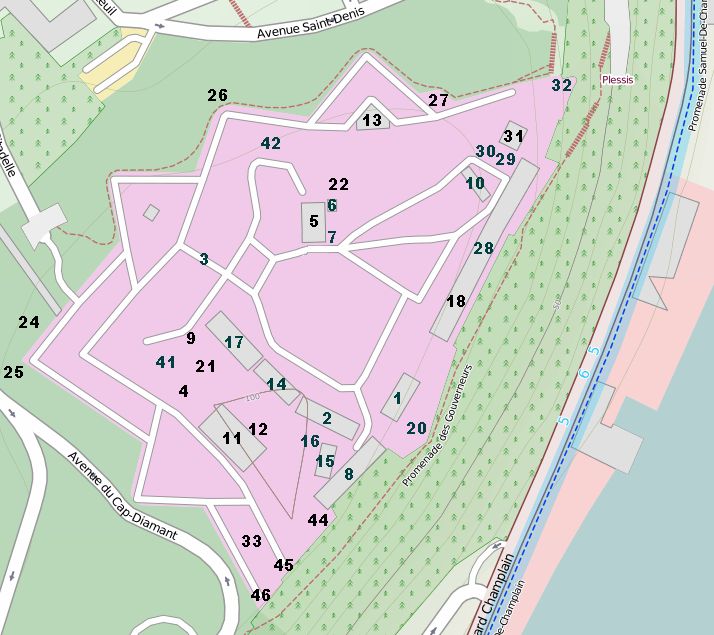
The Citadelle is an uneven star-shaped fortress comprising four bastions and three straight curtain walls, all constructed with locally quarried sandstone. Within its walls stand 24 buildings, most built of grey cut stone, serving various military, residential, and ceremonial functions. The layout follows Vauban's principles, designed as an arms, munitions, and supplies depot as well as a barracks. Key structures within the fortress include the Officer's Barracks, which serves as the governor general's residence, and Building 15, the 1750 powder magazine that now houses the Royal 22e Régiment Museum. Other significant buildings are spread across the bastions and parade ground, each with a distinct historical purpose and architectural character.
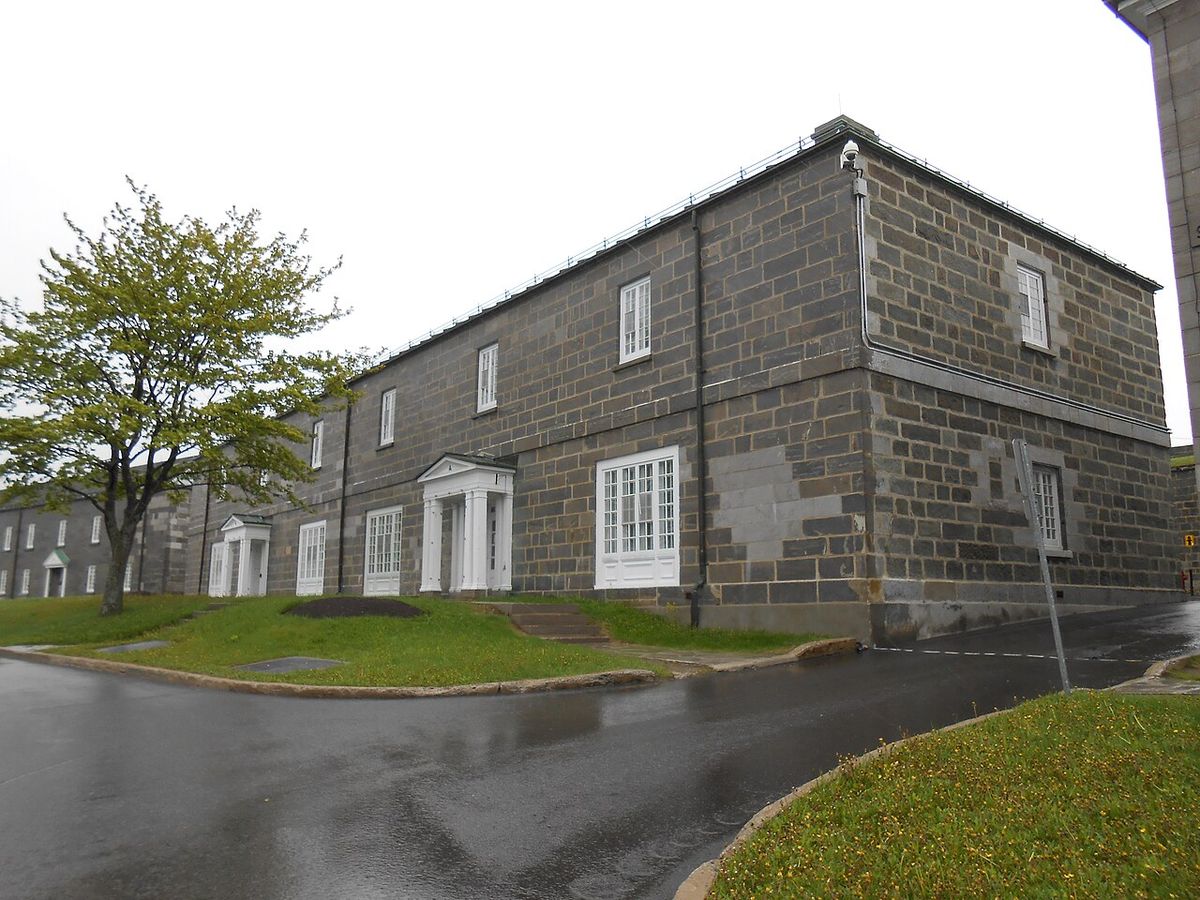
- Building 1 (Former Hospital Administration Building): A two-storey rectangular stone structure in Mann's Bastion with a hipped roof and restrained decorative pilasters.
- Building 2 (Men's Barracks): A long, two-storey masonry building near the parade ground, formerly an armoury and powder magazine.
- Building 5 (Former Powder Magazine): A low, rectangular stone structure with a gabled roof and a protective blast wall, featuring distinctive half-barrel-vaulted passages.
- Building 7 (Memorial Building): A small, one-storey masonry edifice with a pyramidal stone roof, part of a complex that includes a chapel where Governor General Georges Vanier and his wife Pauline are interred.
- Building 10 (Former Military Prison): A two-storey rectangular stone building from 1842 in the King's Bastion, now used as a museum annex.
- Building 20 (Ball House): A compact, tall stone structure that served as the former observatory and time ball tower, clearly visible from the St. Lawrence River.
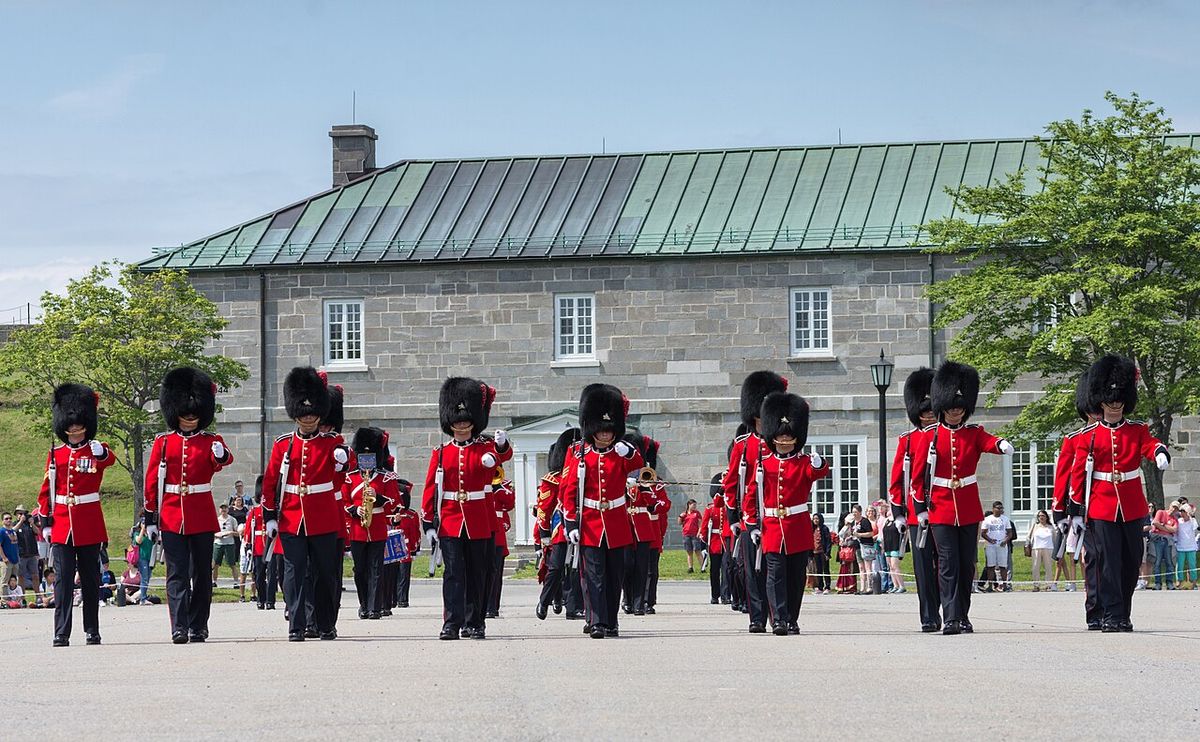
The architectural ensemble represents a blend of functional military design from the first half of the 19th century. The modern citadel was built from 1820 to 1850 based on a design by Sébastien Le Prestre de Vauban. Later additions and modifications adapted the site to its evolving roles as a garrison, residence, and museum. The buildings were constructed with locally quarried sandstone to withstand siege and house troops. Features include loopholes for defence and copper clad roofs for durability.
Military and Ceremonial Functions
The Citadelle remains an active military installation for the Canadian Armed Forces, primarily as the home of the Royal 22e Régiment. Building 1 serves as the regiment's staff headquarters. The fortress is the scene of several distinctive military ceremonies that are integral to its operational life and a draw for visitors. The daily firing of a cannon at noon, a tradition dating to 1871, serves as a time signal audible throughout Quebec City. Originally, a second shot was fired at 9:30 pm to mark curfew, a practice that continued intermittently until being suspended between 1994 and 2008. The parade ground hosts the ceremonial changing of the guard during the summer months, a colourful display of military precision. Other regimental ceremonies held here include the changing of battalion command and the consecration of each successive Batisse the Goat as the official regimental mascot.
As an official residence, the Citadelle hosts state functions similar to those at Rideau Hall in Ottawa. Canadian award presentations and investitures take place within its walls, as do ceremonies for incoming and outgoing ambassadors and high commissioners. The site's dual nature as both a working base and a vice-regal seat is unique in Canada. The Royal 22e Régiment Band also performs public concerts, such as the Music in Red performances, depending on the season. Due to its operational status, public access to the fortress is exclusively through guided tours, which include observation of the exterior grounds and some ceremonial areas, ensuring visitors can safely experience this active military environment while learning about its history and current role.
The Governor General's Residence
The Officer's Barracks, a neo-Norman structure built by the British Army in 1831, has served as a residence for the governor general since 1872. The residence comprises 153 rooms over 4,459 square metres. The original entrance features a neo-classical porch bearing the words Gouverneur Général and the crest of the royal arms of Canada. Inside, the Georgian-style foyer and hall are decorated in beige, cream, and gold, with the Small Dining Room featuring robin's egg blue walls and crystal chandeliers. Soon after its establishment as a residence, additions including a ballroom and sunroom were built to accommodate the viceregal household. These post-1872 additions were destroyed by a fire on 2 February 1976, which also caused smoke and water damage to other rooms.
Restoration and reconstruction were undertaken by the Department of Public Works and Government Services Canada, completing a new wing in 1984. This modern addition, built at the east end of the original structure, features copper roofing and masonry matching the adjacent buildings but with a more regulated, less detailed aesthetic. Designed by Quebec artist Madeleine Arbour, the interiors draw inspiration from Quebec's winter colours and utilize Canadian materials like granite, walnut, and aluminum. The wing contains a ceremonial foyer with twin spiral staircases leading to a piano nobile housing an event space, lounge, and sunroom with a terrace overlooking the St. Lawrence River. The residence is furnished with pieces from the Crown Collection, blending antique New France-style furniture with contemporary Canadian art. The residence runs a visitors' program with free tours of the state rooms throughout the year, though it is managed separately from the main Citadelle tours, requiring visitors to check its specific schedule for availability and access details.
Visitor Experience and Museum
The Citadelle welcomes approximately 200,000 visitors each year, offering a combination of history, military tradition, and architecture. General admission includes a mandatory 60-minute outdoor guided tour of the fortress, providing insight into its construction, strategic role, and current military function. All visits are guided due to the site's status as an active military base. Admission also includes free access to the Royal 22e Régiment Museum, located in the East Casemate at the entrance. The museum, housed in the 1750 powder magazine (Building 15), collects, preserves, and displays artifacts of Canadian military historical significance, with a particular focus on the weapons, uniforms, and history of the Royal 22e Régiment. It is affiliated with several national organizations including the Canadian Museums Association and the Virtual Museum of Canada.
For a deeper exploration, a 90-minute regimental tour is available, offering access to sacred regimental spaces not included on the general tour. The Citadelle provides tailored educational tours and workshops for school groups, exploring the history of the site's first occupants and the regiment. Group tours for businesses, travel agencies, and other organizations are also available with preferential rates. Special activities like night tours are offered in summer, and visitors can attend public military ceremonies when scheduled. The site includes a gift shop selling souvenirs, books, and commemorative items. While the fortress is open year-round, hours vary seasonally, with extended hours typically from May to August, providing different perspectives on the site throughout the year.
Planning Your Visit
The Citadelle is located at 1 Côte de la Citadelle in the Historic District of Old Quebec, at the top of Cap Diamant. It is open daily year-round, though seasonal hours apply. For example, from May 16 to August 31, 2026, hours are 10:00 AM to 5:30 PM. The site is generally closed only on Christmas Day and New Year's Day. Admission for adults was listed as $22 for the 2026 season, with reduced rates for children, students, and groups. All admission includes the guided tour and museum access. Reservations are not mandatory for individual visitors but are recommended for groups and are essential for special events or educational programs. Guided tours are offered in both French and English to accommodate a wide range of visitors.
Visitors should be prepared for outdoor walking and dress according to the weather, as tours proceed rain or shine. Due to the historic architecture, some areas may present accessibility challenges, though efforts are made to accommodate visitors with reduced mobility where possible. The Royal 22e Régiment Museum within the Citadelle is generally open from 9 a.m. to 5 p.m., with self-guided exploration. The adjacent governor general's residence offers separate tours of its state rooms, but visitors must consult its specific schedule. A typical visit to the Citadelle, including the tour and museum, lasts approximately 1.5 to 2 hours, providing a comprehensive overview of this historic site and its ongoing military role.
| Visitor Information | Details |
|---|---|
| Location | 1 Côte de la Citadelle, Quebec City |
| Standard Tour | 60-minute outdoor guided tour (mandatory) |
| Museum Access | Included with admission. Self-guided |
| Primary Season Hours (2026) | May 16-Aug 31: 10:00 AM-5:30 PM |
| Adult Admission (2026) | $22 |
| Languages | Guided tours in French and English |
| Annual Closures | December 25, January 1 |
Questions about Citadelle of Quebec
Can you visit the Citadelle of Quebec without a guide?
No, due to its status as an active military base, access to the Citadelle is exclusively by guided tour. General admission includes a mandatory 60-minute outdoor guided tour of the fortress. This policy ensures visitor safety and security while providing structured insight into the site's operational and historical significance. The guided format allows the military to manage access to sensitive areas while sharing the rich history of the garrison.
What is included in the admission price to the Citadelle?
The admission price includes the mandatory guided tour of the outdoor fortress and free access to the Royal 22e Régiment Museum located on site. For the 2026 season, general adult admission was listed at $22. The tour lasts about 60 minutes, and visitors can then explore the museum at their own pace, making for a total visit of approximately 1.5 to 2 hours. Reduced prices are available for children, students, and groups booking in advance.
Is the governor general's residence inside the Citadelle open to the public?
Yes, the residence is open to the public. The governor general's residence runs a visitors' program and offers free tours of the state rooms throughout the year. Educational tours for students are also available. The residence is located in the Officer's Barracks building, which has been a vice regal residence since 1872.
What military ceremonies can the public see at the Citadelle?
The public can witness several military ceremonies, most notably the changing of the guard on the parade ground during the summer months. Other observances include the daily firing of the noon cannon, a tradition since 1871. Depending on the season and schedule, performances by the Royal 22e Régiment Band, such as Music in Red concerts, may also be open to the public. Regimental ceremonies like the consecration of the regimental goat mascot are held here but may have limited public access due to their official nature.
How long did it take to build the Citadelle of Quebec?
The present star-shaped fortification was built over a period of 30 years, from 1820 to 1850. The construction was directed by Lieutenant-Colonel Elias Walker Durnford of the Royal Engineers under a wider defence plan coordinated by the Duke of Richmond. The fortress incorporated a section of an earlier 1745 French defensive wall and was based on design principles of the French military engineer Sébastien Le Prestre de Vauban. Additional buildings within the complex were completed in 1850.
Why is the Citadelle historically significant for Canada?
The Citadelle is historically significant as an active military installation and an official residence of both the monarch and the governor general. It is a National Historic Site of Canada and forms part of the Fortifications of Quebec National Historic Site of Canada. The fortress is within the Historic District of Old Quebec, a UNESCO World Heritage Site. It was the location for the Quebec Conferences of 1943 and 1944 during World War II. It has been the home station of the Royal 22e Régiment since 1920.
Sources and further reading
- Citadelle of Quebec (Wikipedia)
- The Citadelle of Quebec | Hours and Admission (lacitadelle.qc.ca)
Checked by the Novello Desserts desk. Last updated 2026-10-28.