Parliament Hill
Parliament Hill, known in French as Colline du Parlement, is the historic heart of Canadian democracy and a premier tourist destination in Ottawa, Ontario. This nine-hectare Crown land on the southern bank of the Ottawa River houses the Gothic revival buildings of the Parliament of Canada, designed to evoke the traditions of parliamentary government. Designated a National Historic Site, the hill attracts approximately three million visitors annually who come for tours, ceremonies, and to witness the seat of federal power. The site is undergoing a major, multi-billion dollar renovation project expected to conclude after 2028, ensuring its preservation for future generations.
Historical Development and Construction
The history of Parliament Hill begins long before Confederation, with the limestone outcrop serving as a landmark for First Nations peoples and European traders along the Ottawa River. Following the founding of Bytown, the British military established a base on the site, naming it Barrack Hill. After Queen Victoria selected Ottawa as the capital of the Province of Canada in 1858, Barrack Hill was chosen for the new parliament buildings due to its prominence and existing Crown ownership. A design competition in 1859 drew 298 submissions, with the Victorian High Gothic schemes of Thomas Fuller and Chilion Jones for the Centre Block and Thomas Stent and Augustus Laver for the departmental buildings ultimately selected. Construction was the largest project in North America at the time, facing delays and cost overruns before the site was temporarily shut down in September 1861. When the Dominion of Canada was formed in 1867, the buildings were still unfinished, but they quickly became the symbolic centre of the growing nation. The grounds and the Victorian high-gothic wrought iron fence named the Wellington Wall were completed by 1876, establishing the hill's formal appearance.
The early use of the site included military traditions adopted by the new government. The Dominion of Canada purchased a nine-pounder naval cannon in 1869, firing it on Parliament Hill as the Noonday Gun for many years. It was colloquially known as Old Chum. The landscape design received help from architects Thomas Scott and Calvert Vaux. Following the death of Queen Victoria in 1901, her grandson Prince George, Duke of Cornwall, dedicated a large statue in her honour on the hill in late September of that year. The British military had originally allocated the cannon to Ottawa's garrison in 1854. The architectural competition for the buildings saw the initial 298 entries reduced to three finalists, and Governor General Sir Edmund Walker Head was called upon to break the stalemate among the judges, announcing the winners on 29 August 1859.
Architecture and Building Renovations
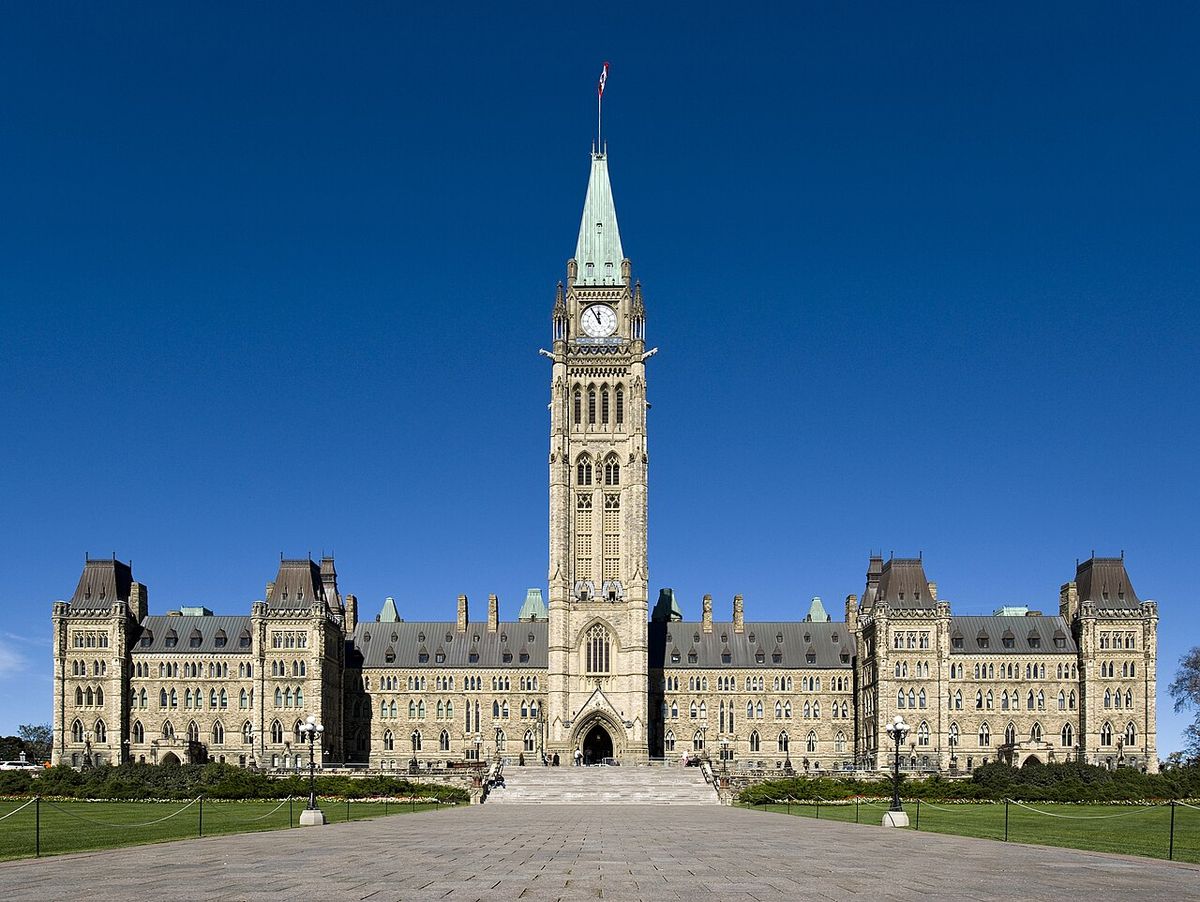
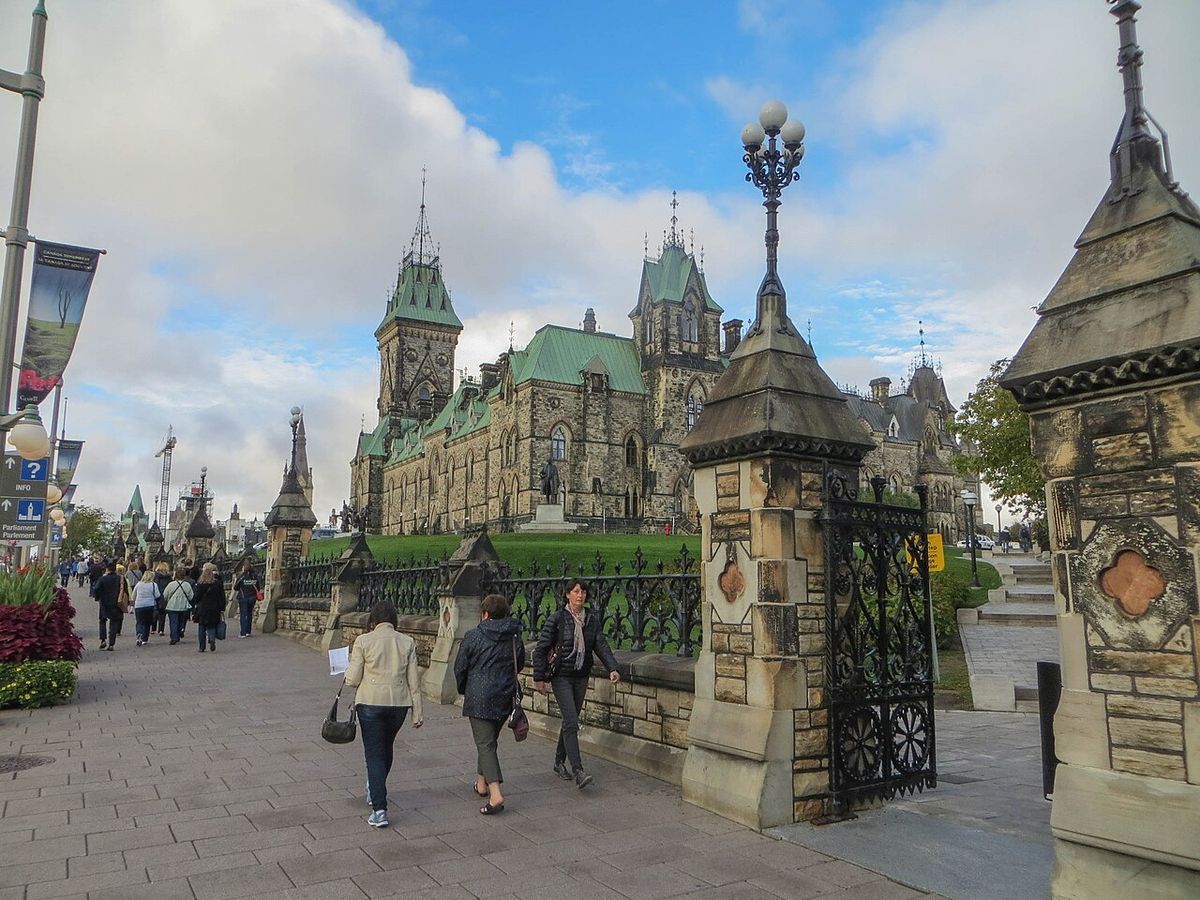
The Parliament Buildings are a suite of three Gothic Revival edifices arranged around the central lawn. The unifying architectural style was deliberately chosen to contrast with the neoclassical style of Washington, D.C., and to reflect parliamentary traditions. The Centre Block, fronted by the Peace Tower, originally housed the Senate and House of Commons chambers and the Library of Parliament at its rear. The East Block contains ministers' and senators' offices and meeting rooms. The West Block, now serving as the temporary House of Commons, features a glass-roofed chamber constructed in its former courtyard. A major, decade-long renovation project for the entire parliamentary precinct began in 2002. Key milestones in this ongoing work include the completion of the West Block for the House of Commons in November 2018, the Senate of Canada Building renovations in 2019, and foundational work on the Centre Block that includes installing 500 base isolators for earthquake protection. The project aims to modernize safety standards and address deterioration, with full completion not expected until after 2028.
The original construction contracts were awarded separately, with $300,000 allocated for the main Centre Block and $120,000 for each of the departmental buildings. The builders used Potsdam sandstone quarried in Nepean, 30 kilometres away. Workers hit bedrock sooner than expected during foundation digging, requiring blasting and forcing architects to set the foundations 5.2 metres deeper than first planned. By early 1861, the Department of Public Works reported over $1.4 million had been spent, leading to the site closure. The unfinished structures were covered with tarpaulins until 1863 when construction resumed after a commission of inquiry. The current renovation project also includes work on ancillary buildings: the Sir John A. Macdonald Building was completed in 2015 and the Wellington Building in 2016. An architectural competition was held for designs pertaining to the city block south of Wellington Street between O'Connor and Metcalfe streets, with the winner selected in 2022 and construction underway as of 2025.
Monuments, Statues, and Grounds Layout
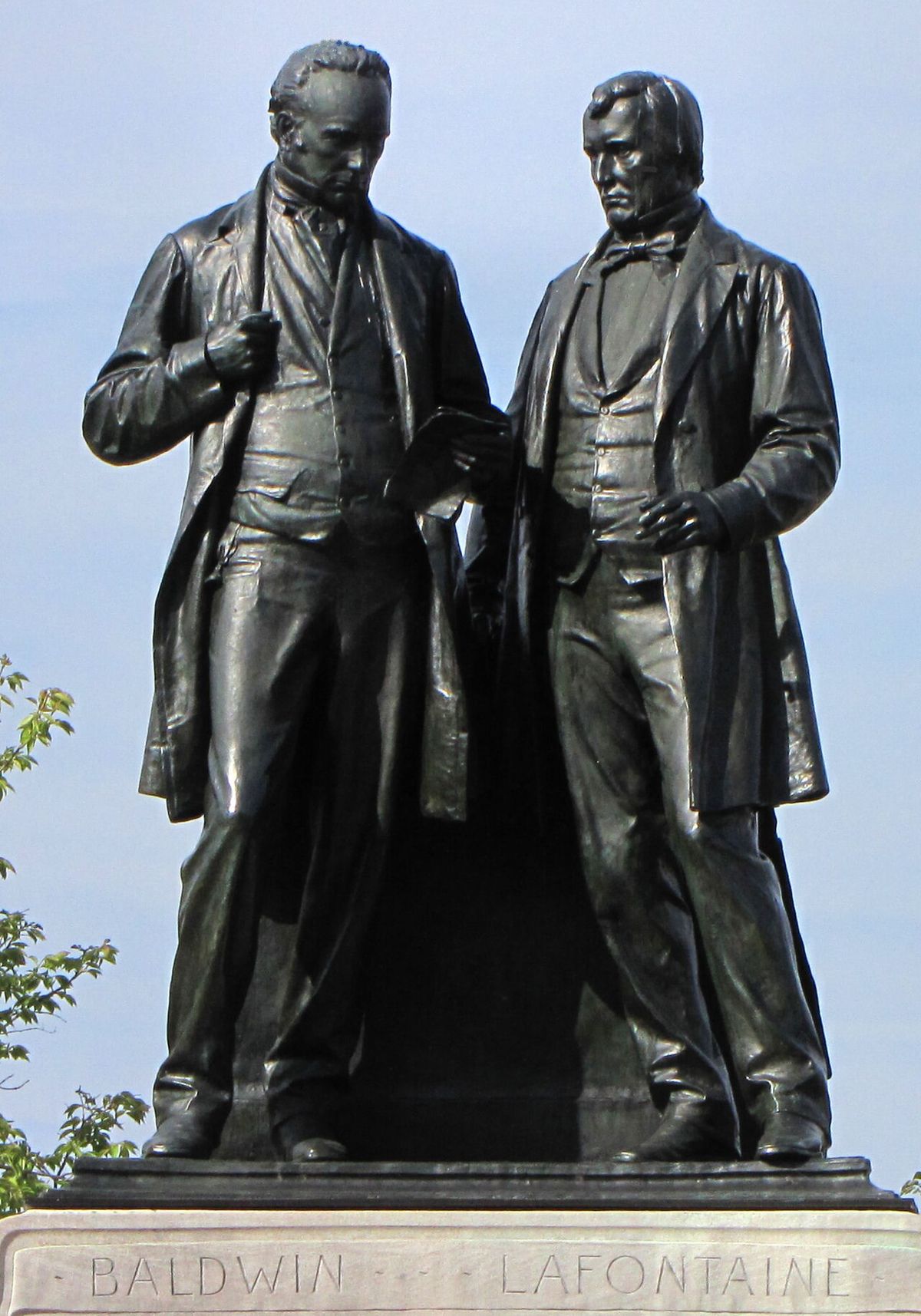
The landscaped grounds of Parliament Hill feature more than 20 bronze statues and several significant monuments that commemorate key figures and events in Canadian history. These works are primarily located in the gardens behind the three parliamentary buildings. The original gazebo, called Summer House, was built for the Speaker of the House of Commons in 1877 by Thomas Seaton Scott and was demolished in 1956. At the base of the escarpment runs a section of the Trans-Canada Trail named the Queen Elizabeth II Diamond Jubilee Trail, commemorating the 60th anniversary of her accession. Major monuments on the hill include the statue of Queen Victoria dedicated by the future King George V in 1901 and the Peace Tower, completed in 1927 as a memorial to Canadians who died in the First World War. The hill's role as a focal point for national remembrance and celebration is physically embodied in these installations.
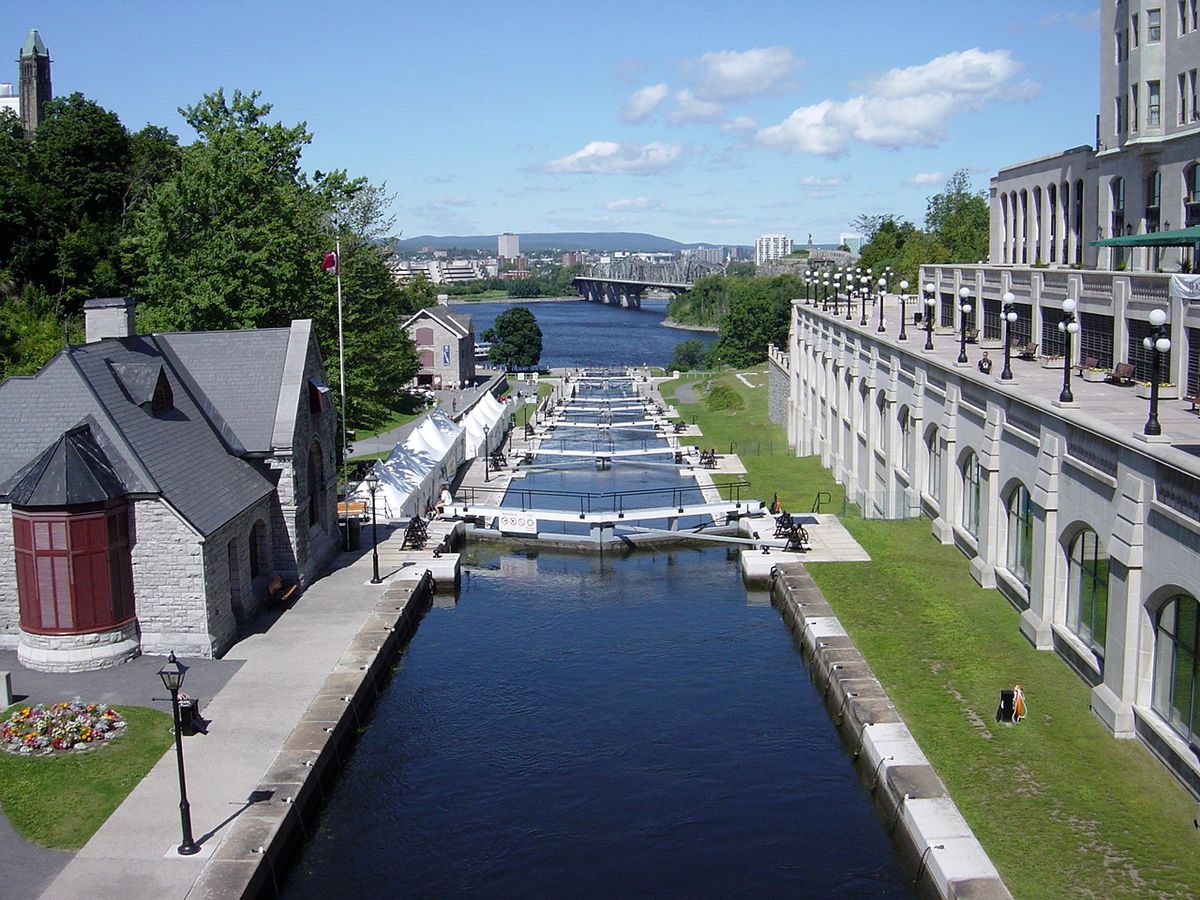
The nine-hectare area is legally defined by the Parliament of Canada Act as resting between the Ottawa River to the north, the Rideau Canal and Colonel By Valley to the east, Wellington Street to the south, and a service road near the Supreme Court to the west. The main outdoor area is the formal forecourt, formed by the arrangement of the buildings, and is used for major events. To the sides of the buildings are the statues and memorials, and at the northwest corner is the Summer Pavilion. Beyond the landscaped areas, the escarpment remains in its natural state. The Wellington Wall fence has its centre on an axis with the Peace Tower and the formal entrance known as the Queen's Gates, which were forged by Ives & Co. of Montreal. The Parliament of Canada Act also prohibits naming any other area in the National Capital Region 'Parliament Hill' or producing merchandise bearing that name, with violations punishable on summary conviction.
- Over 20 bronze statues of figures like Sir John A. Macdonald.
- Summer Pavilion (1995), serving as the National Police Memorial.
- Queen Elizabeth II Diamond Jubilee Trail along the escarpment base.
- Statue of Queen Victoria, dedicated 1901.
- Peace Tower war memorial, completed 1927.
- Wellington Wall wrought iron fence and Queen's Gates entrance.
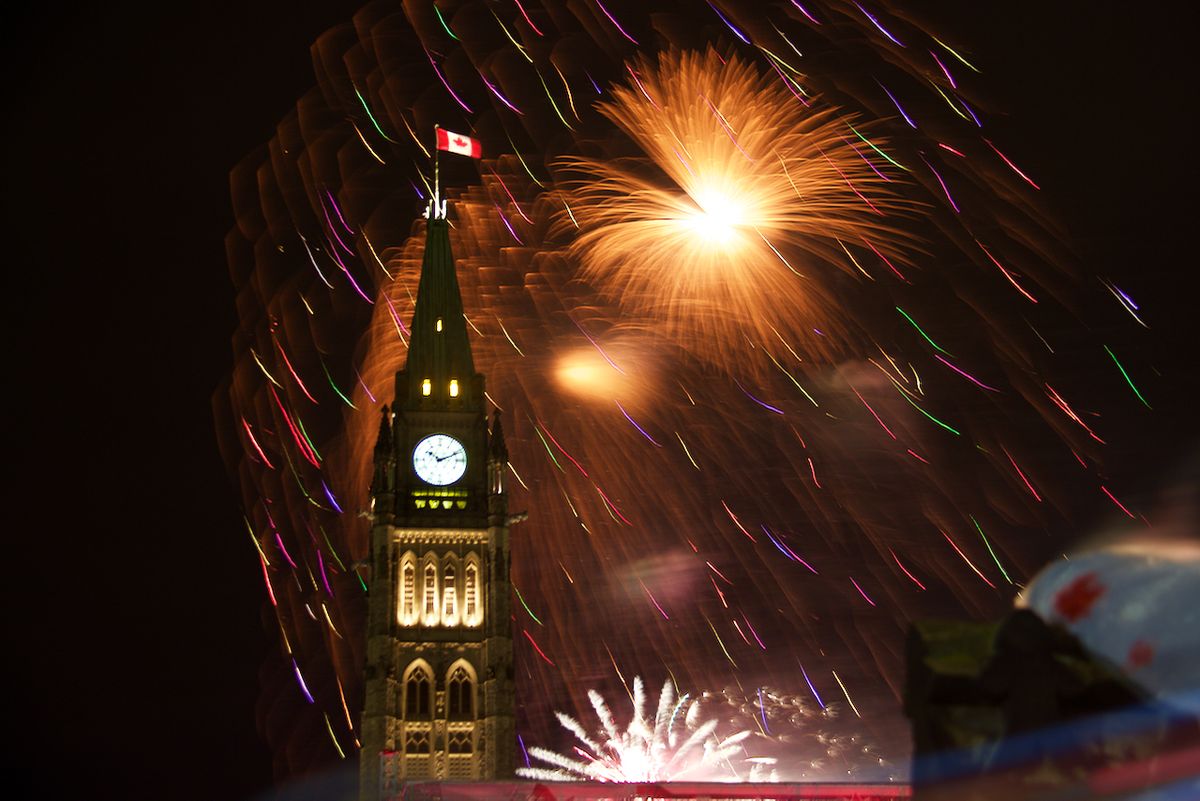
- Formal forecourt used for Canada Day and Changing of the Guard.
Significant Events, Incidents, and Security
Parliament Hill has been the stage for numerous important moments in Canadian national life. It hosted the first visit of a reigning Canadian sovereign, King George VI, and Queen Elizabeth in 1939, and massive celebrations for Victory in Europe Day on 8 May 1945. The first raising of the new Canadian flag occurred on the hill on 15 February 1965. Queen Elizabeth II returned on 17 April 1982 for the proclamation of the Constitution Act. The hill has also witnessed tragedy and security incidents. A devastating fire destroyed the original Centre Block on 3 February 1916, leading to its reconstruction. Despite the ongoing First World War, Governor General Prince Arthur, Duke of Connaught, re-laid the original building stone on 1 September 1916, exactly fifty-six years after his brother first set it. Eleven years later, the rebuilt Centre Block was completed with the new Peace Tower. In 1989, an armed man named Charles Yacoub hijacked a Greyhound bus with eleven passengers and drove it onto the lawn, leading to a six-hour standoff where three shots were fired but no one was injured.
The most serious modern incident occurred on 22 October 2014, when a gunman attacked the National War Memorial and then entered the Centre Block, where he was killed in a firefight with Sergeant-at-Arms Kevin Vickers and RCMP Constable Curtis Barrett. This event directly led to the creation of the unified Parliamentary Protective Service, which integrated House of Commons and Senate security with the RCMP. The hill also served as a gathering place for 100,000 people to honour victims of the September 11 attacks on 14 September 2001. Queen Elizabeth II's Diamond Jubilee was commemorated with a stained glass window installed in the Centre Block on 7 February 2012. The 1916 fire required the complete rebuilding of the Centre Block, and the Peace Tower was dedicated as part of that reconstruction. The 2014 shootings fundamentally changed security protocols and organizational structure for the entire parliamentary precinct.
Visitor Experience, Tours, and Annual Events
Parliament Hill is a major year-round attraction, offering a range of free experiences for the public. The primary draw is the opportunity to take guided tours of the parliamentary buildings, which provide insight into Canadian governance and history. Due to the extensive renovations, tours currently visit the temporary locations of the House of Commons in the West Block and the Senate in the Senate of Canada Building. Visitors can reserve tickets online, which shows real-time availability, or attempt to obtain them on a first-come, first-served basis at the door, though all access is subject to parliamentary activity and strict security screening. The recommended contact for general inquiries is the number 1-833-864-7839. Beyond tours, the grounds themselves are open for exploration, featuring the monuments, landscaped gardens, and scenic views of the Ottawa River. Special programming includes the daily Changing of the Guard ceremony in summer and carillon concerts from the Peace Tower. A new 'Parliament: The Immersive Experience' offers an innovative exhibition and multimedia show about the Centre Block, and virtual tour options are also available through the Library of Parliament.
The main lawn, or forecourt, is the site of major celebrations and traditional shows. The largest annual event is the Canada Day celebration on 1 July. The Changing of the Guard is a daily summer tradition. Visitors are advised to arrive 30 minutes before a booked tour time to allow for registration and security screening, which is similar to airport procedures. The 'Parliament: The Immersive Experience' includes a 360-degree multimedia show. The National Capital Commission is responsible for maintaining the grounds, while the Parliamentary Protective Service handles security. The online booking system for tours allows for advanced reservations, helping manage the high volume of approximately three million annual visitors. The hill is ranked as the number four thing to do in Ottawa according to one review source.
- Free guided tours of the House of Commons and Senate (temporarily relocated).
- Online ticket reservations recommended, with same-day tickets subject to availability.
- Self-guided exploration of the nine-hectare grounds and over 20 monuments.
- Changing of the Guard ceremony (seasonal).
- 'Parliament: The Immersive Experience' exhibition and 360-degree show.
- Virtual tours available through the Library of Parliament.
- Major annual events like Canada Day celebrations on 1 July.
Governance, Precinct Expansion, and Legal Status
The administration and security of Parliament Hill involve several federal bodies operating under specific legislation. The Parliament of Canada Act legally defines the area and prohibits the use of the name 'Parliament Hill' for any other site or merchandise in the National Capital Region. The National Capital Commission is responsible for maintaining the nine-hectare grounds, while the Parliamentary Protective Service, formed after the 2014 attack, integrates security forces for law enforcement on the hill and throughout the parliamentary precinct. The precinct itself has expanded far beyond the original hill. Growth began in the 1880s with buildings like the Langevin Block across Wellington Street and continued westward after the Château Laurier hotel was built east of the canal. The government erected the Confederation and Justice Buildings on Wellington Street's north side in the 1930s. By the 1970s, the Crown began purchasing other structures or leasing space in downtown Ottawa.
In 1973, the Crown expropriated the entirety of the three blocks between Wellington and Sparks Streets from Bank to Elgin Street, intending to construct a south block for Parliament Hill, but this proposal was dropped in favour of building office space in Hull, Quebec. In 2021, this idea was revisited, and the Ministry of Public Services announced an architectural design competition for the block, with the winner selected in 2022 and construction underway as of 2025. A new Visitor Welcome Centre is also being built as part of the Centre Block renovations. The speakers of each chamber of the legislature oversee the use and administration of the spaces within each building on the hill. The expansion reflects the growing needs of the national government while the historic hill remains its symbolic core. The legal prohibition against using the 'Parliament Hill' name elsewhere highlights its unique status as the designated seat of government.
Cultural Significance and National Role
Parliament Hill's status as a premier destination is confirmed by its consistent draw of approximately three million visitors every year. This figure reflects its dual role as both a functioning seat of government and a powerful national symbol accessible to the public. Its designation as a National Historic Site in 1976 recognized its importance as the physical embodiment of the Canadian government and as the country's focal point for national celebrations. The hill's Gothic silhouette, particularly the Peace Tower, is instantly recognizable to Canadians and serves as a backdrop for political discourse, public protest, and civic pride. The extensive renovations, while disruptive, represent a national investment of $3 billion in preserving this heritage for centuries to come. The 1976 designation applied separately to both the Parliament Buildings and the grounds. The site's history as Barrack Hill and its selection by Queen Victoria are foundational to Ottawa's identity as the capital.
The hill's role in national ceremonies is extensive, from the 1939 royal visit to the 1982 proclamation of the Constitution Act. It is the traditional site for the installation of commemorative features like the Diamond Jubilee stained glass window in 2012. The architecture was intended to evoke the history of parliamentary democracy, and the choice of Gothic over American neoclassicism was a deliberate statement. The Summer Pavilion's role as the National Police Memorial adds a layer of solemn remembrance. The table below outlines key structures and their current status within the renovation project, illustrating the scale of the preservation effort.
| Building | Primary Function | Renovation Status (as of 2026) | Notable Fact |
|---|---|---|---|
| Centre Block | Houses Peace Tower, Library of Parliament. Future home of Commons & Senate | Under major renovation until after 2028 | Destroyed by fire in 1916, rebuilt by 1927 |
| West Block | Temporary House of Commons chamber | Renovation completed November 2018 | Courtyard converted into a glass-roofed chamber |
| East Block | Offices and meeting rooms | Undergoing renovations | Original departmental building by Stent & Laver |
| Senate of Canada Building | Temporary Senate chamber | Renovation completed 2019 | Accommodates Senate during Centre Block work |
| Sir John A. Macdonald Building | Parliamentary functions and events | Work completed 2015 | Part of the broader precinct renewal |
| Wellington Building | Parliamentary office space | Work completed 2016 | Provides additional space for members |
| New Block (Planned) | Future parliamentary space | Design winner 2022, construction underway 2025 | Located on block south of Wellington Street |
Questions about Parliament Hill
Can you tour Parliament Hill for free?
Yes, guided tours of the Parliament Buildings are offered free of charge. Due to ongoing renovations, these tours currently visit the temporary House of Commons in the West Block and the Senate in the Senate of Canada Building. Tickets can be reserved online in advance or obtained on a first-come, first-served basis at the tour locations, though availability is subject to parliamentary activity. All visitors must pass through security screening similar to airport procedures before entering.
What happened at Parliament Hill in 2014?
On 22 October 2014, a shooting attack occurred on and near Parliament Hill. A gunman fatally shot a Canadian soldier standing guard at the National War Memorial before entering the Centre Block of the Parliament Buildings. Inside, the attacker was engaged and killed by Sergeant-at-Arms Kevin Vickers and RCMP Constable Curtis Barrett. This security incident directly led to the creation of the unified Parliamentary Protective Service, which now handles security for the hill and parliamentary precinct.
When will the Parliament Hill renovations be finished?
The extensive renovation and rehabilitation project for the parliamentary precinct, budgeted at $3 billion, began in 2002. Work is not expected to be fully completed until after 2028. Major milestones have already been reached, including the completion of the West Block in 2018 to house the temporary House of Commons and the Senate of Canada Building in 2019. The most complex work involves the Centre Block, which is undergoing foundational upgrades, including the installation of 500 base isolators for earthquake protection.
What statues and monuments are on Parliament Hill?
The grounds feature more than 20 bronze statues commemorating important figures in Canadian history, with most arranged in the gardens behind the three parliamentary buildings. A number of other monuments are distributed across the hill, marking historical moments or acting as memorials for larger groups of people. One significant statue is a large statue of Queen Victoria, which was dedicated on the hill in late September 1901 by Prince George, Duke of Cornwall. The Summer Pavilion, a reconstructed gazebo at the northwest corner of the grounds, now serves as the National Police Memorial.
What events are held on Parliament Hill?
Parliament Hill is the nation's premier site for major celebrations and ceremonies. The largest annual event is the Canada Day celebration on 1 July, featuring concerts and fireworks. Other regular events include the daily Changing of the Guard ceremony during the summer months. The hill has also hosted historical events like the first raising of the Canadian flag in 1965, Victory in Europe Day celebrations in 1945, and memorial gatherings such as for the victims of the September 11 attacks in 2001.
What is the Peace Tower?
The Peace Tower is a freestanding bell tower on the south facade of the Centre Block on Parliament Hill. It was completed in 1927 and dedicated as a memorial to the Canadians who died during the First World War. The tower was rebuilt as part of the Centre Block after the original was destroyed in the 1916 fire. The Peace Tower is one of the most recognizable national symbols, though public access is currently suspended due to the extensive renovation project underway on the Centre Block, which is expected to conclude after 2028.
Sources and further reading
- Parliament Hill (Wikipedia)
- Parliament Hill free tours and programming (ottawatourism.ca)
Checked by the Novello Desserts desk. Last updated 2026-10-27.