Percé Rock
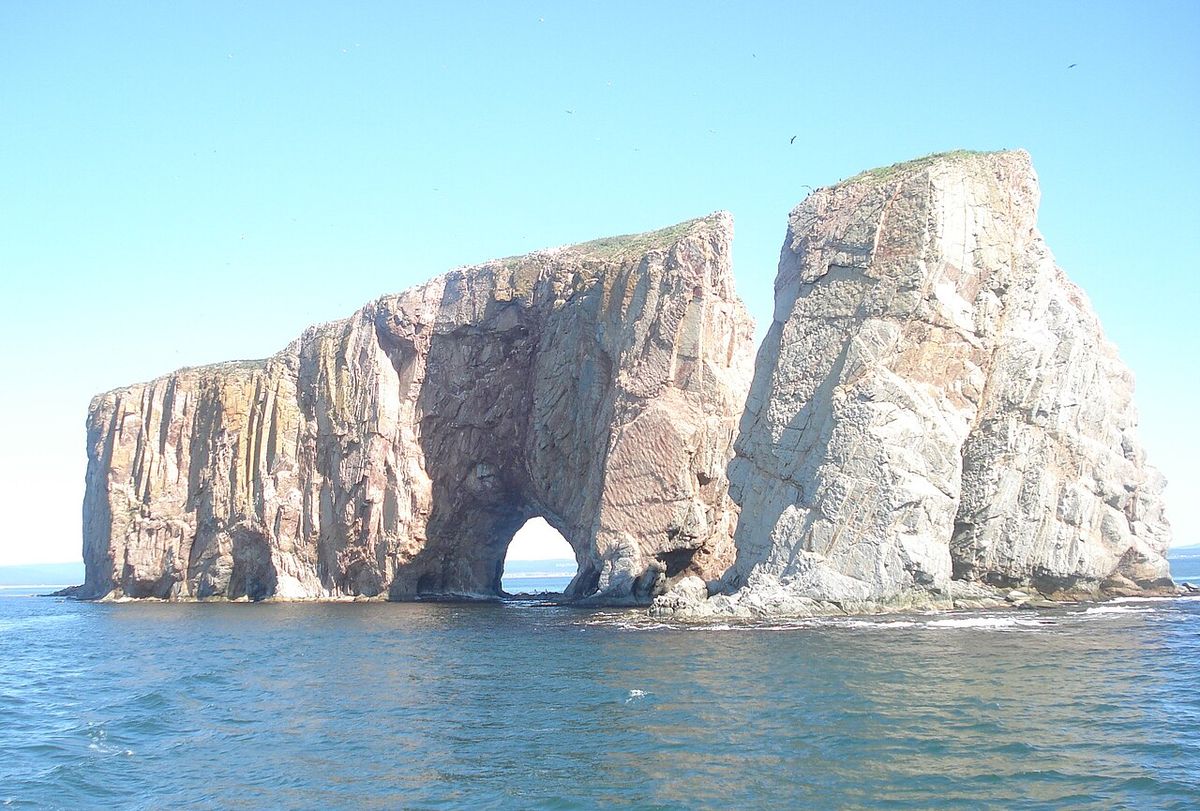
Percé Rock, known in French as Rocher Percé, is a massive limestone monolith rising dramatically from the Gulf of Saint Lawrence at the tip of Quebec's Gaspé Peninsula. Often described as resembling a ship under sail, the rock is famed for its large sea arch and is one of the world's largest natural arches located in water. It is the centrepiece of the Parc national de l'Île-Bonaventure-et-du-Rocher-Percé, a major tourist destination celebrated for its immense seabird colonies and rich Devonian-period fossils. As a geologically and historically significant natural landmark, Percé Rock is considered a tourist emblem of Quebec and a must-see attraction in the Gaspésie region.
Geography and Geology
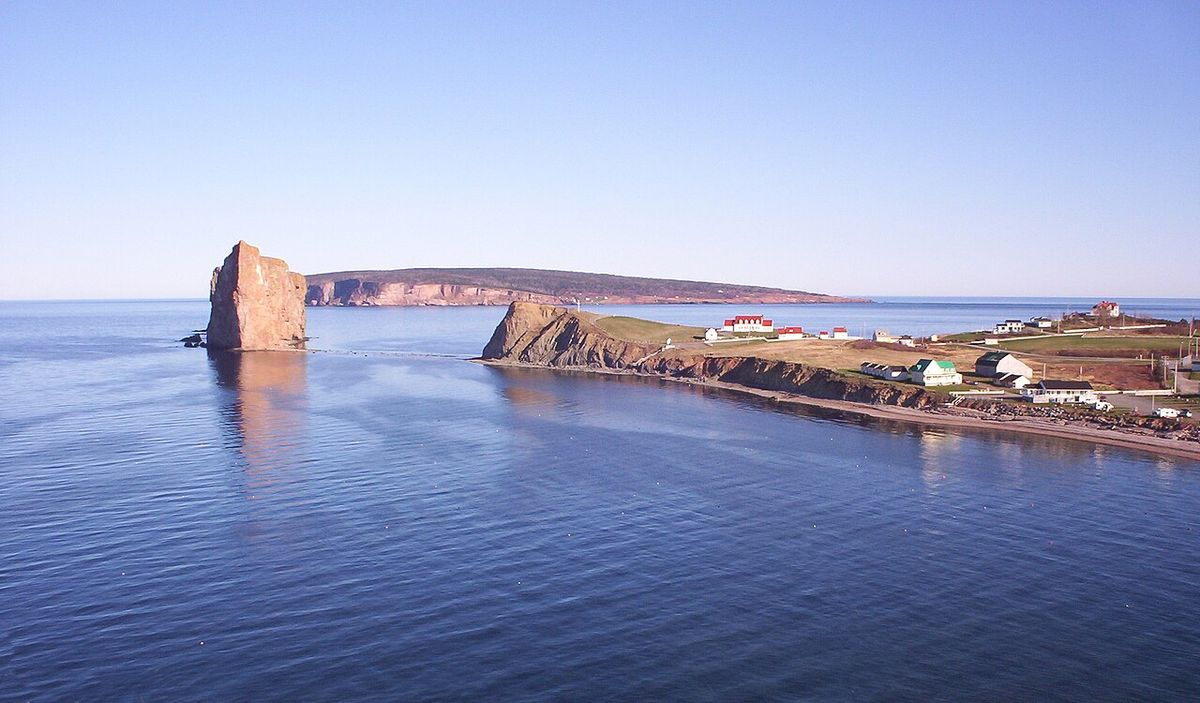
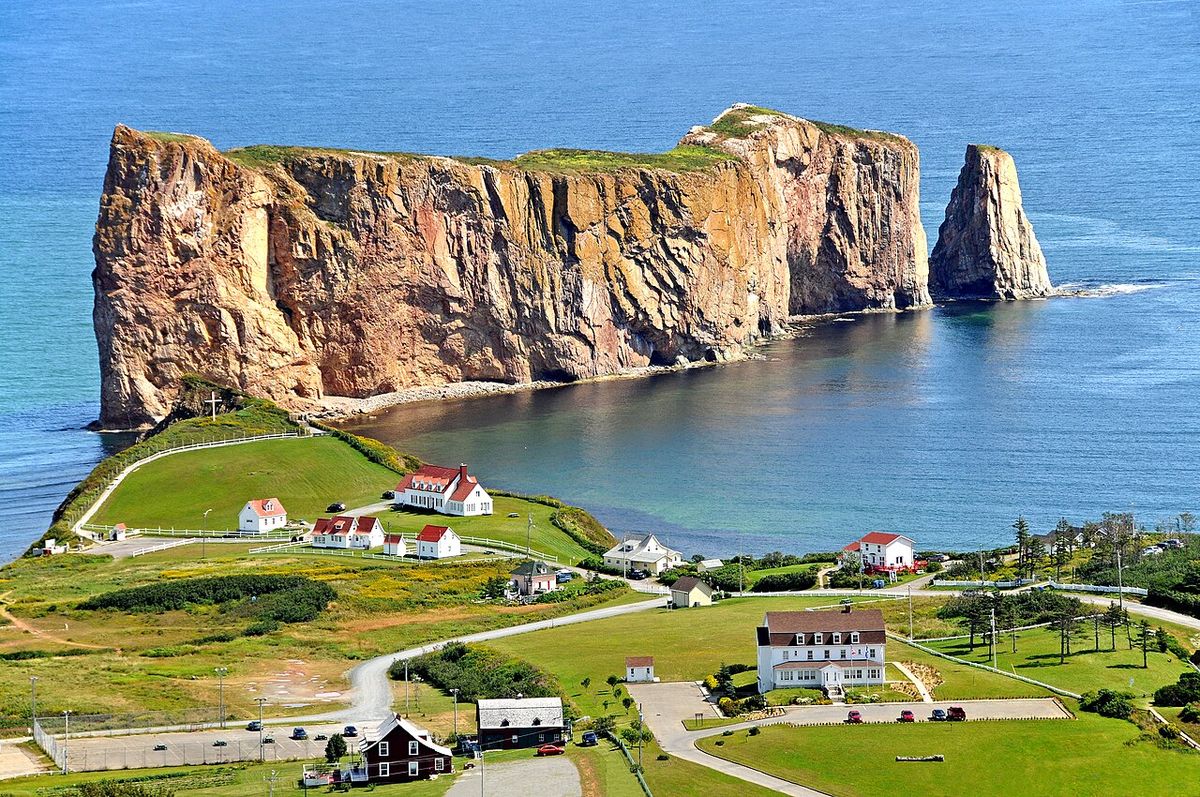
Percé Rock is a sheer stack formation composed primarily of siliceous limestone with veins of sandstone and siltstone, presenting steep cliffs on all sides. It is located off Percé Bay, linked to the mainland at Rue du Mont Joli by a sandbar that is exposed only during low tide for approximately four hours. The rock measures 433 metres in length, 90 metres in width, and stands 88 metres high at its tallest point. Geologically, the formation dates to the Devonian period, over 400 million years ago, and contains an estimated 150 fossil species including brachiopods, trilobites, and corals. The massive monolith is estimated to weigh 5 million tonnes, but erosion from wind and water removes about 300 tonnes per year, a rate that suggests the rock could disappear in roughly 16,000 years.
The rock is the most prominent feature within the Parc national de l'Île-Bonaventure-et-du-Rocher-Percé, which was founded in 1985 and covers 5.8 square kilometres. The park encompasses a 2-kilometre stretch of coastline, the rock itself, and the nearby Bonaventure Island. This area represents one of five geological formations on the tip of the Gaspé Peninsula. The region's bedrock consists of reddish-gold limestone and shale, part of the cliffs and hills along the southwest side of the Gulf of Saint Lawrence. A reef exists about 800 metres southwest of Percé Rock, and a shoal stretches 400 metres midway across the rock formation.
The Sea Arch and Historical Changes
The name Percé, meaning 'pierced', was given by explorer Samuel de Champlain in 1607 in reference to the holes he observed in the limestone mass. The defining feature is a Gothic-style sea arch on the rock's seaward southern end, approximately 15 metres high, through which a small boat can pass at high tide. Historically, the rock's form has changed significantly due to collapses. When Jacques Cartier arrived in 1534, he reported three arches. By the time Samuel de Champlain saw it in 1603, only one arch remained, though a 1760 drawing by Captain Hervey Smyth showed two. The last major collapse occurred on June 17, 1845, when the outer arch fell with great force, leaving behind a separated pillar or obelisk. This event left the single arch seen today, creating the pierced silhouette that defines the landmark.
Bonaventure Island and Percé Rock National Park
The Parc national de l'Île-Bonaventure-et-du-Rocher-Percé protects both the famous rock and the adjacent Bonaventure Island, creating a unified natural sanctuary. The park is internationally renowned as one of the largest and most accessible migratory bird sanctuaries in the world. It is home to a recorded 293 different bird species, with a total bird population exceeding 280,000. The most famous residents are the northern gannets, with a colony of over 121,000 birds, making it the largest gannet colony in the world, surpassing the archipelago of St Kilda in Scotland. Other notable seabirds include puffins, razorbills, black guillemots, and kittiwakes. The park's Bonaventure Island sector offers four main hiking trails totalling 15 kilometres, allowing visitors to explore meadows, coniferous forests, and coastal paths that lead to the gannet colony. Park wardens and naturalists offer guided hikes, visits to ancestral homes on the island, and interpretive activities at the bird colony. On-site services include a restaurant, sanitation facilities, and a nature boutique. The purchase of access rights is done online, and transportation is provided by boat operators from the Percé wharf.
Key Park Features and Activities:- Four hiking trails on Bonaventure Island (Des Mousses, des Colonies, du Roy, Paget) totalling 15 km.
- World's largest accessible northern gannet colony (over 121,000 birds).
- Guided hikes, heritage home tours, and interpretive activities with park staff.
- Restaurant, sanitation facilities, and nature boutique on Bonaventure Island.
- Boat access from Percé wharf via operators like Les Bateliers de Percé and Les Croisières Julien Cloutier.
- Seasonal operation from late May to mid-October annually.
Visitor Experience and Access
Visiting Percé Rock involves several unique experiences shaped by the tides and seasons. Direct access to the base of the rock is only possible during low tide via the exposed sandbar, a window that lasts about four hours. This access is permitted from May 28 to October 12 each year, during which park guides are present to provide information on the beach creatures, geology, and fossils. Due to the risk of collapse, it is dangerous to venture too close, and the top of the rock is not accessible as it serves as a perch for birds. A more comprehensive visit typically involves a boat trip from the Percé wharf, which takes about 75 minutes and provides views of the rock from the water and access to Bonaventure Island.
The town of Percé serves as the gateway, with an interpretation centre located in a restored building called Le Chafaud. This centre hosts a thematic exhibition titled 'Un rocher, une île, un parc national' (one rock, one island, one national park), detailing the bird life, marine life, geology, history, and ecosystem of the area. Beyond the park, the broader Percé region offers 18 kilometres of hiking trails through the Percé UNESCO Global Geopark, which includes lookouts and a glass platform suspended 200 metres above sea level. Other local attractions include sea kayaking, visits to the historic Robin, Jones and Whitman general store, and the Emerald River (Rivière aux Émeraudes) municipal park.
Seasonal Events in Percé:- Fête de la Saint-Jean: Quebec's National Holiday celebration in Percé on June 24, featuring entertainment and family activities.
- Festi-Plage Cap-d'Espoir: A seaside festival on Cap-d'Espoir Beach from July 23 to 25, with live shows, fireworks, and bonfires.
- Les Percéides Film Festival: An independent film festival screening features and shorts from August 17 to 23.
- Candlelight Concerts: Intimate musical performances held Wednesdays from July 1 to August 19 at the Coin-du-Banc Cultural Museum.
Natural History and Wildlife
The ecological significance of the Percé Rock and Bonaventure Island area is substantial, supporting diverse marine and avian life. The nutrient-rich waters of the Gulf of Saint Lawrence make it a prime area for whale watching from May to December, with species such as blue whales, humpback whales, minke whales, and fin whales often spotted near Percé, Bonaventure Island, and Forillon National Park. The park's coastal ecosystems exhibit a wide variety of flora and fauna adapted to the maritime climate. The limestone cliffs and forests provide critical nesting and resting habitat for hundreds of thousands of birds. The northern gannet colony is the park's most significant biological feature, with these large seabirds arriving each spring to nest on the cliffs of Bonaventure Island.
The colony's size and accessibility make it a vital site for scientific research and public education about seabird ecology. The park's status as a migratory bird sanctuary helps protect these populations. The fossil record within the limestone of Percé Rock itself provides a snapshot of ancient Devonian-period marine ecosystems, offering insights into life over 375 million years ago. These fossils show a variety of animal and plant communities from both terrestrial and marine habitats of that era, including marine worms and corals.
Cultural Significance and Representation
Percé Rock holds a powerful place in the cultural imagination of Quebec and Canada. It was nominated as one of the Seven Wonders of Canada by the CBC, highlighting its status as a national natural landmark. Its dramatic form has inspired artists, writers, and poets for centuries. Most notably, French surrealist poet André Breton visited the Gaspé in October 1944 and was deeply moved by the rock, which he described in his work Arcanum 17. He saw it as a 'razor blade rising out of the water' and a 'marvellous iceberg of moon stone,' drawing from it a sense of hope and natural renewal amidst the turmoil of the Second World War.
Local legends also surround Percé Rock. Some residents historically referred to it as 'Le Génie de l'Isle Percée', perceiving it as a phantom shape during storms. The rock's image is ubiquitous in tourism promotion for the Gaspésie region and it is considered the tourist emblem of Quebec. In 2009, National Geographic Traveler ranked the Gaspé Peninsula third on its list of the world's must-see destinations, largely due to the impressive presence of Percé Rock and the birdlife of Bonaventure Island. The rock is a major tourist attraction in Quebec with picturesque views.
Planning Your Visit
A trip to Percé Rock requires some planning due to its seasonal accessibility and tidal dependencies. The core visiting season for accessing the rock on foot and for park operations on Bonaventure Island runs from late May to mid-October. The town of Percé, whose main industry is fishing, offers a range of accommodations, dining, and services for tourists. When planning, visitors should check the tide tables to time their walk to the rock and book boat tours in advance, especially during peak summer months.
For a comprehensive experience, a multi-day stay is recommended to allow time for a boat tour to Bonaventure Island, hiking the geopark trails, visiting the interpretation centre, and possibly joining a whale-watching excursion. The Percé UNESCO Global Geopark network provides extensive hiking opportunities with stunning viewpoints. The region's events calendar, featuring festivals like Festi-Plage and Les Percéides, can also enhance a visit. Given the rock's distance, approximately 750 kilometres east of Quebec City, travelers should account for significant driving time or consider regional flight options to the Gaspé Peninsula.
| Activity | Key Details | Season/Timing |
|---|---|---|
| Walk to Percé Rock | Via sandbar at low tide. Guided info available | May 28, Oct 12 (4-hour tide window) |
| Boat Tour to Bonaventure Island | 75-min trip. Access to hiking trails & bird colony | Park open May 31, Oct 12, 2026 |
| Percé Geopark Hiking | 18 km of trails with lookouts & glass platform | Seasonal (spring to fall) |
| Whale Watching | Spot blue, humpback, minke, fin whales | May, December |
| Interpretation Centre Visit | 'One rock, one island, one national park' exhibition | Seasonal hours |
Questions about Percé Rock
Where is Percé Rock located?
Percé Rock is situated in the Gulf of Saint Lawrence at the tip of the Gaspé Peninsula in Quebec, Canada. It lies off Percé Bay, directly adjacent to the town of Percé. The rock is approximately 750 kilometres east of Quebec City. It is the central feature of the Parc national de l'Île-Bonaventure-et-du-Rocher-Percé, which also includes nearby Bonaventure Island.
Can you walk to Percé Rock?
Yes, but only during low tide when a sandbar is exposed, connecting the rock to the mainland at Rue du Mont Joli. This tidal window lasts for about four hours. Walking access is permitted and supervised by park guides from May 28 to October 12 each year. Visitors are cautioned that it is dangerous to venture too close to the rock due to the risk of collapse from erosion.
What kind of birds can be seen at Bonaventure Island?
Bonaventure Island is a world-renowned bird sanctuary hosting over 280,000 birds from 293 recorded species. The most famous is the northern gannet, with a colony of over 121,000 individuals, the largest such colony in the world. Other common seabirds include Atlantic puffins, razorbills, black guillemots, and black-legged kittiwakes. The island's cliffs and forests provide essential habitat for these and many other migratory and nesting species.
How was Percé Rock formed?
Percé Rock is a limestone stack formed over 400 million years ago during the Devonian period. It was originally connected to the mainland. The sea arch was carved by the relentless force of sea waves eroding the softer limestone. The rock has changed shape over centuries. It once had three arches, but collapses, including a major one on June 17, 1845, have left the single 15-metre-high arch seen today. The monolith continues to erode at an estimated rate of 300 tonnes per year.
What other activities are there to do in the Percé area?
Beyond visiting Percé Rock and Bonaventure Island, the area offers many activities. The Percé UNESCO Global Geopark features 18 km of hiking trails with lookouts and a glass platform. Activities include sea kayaking, bird watching, and exploring historic sites like the Robin, Jones and Whitman general store. You can also visit the Emerald River park or participate in seasonal events such as Festi-Plage and the Percéides film festival. Whale watching tours are popular from May to December.
What is the best time of year to visit Percé Rock?
The best time to visit Percé Rock is from late May to mid October. The park is officially open from May 28 to October 12, which is the only period when visitors can access the rock on foot via a sandbar at low tide. This season also aligns with boat tour operations to Bonaventure Island and the active nesting season for the vast northern gannet colony. From May to December, various whale species such as blue, humpback, minke, and fin whales can be seen along the coast. The summer months also feature local events like Festi Plage and the Percéides film festival.
Sources and further reading
- Percé Rock (Wikipedia)
- Can't-Miss Experiences in Le Rocher-Percé in Gaspésie (tourisme-gaspesie.com)
- Percé Rock in Quebec's Famous Gaspé (denuretours.com)
- Bonaventure Island and Percé Rock National Park / Île ... (perce.info)
Checked by the Novello Desserts desk. Last updated 2026-10-28.