Quebec Bridge
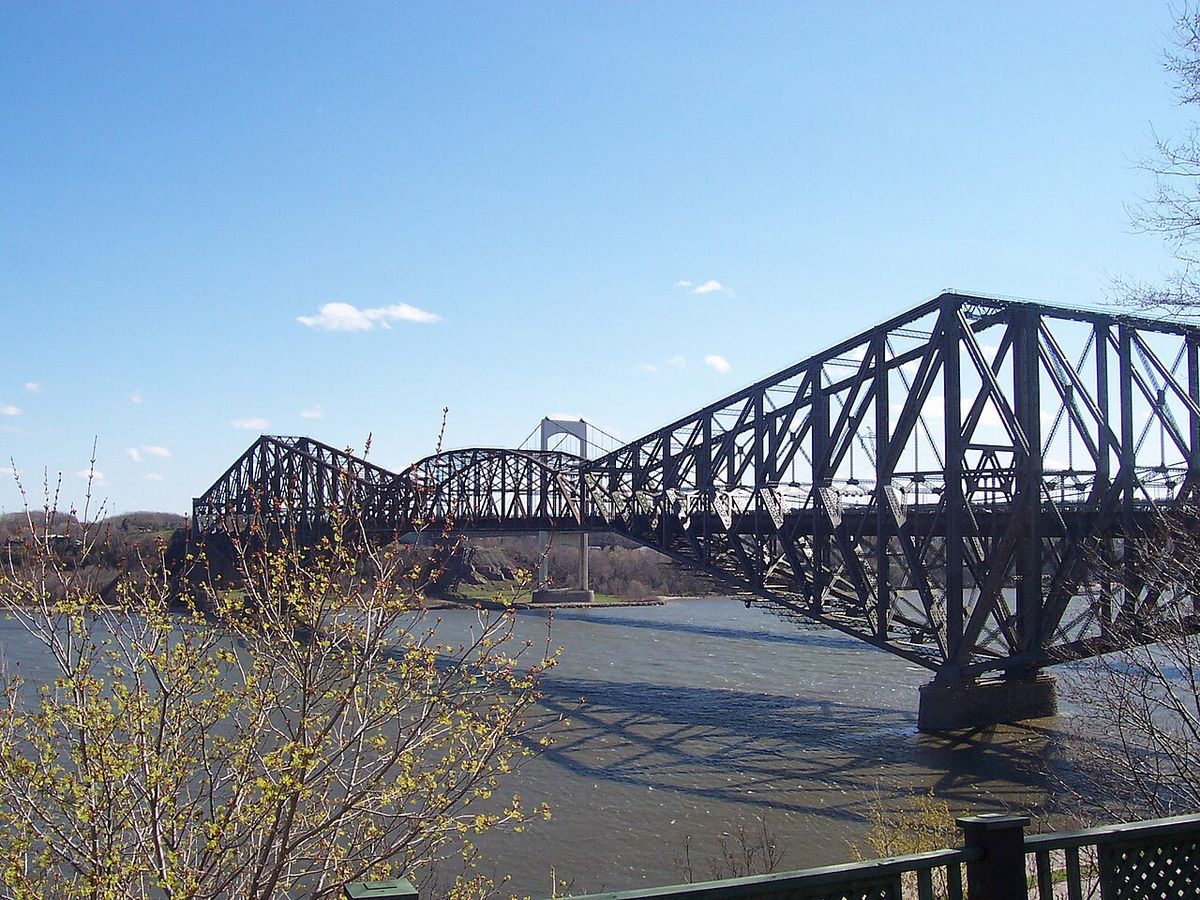
The Quebec Bridge is a large steel cantilever bridge crossing the St. Lawrence River, linking the Quebec City borough of Sainte-Foy-Sillery-Cap-Rouge to Lévis. Its construction, finished in 1919, was marked by two collapses that killed 88 workers, making it a significant chapter in Canada's industrial history. The bridge's main span of 549 metres is the longest of any cantilever bridge in the world. It serves as an important transport route and a recognized landmark for visitors to the Quebec City area.
Historical Context and Early Efforts
For decades before the bridge's construction, crossing the St. Lawrence River at Quebec City was a seasonal challenge, reliant on ferries or a treacherous ice bridge in winter. The idea of a permanent crossing was discussed as early as 1852, with renewed political interest in 1867, 1882, and 1884. The project gained significant momentum after the election of Liberal Prime Minister Wilfrid Laurier, the Member of Parliament for Quebec East, in 1896. Laurier championed the bridge as part of a national vision, linking it to the broader National Transcontinental Railway project. Local business leaders and newspapers, such as the Quebec Morning Chronicle in 1897, debated potential sites and costs, with early estimates for a bridge at Diamond Harbor reaching eight million dollars. The Quebec Bridge Company was first incorporated by an Act of Parliament in 1887 under Sir John A. Macdonald's government, but it was Laurier's administration that revived the company for good in 1897 and provided crucial federal backing. The company was revived again in 1900 with an extension of time granted by Laurier, and in 1903 its bond issue was increased to six million dollars and its name changed to the Quebec Bridge and Railway Company, with an Act of Parliament guaranteeing the bonds with public funds.
Engineering Leadership and the Path to the 1907 Collapse
The initial engineering oversight for the Quebec Bridge and Railway Company was complex and flawed. Edward A. Hoare served as the company's Chief Engineer, though he had no experience with cantilever bridges longer than 91 metres. The federal Department of Railways and Canals was represented by Chief Engineer Collingwood Schreiber, who was assisted by bridge engineer R.C. Douglas until 9 July 1903. Douglas was removed for opposing the contractors' calculations, and Schreiber's subsequent request for another qualified bridge engineer was overruled by the federal Cabinet on 15 August 1903. This left consulting engineer Theodore Cooper, based in New York, with complete charge of the works. By 1904, construction was underway, but preliminary design calculations were never properly checked. As the southern cantilever arm grew in the summer of 1907, site engineer Norman McLure documented increasing distortions in critical structural members, realizing the bridge's dead load was far in excess of its carrying capacity. McLure wrote repeatedly to Cooper, who initially dismissed the concerns. On 27 August 1907, convinced the bending beams were not a pre-installation defect, McLure traveled to New York. Cooper agreed the issue was serious and sent a telegram to the Phoenix Bridge Company ordering a halt to adding load. This message was not relayed to the Quebec site in time.
The 1907 Disaster and Its Aftermath
Near quitting time on 29 August 1907, after four years of construction, the south arm and part of the central section of the bridge collapsed into the St. Lawrence River in just 15 seconds. Of the 86 workers present, 75 were killed and the rest injured, marking the world's worst bridge construction disaster at that time. Among the victims were 33 Mohawk steelworkers from the Kahnawake reserve near Montreal, who were later buried under crosses made of steel beams. The next day, a Royal Commission of inquiry was provisionally appointed by the Deputy Minister of Railways and Canals, Matthew J. Butler, who had replaced Schreiber in 1905. Officially granted by King Edward VII on 31 August, the commission consisted of engineers Henry Holgate, J.G.G. Kerry, and University of Toronto dean John Galbraith. Their report, delivered on 20 February 1908, included the analysis of consulting engineer C.C. Schneider and issued 15 conclusions. The commissioners placed direct responsibility on consulting engineer Theodore Cooper and Phoenix Bridge Company's chief designing engineer, Peter L. Szlapka, citing errors in judgment. They also faulted the Quebec Bridge and Railway Company for not appointing an experienced chief engineer, resulting in loose and inefficient supervision. The abortive construction spanned the terms of two Ministers of Railways and Canals and one temporary replacement.
The Second Design, Collapse of 1916, and Final Construction
Following the Royal Commission, a second bridge was designed with a more massive single cantilever span. A new engineering team was appointed, led by H.E. Vautelet, a former Canadian Pacific Railways engineer, as President and Chief Engineer. He was joined by British engineer Maurice FitzMaurice, who worked on the Forth Bridge, and American designer Ralph Modjeski. Construction progressed until 11 September 1916, when the central span was being raised into position. The engineer responsible for the centre section, Frants Lichtenberg, who was also a federal government inspector, had alerted the chief engineer to a problem six weeks prior. The central span collapsed into the river due to the failure of a casting in the erection equipment, killing 13 workers. Initial fears of German sabotage during the First World War were disproven. Reconstruction began almost immediately, with the government granting special permission to acquire needed steel despite wartime demand. The bridge was structurally completed in September 1917 at a total cost of 23 million dollars. The first train crossed on 17 October 1917, and it officially opened for rail traffic on 3 December 1917. The bridge was fully opened in 1919, ending almost two decades of construction. For the remainder of the war, the completed bridge was guarded by armed soldiers and later Dominion Police, requiring special passes for crossing due to security concerns.
Design, Specifications, and Evolving Use
The completed Quebec Bridge is a riveted-steel truss structure measuring 987 metres long, 29 metres wide, and 104 metres high. Its record-holding 549-metre main span is supported by cantilever arms each 177 metres long, which hold a 195-metre central structure. It was the longest bridge span of any type in the world until the completion of the Ambassador Bridge in 1929. Originally built as a railway bridge for the National Transcontinental Railway, it carried two rail tracks, two streetcar lines for the Quebec Railway, Light & Power Company, and pedestrian walkways. Its conversion to accommodate automobile traffic occurred in stages over several decades, fundamentally changing its primary function.
- 1929: One of the two railway tracks was converted into a highway lane.
- 1949: A second highway lane was added, reducing the rail lines to one.
- 1993: A third highway lane was created, resulting in the current configuration of three highway lanes, one railway line, and one pedestrian walkway.
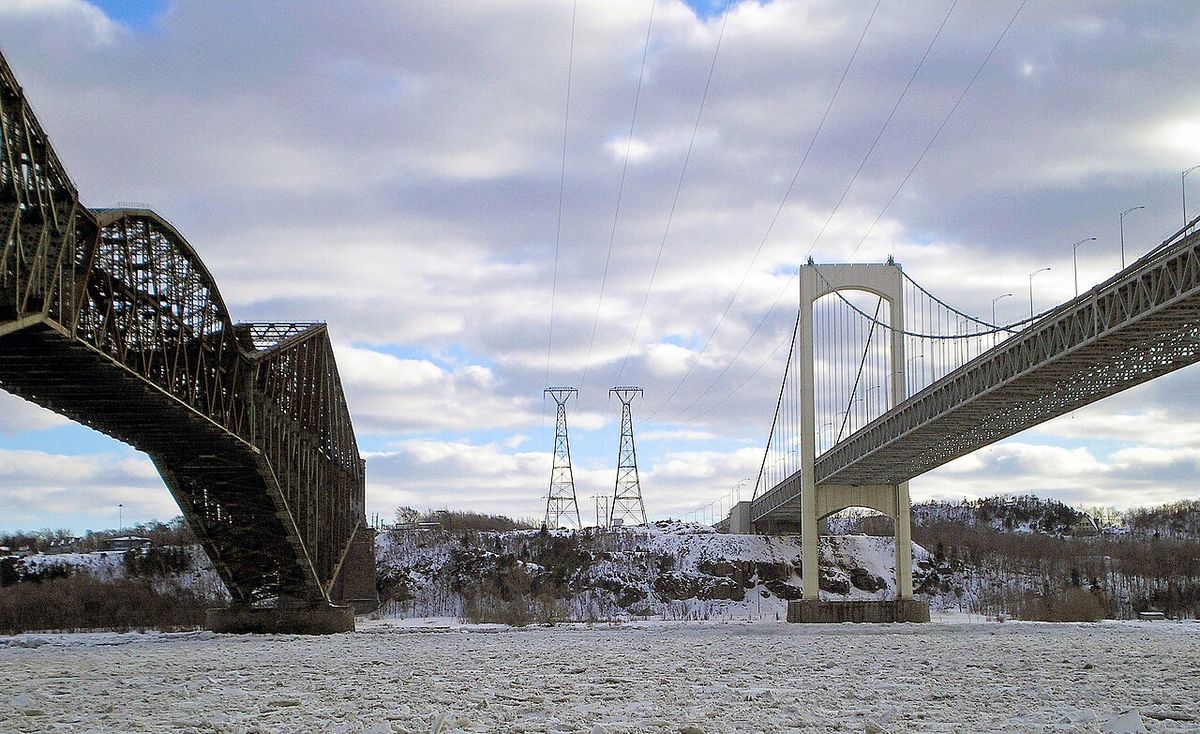
The Quebec Bridge is the easternmost complete crossing of the Saint Lawrence River, which also makes it the farthest downstream crossing. It was built primarily as a railway bridge but later accommodated automotive traffic. In 1970, the Pierre Laporte Suspension Bridge opened just upstream from the Quebec Bridge. This newer bridge was built to carry the freeway traffic of Autoroute 73.
Ownership History and Maintenance Challenges
The bridge was constructed as part of the National Transcontinental Railway, which was merged into Canadian Government Railways. This federal Crown corporation maintained ownership until 22 July 1993, when a Privy Council order authorized its sale, including the Quebec Bridge, to the Crown corporation Canadian National Railway (CN) for one dollar. CN was privatized in November 1995, transferring the historic infrastructure into private ownership. Despite this, CN received federal and provincial funding for repairs. By 2014, severe corrosion was evident, with an estimated 60 percent of the bridge covered in rust, prompting the National Trust of Canada to list it among the country's ten most endangered historic sites in 2015. The Cities of Quebec and Lévis, the Province of Quebec, and the Government of Canada jointly pledged half of the estimated 200 million dollar restoration cost, but CN refused to match it, arguing the work was aesthetic. A 2016 revelation showed a lease agreement limited CN's contribution to paint work to a maximum of 10 million dollars until 2053. The federal government then proposed investing 75 million dollars and asked the province to provide an estimated 275 million dollars, leading to accusations from Quebec City Mayor Regis Labeaume that Ottawa had broken a 2015 campaign promise.
The 2024 Government Repurchase and Future
The long dispute over responsibility for the bridge's preservation was resolved on 10 May 2024, when the Government of Canada and CN announced an agreement for the federal repurchase of the Quebec Bridge for the symbolic sum of one dollar. As part of this historic transaction, the federal government committed to spending one billion dollars over the next 25 years on comprehensive repairs, restoration, and ongoing maintenance. Under the new ownership structure, CN and the Quebec provincial government will retain shared ownership of the railway tracks and the roadway that cross the bridge. This agreement ensures the long-term stewardship of the national historic site and addresses the critical maintenance backlog that had threatened the structure's integrity.
Cultural Significance and Commemoration
The Quebec Bridge holds multiple layers of significance for Canada. It was designated a National Historic Site in 1995 and was featured on commemorative postage stamps issued in 1929 and 1995. In 1987, it was declared an International Historic Civil Engineering Landmark by the Canadian and American Societies of Civil Engineers. The tragedies during its construction led directly to the formalization of engineering professionalism in Canada. Inspired by the 1907 disaster, Professor John Galbraith and others helped establish provincial associations that govern Professional Engineers (P.Eng.), which enforce strict requirements including ethical exams, character witnesses, and a minimum of four years' supervised practice. The bridge is also central to the ritual of the Calling of an Engineer and the Iron Ring ceremony, though the legend that metal from the 1907 collapse was used for the first rings is a myth. The workers, especially the Mohawk ironworkers, are commemorated through memorials. A year-long commemoration began in Kahnawake on 29 August 2006, and on the centenary of the first collapse in 2007, a memorial with the victims' names was dedicated on the Lévis side, and a steel replica of the bridge was unveiled in Kahnawake.
The Bridge as a Tourist Attraction
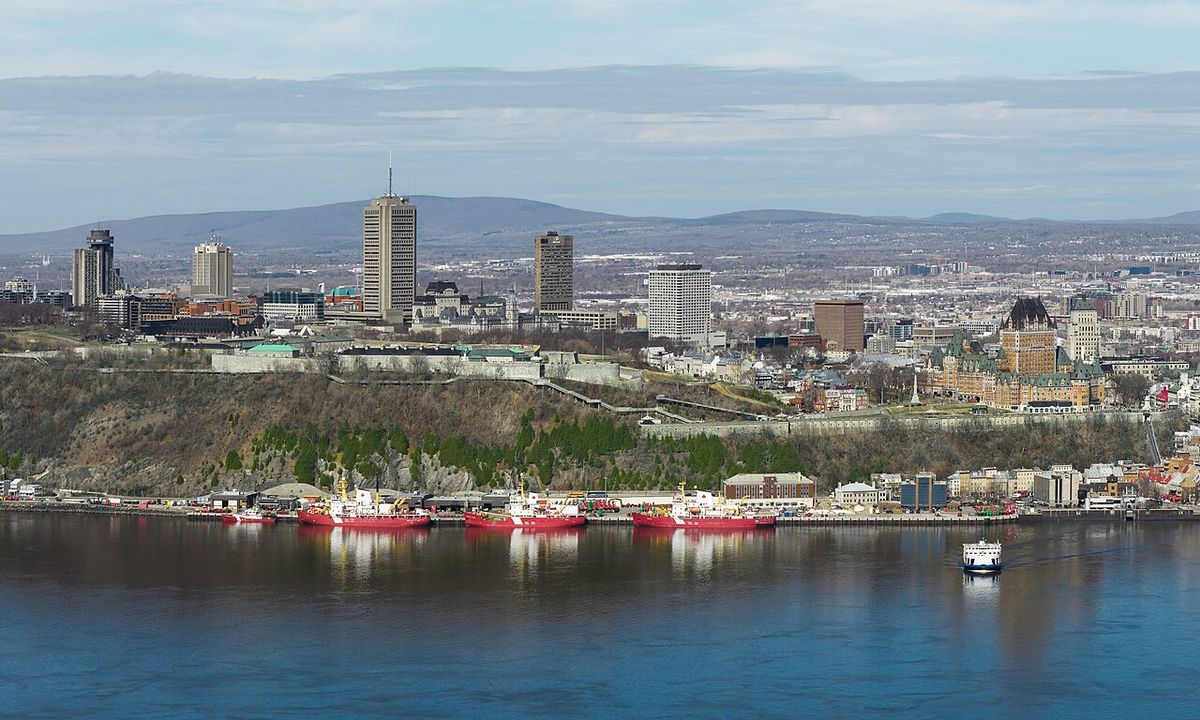
The Quebec Bridge is a major visual landmark for the Quebec City region, frequently included in tourist itineraries and promotional materials. The Aquarium du Québec on the north shore in Sainte-Foy is consistently noted as offering one of the best viewing points for the structure. The bridge is a highlight on scenic routes, including cycling paths and the expanded Red Bus tour route along Boulevard Champlain, which was promoted in 2026 for its spectacular views. Its imposing silhouette provides a dramatic backdrop to the historic architecture of Old Québec, visible from across the river. While there is no fee to see the bridge, its pedestrian walkway allows for a unique crossing experience. The surrounding parks in Sainte-Foy and along the Lévis waterfront offer public spaces to observe the engineering marvel, making it a constant and impressive feature of the area's geography.
Questions about Quebec Bridge
How many people died building the Quebec Bridge?
A total of 88 workers lost their lives during the construction of the Quebec Bridge across two separate collapses. The first and most devastating collapse occurred on 29 August 1907, killing 75 workers. The second collapse happened on 11 September 1916 during the raising of the central span, resulting in 13 fatalities. These workers are commemorated at memorials in Lévis and the Kahnawake Mohawk Territory.
Why is the Quebec Bridge famous?
The Quebec Bridge is famous for three primary reasons. First, it holds the world record for the longest cantilever bridge span at 549 metres, a title it has maintained since 1919. Second, its construction was marred by two of the worst disasters in bridge-building history. Third, it is a National Historic Site of Canada and an International Historic Civil Engineering Landmark, representing a major moment in both Canadian infrastructure and the professionalization of engineering.
Can you walk or drive across the Quebec Bridge?
Yes, the bridge accommodates both vehicular and pedestrian traffic. It carries three lanes of highway traffic, one active railway line, and a dedicated pedestrian walkway. Drivers and cyclists use the roadway, while pedestrians can walk across on the provided pathway, offering unique views of the St. Lawrence River. The bridge functions as a crucial daily transportation link between Quebec City and Lévis.
Who owns the Quebec Bridge now?
As of May 2024, the Quebec Bridge is owned by the Government of Canada. The federal government repurchased the bridge from Canadian National Railway (CN) for a symbolic one dollar. As part of this agreement, the government committed to investing one billion dollars over 25 years for its restoration and maintenance. CN and the Quebec provincial government share ownership of the rails and roadway on the bridge.
Where is the best place to view the Quebec Bridge?
The best place to view the Quebec Bridge is from the aquarium on the north side of the river. This location offers a clear and spectacular view of the structure. The bridge spans the Saint Lawrence River between Sainte-Foy in Quebec City and Lévis. Its massive cantilever design, with a height of 104 metres, makes it a prominent landmark. The bridge is also visible from the Lévis waterfront and from the expanded Red Bus tour route along Boulevard Champlain, which provides scenic vistas. As the easternmost complete crossing of the Saint Lawrence, it forms a dramatic part of the regional landscape.
What is the Iron Ring connection to the Quebec Bridge?
The Iron Ring connection is a popular myth stating that the iron and steel from the collapsed 1907 Quebec Bridge was used to forge the early Iron Rings worn by Canadian engineering graduates. This ritual, the Calling of an Engineer, began in 1925. The disaster, which killed 75 workers, highlighted the dangers of inadequate engineering supervision and was a catalyst for forming professional engineering organizations. These groups established strict rules for certification, including ethical exams and supervised experience. While the metal's reuse is a myth, the bridge's failure deeply influenced the profession's commitment to ethics and safety in Canada.
Sources and further reading
- Quebec Bridge (Wikipedia)
- The Latest and the Greatest of Summer 2026 | Visit Québec City (quebec-cite.com)
- Bonjour Québec: Tourism and holidays Québec, Canada (bonjourquebec.com)
Checked by the Novello Desserts desk. Last updated 2026-10-25.