Nougat
Nougat is a category of confections made from whipped egg whites, sugar or honey, and roasted nuts, producing textures ranging from soft and chewy to firm and crunchy. Its origins trace back to medieval Middle Eastern cookbooks, but it gained widespread popularity in Europe, particularly through French Montélimar nougat in the 19th century. In North America, nougat is most commonly recognized as a softer, aerated filling in commercial candy bars such as Milky Way and Snickers. For Canadians, nougat represents both a global culinary tradition and a familiar component of everyday treats, with artisanal varieties available in specialty shops and homemade versions enjoying a resurgence as a festive holiday project.
Etymology and Pronunciation
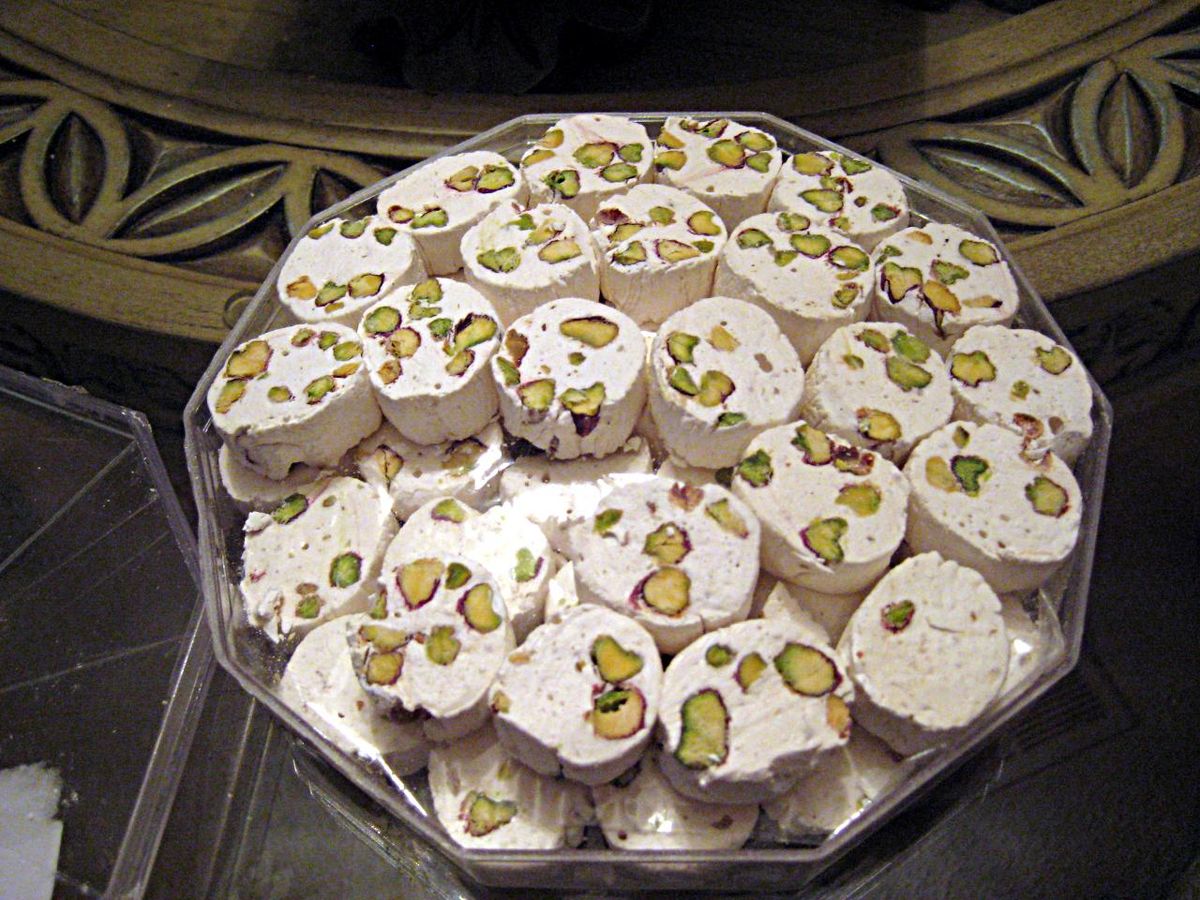
The English word nougat was borrowed from French in the early 19th century. The French term itself originated from Old Occitan nogat, meaning nutty or thing with nuts. This root reflects the confection's defining ingredient. In English, the pronunciation has diverged into several accepted forms. The original French approximation is /ˈnuːɡɑː/ (NOO-gah), but common North American usage favours /ˈnuːɡət/ (NOO-gət). Another pronunciation, /ˈnʌɡɪt/ (NUH-git), rhyming with nugget, is also heard, particularly in British English. Regional names for specific varieties are often used instead of the generic term. In Spain, the confection is called turrón, while in Italy and Brazil it is known as torrone. These names derive from the Latin torrere, meaning to roast, referencing the toasted nuts. Other local names include mandorlato in parts of Italy, from the vulgar development of Latin amygdala for almond. In Iran, the pistachio nougat is known as gaz, named for its incorporation of psyllid honeydew. In Malta and Sicily, names like qubbajt and cubbàita derive from the Arabic qubbayṭ.
Historical Development from Antiquity to the Middle Ages
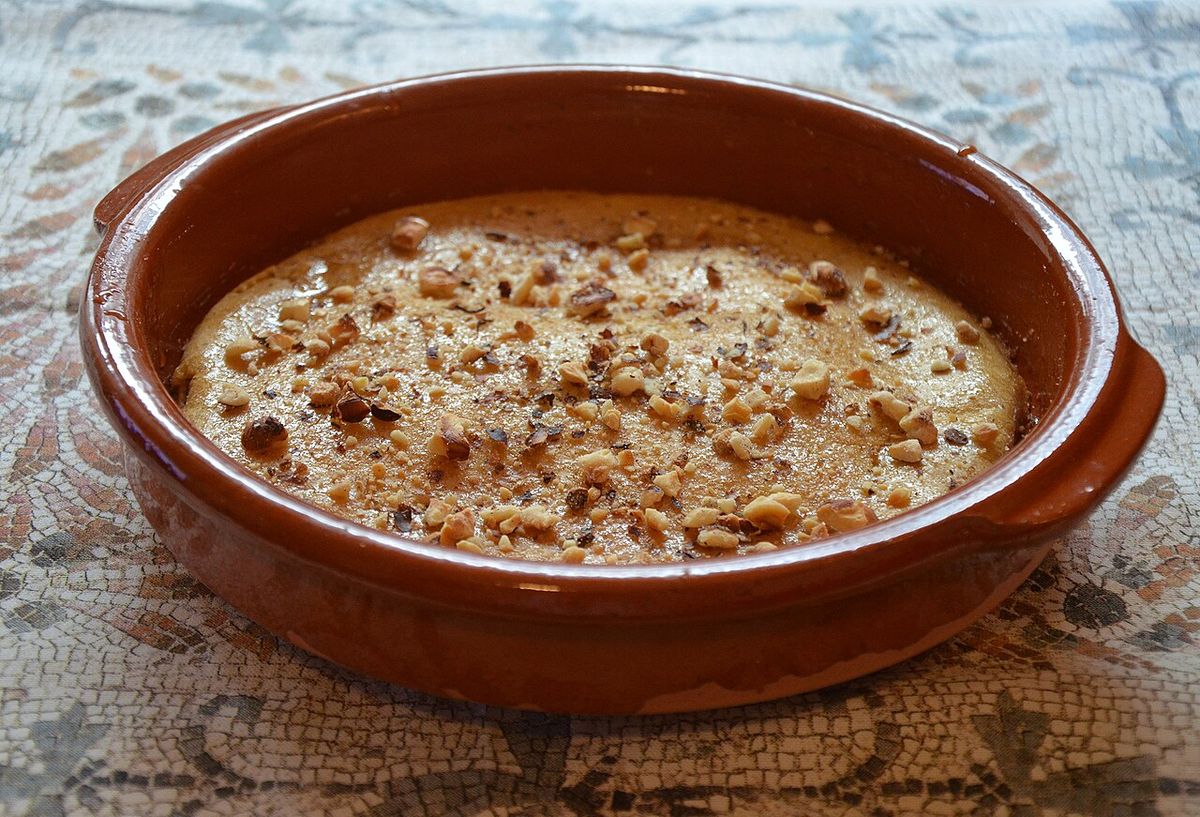
References to nut and honey confections appear in ancient texts, though not definitively as nougat. Roman authors like Varro, Livy, and Cato used generic terms for delicacies that may have included similar dishes. Cato described a Carthaginian dish of eggs, honey, flour, and cheese, while recipes in Apicius for nut custards could be early precursors. The first clear recipes for nougat appear in a 10th-century culinary book from Baghdad, the capital of the Abbasid Caliphate. There it was known as nāṭif, a term from an Arabic root meaning dribbling or trickling, describing the paste's viscous consistency. The 10th-century traveler Ibn Hawqal recorded eating nāṭif in locations from Manbij in Syria to Bukhara in Uzbekistan. The related Persian confection halva is attested by the 9th century, but the specific Iranian pistachio nougat, gaz, flavoured with plant lice honeydew and rosewater, is only documented from the late 16th century. Arab and Persian recipes often included spices and flower waters, a practice not typically replicated in later European versions.
Introduction and Evolution in Europe
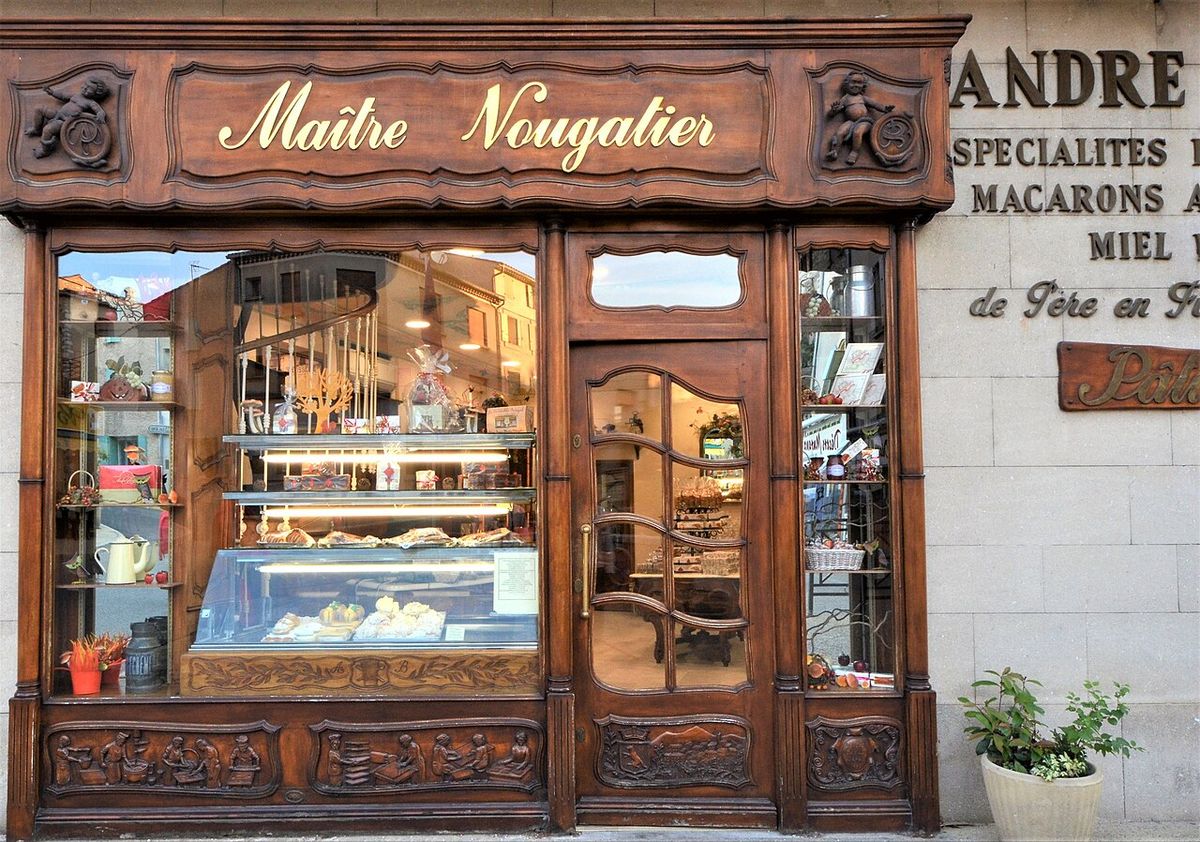
Nougat entered European culinary records through multiple routes over several centuries. It is first attested in Spain in the 15th century, appearing in Enrique de Villena's 1423 Arte Cisoria, a treatise on the use of knives at table. By the 16th century, it featured in the works of Miguel de Cervantes and in recipe collections like Lope de Rueda's La Generosa Paliza. In Italy, local legend places the creation of torrone at a 1441 wedding in Cremona, though this is considered a 20th-century fabrication. However, the translator Gerard of Cremona may have mentioned an Arabic form of nougat as early as the 12th century. Production was established in southern Italy and across the Venetian Empire by the early modern period. Nougat likely reached Marseille in southern France by the mid-16th century and is first attested in Provence in the 17th century. The town of Montélimar in the Provençal interior became the epicentre of French nougat production. Its fame spread across Europe in the 19th century, boosted by a successful showing at the 1878 Paris World's Fair and vigorous promotion by the town's mayor, Émile Loubet, who later became Prime Minister and President of France.
Separately, the 19th century saw the development of chocolate-based confusions in Central Europe. During the Napoleonic wars, blockades limited cocoa supplies, prompting chocolatiers around Turin to experiment with fillers. In 1852, Michele Prochet successfully used finely ground roasted hazelnuts, leading to Caffarel's gianduiotto chocolates. This hazelnut paste blended with chocolate became the basis for what is called nougat in Germany, Austria, and Scandinavia, a distinct product from the egg-white variety. The American industrial form emerged from an accident in the early 20th century at the Pendergast Candy Company in Minneapolis. A batch of their darker, firmer nougat, made for local European immigrants, was prepared with too many eggs, creating a much airier confection. This was used for a walnut-flavoured bar called the Fat Emma, and its formula was soon copied by Frank and Forrest Mars for their Milky Way bar introduced in 1923.
Global Variations and Protected Styles
Nougat manifests in three primary styles globally, distinguished by ingredients, preparation methods, and cultural context. The first is white nougat, the classic form prevalent in Western and Southern Europe. It is made from a mousse of whipped egg white sweetened with sugar or honey, into which roasted nuts and sometimes candied fruit are folded. This type is often produced artisanally by specialists known as nougatiers. Key regional varieties of white nougat include several protected and traditional styles.
- Montélimar Nougat (France): Traditionally made with lavender honey, roasted almonds and pistachios, vanilla, and unleavened bread. It received protected status in 2024.
- Spanish Turrón: Comes in two main styles. Soft (blando) or Jijona nougat is over 60% almonds by mass and kept soft with oil. Hard (duro) or Alicante nougat is extremely firm. Jijona nougat has Protected Geographical Indication (PGI) status.
- Italian Torrone: Made with whipped egg whites, sugar, honey, roasted almonds, and usually vanilla or citrus, wrapped in edible rice paper.
- Venetian Mandorlato: A firmer almond-based variety particularly esteemed from Cologna Veneta on the Veneto mainland.
The second style is the aerated, whipped nougat common in the United States and used industrially. This softer, lighter brown paste is made from corn syrup or sucrose aerated with agents like hydrolyzed soy protein or gelatin, often with added milk powder, vegetable fats, and preservatives. It serves as the primary filling in numerous candy bars such as Baby Ruth, Double Decker, Snickers, and 3 Musketeers, where the latter features an especially aerated fluffy nougat as its main component. The third major style is the chocolate-derived confection of Central and Northern Europe, often confusingly labelled as nougat. This type, such as German nougat or Viennese nougat, consists primarily of chocolate and ground nuts, hazelnuts or almonds respectively, and is more closely related to gianduja. In these regions, traditional egg-white nougat is specifically called French nougat for clarity. Other global variations include Taiwanese nougat, which incorporates milk powder as a main ingredient along with dried fruits and petals, and the Romanian festival sweet alviță.
Nougat in Contemporary Manufacturing and Candy Bars
In modern candy manufacturing, particularly in North America, nougat is a foundational component of the chocolate bar industry. The aerated, whipped style developed in Minneapolis forms the core of many mass-produced treats. This nougat is valued for its light texture, mild sweetness, and ability to pair with other layers like caramel and chocolate. Its industrial production allows for consistency and shelf stability, using ingredients like hydrolyzed soy protein as a whipping agent. A survey of popular candy bars reveals the ubiquity and specific roles of this style.
| Candy Bar | Primary Nougat Characteristic | Common Companion Elements |
|---|---|---|
| Milky Way | Fluffy, aerated vanilla nougat | Milk chocolate, caramel |
| Snickers | Firmer, chewy nougat | Milk chocolate, caramel, peanuts |
| 3 Musketeers | Extra-light fluffy nougat | Milk chocolate coating |
| Baby Ruth | Chewy nougat | Peanuts, caramel, chocolate |
| Zero | White, vanilla-flavoured nougat | Almonds, caramel, white chocolate |
| Twin Bing | Cherry-flavoured nougat | Peanuts, chocolate coating |
Beyond the commercial sphere, artisanal and homemade nougat has seen a revival, often shared as family or community recipes. This trend aligns with a broader interest in craft confectionery and edible gifting, especially during the winter holidays. Common challenges for home cooks include sticky results or failure to set, often due to undercooked syrup, high humidity, or inaccurate thermometers. Successful batches result in a confection that is billowy, sweet, and richly nutty, stored in an airtight container for up to a week.
Cultural Significance and Festive Roles
Nougat holds specific cultural roles that extend beyond everyday snacking, often marking religious and seasonal festivals. In many Mediterranean countries, it is intrinsically linked to Christmas. In Spain and Italy, varieties of turrón and torrone are essential components of Christmas celebrations and holiday meals. In Malta, local nougat is sold at village festivals, while in Romania, a similar confection called alviță is traditionally sold at fairgrounds on the Sunday of Forgiveness preceding Lent. In Iran, gaz is a cherished sweet often associated with Nowruz, the Persian New Year, and other special occasions. In Central and Northern Europe, chocolate-based nougat, such as that introduced to Finland by Fazer in 1904, has become a staple Christmas treat. In Britain, nougat is commonly found at fairgrounds and seaside resorts, often coloured pink and white with fruit flavouring and containing almonds and cherries. The portable and durable nature of hard nougat also makes it a popular souvenir item in regions famous for its production, such as Montélimar in France or Cremona in Italy. In North America, while the candy bar form is consumed year-round, the process of making homemade nougat has been adopted as a festive holiday activity, with recipes frequently shared as family traditions from sources like old church cookbooks and featured in seasonal baking guides for 2026.
Ingredients, Technique, and Home Confectionery
Making nougat from scratch is a rewarding project that demystifies the confectionery process, though it requires careful attention to temperature and technique. The three essential ingredients are egg whites, a sweetener, and roasted nuts. The egg whites are whipped to stiff peaks to create the aerated structure. The choice of nuts is central. Almonds, pistachios, hazelnuts, and walnuts are most common, with freshly roasted nuts providing the best flavour. Once the base is prepared, the nuts and any dried fruits or flavourings like vanilla are folded in. The mixture is then pressed into a pan lined with parchment paper or edible rice paper, the latter being traditional for gifting and long-term storage as it prevents sticking. The setting time can vary from a few hours to overnight. Common challenges for home cooks include the nougat being too sticky or failing to set properly, often due to undercooked syrup, high humidity, or under-whipped egg whites. Adjustments for altitude are also necessary, as the boiling point of water lowers, affecting syrup temperatures. Successful batches result in a confection that is billowy, sweet, and richly nutty. Homemade nougat is often packaged in parchment paper for gifting and connects modern home bakers to centuries of confectionery tradition, allowing for personalization with local ingredients like Canadian honey, maple syrup, or toasted pecans.
Questions about Nougat
What is the difference between white nougat and the nougat in candy bars?
White nougat is the traditional European form made from whipped egg whites, sugar or honey, and whole roasted nuts or candied fruit. It is typically dense, chewy, or crunchy and often made by artisans. In contrast, the nougat in most North American candy bars is an industrial product. It is a softer brown paste made from corn syrup or sucrose, aerated with whipping agents like gelatin or hydrolyzed soy protein, and often includes milk powder and vegetable fats. This version is used as a uniform filling in combination with chocolate, caramel, and peanuts.
Why is Montélimar nougat famous?
Montélimar nougat from Provence, France, became famous across Europe in the 19th century due to strategic promotion. Its traditional recipe uses local lavender honey, roasted almonds and pistachios, vanilla, and unleavened bread. Its reputation was solidified when it was well-received at the 1878 Paris World's Fair and actively promoted by the town's mayor, Émile Loubet, who later became President of France. In 2024, Montélimar nougat received protected status, recognizing its specific geographical origin and traditional production methods.
Is nougat gluten-free?
Traditional recipes for white nougat, such as French Montélimar nougat, Spanish turrón, or Italian torrone, are typically gluten-free as their core ingredients are egg whites, sugar or honey, and nuts. However, some commercial or industrial versions may include additives, flavourings, or stabilizers that contain gluten. For example, some whipping agents used in American candy bar nougat can be derived from wheat. It is always essential to check specific product labels or recipe details to confirm.
How should nougat be stored and how long does it last?
Nougat should be stored in an airtight container at cool room temperature, protected from humidity which can make it sticky. Individual pieces are often wrapped in parchment or wax paper to prevent them from adhering to each other. Properly stored, homemade nougat typically lasts for about one to two weeks. Commercial candy bars containing nougat have much longer shelf lives due to preservatives and specific packaging. Artisanal nougat, especially varieties wrapped in edible rice paper, may also be stored for several weeks if kept in ideal conditions.
What are the key ingredients in traditional nougat?
The three essential ingredients in traditional nougat are egg whites, a sweetener, and roasted nuts. The egg whites are whipped to provide the aerated structure. The sweetener is usually honey, which adds flavour and moisture, or a sugar syrup, which provides stability and sweetness. The nuts, most commonly almonds, pistachios, or hazelnuts, are roasted and folded in to give texture and rich flavour. Additional ingredients like vanilla, citrus peel, or candied fruit are used for variation, but the core trio defines the confection.
Can I make nougat without a candy thermometer?
While it is possible, using a candy thermometer is highly recommended for consistent results. The temperature of the sugar syrup is critical to achieving the desired texture, whether soft and chewy or firm and crunchy. Without a thermometer, it is difficult to gauge the syrup's stage accurately, leading to batches that may be too soft and sticky or too hard and brittle. For beginners, a thermometer is a crucial tool for mastering the technique and ensuring successful, reproducible batches of homemade nougat.
Sources and further reading
- Nougat (Wikipedia)
- Nougat Recipe (Grandma's Recipe!) (meaningfuleats.com)
- Soft and Chewy Nougat, Recipes (jamiegeller.com)
- The Complete Guide to Nougat Candy, Ingredients, Types, ... (ayoubs.ca)
- Making nougat from scratch isn't as complicated as it looks (theglobeandmail.com)
Checked by the Novello Desserts desk. Last updated 2026-10-21.