Whale meat
Whale meat is the flesh and other edible parts of cetaceans, including whales, dolphins, and porpoises, consumed as food. Its consumption is a complex global issue, intersecting cultural tradition, subsistence economies, commercial enterprise, and intense environmental and ethical debate. For Canadians, the topic is particularly relevant due to the long-standing, legally protected practice of aboriginal subsistence whaling by Inuit and other Indigenous peoples in the Arctic, where whale meat and muktuk (skin and blubber) are vital food sources. While commercial whaling is now limited to a few nations, the dish remains a culinary tradition in regions like Japan, Norway, Iceland, and the Faroe Islands, though it faces scrutiny over conservation, toxicity, and animal welfare concerns.
Historical Consumption and Cultural Context
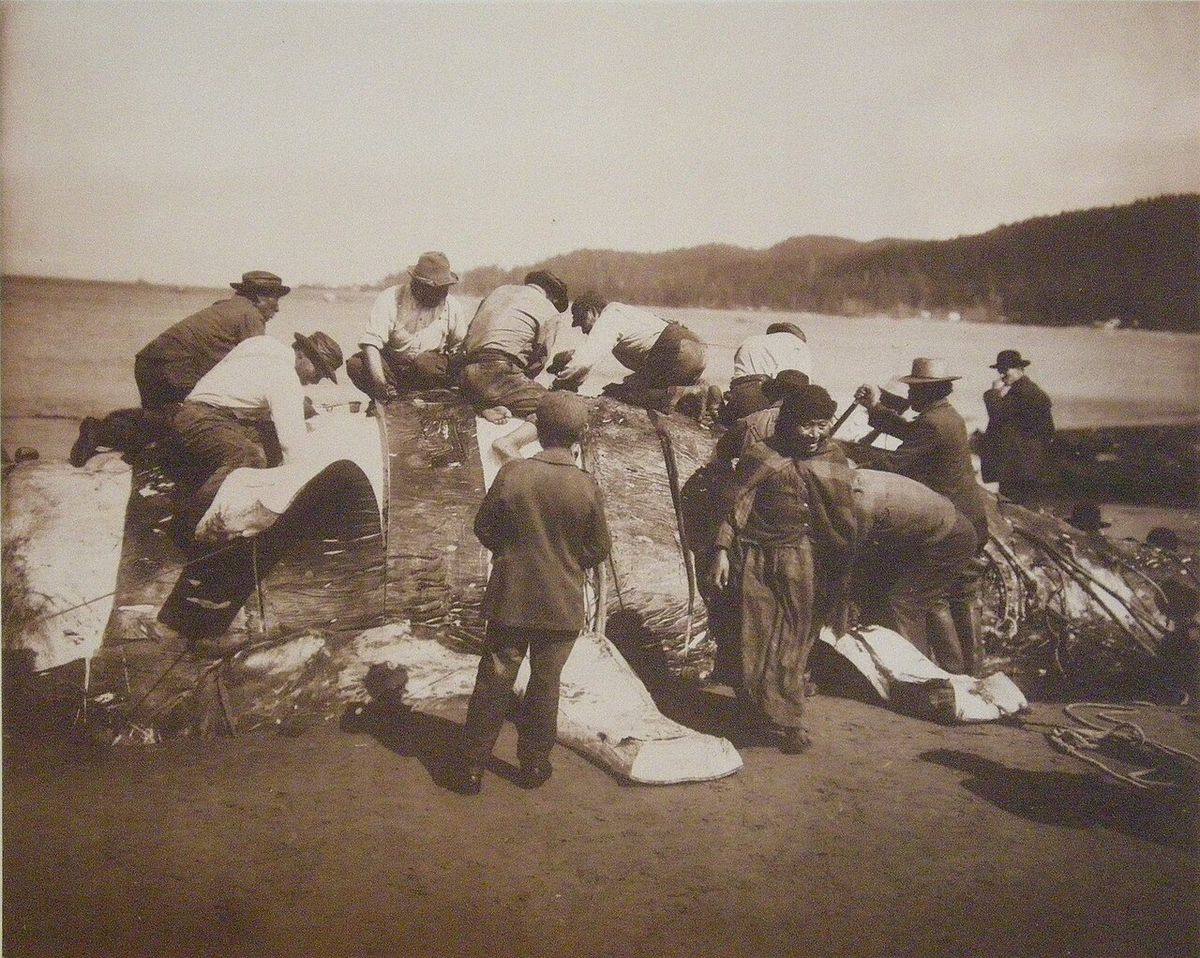
Whale meat has been consumed for centuries across diverse cultures, serving roles from staple food to Lenten fare to delicacy. In medieval Europe, whales were hunted in nearby waters, and their meat was considered "fish" by the Catholic Church, making it permissible for consumption during Lent and other fasting periods. European whaling expanded to the New World as local whale stocks, like the right whales in the Bay of Biscay, were depleted by overexploitation, with Basque, Dutch, and Flemish whalers leading the trade. In colonial America, pilot whale or "blackfish" was consumed, and sailors on whaling ships ate rendered blubber cracklings or fritters, which were sometimes reused as fuel. By the era of large-scale commercial whaling, however, whale meat was not generally consumed by the American public, seen as unfit for so-called civilized peoples.
During the Second World War, whale meat entered the British diet as an unrationed protein source, sold as "whacon," a corned product described as almost identical to corned beef but brownish in colour. The British Ministry of Food promoted its high nutritional value, though it was unpopular due to its bland taste and unpleasant cooking smell. In Japan, whales have been hunted for meat since at least 800 AD, and it became a crucial source of protein in the post-war period when the country's infrastructure was damaged. Norwegian cuisine historically featured whale meat as a cheap and common food until the 1980s, often boiled in a pot with a little water to create a broth and served with potatoes, vegetables, and flatbrød. For Indigenous Arctic communities in Canada, Greenland, and Alaska, whale meat is a fundamental component of cultural identity and survival, harvested through legal, non-commercial subsistence hunts in spring and autumn, with the meat stored and eaten throughout the winter. The Faroe Islands have practiced the community-organized "grindadráp" hunt of pilot whales since Norse settlement, with the meat and blubber forming a traditional part of the local cuisine.
Species Hunted and Market Dynamics
The species targeted for meat vary by region and regulatory framework, with significant implications for conservation. The minke whale is the most common species hunted in substantial numbers commercially today. Larger baleen whales, such as fin and sei whales, are also taken by whaling nations like Japan under research programs, with the meat sold as a byproduct. The fin whale's tail meat, called onomi or oniku, is particularly prized and can command prices on par with Kobe beef, roughly $28 for 100 grams, because it is regarded as marbled and is eaten as sashimi or tataki. DNA testing of Japanese market samples in the late 1990s revealed the presence of meat from dolphins, porpoises, and endangered species like fin and humpback whales mingled with legal minke whale meat, with blue whale DNA also detected but attributed to crossbreeding with fin whales.
The Japanese market for whale meat has contracted significantly in recent decades. A 2005 poll commissioned by Greenpeace found 95 percent of Japanese people very rarely or never eat it. In contrast, premium cuts like fluke meat (oba or obake) can sell for over $200 per kilogram, over three times the price of belly meat. The distribution channels for such premium cuts remain opaque, with a Greenpeace activist report suggesting it would take high government connections in Nagatachō to obtain genuine fin whale tail meat. Anti-whaling groups have alleged that some meat is illegally sourced from research vessels and that up to 20 percent of the 2004 catch went unsold. Since 2011, Japan has used an auction bid system for research whale meat, with realized prices not publicly posted.
Regional Preparations and Dishes
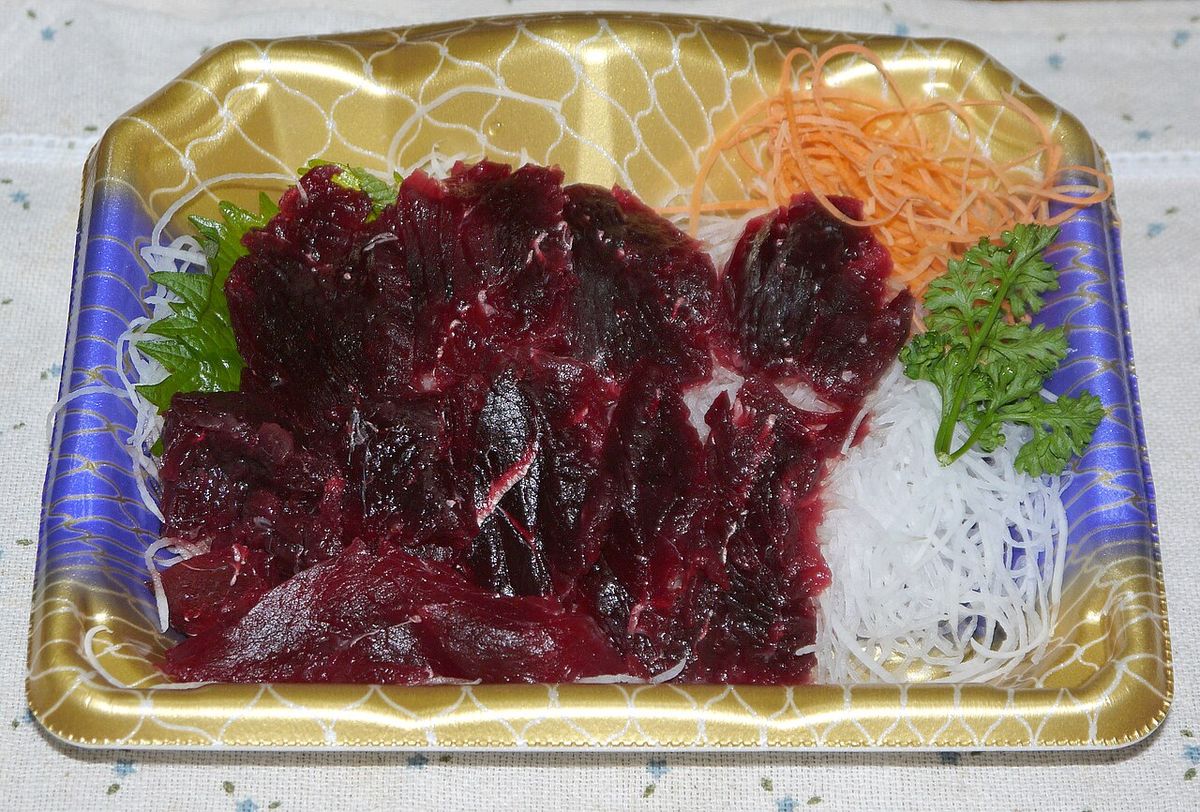
Whale meat is prepared in numerous ways globally, reflecting local culinary traditions. In Norway, Iceland, and Alaska, it may be served simply without seasoning, but it is also commonly cured, marinated, or made into jerky. Japanese cuisine features specialized cuts and preparations, with distinct names for different parts of the animal. The belly meat, or unesu, from the striped underbelly of baleen whales, is often made into whale bacon. The prized tail meat (onomi) consists of two strips of muscle running from the dorsal to the base of the fluke. Other preparations include harihari-nabe, a hot pot with whale meat and mizuna greens, and kujira no nanban-ni, a dish simmering meat and skin in a miso-based broth. Abura-sunoko is sashimi made from striped layers of meat from the root of the flippers, and udemono consists of boiled and sliced innards. The tongue, called saezuri, is used in high-end oden, and the fried skin after blubber is removed is called koro, similar to a crackling.
In the Arctic, the skin and blubber of bowhead, beluga, or narwhal whales are eaten raw or cooked as muktuk, a culturally significant food. Mikigaq is fermented whale meat. The Iñupiat of Alaska traditionally divided a catch into ten sections, with the fatty tail reserved for the hunt captain. Faroese cuisine includes tvøst og spik (salted and boiled meat and blubber served with potatoes), grindabúffur (whale steak), and wind-dried whale meat served on a cold table (kalt borð) alongside dried blubber, fish, and sheep meat. Traditional preservation methods like salting and wind-drying pieces called likkjur are still used alongside modern freezing.
- Japan: Sashimi, tataki, harihari-nabe, kujira no nanban-ni, udemono, whale bacon, tongue in oden.
- Arctic (Canada/Greenland/Alaska): Muktuk (raw skin/blubber), boiled meat, mikigaq (fermented), dried and stored meat.
- Faroe Islands: Tvøst og spik, grindabúffur, wind-dried slices, salted blubber preserved in water.
- Norway: Pot-roasted with vegetables, steak, cured, fried as fritters.
- Historical UK: "Whacon" (corned whale meat), curried whale meat recipes promoted by the Ministry of Food during wartime rationing in the 1940s.
Health and Toxicity Concerns
Consumption of whale meat raises significant health concerns due to bioaccumulation of environmental toxins, particularly in top predator species. Research has consistently found high levels of mercury and other contaminants like PCBs and DDT derivatives in whale meat and organs. A study by researchers at Hokkaido University found mercury levels in whale liver samples for sale in Japan averaged 370 micrograms per gram, approximately 900 times the Japanese government's limit. Kidney and lung samples were about 100 times over the limit, and the scientists warned that acute intoxication could result from a single ingestion of liver. The risk is higher in toothed whales (like dolphins and pilot whales) which feed on fish and mammals, compared to baleen whales which feed on plankton, due to their higher trophic level.
In the Faroe Islands, where pilot whale meat is traditionally consumed, public health authorities have issued specific advisories based on local research. In 2008, Chief Medical Officer Høgni Debes Joensen and Pál Weihe recommended that pilot whales no longer be considered fit for human consumption due to contaminant levels. As of June 2011, official guidelines include not eating the kidney or liver, limiting consumption to no more than one serving per month, and advising women and girls to avoid blubber if planning for pregnancy and to avoid whale meat entirely if pregnant, breastfeeding, or planning to conceive within three months. These guidelines are based on research linking mercury intake from whale meat to neurological problems in children and a correlation with a high rate of Parkinson's disease on the islands.
Environmental, Ethical and Legal Debates
The hunting of whales for meat sits at the centre of protracted international environmental and ethical conflicts. Conservation organizations argue that commercial whaling threatens endangered species and marine ecosystem health. In response, pro-whaling groups like the High North Alliance have argued that whale meat has a lower carbon footprint than beef, a point countered by Greenpeace's assertion that species survival outweighs emissions considerations. The International Whaling Commission (IWC) maintains a moratorium on commercial whaling, though countries like Iceland, Japan, and Norway continue hunting through objections, research programs, or commercial permits. Iceland's renewal of one-year commercial whaling permits has been met with widespread criticism from environmental groups.
Aboriginal subsistence whaling, such as that practiced by Inuit in Canada, is exempt from the moratorium and recognized under international law as a cultural and nutritional necessity. This creates a distinct legal framework separate from commercial whaling. In Canada, the harvest and consumption of whale meat is legally restricted to these Aboriginal subsistence hunts, primarily in the Arctic. The meat, blubber, and other parts cannot be sold commercially but are distributed within communities. Canadian law strictly prohibits the commercial sale and import of whale meat from non-Indigenous sources, aligning with international trade restrictions under the Convention on International Trade in Endangered Species (CITES). Activist groups like the Sea Shepherd Conservation Society have undertaken direct action to disrupt commercial whaling operations, with varying degrees of success. The debate encompasses animal welfare, Indigenous rights, conservation biology, and food sovereignty, making whale meat one of the world's most politically charged food items.
Modern Culinary Practices and Recipes
Contemporary recipes for whale meat illustrate a range of cooking techniques aimed at highlighting or complementing its distinctive flavour, often described as dark, lean, and similar to irony tuna or gamey beef. Common methods include quick frying for steaks, deep-frying in batter, and simmering in soups or hot pots. Many recipes suggest marinating the meat beforehand, often in mixtures containing sake, vinegar, or dairy, to tenderize it and mitigate any strong fishy notes. For example, one personal recipe starts with marinating a whale steak in vinegar and water overnight before cutting it thin for frying. Seasonings frequently include garlic, ginger, soy sauce, miso, and spices like curry powder or juniper berries.
Specific preparation examples include cutting whale meat into loins, seasoning with coarse salt and pepper, and frying quickly at high heat for about 30 seconds per side to leave a rare core, then slicing and serving with a sauce of balsamic vinegar, soy, lime, chili, garlic, coriander and sesame seeds. Another method involves making a creamy sauce with water, crème fraîche, and juniper berries to accompany pan-fried whale strips, finished with fresh wild berries. A recipe for a main course steak involves frying thick slices in a hot pan, resting them with butter, and serving with fried mushrooms and a garlic butter made from oven-baked garlic, lemon juice, and parsley. In Japan, home cooks prepare kujira no nanban-ni by stir-frying meat with ginger, then simmering it with vegetables like daikon, carrot, burdock root, and konjac in a dashi, soy, and miso broth. The diversity of recipes reflects both traditional knowledge and modern adaptations to a controversial ingredient.
Cultural Significance and Contemporary Trends
Whale meat holds deep cultural meaning in many societies, often tied to history, identity, and ritual. In Japan, areas like Shimonoseki and Nagato City in Yamaguchi Prefecture have long historical connections to whaling, with monuments recording the capture of over 2,800 whales in the Kawajiri region from 1698 to 1910. Whale meat is eaten on significant days like New Year's Eve and Setsubun with wishes for good fortune, and it remains a menu item in some school lunches. In Greenland, the consumption of whale meat by Inuit is a cultural practice, but it has also become available to tourists and is sold in four-star hotels, with investigations documenting commercial wholesalers commissioning subsistence whalers to supply supermarkets. The cultural argument is also used in Norway, where some contend whale meat has historical significance dating to the Viking era.
Despite this cultural embedding, consumption trends are shifting. In Japan, the food is highly nostalgic, a staple of post-war school lunches, but modern demand is low. A study of British recipes over the last century shows how whale meat, once featured in a 1940s Ministry of Food recipe for curry during rationing, has completely disappeared from mainstream culinary guidance, replaced by a narrow focus on five common fish species. In the Faroe Islands, traditional consumption continues but under the shadow of health advisories. For Arctic Indigenous communities, the practice is non-negotiable, representing food security and cultural continuity in the face of external pressures. The future of whale meat as a dish is therefore inextricably linked to ongoing negotiations between cultural preservation, public health, environmental conservation, and evolving global food norms.
Questions about Whale meat
Is it legal to eat whale meat in Canada?
In Canada, it is legal for Inuit and other recognized Indigenous peoples to hunt whales and consume the meat as part of legally protected aboriginal subsistence rights. These hunts have specific quotas and are for community consumption, not commercial sale. For the general Canadian public, the commercial sale, import, and consumption of whale meat from commercial or foreign sources is illegal, in accordance with international treaties and domestic wildlife protection laws. The meat from subsistence hunts is shared within communities and is a vital part of the northern food system.
What does whale meat taste like?
Descriptions of whale meat's taste vary by species and preparation. It is often described as very dark, lean, and having a strong, distinctive flavour. Some compare it to irony tuna or very gamey beef, while others note a pronounced fishiness. The prized tail meat (onomi) from larger baleen whales like fin whale is considered marbled and delicate, suitable for sashimi. The fluke meat is cured in salt and served thinly sliced as sarashi kujira. The taste can be moderated through marinating or pairing with sauces and seasonings like miso, garlic, or curry powder.
Why is whale meat controversial?
Whale meat is controversial for several interconnected reasons. Conservationists argue that commercial whaling threatens endangered whale populations and marine ecosystems. Animal rights activists oppose the killing of highly intelligent, social cetaceans. Health experts warn of dangerously high levels of toxins like mercury and PCBs in the meat, leading to consumption advisories in places like the Faroe Islands. The debate also involves cultural rights, as Indigenous groups assert that subsistence whaling is essential to their survival, while others condemn all whaling on ethical grounds. The illegal mixing of endangered species meat into markets has further fueled controversy.
Which countries still hunt whales for meat?
As of recent years, the primary countries engaged in commercial or research whaling for meat are Iceland, Japan, and Norway. Japan has conducted whaling under scientific research programs, with the meat sold commercially, though domestic demand has declined. Iceland and Norway lodge formal objections to the International Whaling Commission's moratorium and permit commercial hunts, mainly for minke whales. Aboriginal subsistence whaling for local consumption occurs in Greenland (Denmark), the Faroe Islands (Denmark), parts of Alaska (United States), the Russian Arctic, and by the Inuit in Canada. Limited hunting also occurs in Saint Vincent and the Grenadines, Indonesia, and some South Pacific islands.
Is whale meat safe to eat?
Whale meat, particularly from certain species and organs, can pose significant health risks due to bioaccumulation of environmental pollutants. Studies have found extremely high levels of mercury, PCBs, and DDT in whale meat, especially in the liver and kidneys of toothed whales like pilot whales. Public health authorities in the Faroe Islands advise strict limits on consumption, particularly for pregnant women and children. While the meat from some baleen whales may have lower contaminant levels, general health advisories caution against regular consumption due to the potential for acute and chronic toxicity. A single ingestion of whale liver could cause acute intoxication.
How is whale meat traditionally prepared by Inuit in Canada?
Inuit in Canada traditionally prepare whale meat in several ways. The skin and attached blubber of bowhead, beluga, or narwhal whales, known as muktuk, is often eaten raw, frozen, or boiled. The muscle meat may be boiled, dried, or fermented to make mikigaq. These foods are rich in essential nutrients and vitamins crucial for survival in the Arctic climate. The harvest and preparation are communal activities, and the meat is shared throughout the community, underpinning social bonds and cultural practices. Commercial sale of this meat is prohibited. The Iñupiat of Alaska traditionally divided the catch, with the best fatty tail section going to the hunt captain.
Sources and further reading
- Whale meat (Wikipedia)
- Whale meat curry for dinner? Study of bygone seafood ... (theguardian.com)
- Recipes (nammco.no)
- Kujira no Nanban-ni (Simmered whale meat with seasonings (maff.go.jp)
- A Whale of a Good Time: Kujira Three Ways (goodmorningaomori.wordpress.com)
Checked by the Novello Desserts desk. Last updated 2026-10-28.